Blog Archives
Taking Up Life in Both Hands


Taking Up Life in Both Hands is a sharp, crowded political satire that drops readers into the overlapping worlds of Big Law, Catholic health care, presidential politics, and corporate medicine. Its central pair makes the novel work: Claire Flanagan, an ambitious young health lawyer trying to survive a morally slippery law firm, and Sister Ursula, a cigar-smoking nun determined to protect the charitable mission of the enormous hospital system she helped build. Their relationship develops from an awkward professional assignment into a genuine alliance, giving the story an emotional center beneath all the schemes, kickbacks, campaign maneuvering, and executive backstabbing.
Tim Greaney writes with the confidence of someone who knows these institutions from the inside. The legal and healthcare details feel specific without turning the novel into a textbook, and the book is especially good at showing how respectable language can disguise ugly behavior. Executives talk about innovation and restructuring when they mean profit and control. Lawyers talk about loyalty when they mean obedience. Politicians wrap raw ambition in patriotism, religion, or public service. Greaney keeps translating that polished language back into plain English, usually through Claire’s skeptical observations or Sister Ursula’s blunt refusal to tolerate nonsense.
The closest comparison is probably Carl Hiaasen, especially novels such as Sick Puppy or Strip Tease. Like Hiaasen, Greaney builds comedy from institutions that have become so corrupt and self-important that they barely need exaggeration. His cast also includes the sort of schemers, opportunists, damaged idealists, and cheerful eccentrics who’d fit comfortably into a Hiaasen plot. Greaney’s humor is more rooted in legal procedure and healthcare policy, though, and his satire spends more time explaining how the machinery works. That gives the book a heavier factual texture, but it also makes the misconduct feel plausible rather than merely cartoonish.
The novel’s greatest strength is the way its comedy and moral seriousness reinforce each other. Claire’s gradual decision to risk her career, Sister Ursula’s insistence that health care should still involve caring, and the eventual exposure of Brian Shea’s schemes give the sprawling plot a satisfying direction. The final chapters bring consequences, personal renewal, and a touching farewell without losing the book’s irreverent voice. Taking Up Life in Both Hands is an energetic institutional comedy about conscience under pressure, and its best moments come when two very different women recognize that professionalism means more than protecting the people who sign the checks.
Pages: 244 | ASIN : B0GSXMS522

Adapt and Overcome, Dear: Oh, Victoria!

Adapt and Overcome, Dear: Oh, Victoria! by Brendan Bey is a work of historical military fiction that blends barracks comedy, crime drama, romance, and a coming-of-age story. Set largely at Fort Knox in the late 1970s, the novel follows Jack Behan, a college graduate who enters Army basic training on his way to Officer Candidate School. He expects physical hardship and strict discipline, but soon finds himself surrounded by corrupt soldiers, dangerous recruits, bitter rivalries, and a murder hidden beneath the routines of military life. At the same time, his letters to his former college classmate Victoria grow increasingly intimate as both struggle through training, troubled relationships, and questions about the lives they truly want. Their personal story unfolds alongside investigations, courtroom maneuvering, violence, and an Army institution trying to protect both its honor and its secrets.
Bey doesn’t present the Army as a polished machine. It is loud, exhausting, funny, unfair, and sometimes deeply threatening. The basic-training scenes have a lived-in quality, from the aching feet and rushed meals to the strange friendships that form when people are pushed beyond their limits. I often felt as though I were standing inside the barracks, surrounded by shouted insults, nervous laughter, dirty uniforms, and men trying not to show fear. The humor can be broad and rough, but it serves a purpose. It shows how the recruits use jokes as a shield. Drill Sergeant Banks was especially memorable to me because he brings discipline without surrendering his humanity, while Savage represents authority twisted by resentment and greed.
The letters between Jack and Victoria give the novel a more personal pulse. Through them, the author lets two people speak with less armor, even when their flirting and emotional dependence raise uncomfortable questions about loyalty and marriage. I appreciated that tension because it kept their relationship from feeling too simple. The novel is ambitious, perhaps sometimes too ambitious. It carries a large cast, several criminal schemes, military politics, courtroom drama, family troubles, and a romance all at once. There is an earnest energy behind the writing. Bey clearly cares about perseverance, friendship, justice, and the lasting damage caused when institutions ignore the worst behavior within their ranks. The title’s message isn’t subtle, but it’s sincere: survival often means changing without letting hardship erase who you are.
I would recommend Adapt and Overcome, Dear: Oh, Victoria! to readers who enjoy character-driven military fiction, especially stories that mix the harsh routines of training with dark humor, corruption, romance, and legal conflict. Readers with military experience may recognize both the absurdity and the emotional pressure of barracks life, while those interested in the post-Vietnam Army will find a candid portrait of an institution still wrestling with low morale and internal division. It’s a sprawling novel, but also a spirited one. By the end, I felt that Jack and Victoria had earned their hope, not because every wrong had been neatly corrected, but because they had learned how to keep moving through a world that rarely offered easy choices.
Pages: 318 | ASIN : B0GFXXLMKD
Agent Bigglesby: Not Dead Yet


Agent Bigglesby: Not Dead Yet, by James P. Rochester Jr. III, is a satirical spy comedy about Herbert Bigglesby, an 84-year-old former superspy who has been officially declared dead, tucked away in a senior living facility, and expected to fade quietly into the background. Herbert, naturally, has other plans. What begins as a comic portrait of a retired agent refusing to accept retirement turns into a wild genre-bending romp involving old enemies, senior scams, family complications, cruise-ship chaos, and one last chance for Herbert to prove he is still useful, even if his body, his colleagues, and common sense keep suggesting otherwise.
What struck me first was how committed the book is to its own absurdity. Rochester writes with a restless comic energy, piling jokes on top of references, misunderstandings, wordplay, and physical mishaps until the story feels almost like a spy movie being performed in a nursing home after someone misplaced the script. Sometimes that works beautifully. The opening scenes at Sunset View are sharp, funny, and oddly vivid, with all the fluorescent lighting, bad smells, institutional blandness, and bruised pride of old age turned into the setting for espionage. I liked that the humor is not gentle. It pokes. It elbows. It’s often ridiculous, but it also has a clear target: the way society files people away once they are no longer convenient.
The author’s biggest choice is also the book’s biggest risk. Herbert is not always easy to like. He’s vain, inappropriate, stubborn, and trapped in an old version of himself that the world has mostly outgrown. Still, I found myself curious about him because the book does not treat aging as a soft-focus lesson in wisdom. It treats it as a collision. Herbert’s mind is full of old missions, old habits, old desires, and old wounds, while the present keeps interrupting him with pills, liability forms, family demands, and people who do not remember why he mattered. That tension gives the comedy more weight than I expected. Beneath the jokes about spycraft and senior living, there is a real question here: what happens to a person when the role that gave them meaning is taken away?
As a work of comic spy satire, Agent Bigglesby: Not Dead Yet will appeal most to readers who enjoy humor, parody, and stories that move fast even when their hero doesn’t. Readers who enjoy messy, loud, self-aware comedy with a surprising amount of heart should have a good time. I would recommend it to fans of spy spoofs, aging antiheroes, and books that are willing to be silly while still asking what dignity, purpose, and usefulness look like near the end of life.
Pages: 310 | ASIN : B0GSPKG78M
The Muck: A Neo-Gothic Horror-Thriller
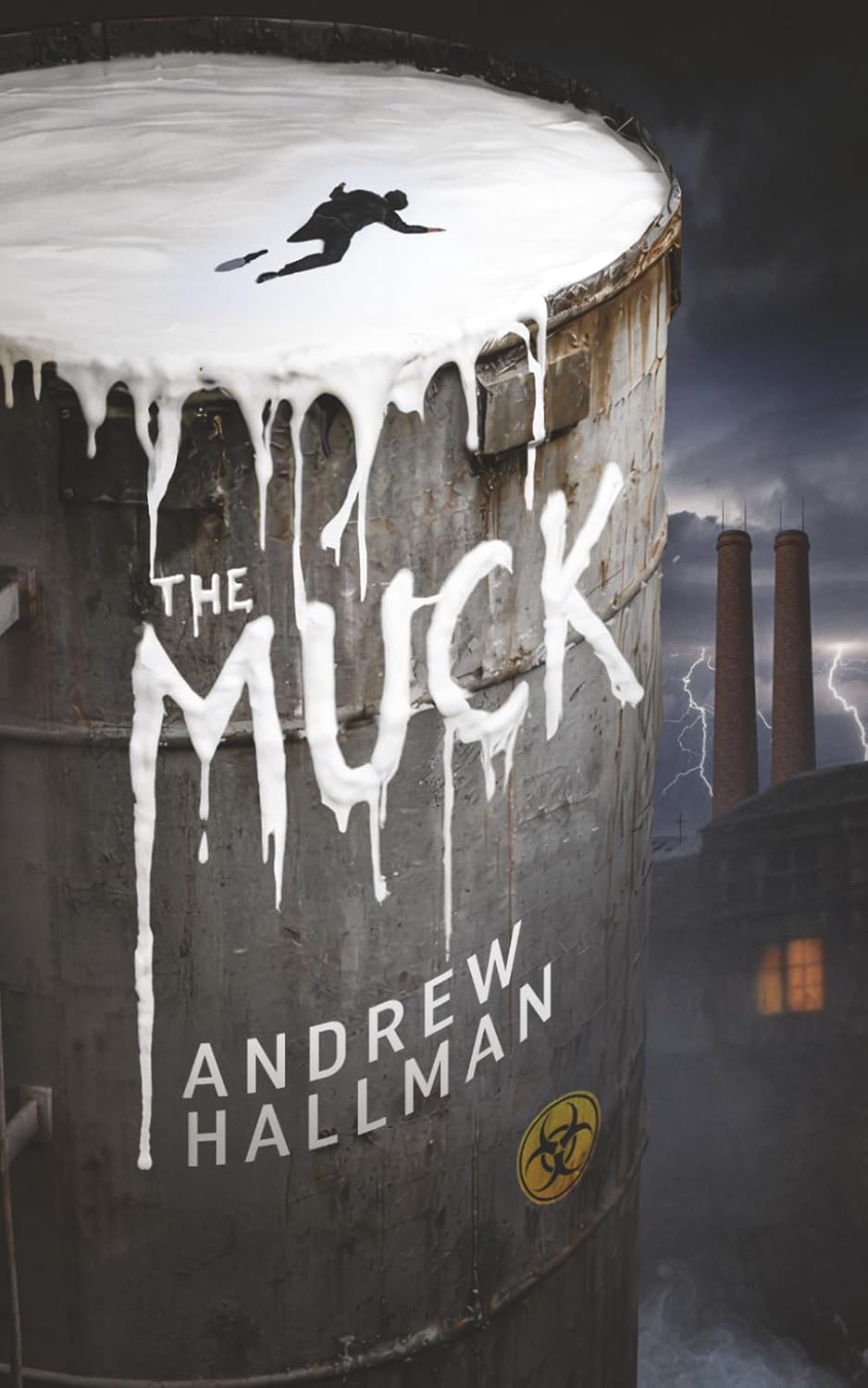
The Muck, by Andrew Hallman, follows Glenn Hurst, a cash-strapped ghostwriter who accepts a lucrative job writing the “origin story” of crypto magnate Brad Thorsen. The assignment brings him to the Mattison Alkaline Works, a decaying industrial complex in rural Virginia known locally as the Maw, where old chemical horrors, corporate ambition, exploited workers, invasive technology, and a maddening itch begin to converge. What starts as a vanity memoir project curdles into a neo-gothic horror-thriller about pollution, power, and the monstrous appetite to turn every human weakness into product.
I was pulled in first by Glenn, who is not heroic in the gleaming, uncomplicated sense. He is broke, defensive, lonely, vain in small ways, and painfully aware of his own failures. That makes him interesting company. His interior voice has a sour wit that never fully protects him from shame, and the book uses that tension well. The Maw itself is the real cathedral here: part factory, part castle, part tomb. Its rusted chambers, poisoned runoff, salt tunnels, and technological altars give the story a thick, tactile dread.
I really enjoyed how the horror keeps widening. The book isn’t content with one monster. It finds terror in chiggers, toxic sludge, AI content mills, billionaire self-mythology, immigration abuse, surveillance, and the old American habit of burying disaster until it leaks back into the water. There are many moving parts, and the momentum can feel almost feverish. But that excess also suits the material. This is a novel about systems that metastasize, and its best passages have the nasty propulsion of an allergic reaction you know you should not scratch.
This book is for readers who like neo-gothic horror-thriller, eco-horror, industrial horror, tech horror, and corporate satire sharpened into a blade. Fans of Stephen King’s character-driven dread and Michael Crichton’s techno-paranoia will find familiar pleasures here, though The Muck has a grimier, more caustic personality all its own. It’s smart, grotesque, and unnervingly contemporary. The Muck turns the American dream into a contaminated site, and dares you to keep digging.
Pages: 392 | ISBN : 978-1969599040
Disability Representation in Fiction

A Life in Too Many Margins follows a man looking back on his life from childhood to now, exploring how forced gender roles, neurodivergent masking, disability, and medical trauma have shaped him into the person he is today. Why was this an important book for you to write?
I found myself feeling sad quite often about the lack of disability representation in fiction, especially contemporary literary fiction by queer and neurodivergent folks and/or other intersectional groups. It’s gotten better in recent years as we’ve moved away from disabled characters being villains or “inspiration pornography,” but my dream world would have an entire section in every bookstore!
This story explores many kinds of labels. Which ones felt hardest to untangle?
The one I try hardest to help readers understand is the medical trauma. It’s hard to explain to anyone who isn’t trans or a woman the extent to which doctors will gaslight us when we don’t have the more obvious symptoms. The hardest emotionally was being neurodivergent. I am in my 40s and still working on unmasking behaviours.
Humor plays a central role in the book. How do you balance humor with emotional weight?
This didn’t really feel like a job or anything I had to balance, honestly. My humor is what’s gotten me through my worst times; I used it as a coping mechanism, then a grounding technique, and now it’s just a part of how I present myself and my stories.
Did writing this book feel like an act of advocacy?
Absolutely. I wanted to write about what it feels like to grow up learning how to adapt constantly, often without realizing you’re doing it. Also, because enough people told me I had to write a book, I eventually gave in. It’s almost completely a memoir, so it’s rooted in my lived experience, but it’s shaped intentionally with the occasional note of fiction. I wasn’t interested in documenting everything that happened so much as capturing how it felt. It took time to have the language and distance to write it clearly, but I always meant to share it to help others going through similar situations.
Author Links: GoodReads | Website | BlueSky | Instagram | Amazon
A Life in Too Many Margins is the story of a man looking backward while time keeps nudging him forward. From childhood misunderstandings to medical disasters, David is collecting the fragments of a life shaped by truths he didn’t discover until far too late: that he’s neurodivergent, that his body will never play by the rules. That gender was never the box people insisted it had to be.
If you’ve ever felt like the world wasn’t built with you in mind, or if you just enjoy a dark laugh in the middle of disaster, David’s story will remind you that sometimes real life only happens… in the margins.
The Great Dick: And the Dysfunctional Demon

Barry Maher’s The Great Dick and the Dysfunctional Demon starts with a Harvard professor in the late sixties riffing on Moby-Dick and The Great Gatsby and tossing off the idea of a modern version called “The Great Dick.” The story then jumps to 1982 and to Steve Witowski, a thirty-something screwup on the run from a botched drug deal who stumbles into a brutal assault near an old church on the California coast. He tries to help, kills the attacker in chaotic self-defense, and meets Victoria Fairchild, a luminous stranger with secrets of her own. From there, the book slides into a mix of road novel, noir, and supernatural thriller as Steve gets dragged deeper into a tangle of murder, occult relics, demons that may or may not be real, and his own talent for bad decisions.
Steve opens by flat-out calling himself an asshole, and the narration never lets him off the hook. His inner monologue is sharp, petty, funny, horny, scared, sometimes all in the same beat. The writing leans hard into sensory detail and low-level absurdity, like the reek of the Checker cab or the way cheap weed and an old song drift through the scene right before the attack. The fight on the embankment is brutal and weirdly intimate. Keys in his fist, Latin muttered at the worst possible moment, a truck roaring closer. I could feel the panic in my throat. When the book slows down afterward and lets Steve and Victoria talk, that same energy hums under the dialogue. The tone stays casual and foul-mouthed, yet there is a careful rhythm in the sentences. It feels tossed off in the way really worked-over prose often does. I found myself rereading lines just to enjoy how a joke landed or how an image curved at the end.
The book plays with failure and faith in a way that was thought-provoking. Steve keeps trying to patch his life with lies, quick exits, and a little dope, then suddenly he is neck deep in something that smells like capital E Evil. The dagger with the names of Jehovah, Ahura Mazda, Huitzilopochtli, and Asmodeus etched into the handle is such a great symbol for the book’s spiritual chaos. It pulls Jewish, Christian, Zoroastrian, and Aztec gods into the same creepy object and then hands it to a loser who just wanted to dodge a prison sentence. I liked how the story keeps asking what counts as sin, what counts as choice, and where simple cowardice shades into something darker. At the same time, it never reads like a lecture. It feels like a wild story that happens to drag big questions in behind it.
The book is full of sex, violence, and black humor, yet there are small, quiet moves that give it an unexpected emotional weight, little flashes of shame or tenderness or sheer exhausted relief. The setting, work around coastal California, and the abandoned church give the more supernatural turns a solid, grimy base to grow out of, which I really liked, and the whole thing runs on a kind of nervous, late-night momentum.
I would recommend The Great Dick and the Dysfunctional Demon to readers who enjoy flawed, talkative narrators, morally messy thrillers, and horror that leans into both jokes and genuine unease. If you like work in the vein of Carl Hiaasen or early Stephen King but wish it had more occult weirdness and a bit more sex, this will probably hit the spot. For anyone up for a fast, foul-mouthed, slightly unhinged ride that still has something on its mind, I think this book is absolutely worth the trip.
Pages: 464 | ASIN : B0FKWK2K7C
Intention and Action
Where The Winds Blow follows the rise of Path Finder, a grassroots movement born from grief and idealism, while powerful governments, criminal networks, and ordinary people collide around it. What was the inspiration for the original and fascinating idea at the center of the book?
The inspiration for Path Finder came during the COVID crisis, while I was cleaning out my garage for the third time in a week. I suddenly imagined finding the UK’s prime minister hiding in there – someone who’d simply decided he couldn’t cope any more. That image stuck, and I started writing, using it as a focal point.
It led to a simple but unsettling thought: for all their bombast and posturing, governments have only limited control over what actually happens within their own borders. The responses to the 2008 crash, COVID, and countless regional crises revealed not grand strategists, but leaders who were overwhelmed, reactive, and often out of their depth.
Lies, distraction, and obfuscation disguise their weakness and uncertainty – skills that modern power structures have perfected. Meanwhile, real influence increasingly sits with billionaires, technocrats, and the vague, unaccountable entity we call “the markets,” all of whom operate with little responsibility to the societies they shape.
Across much of the world, there’s a simmering resentment paired with helplessness – a frustration that’s often misdirected toward convenient scapegoats rather than those truly responsible. What feels missing is a spark: something that turns anger and despair into constructive action rooted in honesty, humanity, and hope.
I don’t pretend to know how that spark might happen in real life, although I believe it will. In the Path Finder series, I’ve created a world only inches removed from our own, where readers can enjoy the humour and drama in the story, recognise familiar institutions and personalities, and perhaps imagine a different future – for themselves as much as for society as a whole.
History is full of ordinary people doing extraordinary things, often accidentally or without understanding where their choices might lead. This series begins with one man deciding he’s had enough of pretending to be something he isn’t and disappearing. Three books in, even I’m not entirely sure where that decision will ultimately take him or Path Finder. I just know it’ll be fun finding out!
What are some things that you find interesting about the human condition that you think make for great fiction?
What fascinates me most about the human condition is the gap between who we think we are and how we actually behave when things stop going to plan. We like to believe we’re rational, principled, and in control, but pressure, fear, love, grief, and ambition have a habit of knocking those ideas sideways. That gap – between intention and action, certainty and doubt – is where great fiction lives.
I’m also interested in how ordinary people respond when they’re swept up in events far bigger than themselves. Most of us don’t set out to change the world, break systems, or become symbols of anything. We’re just trying to get through the day, protect the people we care about, and make sense of the noise. Yet history shows that it’s often these accidental participants – people acting from love, stubbornness, guilt, or hope – who trigger the biggest consequences. That tension between small, human decisions and vast, unpredictable outcomes runs through the Path Finder series.
Finally, there’s the absurdity of it all. Humans are capable of extraordinary kindness, bravery, and resilience, but we’re also unwittingly brilliant at self-delusion, tribalism, and panic. Put those traits under stress – mix them with power, money, ideology, or blind faith – and you get situations that are by turns terrifying, ridiculous, and darkly funny. Satire lets me explore those contradictions honestly, without pretending we’re either heroes or villains. We’re usually just flawed, emotional creatures doing our best… sometimes making an almighty mess of it… occasionally doing something amazing.
What is one thing that you hope readers take away from Where The Winds Blow?
More than anything, I hope readers come away feeling that the time they spent with Where The Winds Blow was time well spent. I want them to have been entertained – laughing at the absurdity, caught up in the momentum, and maybe a little breathless at times – but also quietly validated in the way they see the world.
If there’s a deeper takeaway, it’s the reassurance that confusion, doubt, and frustration aren’t personal failings; they’re rational responses to a chaotic system. The characters in the book don’t have grand plans or neat answers – most of them are muddling through, reacting, improvising, and occasionally getting things spectacularly wrong. And yet, meaning still emerges from those imperfect choices.
I also hope the book leaves readers with a sense that individual actions matter, even when they seem small, accidental, or misdirected. Change doesn’t always come from heroes or leaders; it often starts with ordinary people deciding to stop pretending, to care a little more honestly, or to take one step they didn’t think they were capable of taking.
If readers finish the book feeling entertained, understood, and perhaps a little more open to the idea that hope can exist without certainty, then I’ve done my job.
I hope the series continues in other books. If so, where will the story take readers?
The series will continue. As for where the story will take the reader, who knows?! I’m currently writing shorter pieces for my Path Finder newsletter subscribers that fill in some of the character back stories. One of those pieces became a major plot line in Where The Winds Blow, and I have no doubt that one or two of my current works in progress will do the same in the fourth novel.
Author Links: GoodReads | Threads | Facebook | Website | Amazon
The Path Finder movement has gone global. Millions of followers. Endless headlines. Oceans of cash.
Only one tiny snag: the founders still have no idea what the movement actually is. Now the powerful want answers – and they’ll do anything to keep control.
Meanwhile, an ex-soldier from Afghanistan crosses continents and the Mexico-US border, desperate to reach his family before the authorities catch him or local vigilantes do even worse.
Elsewhere, Simon and Pippa Pope are chasing storms, blissfully unaware that their late wedding gift could unleash consequences for humanity, the planet, and a whisky-soaked Scotsman on a collision course with destiny.
Fast, funny, and ferociously sharp, Where The Winds Blow skewers the powerful and the absurd in equal measure.
It’s the third and wildest instalment in The Path Finder Series, following Paths Not Yet Taken and Good for the Soul. Each offers satire with bite, stories with heart, and storms of every kind.
Reputation Is Paramount

Gods of Glenhaven follows a middle-aged couple and their teen daughter trying to navigate a failing marriage and broken family dynamic in a talkative small town. What was the inspiration for the setup of your story?
I love suburbia for many reasons. What fascinates me most about it is that it seems like the goal is to eliminate as many of the hardships and vicissitudes of life as possible. In the suburbs, you try to capture and keep the good things, while either ignoring or reframing the bad things you can’t manage to avoid. And reputation is paramount — you don’t want to become known as anything other than an upstanding person who loves their job, their children, and their community.
Do you have a favorite scene in this story? One that was especially enjoyable to craft?
I especially enjoyed writing the scene in the Home Depot, which takes place the morning after the Rites of Initiation at the high school. There are seventy naked people slumbering amidst the lumber and wheelbarrows, and a stunned police sergeant has to sort it all out.
What were some themes that were important for you to explore in this book?
The value of the social contract is the big theme. This is why I needed Gods (who don’t play by the rules) and the potential for humans to have unusual power, which might encourage them to break the terms of the social contract.
Can fans expect to see more releases from you soon? What are you currently working on?
I like to write short comedy pieces — my work has been published in McSweeney’s, Points in Case, Weekly Humorist, and other magazines. I’m doing a lot of that kind of writing while also beginning work on a second novel, entitled Little Dan.
Author Links: GoodReads | Facebook | Website | Amazon
When Greek gods sweep into the quaint suburban town of Glenhaven to untangle their messy love lives, the helpless mortals don’t stand a chance.
Christian Orr, struggling with work and erectile dysfunction after discovering his wife’s infidelity, has just moved into what his daughter Francesca calls the Divorced Dads Apartment Complex. His high-powered attorney ex, Sloan, is jaded and restless, leaving precocious Francesca caught in the crosscurrents of change.
Enter Dionysus-“Dee”-the god of wine, sex, and questionable decisions, who shows up searching for his estranged wife Ari and their teenage son Maron. After three thousand years of Dee’s antics, Ari has had enough. She’s struck a deal with Zeus to start fresh-as a mortal suburban mom. And what’s more normal than falling for a regular guy like Christian? If only Dee would stop tearing through Glenhaven in his quest to win her back.
Drunk on Dee’s wine, the residents of Glenhaven form chanting covens in the woods, participate in ecstatic rituals, and experience divine revelations-all while Led Zeppelin’s “Whole Lotta Love” loops faintly in the background of their lives.
Gods of Glenhaven is a hilarious, poignant, and confronting novel about the universal fears and follies of the human condition, and the joy and freedom we can experience by letting go.


