Blog Archives
Re-Crafting the Relationship

Beneficial Economics examines history, political theory, and constitutional design to equip readers with the critical information they need to combat the growing ideological divide in America and rebuild a stable and moral society. Why was this an important book to publish at this time?
We provide red state citizens with the constitutional framework of 4 essential functions of the national government:
1. The protective state, which protects citizen liberty and freedoms from coercion and exploitation.
2. The productive state, which creates the fair rules for citizen freedom to produce and obtain the future value of their production.
3. The entrepreneurial state, which decentralizes economic activity to the most local regional metro level to allow citizens maximum ability to innovate.
4. The sovereign state, which protects the sovereignty of citizens and the nation from outside threats from other nations and from inside threats from anti-national forces.
At this time in the nation’s history, the government has strayed from its initial purpose, and is untethered to Madison’s constitution.
The government has failed the citizens, and the citizens have a natural right to abolish this government and start over, with the principles of 1776, which is what the book’s four functions are designed to create.
In your book, you sketch a new political architecture —a “Democratic Republic of American States” — built on state sovereignty, fair economic rules, and resistance to “predatory state capitalism.” Can you give a high-level explanation of what this would look like?
The new architecture of the national government offers two forms of decentralization, intended to overcome the flaws of centralization in Madison’s constitution.
First, the new constitution aims at geographic political decentralization, intended to return authority and government power to citizens at the most local levels of government.
We cite Jefferson’s phrase,
“That which governs the best, governs the least, and closest to the people.”
The book proposes re-crafting the relationship between states and the national government by limiting the national government powers to those “expressly delegated” to the national government, by the states, in the constitution.
Second, the book describes the economic relationship between decentralized entrepreneurial innovation, in metro regions, to the freedom and liberty of citizens to obtain the future prosperity that they are imagining for themselves.
This economic future would look very much like what Adam Smith described for British society in his 1776 book, The Wealth of Nations.
This future economy, in the Democratic Republic of American States, would look like free citizens making free financial and economic decisions which leads society to beneficial outcomes for all citizens.
After reading your book, what steps can the average citizen take to start making meaningful change in their own communities?
In the current two-party, first-past-the post political system, red state citizens do not have a political party or political movement that aims to champion their liberty and financial interests.
The book is designed to promote a red state citizen consciousness of their own class interests, which depends on the creation of a coherent ideology of freedom.
As the political polarization intensifies, and as the Democrat Marxist seek to impose a communist solution, red state citizens will use their state legislatures to implement citizen-led study commissions to recommend changes to the state-national relationship.
Those citizen study commissions become the launching pad for a new constitution.
What is one thing that people point out after reading your book that surprises you?
I am surprised at how alien the notion of citizen liberty and economic freedom has become for red state citizens.
Part of the intent of the book is to use the notion of quantitative physics to explain to red state citizens that nothing bad will happen if citizens are free to make their own decisions.
We extend the notion of Adam Smith to describe that something good will emerge in society when citizens have the greatest ability to obtain the future that their brains are imagining, for themselves, and their families.
Author Links: X | Website | Rumble | YouTube | Substack | Gettr
At this point in American history, middle and working class citizens in red states are confronted with two paths.
Red state citizens could do nothing, and accept the path of blue state Democrat Marxism, that increases the power of the central government over the lives of citizens.
That path leads to a global police state of citizen surveillance and a social credit system controlled by central banks, private corporations, and tech companies.
Alternatively, citizens in red states could restore the original 1776 principles of liberty that animated the first American Revolution, by implementing a decentralized political system, based upon a metro-decentralized entrepreneurial capitalist economic system.
We wrote about the irreconcilable cultural and moral differences between citizens in red and blues states, leading up to a political civil dissolution, at this point in history. (Laurie Thomas Vass, A Civil Dissolution: The Best Solution to America’s Irreconcilable Ideological Conflict, 2023).
In this book, we extend our analysis, that after a political civil dissolution, what comes next for citizens in the red states is creating a new, better constitution.
Our book explores how red state citizens might craft a more fair constitution that puts political power back in the hands of ordinary people, at the state and local levels of government.
We combine a political dissolution with a constitutional dissolution that aims at creating fair economic rules.
Political geographical dissolution – the cultural/geographic separation along red/blue state lines that is inevitable.
Constitutional dissolution – the fundamental redesign of economic rules and institutional structures, moving away from Madison’s system that enabled the original ruling class aristocracy, that eventually turned into a global predatory state capitalism.
Benefical Economics: A Red State Citizens Guide to Crafting A Better Constitution When the Govrnment Fails The Citizens
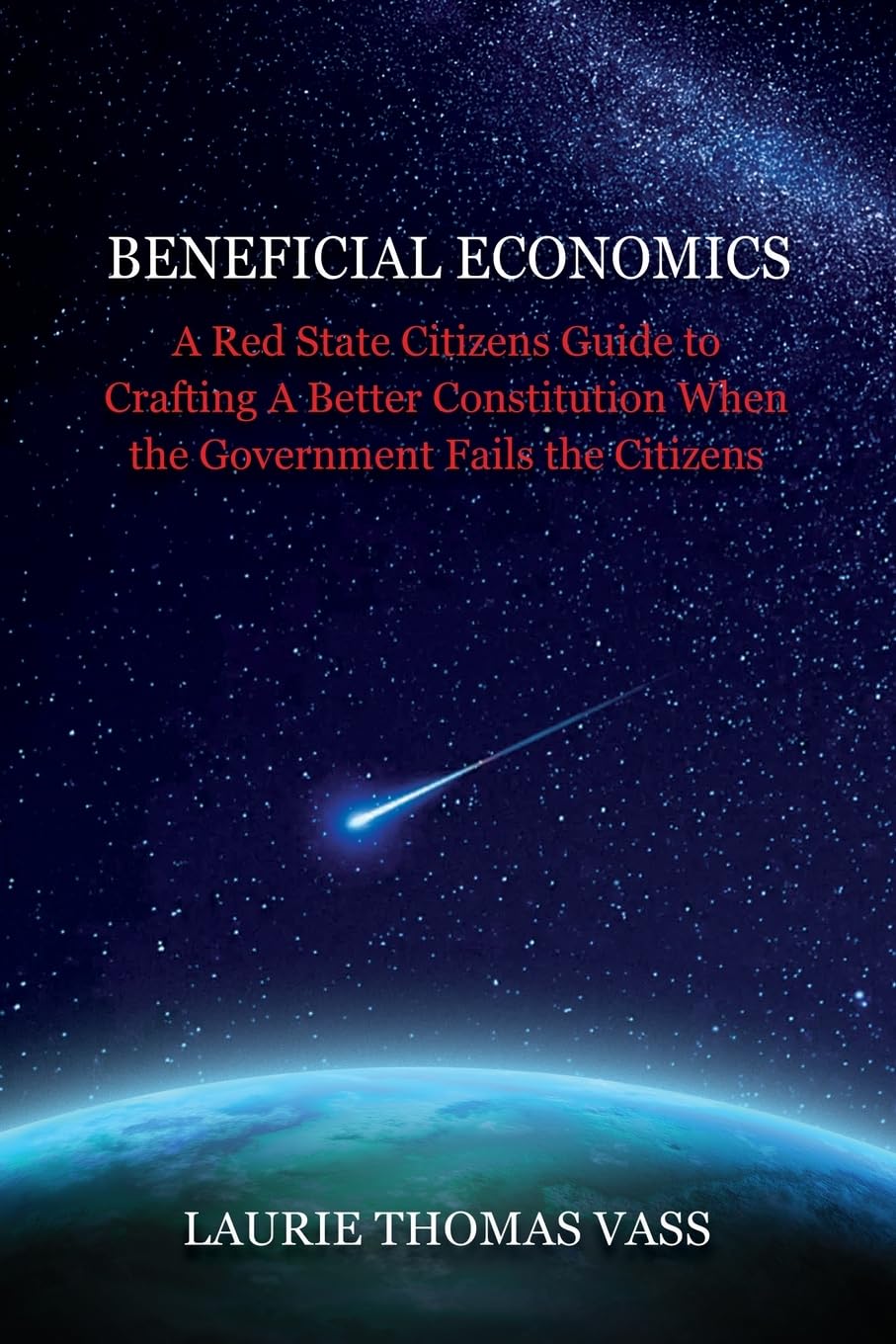

Laurie Thomas Vass’s Beneficial Economics dives headfirst into the chasm of America’s growing ideological divide. It lays out a detailed case for why, in the author’s view, “red state citizens” must abandon what’s left of Madison’s Constitution and rebuild a new one that decentralizes power and restores liberty. The book mixes history, political theory, and constitutional design, using thinkers like Adam Smith, James Buchanan, and Immanuel Kant to argue that liberty, trust, and decentralized economics are the keys to a stable and moral society. Across its dense chapters, Vass sketches a new political architecture, a “Democratic Republic of American States,” built on state sovereignty, fair economic rules, and resistance to what she calls “predatory state capitalism.”
Reading this book felt like a deep plunge into one person’s grand blueprint for reimagining America. I admired the sheer audacity of it. Vass writes like someone convinced of their mission, and that conviction gives the prose a pulse. Their tone is urgent, sometimes fiery, and often unapologetic. The author mixes scholarly arguments with plainspoken outrage, and that combination keeps the reader hooked even through pages of constitutional draft language. I don’t agree with all their conclusions, but I couldn’t help respecting the clarity of their beliefs. The author connects economics, morality, and governance in ways that made me stop and think. There’s a spark of rebellion in every sentence, and I found myself drawn to the raw energy of that.
The book swings between philosophy, constitutional text, and economic diagrams with little warning. Sometimes I felt like I was in a civics lecture, then suddenly in a manifesto. The passionate tone sometimes leads the underlying reasoning, but underneath all that, there’s a real idea here, a longing for fairness, for a government that listens to people, for communities that grow from trust instead of control. When Vass ties Adam Smith’s “invisible hand” to quantum theory and self-organizing order, it’s wild and fascinating. The author is trying to link economics to physics, politics to morality, and citizens to cosmic principles of order. That ambition alone makes the book worth wrestling with.
I’d recommend Beneficial Economics to readers who enjoy bold political thought experiments, especially those skeptical of centralized government or curious about alternative constitutional models. It’s not an easy read, and it’s not neutral, but it’s brimming with conviction and intellectual fire. People who feel alienated by modern politics might find it empowering, and those who don’t agree with Vass will still find it thought-provoking.

Practical Solution for Middle-Class Citizens

A Civil Dissolution: The Best Solution to America’s Irreconcilable Ideological Conflict offers an interesting exploration into the often complex landscape of American politics. Why was this an important book for you to write?
I have been concerned about the growing polarization between natural rights conservatives and leftist Democrats. I finally came to the conclusion that the ideological differences were irreconcilable and that the best solution was civil dissolution and starting over in 1776 with a new state sovereignty constitution for a new Democratic Republic of American States.
This book examines the divisions and dialogues between different political viewpoints, inviting readers to engage in discussions and consider diverse perspectives. What is a common misconception you feel people have about the purpose of the political parties?
The basic issue is that Madison’s constitution of 1787 was based upon two social classes, the natural aristocracy and common citizens. When the Democrat Party shifted to an ideological party in 2008, common middle-class American citizens were left behind without a political party to represent their financial interests. Madison’s constitution centralized power in Washington, and that power became disconnected from the consent of the governed. In the current structure of government, common middle, and working-class citizens do not have a method to restore the political balance between the central government and the states.
What were some goals you set for yourself as a writer in this book?
My intent was to move beyond an analysis of the problems in the nation and try to offer a practical solution for middle-class citizens to restore a natural rights republic form of government.
What is one thing that you hope readers take away from A Civil Dissolution?
The solution for the irreconcilable ideological differences reside in the state legislatures to allow citizens in each state to vote on forming a new nation called the Democratic Republic of American States.
Author Links: Twitter | Website
The transformation of the Democrat Party from an economic faction political party to an ideological social class and race war political party is a permanent change in American politics.
The Democrat Marxists will never go back to being a political party that represented common citizens, as intended by Madison’s constitution.
Even if the Republican Party happened to win an election in the future, the Democrat Marxists will continue their quest to undermine the American political system in order to achieve permanent authoritarian power.
The concentration of power that was reserved to the ruling class, under Madison’s checks and balances, was obtained by the Democrats in the stolen election of 2020.
The moral and ideological differences between Marxist Democrats and natural rights conservatives are irreconcilable.
This book explains why the philosophical differences between the two groups of voters are irreconcilable and presents the argument that a civil dissolution of the nation into socialist slave and liberty free states is the best possible strategy to resolve the ideological conflict.
A Civil Dissolution: The Best Solution to America’s Irreconcilable Ideological Conflict


In A Civil Dissolution, author Laurie Thomas Vass delves into the tumultuous landscape of contemporary American politics, characterized by stark divisions and relentless debates between the Republican and Democratic parties. Vass presents an unconventional proposition: dividing the United States into two distinct entities based on divergent ideological beliefs—one embracing socialist principles and the other championing ‘liberty-free’ states.
The book thoughtfully critiques James Madison’s constitution, pinpointing perceived weaknesses in the amendment process. Vass supports her arguments with a rich tapestry of historical texts and insights from renowned intellectuals. The inclusion of perspectives from figures like George Mason, James Buchanan, and Joseph Schumpeter enriches the narrative, providing a multi-faceted examination of potential pathways to a more effective governance system. One of the book’s strengths lies in its balanced approach. While part of it delves into the analytical exploration of quotes and concepts from notable political thinkers, another segment is dedicated to outlining tangible, actionable solutions for establishing a more efficient government framework. The author’s skill in distilling complex political theories into accessible ideas is commendable. A Civil Dissolution is not just a critique of the current political scenario but a comprehensive exploration of various themes such as history, economics, banking, corruption, racism, slavery, and natural rights. It is as much an analysis of past events and ideologies as it is a commentary on contemporary economic structures, proposing ways to foster a more equitable society.
This book stands out for its insightful discussions and clear presentation of ideas. It is an engaging read for anyone interested in understanding the depths of American political discourse and those seeking novel solutions to the ongoing political divide between Republicans and Democrats. A Civil Dissolution is a conversation starter, inviting readers to consider new perspectives on achieving political harmony in the United States.
Pages: 258 | ASIN : B0CR5JD7F3

Laurie Thomas Vass Author Interview

George Mason’s America is a compelling look at the vision that George Mason had for America and how, had his vision been followed, where would we be today? Why was this an important book for you to write?
The ideological conflict in America between natural rights conservatives and left-wing groups is irreconcilable. The origins of the conflict begin in 1787 when Madison and 38 delegates to the Philadelphia convention overthrew the Articles of Confederation. I wanted to describe that the principles of liberty, in 1776, would have been a better pathway for ordinary common American citizens.
How much research did you undertake for this book and how much time did it take to put it all together?
I began writing this book at the same time that I was writing America’s Final Revolution, in 2021. The more I read about George Mason, the more I thought that Mason deserved his own book. I finished this book in March of 2023.
Author Links: Twitter | Website

“Let us at once take friendly leave of each other.”
In her book, George Mason: Constitutionalist, Helen Hill describes the debate during the 1787 convention in terms of sectionalism, meaning that the northern states did not want to form a centralized union with the southern slaveocracy.
Hill writes,
“The sense of sectionalism became so strong that some of the members saw no solution but to organize two confederacies…on July 13 Morris stated, “Instead of attempting to blend incompatible things, let us at once take friendly leave of each other.”…on July 23 Pinckney “reminded the Convention that if the Constitution should fail to insert some security to the Southern States against an emancipation of slaves and taxes on exports, he should be bound by duty to his State to vote against their report,”
Both Morris and Pinckney were correct in their opinion that the two alien cultures should never have been rammed together under a centralized, all-powerful government.
Likewise, today two alien cultures do not co-exist in peace, and do not share common cultural or philosophical principles on the mission of the national government.
We argue that the differences are irreconcilable, and cannot be remedied by amendments or modifications to Madison’s document.
We agree with Delegate Morris that the time has come for the conservative states to take friendly leave of the Democrat Marxist states.
We argue that there is only one pathway back to freedom, and taking that path means starting over, with a new constitution, at the point in history when Mason and Jefferson wrote their respective documents, in 1776.

Overcoming The Dysfunction
Reclaiming the American Democratic Impulse presents a comprehensive analysis of the political climate in the United States, past and present, and the nation’s future. What were some ideas that were important for you to share in this book?
My intent in writing this book is to provide citizens with a coherent strategy for overcoming the dysfunction in the current United States government and resolving the irreconcilable cultural differences in American society. The primary idea presented in the book is that the political and economic history of America provides examples of how more citizen participatory democracy would be a better solution than the centralized ruling class elite decision-making model currently in operation. In other words, the best solution is more citizen democracy, not less.
How much research did you undertake for this book and how much time did it take to put it all together?
I began research on this book in 2018 by reading historical accounts of the events of 1775, and the ensuing revolution. Much of my time was involved in uncovering the obscure history of the Articles of Confederation, and the logic of the original founders in creating a state sovereignty framework of government. I worked on writing this book over a 15 month period.
What is the next book that you are working on and when will it be available?
I just published my most recent book in April 2023, titled George Mason’s America: The State Sovereignty Alternative to Madison’s Centralized Ruling Class Aristocracy. The book offers a synthesis of the radical i indvidualistic ideology of George Mason, the methodology of constitution creation of James Buchanan, of George Mason University, and the principles of entrepreneurial capitalism of Joseph Schumpeter. My intent in writing this book is to offer a strategy for forming a new nation based upon the ideology of liberty of George Mason and Thomas Jefferson.
I have been mulling over how to incorporate moral and religious principles into a new constitution. If it is true that citizens derive their natural rights from the grace of God, then it would seem important to offer some concept of God in a democratic republic. I have begun research on the Jewish Old Testament, especially the 10 commandments of Moses. Stay tuned.
Author Links: GoodReads | Reedsy Discovery | Twitter | Substack | Locals | Website
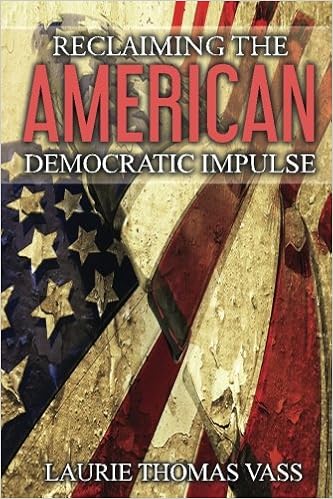
What to do after Obama?What do freedom-loving American citizens do to restore the rule of law after Obama’s lawless administration?In his recent book, The Liberty Amendments, Mark Levin suggests the enactment of 10 amendments to the U. S. Constitution, using the second method of amendment outlined in Article V of the Constitution of 1788.While his suggested amendments could possibly offer relief from the dysfunction in the American political system, his suggestions contain two debilitating flaws that would not remedy the loss of individual freedoms from the tyranny of Obama’s centralized, socialist government power.This book examines how a new constitution, which includes both Levin’s suggested amendments, and the telos of liberty as the end goal, would be a better path than his idea of amending a hopelessly broken representative republic.That pathway back to freedom means reclaiming the American Democratic Impulse



 LITERARY TITAN