Blog Archives
Gritty Environments

Hessman’s Necklace is a gritty noir thriller set in 1950s America, where a reckless fixer hunts a legendary necklace through a smoky maze of lust, lies, and moral ruin. What was the inspiration for the setup of your story?
I was reading a lot of crime stories from the period when I first began Hessman’s Necklace, adhering to the conventions of noir. I focused on seedy settings, grim circumstances, and deeply flawed characters with dubious pasts and unsavory motivations. The very first scene I penned was a visceral torture sequence, featuring Ray wielding a blade while the Reverend, bound to a harsh wooden chair, pleaded for his life, fervently asserting his innocence. Initially conceived as a short story, it was rejected by a magazine due to its graphic and violent nature. Through numerous revisions, I softened the scene to make it more palatable. Eventually, I expanded it from a short story into a novelette, and then into a full-fledged novel, yet that pivotal scene continued to serve as the heart of the book. It encapsulates a moment where the central character, Ray, is pushed to the brink of barbarity as pressure and ambition drive him further into darkness.
The prose in Hessman’s Necklace is bold and stylized. How did you develop that voice?
I drew inspiration from the works of writers such as Dashiell Hammett, John D. MacDonald, and F. Scott Fitzgerald. Hammett, in particular, possessed a remarkable talent for crafting memorable characters, each defined by their actions, appearance, and dialogue. In Hessman’s Necklace, my intention was to honor this style by bringing my characters to life through their distinct voices and the authenticity of their interactions. Like Hammett’s dialogue, which flows organically, I aimed to make my characters’ exchanges engaging and meaningful, propelling the narrative forward while revealing their complexities and motivations. John D. MacDonald’s mastery of detail and sensory richness played a crucial role in shaping my narrative choices. I carefully wove my characters into gritty environments, ensuring that readers could not only follow the unfolding drama but also feel the weight of their surroundings. I embraced sharp, raw language to convey tension and captured the visceral sensations of key moments. At the same time, I drew from Fitzgerald’s lyrical prose, employing vivid imagery and striking metaphors to enhance the depth of the narrative.
The book leans into noir tropes but still feels fresh. How did you strike that balance between homage and originality?
I’ve always had a fondness for the 1950s noir and crime fiction paperback originals from publishers like Gold Medal Books, as well as others such as Signet, Dell, Lion, and Ace. While many of these works adhere closely to established formulas, the sheer demand and profitability urged writers to produce quickly. It’s impressive how prolific authors like Erle Stanley Gardner maintained quality while churning out massive quantities; he produced twenty-eight novels in a single decade. Gil Brewer could wrap up an entire novel in mere days: So Rich, So Dead was completed in just five days, while Flight to Darkness took only three. I aimed to create a 1950s-style noir with a more deliberate approach and a creative twist on conventions. I challenged myself to tell the story from Ray’s perspective, ensuring he was present in every scene, and sought to add a literary flair that elevated the prose without slipping into artificiality or pretentiousness. Underrated crime writer John Flagg, whose novel The Persian Cat was the inaugural release from Gold Medal, excels at high drama—his stories are typically enriched by thrilling scenes, well-imagined locations, and engaging characters. His lush descriptions and sharply sarcastic personas inspired me to keep Hessman’s Necklace both fast-paced and suspenseful while emphasizing wit. I incorporated factual historical details, references to topical news, literature, and art world trivia to capture the essence of that period, all while addressing modern themes that echoed those times. Alas, unlike Gardner and Brewer, it took me years rather than days to finally consider the story complete.
What is the next book that you are working on, and when will it be available?
I’ve started and paused half a dozen novels since finishing Hessman’s Necklace. There’s always a deadline looming that sidelines my creative writing projects, making it a real challenge to find the motivation to complete one before moving on to the next. But I’m determined to get there. Currently, I’m polishing the final chapters of a family drama set in Rhode Island. It leans more towards a beach novel than a crime story, infused with plenty of humor, tension, and personal struggles. Once that’s wrapped up, I plan to revisit the office-based mystery I began last year, and with any luck, both of these novels will finally be ready for publication by early next year.
Author Links: GoodReads | X (Twitter) | Website | Amazon
Ray’s captivating looks and distinction as a ladies’ man persuade Walter to assign him the unusual task of getting romantically close to Merriam Woolcroft, a pretty church secretary. Apparently, Merriam is the mistress of Reverend Arnold Sinclair, a shady South Boston clergyman whose community activities have identified him as a powerful trafficker of stolen antiques.
Although mildly curious if Sinclair’s vestry is stocked with priceless art, one solitary object occupies Walter’s interest: a famed emerald-studded 22-karat gold necklace purloined from a museum thirty years earlier. Convinced that the reverend has this long-lost relic, Walter maintains that Ray should focus on stealing Merriam’s heart to locate the necklace, unaware that manipulating a woman is far more complex and dangerous than manipulating locks.
Escalating tension and unexpected twists turn the stealthy treasure hunt into a ruthless fight for survival.
Hessman’s Necklace
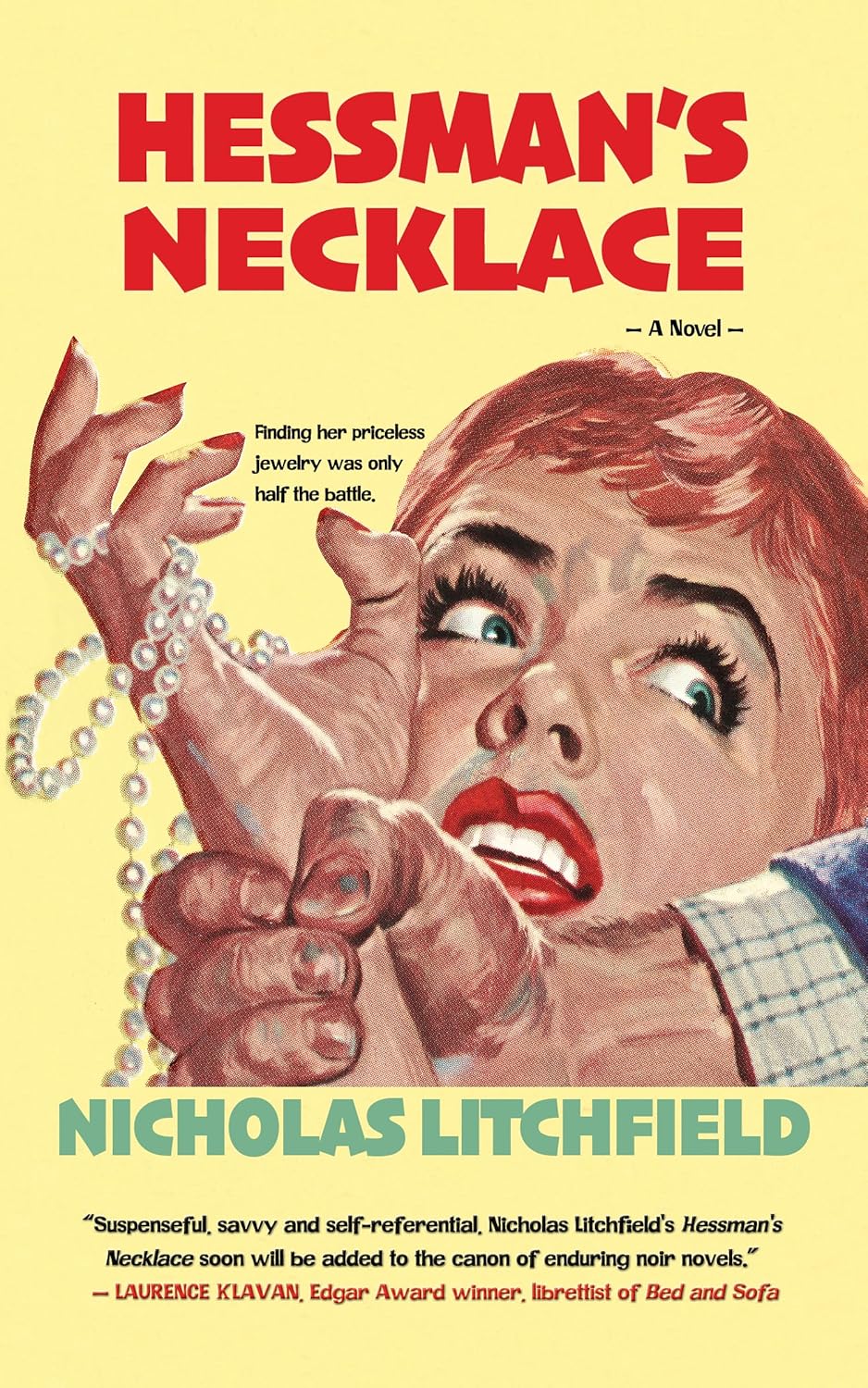

Nicholas Litchfield’s Hessman’s Necklace is a gritty and fast-paced noir thriller set in 1950s America. The novel follows Ray Stokes, a rakish fixer with a thirst for danger, who is sent on a mission by his powerful boss to retrieve a legendary, long-lost necklace. His target? A sultry secretary in Boston and her corrupt lover, a reverend with a taste for contraband and secrets. The story winds through back alleys, smoky bars, and seedy motel rooms, all drenched in bourbon, betrayal, and lust. At its heart, this is a story of greed and moral decay disguised as a treasure hunt, and it plays out like a vintage film noir flick brought to life in brutal, unflinching detail.
What struck me most was the prose. It’s bold, lush, and rich with attitude. Litchfield doesn’t hold back. His writing practically swaggers across the page. There’s an almost hypnotic rhythm to it. Some of it is gloriously over the top: the metaphors, the bravado, the sexual tension. At times, I laughted, not because it was funny, but because it was so brazenly confident. And it works. The characters are larger than life, especially Ray Stokes, who’s every bit the cocky anti-hero, full of flaws and swagger, but weirdly easy to root for even when he’s being a jerk. I didn’t always like him, but I always wanted to see what he’d do next.
This isn’t a quiet, introspective read. It’s brash. It leans hard into noir tropes: femmes fatales, crooked men of the cloth, cynical quips, and backroom deals. But somehow it doesn’t feel tired. There’s a knowing wink in the storytelling, as if the author is in on the joke, and that self-awareness kept things sharp and fresh. The mystery is tight and satisfying, but it’s the mood that really sells it. Litchfield paints the era vividly, full of cigarette smoke and greasy diners and nights that never quite end.
Hessman’s Necklace is a love letter to pulp fiction fans, noir junkies, and readers who like their stories hot-blooded and full of bite. If you want to step into a world of shadows and sin with a smirking guide at your side, this book delivers. I’d recommend it to anyone who enjoys Raymond Chandler, James M. Cain, or even Tarantino at his most playful. It’s a wild, messy, full-throttle ride, and I had a good time reading it.
Pages: 160 | ASIN: B0DXDFQR4W

Chaos and Fury
When The Actor Inspired Chaos and Bloodshed follows an up-and-coming actor who takes a job in a low-budget film where the lines between performance and real violence blur, and it’s a battle for survival. What was the inspiration for the setup of your story?
Years ago, I shared a draft of my thriller manuscript with George Powers Cockcroft, also known as Luke Rhinehart, the author of the cult novel The Dice Man. While he graciously agreed to read it, he candidly expressed that the story was not to his taste and lacked engaging characters. His critical feedback, although disappointing, proved invaluable, prompting me to rethink my approach to character development. I subsequently embarked on a new novel, reimagining those core characters, their identities, and their surroundings. By the summer of 2014, I completed a manuscript titled A Bullet for Silver Face, which eventually evolved into When The Actor Inspired Chaos and Bloodshed. I had read numerous articles and memoir extracts about the volatile relationship between Klaus Kinski and Werner Herzog and wanted to recreate that kind of sizzling tension between actor and director. For instance, Herzog once intended to set fire to Kinski’s house, but the actor’s dog thwarted his plan. Herzog also famously pulled a gun on Kinski during the filming of Aguirre, Wrath of God, threatening to shoot him when Kinski tried to quit the project. I drew inspiration from the chaos and fury underlying their working relationship, particularly during the making of that film.
I dedicated over a decade to refining my story, making changes based on feedback from multiple literary agents. While the core action and characters remained intact, I aimed to shape the narrative into a more conventional thriller. It proved to be much more challenging than I expected. I often wonder if George would have had positive feedback on the final version, especially considering he mentioned that most novels fail to hold his attention. Regardless, his early critique was instrumental in shaping a more compelling narrative, making me believe that the book is better for it.
What are some things that you find interesting about the human condition that you think make for great fiction?
Several elements stand out to me, particularly the complexities of obsession, power dynamics, and the interplay between fear and ambition. In When The Actor Inspired Chaos and Bloodshed, the relationship between Uruguayan director Ignacio Martinez and his lead actor, Dominic Graves, exemplifies the theme of obsession. Ignacio’s deep passion for his art drives him to creative heights but also risks leading him toward personal turmoil, and this delicate balance between artistic fervor and potential self-destruction captures the nuanced duality often present in human endeavors. Additionally, the dynamics of power and vulnerability within their collaboration reveal essential truths about human interaction. The way individuals navigate dominance and submission in creative partnerships reflects broader societal conflicts, and these intricate exchanges underscore the complexities inherent in human connections.
With this book, I tried to maintain an ever-present atmosphere of danger and tension on the set, spotlighting how fear can propel people toward extraordinary achievements or, conversely, contribute to their downfalls. Ignacio’s devotion to his artistic vision serves as a warning regarding the lengths to which directors will go in pursuit of their dreams, often at a substantial cost to their well-being or those around them. While the novel engages with these themes, it is the universal appeal of these aspects of the human condition that invites deeper reflection. Obsession, chaos, power, and fear are not just narrative devices; they resonate profoundly with our experiences, making them timeless subjects worth exploring in fiction.
I found this novel to be a cutting piece of satire. What is one thing that you hope readers take away from your novel?
Thank you for your kind words. The intense relationship between Ignacio and Dominic serves as a potent metaphor for the creative process, showing how passion can both spark brilliance and create chaos. My intention was to highlight the darker aspects of ambition and the sacrifices involved in the pursuit of artistic truth. I hope that through this narrative, readers reflect on the lengths they are willing to go for their craft.
What next book are you working on, and when will it be available?
I’m currently working on a crime novel set in the 1970s, as well as a thrilling office-based drama, although both projects may not be completed until 2027. In the meantime, I have a noir titled Hessman’s Necklace set to be released in late June. This story takes place in the 1950s and follows a skilled cat burglar named Ray Stokes, who a Chicago mob boss has assigned to retrieve an infamous piece of jewelry. Award-winning short story writer Robert Garner McBrearty described Ray as follows: “I pictured the anti-hero Ray as what a young Philip Marlowe might have been like, if Marlowe was hungover, had fewer moral scruples, and had turned his skills to crime instead of detective work.”
Author Links: GoodReads | X | Facebook | Website
When Dominic’s striking, svelte young co-star, Sofia Prodva, becomes enamored with the American actor, the palpable sexual chemistry between the two stars creates a toxic environment. It turns out that Sofia is the director’s mistress, and the moment Ignacio senses the betrayal, relations between the director and his principal actor take a turn for the worse.
The nightmarish movie-making experience is nothing compared to the actor’s exploits away from the film set, where jealousy, rivalry, and revenge stalk him to the final shoot, leading to chaos and bloodshed.
When The Actor Inspired Chaos and Bloodshed
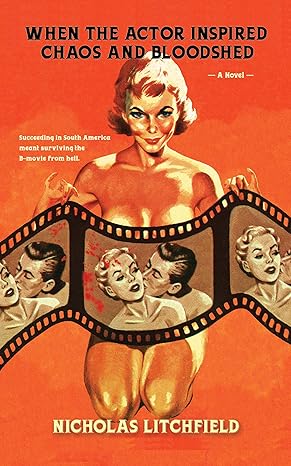
This book is a full-throttle plunge into the absurd, gritty, and dangerous world of low-budget international filmmaking, seen through the often-hungover eyes of Dominic Graves, a fading actor who stumbles into a bloody, chaotic shoot in Montevideo. What starts as a job meant to revive his failing career spirals into a bizarre descent where the lines between performance and real violence blur, egos clash, and survival becomes more than just a metaphor. The story zips from Los Angeles sleaze to South American intrigue, all while Dominic tries to hang on to whatever scraps of dignity he has left.
Litchfield knows how to throw you into a scene. The opening prologue, where a film shoot goes violently sideways, hits hard. Bullets flying, blood spraying, a screaming film exec belly-flopping for cover. It reads like some grainy ’90s action flick at 2 a.m. on cable. That’s the vibe throughout the novel: high tension, slapstick disaster, and sharp edges everywhere. Dominic, caught in the madness, isn’t exactly likable, but he is interesting. He’s the kind of mess you want to keep watching, even when he’s making every wrong choice.
What I really loved is how the book swings between outrageous comedy and deeper, sometimes bleak reflection. Dominic is a washed-up actor carrying guilt, shame, and a streak of self-loathing that sneaks in unexpectedly, like when he reflects on a disturbing sexual encounter with a woman he barely knows, and it genuinely shakes him. These moments add surprising weight to a book that could’ve easily stayed surface-level chaos. And the writing pops. It’s fast, visceral, sometimes poetic, sometimes grotesque, always alive. When Dominic finally meets the creepy director Ignacio, it’s like watching two predators circle each other.
That said, this isn’t a tidy book. It’s messy, like its characters. The pacing jumps around, the tone tilts from noir to satire to farce, and it leans on shock value at times. But I didn’t mind. It fits. The world Litchfield builds is unhinged, and that disorder is the point. When Dominic stumbles into the suite at the lavish Carrasco hotel, high on pills and low on expectations, I felt like I was right there with him, wondering how long it’d take before everything blew up. It’s part travelogue, part fever dream, and fully committed to the bit.
When the Actor Inspired Chaos and Bloodshed is for readers who like their thrillers with grit, grime, and a side of dark humor. It’s a wild ride through the underbelly of the film world, complete with egos, accidents, existential crises, and gunshots. Definitely recommended for fans of noir, black comedy, and stories where everything that can go wrong does, and then some.
Pages: 226 | ASIN : B0DN2Z3D3M



 LITERARY TITAN