Blog Archives
We Are Not Monsters

In Out Of Step, you share your experiences in the military during the Vietnam War, from the rigors of Basic Training to family pressures, shame, and the social physics of the Army. Why was it important for you to share your story?
The first question about that war for those of us who were there is “What the Hell happened? And how did we end up on the wrong side of history, vilified as monsters and baby-killers? It is a little-known fact that ninety percent of us were not in the Hollywood version of Combat. We were the clerks and jerks, the cooks, truck drivers, supply and logistics specialists who played defense. I sat through about ninety mortar attacks but, aside from one time at the range, never fired my weapon. I cleaned it everyday. I arrived a month after the Tet Offensive and did my job…or rather jobs. I had five of those simultanously. I was part of the most effective intelligence collection system of the war but had to add contributions from John Wadje and John A, Reid to create a full picture of what happened at my unit and brief paragraphs from other ASA soldiers. That’s the other thing, I wasn’t really in the Army but a uniformed part of the NSA with compartmented access to protect “sources and methods”. I had to wait fifty years for NSA to declassify most of it so I can provide a wider context. I think it is important to correct the popular culture image and provide a narrative without the guts and glory meme. That’s just for the other ninety percent who were not so-called “front line” soldiers. I’m a novelist so this written as one without the fiction.
I appreciated the candid nature you use in writing about your darkest days. What was the most difficult thing for you to write about?
The humiliations I suffered in training. I think this is where most of my PTSD comes from. Vietnam was easier. I was never really afraid and I never thought I would die there. I was seriously thinking about making the Army a career. The reasons I didn’t are in Part Two. The main reason was an invitation to attend the Iowa Writers Workshop. Even the re-enlistment NCO thought I’d be a fool to turn that down.
Looking back on your writing process, is there anything else you now wish you had included in your memoir?
No. It was already too long. That’s why I split it into two parts. In Part Two I go from the hot war to the Cold War as a General Staff NCO at the European headquarters of ASA. It was a unique path. The most surprising thing about it was the anti-Vietnam veteran prejudice even within the Army. The resentment was palpable. But I ended up in the Public Information Division. That was my first paid job as a writer.
What is one thing you hope readers take away from your story?
That Veterans of all the wars after World War Two, the so-called “Greatest Generation” also deserve respect. And I do not mean that “thank you for your service” BS that most utter and do not mean. That’s just patronizing and demeaning.
Out Of Step – Part One, A Memoir of the Vietnam War
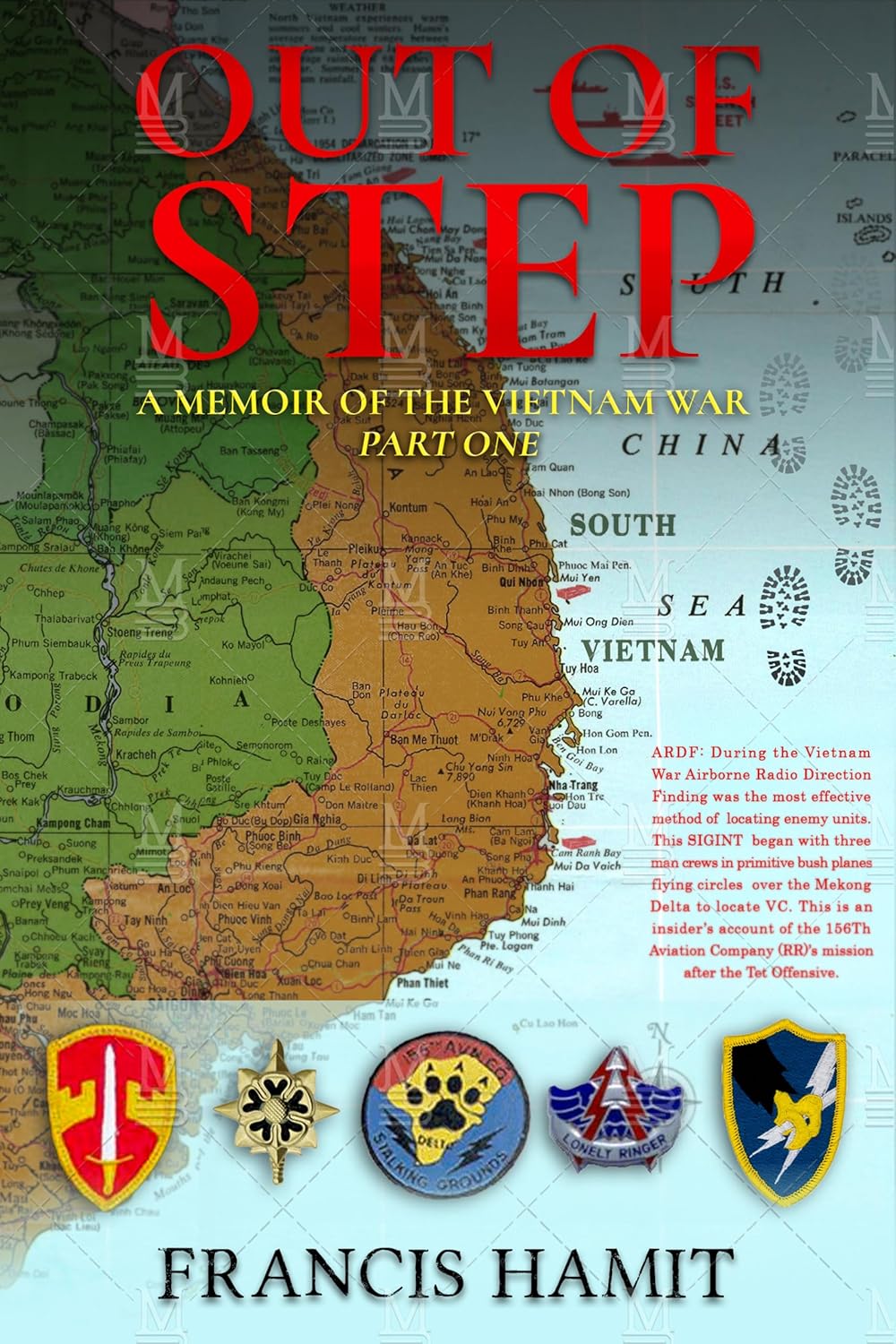

In Out Of Step, author Francis Hamit walks readers through the Vietnam-era hinge where a messy young life gets snapped into military shape, first in Basic Training and stateside intelligence schooling, then into the quieter, stranger corridors of the Army Security Agency (ASA) and its SIGINT world. He frames the war as an intelligence contest as much as a jungle contest, admiring (with a bit of grudging awe) how North Vietnam built a formidable cryptographic service and set the terms of visibility, see clearly or be seen clearly, long before Americans turned it into a slogan.
What struck me first was the book’s refusal to behave like a tidy “war story.” Hamit’s voice is candid, prickly, and alert to the social physics of the Army: who gets hazed, who gets protected, who is quietly sacrificed to bureaucracy. He’s funny in a sharp-edged way, humor as a scalpel, not a comfort blanket, and he’s willing to show himself unflatteringly, including the bad motives that shove him into enlistment and the petty humiliations that sandpaper a person down. The prose keeps swiveling between the personal (family pressure, wounds, lust, shame) and the institutional (orders, cover stories, the odd not-quite-Army status of ASA), which made me feel the claustrophobia of being processed by a machine that doesn’t pause for individual anatomy.
My second reaction was an admiration for the way Hamit describes “realistic training” metastasizing into something darker, particularly the Tactical Training Course at Fort Devens, where simulated capture and interrogation drifts into sanctioned cruelty. Reading about the “menu” of coercion, electric shocks, the “Apache pole,” waterboarding, lands with a delayed thud, because it’s delivered not as a sensational reveal but as another entry in a long ledger of what people will justify when they think the future demands it. And yes: he warns early that sex is plentiful and the story is also a coming-of-age account, which changes the temperature of the memoir. This isn’t antiseptic recollection, it’s lived-in memory with sweat still in it.
This will hit best for readers who like memoir, Vietnam War, military history, espionage, SIGINT, and coming-of-age narratives, especially anyone curious about the war’s less cinematic strata: cover names (“Radio Research”), invisible bounties, and the daily discipline of not drawing attention to yourself while doing work the broader Army barely understands. If Tim O’Brien gives you the war as moral weather in The Things They Carried, Hamit gives you the war as a lived system, bureaucratic, occasionally absurd, and always humming with consequences. In the end, this is a memoir that doesn’t salute the myth of Vietnam; it interrogates it, and keeps its balance while doing so.
Pages: 196 | ASIN : B0G5483Y6L



