Blog Archives
Insane Extremes

Uncommon Sense is a raw, unfiltered, and unapologetic deep dive into the heart of American dysfunction, exploring the problems with both parties, and helping Americans understand how we got to this point and what we can do to correct the course. Why was this an important book for you to write?
We all know the country is more divided than it has ever been, and we all know that it has become the norm to hate those with whom we disagree…simply because we disagree. I just had enough of the shouting and the hate and the noise; I had enough of the lies that are never questioned and the misinformation that is readily accepted as fact. So, I set out to offer context and a tough reality check. Writing this book was the only way I could think of that I could contribute to the solution, to help the country get back to what we were intended to be. My biggest hope is that enough people will read it and be moved by it to wrest the control of society away from the insane extremes on both sides and restore it to the vast majority of voters closer to the middle- where governing and growth can happen.
What is a common misconception you feel people have about how America has drifted so far from its founding principles?
I am not sure I understand what you mean by misconception. America has objectively drifted from its founding principles. I believe mass media and social media are to blame. Too many people accept memes as news and headlines as information. Too many people don’t understand enough about history and the foundation of this country to see that most of what they see is just wrong. If the people shouting the loudest understood the Constitution, for example, they would see there is no reason to shout.
What were some ideas that were important for you to share in this book that can help voters start to heal the division that is dividing the country?
The most significant idea to be found on the pages of this book is that we can disagree and still be friends; that disagreeing doesn’t make us enemies; that supporting conservative ideas does not make one a nazi and supporting liberal ideas does not make one a communist; that the answer to everything that ails us can be found in the middle.
What is one thing that you hope readers take away from Uncommon Sense: For the Voters Who Can Save America From Itself?
Beyond what I have already said, I hope readers take from this book the courage and tenacity to always ask the follow-up questions until they get real answers; to never accept talking points as answers; to hold their elected officials accountable for doing what is right for their constituents, or to vote them out regardless of party affiliation. Mostly, I hope they take away the ability to agree to disagree.
Author Links: GoodReads | Instagram | Facebook | Website | Amazon
The immeasurable abundance of misinformation and outright lies, combined with the unfettered vitriol cloaked in the anonymity of the internet, are feeding the beast of hate faster than anything ever has in our history. If the misinformation and hatred don’t end, America will.
Drawing from American history, the Constitution, and the voices of past leaders, Uncommon Sense makes the case that it’s not politicians who will save America, but informed, engaged, and principled voters who dare to think critically, ask questions, and speak civilly.
This is not a book for the far left or the far right—the extremes on both sides may hate its message. Uncommon Sense is for every American who’s tired of the shouting and the noise and the hate; for every American who is willing to have a real conversation.
Getting there is going to require that we put away our biases and party allegiances; that we take a deep breath and open our minds; that we flush away everything we have been told about governing and politics by network media corporations, social media content creators, and clickbait talking point headlines. We must adopt a position of simple pragmatism and logic—we must all think it through to find the simplest solutions for voters and politicians alike to pursue and tap into the true greatness America has to offer in the twenty-first century and beyond. Getting there is going to require that we ask more questions and listen to more answers . . . and that we normalize talking about it civically.
Uncommon Sense – For the Voters Who Can Save America from Itself


David Givot’s Uncommon Sense is a raw, unfiltered, and unapologetic deep dive into the heart of American dysfunction. The book sets out to diagnose the disease of modern politics, tracing its symptoms through history, culture, and ideology. Givot blends civic education with rant, reflection, and rally cry. He moves from the founding documents of the United States to the wreckage of today’s polarized climate. Along the way, he weaves lessons about government, power, media, and morality into something that feels part history textbook, part barroom sermon, part therapy session for a divided country. It’s loud, often funny, sometimes harsh, and always honest.
Givot’s writing is conversational but sharp. He swears, he jokes, he gets sentimental, and then he slams you with a paragraph that makes you sit up straight. He’s angry, but the anger comes from love. Love of country, love of reason, and maybe even a stubborn hope that we aren’t too far gone. He doesn’t coddle anyone. Both parties take hits. The reader gets hit too. At times, it reads like a wake-up call, a challenge to stop being lazy thinkers and to take back the idea of citizenship. What makes the writing work is its rhythm. Sentences snap. Thoughts come in bursts. There’s no polished political language, just a man trying to talk sense in a world that’s lost it.
I’ll admit, I argued with him in my head more than once. He reminds you that real patriotism isn’t about cheering your team; it’s about caring enough to question it. He calls out hypocrisy wherever he finds it, and though he uses humor to soften the blows, the message cuts deep. Reading this book, I felt frustrated, amused, and oddly hopeful. That’s a rare mix, and it’s what kept me turning pages.
In the end, Uncommon Sense isn’t for everyone. If you prefer quiet agreement or delicate politics, this won’t be your thing. But if you’ve ever yelled at the news or wished someone would just say what we’re all thinking, this book will resonate with you. It’s for voters who still believe America can do better, who want to understand how it went off the rails, and who don’t mind being a little uncomfortable while figuring it out. It’s a loud, messy, heartfelt call to think harder, talk honestly, and demand more, from ourselves and from the people we elect.
Pages: 400 | ASIN : B0FH2W8FF6

Seeing Both Sides of the Problem

Backyard Politics dives deep into the philosophical and societal divide between two opposing ideological camps, Protectors and Promoters, exploring these contrasting views and addressing topics such as freedom of speech, poverty, racism, and family dynamics. Where did the idea for this book come from, and how did it develop over time?
I have been a practicing Psychologist for 45 years. Over this period of time, I noticed a pattern. Namely, that some people seem to focus on blaming others or some other external factor for their problems. In contrast, other people seem more willing to recognize that their actions contribute to their struggles. Likewise, I noticed that when people are having political debates, the same two patterns occur. One side faults external factors in society that devastate individuals and groups, while the other side emphasizes that some people and groups may behave in ways that relate to their misfortunes.
How much research did you undertake for this book, and how much time did it take to put it all together?
For many authors, and in my case as well, a book project generally takes about two years to complete. Due to my decades of clinical practice, I already had a sense of the ways in which individuals and families behave. So when I started to write, content related to politics occupied my most of my time. In my endeavors, I identified seminal political, economic, and sociological books and articles, and I listened to podcasts that represented differing views and explanations for society’s ills.
Once again, I noticed that one side focused on changing external factors to remove hardship, while the other side focused on remediating the ways in which people adapt and cope with their individual and social problems. One side argued to protect people by providing relief, while the other side wanted people to learn new behaviors so that they could promote their own well-being. However, lessons learned in clinical practice taught me that both ways of helping can be beneficial depending on the problem and circumstance.
What were some ideas that were important for you to share in this book?
We all start out helpless and completely dependent on others to rescue us, but over time, we must learn to establish self-sufficiency. As they say, birds must eventually fly out of the nest. The problem is to find a viable way to protect each other without sacrificing opportunities to facilitate competence so that we enhance our survival and are skillful enough to help each other when necessary. Family life, school, and the workplace are primary ways that must address this intricate problem, and when the two helping strategies are out of kilter, we all struggle more. As an alternative to a popular proverb; we must identify times when people need a fish, as well as identify those times when they could benefit from learning how to fish.
What is one thing that people point out after reading your book that surprises you?
I was surprised how often people are unaware of the inside ↔ outside dynamic that seems so prevalent when we are trying to resolve our intimate and less familiar relationships, and/or struggles to achieve. However, once people recognize this way of conceptualizing political and social difficulties, they realize that the problem is to find an acceptable way to both protect those who suffer as well as promote essential new learning, as ignoring either one is likely to result in a diminishment of positive results. People then see that the rigidity of our political and social divide is an obstacle to success, and that exposing children to only one side of the dynamic will only perpetuate society’s breakdown.
Author Links: GoodReads | Website | Publishers Website
Dr. Craig Wiener, a clinical psychologist for over forty years, approaches the current political divide from a desire to understand the differences between opposing political ideologies, and to create space for multiple points of view in highly charged political discussions.
Utilizing an innovative way to conceptualize the two main viewpoints driving American politics, Dr. Wiener discusses how the people holding these perspectives may view, respond to, and interact with highly contentious political issues such as poverty, racism, the patriarchy, and family life. In assessing these issues, he proposes solutions for managing the interpersonal conflicts that occur within our tense political atmosphere.
Backyard Politics is a must-read analysis of today’ s political landscape and a proposed way to overcome our intense differences.
Backyard Politics: A Psychological Understanding of Today’s Political and Social Divide
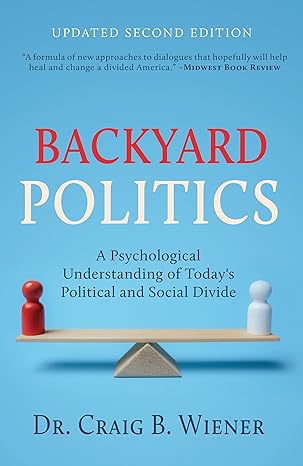
Craig B. Wiener’s Backyard Politics dives deep into the philosophical and societal divide between two opposing ideological camps: Protectors and Promoters. Through a comparative lens, Wiener explores how these groups frame societal problems—whether by focusing on external systemic flaws or emphasizing individual accountability. The book is a detailed exploration of these contrasting worldviews, addressing topics such as freedom of speech, poverty, racism, and family dynamics. Wiener’s central thesis presents a nuanced debate, inviting readers to question their assumptions about the sources of human suffering and societal discord.
What stood out to me was Wiener’s even-handed approach to the two perspectives. The section on “Freedom of Speech” was particularly compelling. He juxtaposes the Promoters’ prioritization of unfettered expression with the Protectors’ emphasis on safeguarding emotional well-being and dignity. His argument that the erosion of free speech could lead to a slippery slope of mob rule was provocative and timely.
One of the book’s strengths lies in its grounding of abstract ideas with concrete examples. In the chapter on poverty, Wiener discusses how Protectors view systemic barriers like income inequality and lack of access to education as insurmountable roadblocks, whereas Promoters focus on fostering self-reliance through individual effort. His analysis of educational reform—specifically the tension between leveling the playing field and promoting personal responsibility—was sharp and thought-provoking.
Wiener’s writing shines brightest when dissecting the family as a microcosm of political ideologies. He draws parallels between parental dynamics and societal governance, arguing that overprotective parents (like Protectors) might unintentionally stifle growth. The discussion on fostering mutual accommodation within families resonated with me, especially his point about balancing support and independence. This felt like a powerful metaphor for the broader societal debate he addresses throughout the book.
Backyard Politics is not a light read, but it’s a rewarding one. Wiener’s analytical style demands engagement, making it ideal for readers who enjoy political philosophy or are eager to understand the ideological divides shaping today’s world. While occasionally dense, his arguments are timely and relevant, offering a roadmap for navigating our polarized era. I’d recommend this book to thoughtful readers curious about the intersection of psychology, politics, and human behavior—especially those who appreciate a balanced, if slightly pointed, exploration of contentious topics.
Pages: 342 | ASIN : B0DP3JQ8WB
Left Wing, Right Wing, People, and Power: The Core Dynamics of Political Action

Douglas Giles’ book Left Wing, Right Wing, People, and Power offers an insightful exploration into fundamental political questions: What is power? What defines political philosophy? How do Democrats differ from Republicans? Giles adeptly unpacks the ideologies of both left-wing and right-wing factions, tracing their impact on historical and contemporary politics.
Giles delves into the origins of conservatism through a study of Edmund Burke, often regarded as the father of conservatism, and his critique of the French Revolution. The book doesn’t just stop at traditional political boundaries; it also examines more radical and so-called “fake left” movements, providing a comprehensive overview of political dynamics.
The author’s prose is both thorough and accessible, making complex ideas approachable without sacrificing depth. His analysis, enriched with historical examples ranging from Hitler’s fascism to the French Revolution, invites readers to draw their own conclusions, supported by extensive references and a detailed appendix for further exploration.
One particularly enlightening segment discusses the distinctions between libertarianism and conservatism, highlighting the former’s emphasis on power over tradition. Giles’ comparisons between historical and modern political movements offer readers a broad perspective on both American and international political histories.
Left Wing, Right Wing, People, and Power is an essential read for anyone seeking to deepen their understanding of the political spectrum. It clarifies the true ideologies behind commonly supported political labels and warns of the risks associated with extremist movements. Giles’ work is a valuable educational tool that could greatly benefit American school curriculums, equipping students with a comprehensive knowledge of political ideologies and their historical contexts.
Pages: 107 | ASIN : B0CWDP6D1H




 LITERARY TITAN