Blog Archives
Better Decisions

In The Diversity Principle, you examine the idea that mixed groups of people are more successful at thinking and acting than homogenous groups. Why was this an important book for you to write?
The book is important for two reasons. First, the diversity principle upends the idea of racial and gender supremacy and replaces it with the knowledge that when we bring all kinds of people together, we make things better for everyone. Second, the diversity principle is under attack from those who want to maintain the status quo or reverse the gains of women and minorities, making this a critical time to explore its historical roots and the contemporary empirical studies that demonstrate that it is scientifically valid.
If you had to condense “the diversity principle” into one sentence for a skeptical reader, what would it be?
After two hundred years of the spread of the diversity principle in universities and free speech law, the scientific evidence now establishes that when you bring together people with different backgrounds and experiences, including people of different ages, religions, ethnicities, races, genders, and other forms of personal identity, they make better decisions.
Are you hopeful or pessimistic about the future of diversity as a constitutional value?
I am hopeful because even though it threatens the status quo, it is such an important principle that in time, people who fail to accept it and implement it will fall behind because they are losing the benefits that diversity offers.
What is one thing you hope readers take away from The Diversity Principle?
We are all better off when we open our circles of community to outsiders and expand our lives to include people of diverse backgrounds and experiences.
Author Links: GoodReads | Facebook | Website | LinkedIn | Instagram | Amazon
The diversity principle—the idea that people with different backgrounds, experiences, identities, and viewpoints produce better work by engaging with one another—was a core tenet of the first modern research university, founded in Germany in 1810. It was the inspiration for John Stuart Mill’s On Liberty, a touchstone of academic freedom; a hallmark of Charles Eliot’s remaking of Harvard in the late nineteenth century to promote the “clash of ideas�; and a foundation of the twentieth century efforts toward equality of Thurgood Marshall, Ruth Bader Ginsburg, and Pauli Murray. In telling the story of the diversity principle through the experiences of these and other remarkable thinkers, Oppenheimer argues for affirming diversity as a central value of education and an essential ingredient for a robust intellectual and political culture.
THE DIVERSITY PRINCIPLE: The Story of a Transformative Idea


David B. Oppenheimer’s The Diversity Principle traces one big claim across two centuries, that mixed groups of people think and act better than homogenous ones. He follows this idea from Wilhelm von Humboldt’s experiments with the early research university, through John and Harriet Mill’s defense of diverse voices in public life, into Charles Eliot’s reinvention of Harvard, and then through the long legal fight over academic freedom and affirmative action in the United States. Along the way, he folds in South Africa’s “open universities,” the growth of “diversity science,” the corporate “business case for diversity,” and finally the recent Supreme Court rejection of race-conscious admissions and the wider political backlash against DEI work.
I enjoyed how firmly the book is rooted in people rather than abstract slogans. Oppenheimer builds the story through vivid portraits of Humboldt, Caroline von Humboldt, the Mills, Pauli Murray, Thurgood Marshall, Felix Frankfurter, Archibald Cox, and Lewis Powell, and the result feels almost like a relay race in which the core idea gets handed from one generation to the next. The explanation of how a fired Watergate prosecutor ends up shaping the doctrine in Bakke is the kind of narrative twist that made me grin because it is both strange and perfectly logical once he sets it up. I also liked the patient way he walks through complicated doctrine without drowning the reader in technical language, so I never felt locked out of the legal debates, even when the cases stack up. The chapters on “diversity science” and the data on how mixed teams outperform homogenous ones gave me a quiet thrill, because they turn what is often treated as a soft feel-good claim into something you can test and argue about with real numbers.
The tone is openly alarmed about the current political moment, and I share a lot of that worry. The framing sometimes feels a bit all or nothing, especially when he describes the “war on diversity” in the courts and in statehouses. There were points where I would have welcomed a more careful look at the most thoughtful criticisms of diversity-based policies, to answer them and acknowledge the tensions they highlight. The early historical chapters are rich and detailed, then the later sections race through business, science, Europe, and current politics in quick succession. Even when I felt a bit overwhelmed, I stayed engaged, because the through line is clear and the stakes are never in doubt.
The Diversity Principle is best suited for readers who care about universities, law, corporate leadership, or democratic life, and who want to understand how one big idea traveled from nineteenth-century Prussia to twenty-first-century fights over DEI statements and student admissions. If you are willing to spend time with legal cases, historical sketches, and social science in one package, I think you will find this book rewarding and surprisingly moving. For everyone else who is trying to make sense of why diversity became such a central and contested value, I would happily recommend The Diversity Principle as a smart and serious guide.
Pages: 416 | ISBN : 978-0300279894

Succeed in Life

100 Things Black Boys Should Do and Know is a no-nonsense, heartfelt, and refreshingly real guide written specifically for young Black boys that mixes tough love with encouragement, serious talk with humor, and spirituality with street smarts. Why was this an important book for you to write?
I wrote this book in the Covid era, when kids were missing out on a lot of educational and social learning. I was in the school system and I noticed how black boys were having a hard time following instructions and showing manners. I was in total disbelief at what I was seeing. So, I said to myself what can I do, to help Black boys? That’s when it came to me, “I can write a book about things Black boys can do and know.” In the process of writing it, themes just came to me as I observed more Black boys. I also did some homework searching for a self-help book for Black boys. The ones that kept coming up were affirmation books, but I felt like they needed more.
What is one piece of advice you wish someone had given you when you were younger?
One piece of advice I wish someone would have given me? I would say, “Don’t let anything or anyone keep you from learning and growing as a person.”
What is one thing that you hope readers take away from 100 Things Black Boys Should Do and Know?
The thing I want anyone who reads my book to understand and know is that I really want Black boys to succeed in life and make a difference in this world.
Author Links: GoodReads | Instagram | Facebook | X (Twitter) | Amazon
100 Things Black Boys Should Do and Know

Jason Huey’s 100 Things Black Boys Should Do and Know is a no-nonsense, heartfelt, and refreshingly real guide written specifically for young Black boys, though honestly, it’s got nuggets for all of us. The book is exactly what the title says—100 pieces of advice, lessons, and life tips, everything from “Tell Your Mom and Dad You Love Them” to “Learn CPR” to “Get Help” when life feels heavy. Huey mixes tough love with encouragement, serious talk with humor, and spirituality with street smarts. The format is easy to follow, the tone is conversational, and the heart behind it is big.
One thing I loved is how Huey doesn’t shy away from anything. He hits real-life issues head-on—mental health, racism, peer pressure, even gun violence. In #69 “12,” he gives a straight-up survival guide for police encounters. It’s heavy but necessary. In #30 “Let It Out,” he tells boys that it’s okay to cry, to be emotional, to feel. That struck a chord in me. Growing up, crying felt like a weakness. Huey flips that script and makes vulnerability a strength. His words are filled with love but also urgency. You can feel he’s been through it, seen it, lived it.
The writing style is raw, it’s funny, it’s deeply personal. I found myself smiling at things like “Takis or Hot Cheetos” (#25) and “Watch Cartoons” (#41), then turning the page and getting a gut check about “Colorism” (#62) and “Never Ending Race” (#71). He breaks things down in a way that feels like a big brother giving you the real talk you never knew you needed. He even sneaks in lines that’ll stay with you: “A man who doesn’t acknowledge his mistakes is a mistake” from #2 “My Bad” really reasonated with me.
I’d recommend this book to every young Black boy—and to the parents, teachers, mentors, and friends who want to love and support them better. It’s not just a list. It’s a roadmap. A compass. A hug and a challenge. You don’t read this book; you hear it. You feel it. And if you let it, it’ll change how you move through the world.
Pages: 50 | ASIN : B0BR46C2S3
Seeing Both Sides of the Problem

Backyard Politics dives deep into the philosophical and societal divide between two opposing ideological camps, Protectors and Promoters, exploring these contrasting views and addressing topics such as freedom of speech, poverty, racism, and family dynamics. Where did the idea for this book come from, and how did it develop over time?
I have been a practicing Psychologist for 45 years. Over this period of time, I noticed a pattern. Namely, that some people seem to focus on blaming others or some other external factor for their problems. In contrast, other people seem more willing to recognize that their actions contribute to their struggles. Likewise, I noticed that when people are having political debates, the same two patterns occur. One side faults external factors in society that devastate individuals and groups, while the other side emphasizes that some people and groups may behave in ways that relate to their misfortunes.
How much research did you undertake for this book, and how much time did it take to put it all together?
For many authors, and in my case as well, a book project generally takes about two years to complete. Due to my decades of clinical practice, I already had a sense of the ways in which individuals and families behave. So when I started to write, content related to politics occupied my most of my time. In my endeavors, I identified seminal political, economic, and sociological books and articles, and I listened to podcasts that represented differing views and explanations for society’s ills.
Once again, I noticed that one side focused on changing external factors to remove hardship, while the other side focused on remediating the ways in which people adapt and cope with their individual and social problems. One side argued to protect people by providing relief, while the other side wanted people to learn new behaviors so that they could promote their own well-being. However, lessons learned in clinical practice taught me that both ways of helping can be beneficial depending on the problem and circumstance.
What were some ideas that were important for you to share in this book?
We all start out helpless and completely dependent on others to rescue us, but over time, we must learn to establish self-sufficiency. As they say, birds must eventually fly out of the nest. The problem is to find a viable way to protect each other without sacrificing opportunities to facilitate competence so that we enhance our survival and are skillful enough to help each other when necessary. Family life, school, and the workplace are primary ways that must address this intricate problem, and when the two helping strategies are out of kilter, we all struggle more. As an alternative to a popular proverb; we must identify times when people need a fish, as well as identify those times when they could benefit from learning how to fish.
What is one thing that people point out after reading your book that surprises you?
I was surprised how often people are unaware of the inside ↔ outside dynamic that seems so prevalent when we are trying to resolve our intimate and less familiar relationships, and/or struggles to achieve. However, once people recognize this way of conceptualizing political and social difficulties, they realize that the problem is to find an acceptable way to both protect those who suffer as well as promote essential new learning, as ignoring either one is likely to result in a diminishment of positive results. People then see that the rigidity of our political and social divide is an obstacle to success, and that exposing children to only one side of the dynamic will only perpetuate society’s breakdown.
Author Links: GoodReads | Website | Publishers Website
Dr. Craig Wiener, a clinical psychologist for over forty years, approaches the current political divide from a desire to understand the differences between opposing political ideologies, and to create space for multiple points of view in highly charged political discussions.
Utilizing an innovative way to conceptualize the two main viewpoints driving American politics, Dr. Wiener discusses how the people holding these perspectives may view, respond to, and interact with highly contentious political issues such as poverty, racism, the patriarchy, and family life. In assessing these issues, he proposes solutions for managing the interpersonal conflicts that occur within our tense political atmosphere.
Backyard Politics is a must-read analysis of today’ s political landscape and a proposed way to overcome our intense differences.
Backyard Politics: A Psychological Understanding of Today’s Political and Social Divide
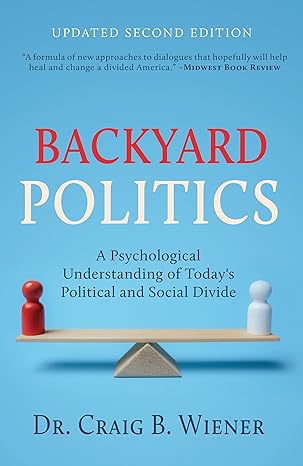
Craig B. Wiener’s Backyard Politics dives deep into the philosophical and societal divide between two opposing ideological camps: Protectors and Promoters. Through a comparative lens, Wiener explores how these groups frame societal problems—whether by focusing on external systemic flaws or emphasizing individual accountability. The book is a detailed exploration of these contrasting worldviews, addressing topics such as freedom of speech, poverty, racism, and family dynamics. Wiener’s central thesis presents a nuanced debate, inviting readers to question their assumptions about the sources of human suffering and societal discord.
What stood out to me was Wiener’s even-handed approach to the two perspectives. The section on “Freedom of Speech” was particularly compelling. He juxtaposes the Promoters’ prioritization of unfettered expression with the Protectors’ emphasis on safeguarding emotional well-being and dignity. His argument that the erosion of free speech could lead to a slippery slope of mob rule was provocative and timely.
One of the book’s strengths lies in its grounding of abstract ideas with concrete examples. In the chapter on poverty, Wiener discusses how Protectors view systemic barriers like income inequality and lack of access to education as insurmountable roadblocks, whereas Promoters focus on fostering self-reliance through individual effort. His analysis of educational reform—specifically the tension between leveling the playing field and promoting personal responsibility—was sharp and thought-provoking.
Wiener’s writing shines brightest when dissecting the family as a microcosm of political ideologies. He draws parallels between parental dynamics and societal governance, arguing that overprotective parents (like Protectors) might unintentionally stifle growth. The discussion on fostering mutual accommodation within families resonated with me, especially his point about balancing support and independence. This felt like a powerful metaphor for the broader societal debate he addresses throughout the book.
Backyard Politics is not a light read, but it’s a rewarding one. Wiener’s analytical style demands engagement, making it ideal for readers who enjoy political philosophy or are eager to understand the ideological divides shaping today’s world. While occasionally dense, his arguments are timely and relevant, offering a roadmap for navigating our polarized era. I’d recommend this book to thoughtful readers curious about the intersection of psychology, politics, and human behavior—especially those who appreciate a balanced, if slightly pointed, exploration of contentious topics.
Pages: 342 | ASIN : B0DP3JQ8WB



