Blog Archives
Our Unfinished Selves

The Courage Gap explores fear and courage, walking readers through five steps to help them shift their focus, rewrite the stories they tell themselves, regulate fear, step into discomfort, and learn from the moments when things fall apart. Why was this an important book for you to write?
Because I’ve watched too many capable people—including myself—stay stuck in the space between knowing and doing. This wasn’t because we lacked the ability to take action but because our fear kept us stuck in place, distorting the risk-magnifying the danger of acting, minimizing the cost of staying put, and shrinking our courage to step forward and back ourselves fully.
Over 25 years coaching many diverse people across the world to meet their challenges and navigate change, I’ve heard countless versions of the same story: “I knew what I needed to do, but I couldn’t bring myself to do it.” The woman in the soul-draining job. The parent avoiding a hard conversation. The person with a dream who keeps finding reasons to wait.
What struck me wasn’t that people feel fear—we all do—but how often they mistake its source. They think they’re being prudent when they’re actually protecting their identity in some way, avoiding disapproval, or clinging to what’s familiar because it feels safer and less confronting than making a change.
Finally, I wrote this book because often we end up suffering more over time from not taking the brave action we know we should be taking than by risking what we fear. That suffering shows up in many forms – ongoing tension and hurt in relationships, the quiet ache of unfulfilled potential, roads not taken, words left unsaid. Right now, when everything feels uncertain, that gap has never been wider. This book offers a practical step-by-step path to move through it.
How did you come up with your five-step process for helping people reprogram their patterns of thought and behavior that are self-sabotaging?
By distilling a lot of research and insights from broad spheres as well as watching what actually worked—not just with clients, but in my own life when fear and doubt have grown really loud or when I’ve come to a moment and hesitated for fear of being ‘exposed’ as not wholly worthy of sufficient in some way. The five steps are a synthesis of research, and experience, and observing people who consistently lead brave and meaningful lives.
The people who closed their courage gap followed a pattern: They shifted focus from worst-case scenarios to what becomes impossible if they don’t act. They chose the mindset they would operate from, rewriting their stories—recognizing narratives about risk were often inherited or outdated. They regulated fear instead of waiting for it to disappear (it never does). They braved awkward moments we are wired to steer away from, and stepped into discomfort incrementally through small acts of bravery. And they learned from setbacks, seeing them as information rather than proof they shouldn’t have tried and made some semblance of peace with the fact that they are innately fallible and a ‘work in progress.’ As I wrote in the book, extending grace and compassion inward, forgiving our ‘unfinished selves’ is a foundational act of courage that can be profoundly transformative.
It’s not linear—it’s messy. But the sequence matters because you can’t regulate fear you haven’t acknowledged, and you can’t step into discomfort if you haven’t challenged the story that discomfort equals danger.
How can implementing the ideas in your book help shape better leaders and encourage growth?
The book helps anyone—leaders, parents, people in transition—close the gap between who they are and who they’re capable of becoming.
As I wrote in the book, sharing a story of my childhood on my parents’ farm, “Growth and comfort can’t ride the same horse.” That is, growth doesn’t happen without exertion or discomfort. It happens when you speak up with a shaky voice. When you try something new, knowing you might fail. When you have the difficult conversation instead of letting resentment build.
The book helps people distinguish between real dangers and magnified fears. Your brain evolved to overreact to threats, which kept ancestors alive, but now makes a tough conversation feel as dangerous as a physical threat. It makes starting something new feel riskier than staying in a situation that’s slowly diminishing you.
When you recognize that fear of judgment isn’t actual danger, or that doubt isn’t incompetence, you can take action despite fear rather than waiting for it to disappear.
For anyone leading—a team, a family, their own life—this matters because people become what they’re willing to confront. Those who act despite fear create environments where others feel permission to do the same. That permission to be imperfect while stepping forward? That’s how everyone grows.
What is one thing that you hope readers take away from your book?
That not only can anyone become a braver version of themselves, but that courage isn’t the absence of fear—it’s choosing to act while fear tags along.
Most people wait to feel brave before acting. But courage doesn’t work that way. You don’t eliminate fear; you change your relationship to it. You learn to distinguish between real dangers and magnified fears.
The shift I want readers to make:
When you ask “What’s the risk?” also ask “What’s the cost if I don’t act?”
That reframe—from “What could go wrong?” to “What will definitely go wrong if I don’t?”—unlocks stalled decisions, avoided conversations, deferred dreams.
I want readers to finish with a quiet push toward things they usually avoid. Not because fear disappeared, but because they realize staying stuck hurts more than stepping forward. The courage they think they lack isn’t something you’re born with—it’s something you build, one uncomfortable step at a time.
If readers take even one brave action they’ve been avoiding, that changes something fundamental. Not just for them, but for everyone who would benefit from them showing up more authentically and backing themselves more boldly – toward their bold goals but also in meeting their biggest challenges too. We all have them.
Author Links: GoodReads | Amazon
Fear creates the gap. Courage closes it.
This powerful guide from the bestselling author of You’ve Got This! cuts through the hype to connect the ‘why’ of courage to the ‘how’ of courage. Drawing on cutting-edge research woven together with stories that compel head andheart, The Courage Gap will help you bridge the think/do gap between what you’ve been doing and what you can do; between where you are and where you want to be—in your career, relationships, leadership, and life.
Distilling theory and hard-won wisdom spanning from Margie’s childhood in rural Australia to her decades of living around the world and coaching ‘insecure overachievers’ in Fortune 500 organizations, Margie shares a powerful 5-step roadmap to reprogram the self-protective patterns of thought and behavior that sabotage success to bring your bravest self to your biggest challenges and boldest vision.
At a time when courage seems in short supply, in a culture continually stoking insecurity and anxiety, this book will transform your deepest fears into a catalyst for your highest growth and the greatest good.
Applying the five steps will:
Ignite passion and unlock the potential fear holds dormant
Rewrite the scripts that have kept you stuck, stressed, and living too safely
Reset your ‘nervous’ system and embody courage in critical moments
Transform discomfort as a cue to step forward and expand your bandwidth for bold action
Reset your relationship to failure and make peace with the part of you that wimps out
For leaders, The Courage Gap provides a guide to operationalize and scale the courage mindset across your team and organization to deepen trust, dismantle silos, foster innovation, accelerate learning, and unleash collective courage toward a more secure and rewarding future.
Purpose: What Evolution and Human Nature Imply about the Meaning of Our Existence
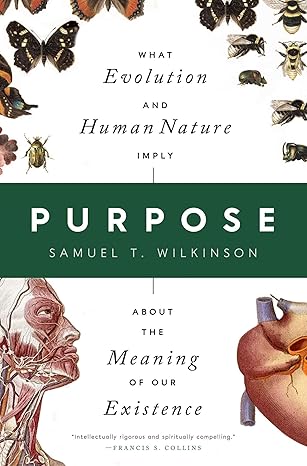

Samuel T. Wilkinson’s Purpose boldly tackles one of life’s grandest questions: Why are we here? Drawing from evolutionary biology, psychology, and theology, Wilkinson builds an argument that evolution, far from being purely random, reveals a higher purpose guided by natural principles. He links humanity’s dual nature—selfishness versus altruism—to the evolutionary forces that shape us. Through this framework, Wilkinson examines profound questions about morality, happiness, and the societal structures that foster human flourishing.
What stood out most to me was Wilkinson’s ability to bridge science and faith. He does so in a way that feels inclusive, not preachy. For instance, his discussion of convergent evolution—the independent development of similar traits in unrelated species—challenges the randomness of evolution. When he points out how dolphins and sharks evolved streamlined forms independently, it’s hard not to feel awe. Wilkinson makes a strong case that these repeated patterns hint at a purpose embedded in nature itself. This was eye-opening and left me rethinking my own assumptions about evolution.
The writing itself is thoughtful and engaging. I appreciated how Wilkinson wove personal anecdotes, like his own struggles with reconciling faith and science, into broader arguments. These moments made the text relatable. His tone remains accessible even when discussing complex topics, such as the psychological effects of incivility or the health benefits of prosocial behaviors. The chapter on family relationships as the foundation of societal well-being struck a particularly emotional chord for me. Wilkinson’s argument that family ties strengthen our altruistic tendencies felt deeply resonant and hopeful.
At times, the pacing felt uneven, particularly in the middle chapters. I believe that some sections, such as the technical discussion of embryonic development as an analogy for evolution, seemed a bit too detailed for a general audience. Still, these moments are outweighed by the clarity of his broader message.
I’d highly recommend Purpose to anyone curious about the intersection of science and spirituality. It’s a thought-provoking read for believers grappling with evolution, skeptics seeking a deeper understanding of faith, or anyone interested in exploring what it means to live a meaningful life. Wilkinson’s synthesis of research and reflection offers a fresh perspective that inspires both introspection and action. This is a book that challenges, uplifts, and ultimately leaves you hopeful about the human journey.
Pages: 321 | ASIN : B0BTZX7D3R




 LITERARY TITAN