Blog Archives
Terrifying Ambition

Resonance Portal Wars blends war fiction, science fiction, fantasy, and conspiracy myth. How did you approach balancing those tones? Were there moments where one genre tried to overpower the others?
That is a fantastic question, and to be completely honest, balancing those wildly different elements was like walking a tightrope during the entire drafting process. When you set out to write a book that is essentially Saving Private Ryan meets The Lord of the Rings—with a healthy dose of cosmic UFO conspiracy thrown in—the risk of the story collapsing under its own weight is massive.
Here is how I approached it, and where the struggles really lay:
Grounding the Bizarre in Historical Reality
My primary rule for the series was that the history had to act as the anchor. The timeline of World War II, the troop movements, the political stakes, and the brutality of the era had to feel meticulously accurate.
If I could make the reader fully buy into the grounded, gritty reality of WW2 and the terrifying ambition of SS Obergruppenführer Hans Kammler, it became much easier to ask them to take the next leap. The science fiction—the crashed UFO in Antarctica and the extraction of Element 115—was treated not as magic, but as cold, calculated military research. By treating the sci-fi with the same clinical, historical lens as the actual war, it paved a logical bridge right into the high fantasy of Ilyndor.
The Constant Tug-of-War
There were absolutely moments where one genre tried to hijack the wheel.
The Pull of High Fantasy
The biggest threat to the balance was Ilyndor. Once Kammler opens the portal and we meet Durgar, Balfur, and their Orc factions, it was incredibly tempting to just stay there. High fantasy offers boundless creative freedom, and there were drafts where the interdimensional politics and the portal-tearing ripples in Ilyndor started to completely overshadow the grim reality of Earth’s global conflict. But hey – there is always Book 2 🙂
The Weight of Historical Fiction
Conversely, there were times when I would get so deep into the weeds of actual WWII history, Nazi hierarchy, and the build-up to D-Day that the fantastical elements felt like they were intruding on a purely historical war novel.
The Cosmic Conspiracy as the Glue
Whenever the tones started to clash, or one tried to overpower the other, I had to rely on the conspiracy mythos—the overarching proxy war between The Watchers and The Hive.
That cosmic layer was the ultimate equalizer. It reminded me (and hopefully the reader) that the gritty trenches of WWII and the high-fantasy battles of Ilyndor weren’t separate stories competing for page time; they were two fronts of the exact same war. Everything had to serve that central spine. If a scene in Ilyndor didn’t have direct, terrifying consequences for the war back on Earth, or vice versa, it had to be reeled in.
It was a tough balancing act, but leaning into the contrast—letting the visceral horrors of human history collide violently with the cosmic and the fantastical—is ultimately what gives the trilogy its pulse.
The alliance between human soldiers and fantasy beings is central. What interested you about that dynamic?
What fascinated me most about putting someone like Hans Kammler in a room with Orc leaders like Durgar and Balfur was the opportunity to completely invert the classic fantasy concept of “the monster.”
When we read traditional high fantasy, Orcs are usually the ultimate, irredeemable evil—a savage horde meant to be slaughtered by the noble heroes. But by bringing them face-to-face with the SS in WW2, I wanted to ask a really uncomfortable question: When the “civilized” humans in pristine uniforms are orchestrating industrialized genocide, who is the real savage?
Here is what really drove that dynamic for me:
The Clash of Brutality
You have two entirely different philosophies of war colliding.
On one side, you have Kammler and the Nazi war machine: cold, calculated, mechanized, and utterly devoid of empathy. It is the horror of the spreadsheet and the laboratory.
On the other side, you have the Orc factions of Ilyndor. Yes, they are violent and brutal, but it’s a visceral, primal warfare. There is a twisted kind of honesty to it.
I loved writing the scenes where Durgar and Balfur realize the sheer scale of human cruelty. There are moments where the fantasy “monsters” are actually taken aback by the cold, bloodless way Kammler views life as a disposable resource for his Element 115 experiments.
A Tense Alliance of Mutual Exploitation
I also wanted to avoid making them “buddies.” There is no friendship here; it is a powder keg of an alliance built entirely on mutual exploitation and convenience.
Kammler looks at the Orcs and sees shock troops and a means to master portal technology to win the war for the Reich. Durgar and Balfur look at Kammler and see an opportunity to harness the cosmic power of Element 115 to dominate their own rivals in Ilyndor. Both sides are absolutely convinced they are the ones using the other, and writing that constant, underlying tension—waiting to see who would betray who first—was incredibly fun.
The Proxy War Reality
Ultimately, this dynamic serves the overarching conspiracy of the series. Both the SS and the Orcs view themselves as the apex predators of their respective universes. Watching them posture and plot against one another is doubly tragic and ironic for the reader, who eventually learns that both humans and fantasy beings are nothing more than pawns being moved around the board by The Watchers and The Hive.
Balancing their egos against their cosmic insignificance was one of the most rewarding parts of writing Book 1 and already creates high stakes for Book 2!
Can you tell us where the book goes and where we’ll see the characters in the next book?
A Changed World and Dead Portals
The world has fundamentally changed since the climax of Book 1. Physical Resonance, which was the source of all the magic we saw, is completely extinct. It’s been replaced by a finite and costly ‘Stored Resonance’ economy, which means all the portals between worlds are completely dead. The genre shifts gear a bit here, elevating the WWII espionage from the first book into full-blown cosmic horror.
Ian Fleming and Project Chimera
As for our characters, the Allies have a secret unit called Project Chimera racing to reopen those dead portals. The one person who has the power to bridge that gap is British Commander Ian Fleming. Fleming makes a terrifying discovery about Element 115 and himself, realizing he has to weaponize his own corruption to hunt down his greatest nemesis.
Kammler’s Horrific Ascension
That nemesis, of course, is the god-like remnant of Hans Kammler. He is being powered by the decaying Pattern and is trying to overwrite reality itself. Readers will see him doing something truly horrific: harvesting the mass suffering of the final, bloody battles of WWII. He essentially tries to turn the historical inferno of war in the Pacific into a grotesque ritual chamber for his own apotheosis.
A Three-Way Cosmic War
Finally, the secret war is no longer just a two-sided conflict. The ancient Watchers step directly into the fray to prevent reality from collapsing. They start using Soviet agents as their pawns on Earth. This escalates everything into an existential three-way clash between Humanity, the Hive, and the Watchers. It all converges on August 1945, and let’s just say the true, cosmic nature of the war’s final historical events is going to shatter everything the characters think they know.
Author Links: GoodReads | Facebook | Website | Amazon
Portals thunder open across the globe, bleeding the dying realm of Ilyndor into our own. Now, Captain Ian Fleming faces a mission that no military manual could prepare him for. On the other side of the rift, orc warlords ride monster wolves through the ruins of civilizations, and elves desperately cling to the last remaining leylines.
An Impossible Alliance. A War Beyond Earth.To stop the Reich from weaponizing a god-like power, Fleming must forge an alliance with Commander Lithariel, an Elven warrior bound to a failing magical Pattern. Together, they must lead a ragtag unit of commandos, spies, and shamans into the heart of the storm.
Element 115 is rewriting the laws of physics. The Dark Portal is hungry. And if Fleming fails, Earth won’t just be conquered—it will be erased.
This is the secret history of WWII you were never told.
Resonance Portal Wars Book One
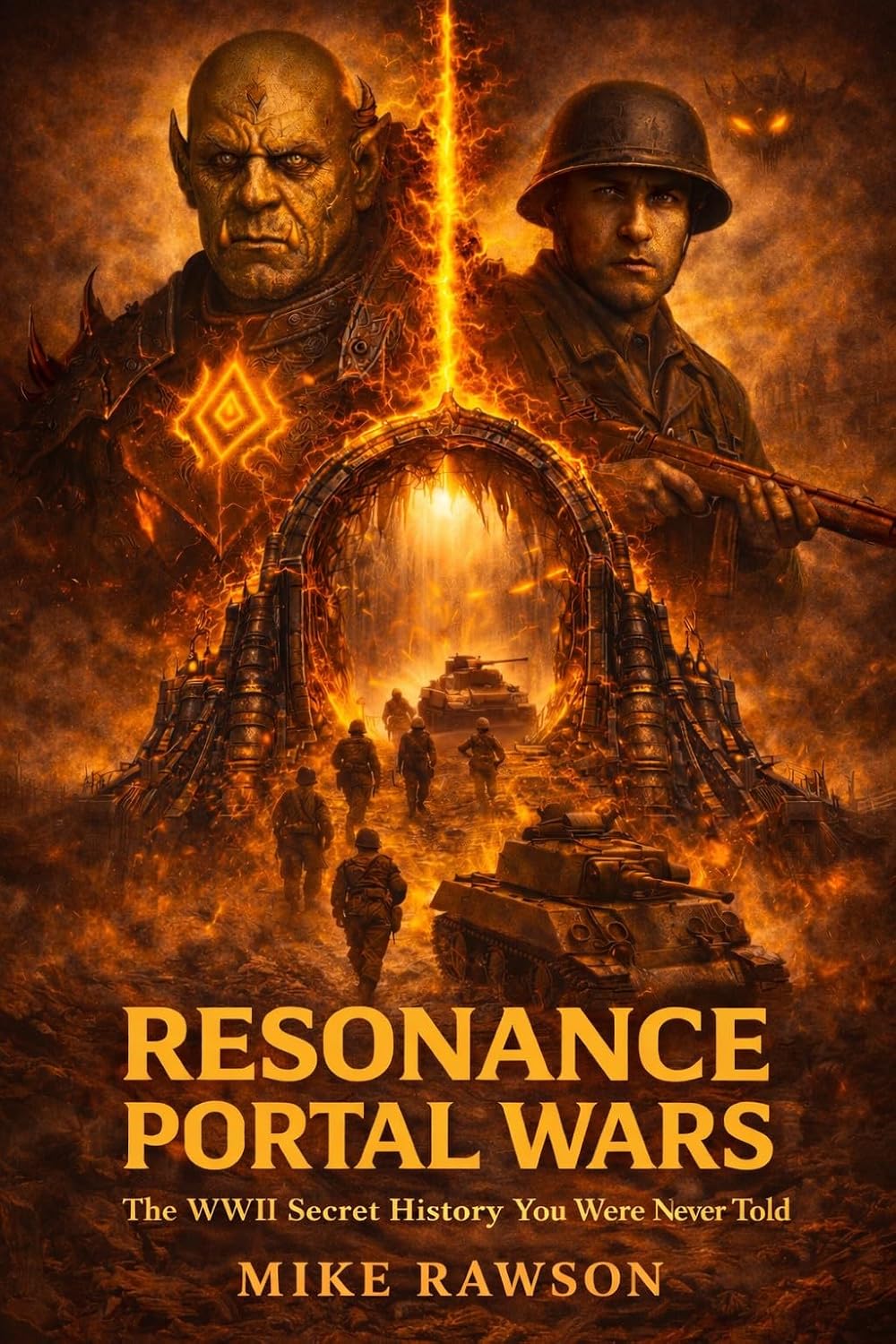

Resonance Portal Wars by Mike Rawson is a maximalist alternate-history war fantasy that reimagines World War II as a secret multidimensional conflict: Nazi occult science, Antarctica UFO lore, Element 115, Die Glocke, portals, orcs, elves, leylines, and Allied commandos all collide in a hidden war behind the war. The book opens with British commandos hunting Otto Skorzeny in occupied France, only to discover the Reich has monsters in its arsenal, then widens into a sprawling struggle involving Hans Kammler, Ilyndor, the Watchers, the Hive, and a victory that feels less like triumph than a scorched threshold.
I enjoyed the book most when it leaned fully into its own outrageous conviction. It doesn’t tiptoe into genre blending; it kicks the portal open and marches through with a Bren gun in one hand and a rune-etched axe in the other. The action has a blunt, pulpy force, especially in the early Grimfang sequences, where the familiar grammar of commando fiction is suddenly mauled by dark fantasy. That collision gives the book its charge: history becomes less a museum corridor than a booby-trapped underworld.
The book often chooses acceleration over pause, and at times I wanted more time to sit with the human cost before the next cosmic mechanism began to grind. Still, the ambition is difficult not to respect. Rawson is clearly fascinated by the shadow shelf of World War II mythology: Nazi occultism, secret weapons, Antarctica, UFO rumor, and the novel’s best passages make those obsessions feel feverish.
This is a great book for readers who enjoy alternate history, World War II fiction, military fantasy, portal fantasy, science fantasy, and pulp adventure in one oversized, bloody package. I’d compare it to a louder, more conspiracy-soaked cousin of Hellboy or Harry Turtledove filtered through a war-gaming fever dream. This is not a subtle book, but it is heartily entertaining.
Pages: 505 | ASIN : B0GJM6QRTW



