Blog Archives
Escala’s Wish


Escala’s Wish is a sweeping, bighearted fantasy adventure built around a wonderfully clever premise: a banished pixie must remove the “boulders” obstructing the True Cycle before she can return home. Escala begins her journey believing the task involves literal stones, but every encounter draws her toward a deeper understanding of responsibility, sacrifice, and love. The result feels like a spirited tabletop campaign shared beside a tavern fire, complete with dangerous creatures, ancient magic, lively banter, and a party of companions you’ll quickly enjoy traveling alongside.
Escala herself gives the story its spark. She’s curious, impulsive, funny, wounded, and often gloriously unaware of how strange she sounds to everyone around her. Her repeated declaration, “No one touches the faerie,” begins as a defensive reflex and gradually becomes a moving measure of trust. Roedyn’s steady devotion, Harper’s sharp-edged affection, Sticky’s oddball wisdom, Rihanna’s enduring friendship, and Wigfrith’s irrepressible storytelling each reveal a different kind of love. Together, they turn Escala’s quest into an emotional education that feels earned through shared danger and small acts of care.
David James tells the story through Wigfrith, a gnome bard performing for a crowded tavern, and that framing gives the novel its distinctive personality. Wigfrith interrupts, jokes with his listeners, explains the lore, and reminds us that stories are communal experiences. The adventure itself is generous and exuberant, moving through fey courts, haunted ruins, traveling circuses, monster-filled forests, a dragon’s hoard, and a tower opening onto the Void. Its humor and graphic action sit comfortably beside sincere conversations about grief, belonging, family, and the choices that give love its meaning.
By the final battles, the many threads have tightened around the question Escala has carried from the beginning: What does love actually ask of us? The answer arrives through action, loss, forgiveness, and choices made when everything is at stake. Even amid spectacular magic, the novel’s most memorable moments are deeply personal, from a hand finally accepted to a sacrifice freely offered. Escala’s Wish is a warm, wild, and emotionally generous fantasy that shows the greatest magic begins when love becomes a choice.
Pages: 536 | ASIN : B0G1XRP6DW

Sorcerer’s Creed: Legends from Qiledara, Book 4

Sorcerer’s Creed: Legends from Qiledara, Book 4 continues Amy Daniels’ fantasy series at a moment of uneasy peace. After a long period of violence, Galdutia and Qiledara are finally beginning to strengthen their relationship. Aaron the Dragonslayer and Elodie welcome the change and focus on preserving the fragile alliance between the two lands. Still, peace does not mean safety. The surviving dragonkin have not forgotten the destruction of the Master and his generals, and the possibility of renewed conflict remains just beneath the surface.
The arrival of Owen and Anna introduces an important new direction for Aaron. They come to Qiledara to help him develop his abilities in the magical arts and to teach him the sorcerer’s creed, an ancient promise that reaches beyond kingdoms, loyalties, and personal beliefs. This element gives the story a broader sense of history and adds another layer to the magical traditions already established in the series.
One of the strongest aspects of Daniels’ writing is the immersive nature of the world she has created. Qiledara feels expansive and lived-in, with distinct cultures, political tensions, histories, and alliances shaping the story. The setting is more than a backdrop. It continues to develop alongside the characters, giving the series a strong sense of continuity.
Aaron remains a compelling central figure. He has changed considerably since his earlier adventures, but his development is clearly not finished. His growing interest in mastering magic adds a new dimension to his journey and creates opportunities for further growth. He is no longer defined only by courage or his reputation as a dragon slayer.
Daniels also does a good job of restoring tension after the Master’s defeat. The alliance between Galdutia and Qiledara may be improving, but hostile forces remain, and the danger has not disappeared. That balance between peace and lingering uncertainty gives the story momentum.
As an audiobook, Sorcerer’s Creed offers listeners a richly imagined fantasy story filled with political tension, magical traditions, character development, and an expanding world. Fans of the earlier books should find plenty here that builds naturally on the series while opening the door to new possibilities.
Listening Length: 21 Hours 3 minutes | ASIN: B0HG23Z927
Thank You For the Journey

A Maker of Magic follows an Enchanter whose inability to cast magic conventionally pushes him to think outside the box and discover a new way to build magic into weapons and armor. What first inspired Levi Richter and the idea of an Enchanter who struggles to cast magic conventionally?
The idea behind the book came to me during a difficult time. My father died on Christmas Eve in 2023. In the months that followed, I traveled between my home in Virginia and my family home in NJ to help with funeral planning, care for my mom, and handle other issues. Sitting in that empty house, my mind started to turn with grief and love. This story just flowed out of me. I wrote the entire book in those three months. I think Levi came from my own feelings of inadequacy. Since both my father and I served in the military, I created a similar connection between Levi and his father. The villains of the story, the undead horde of the Ebon Abyss, came from my childhood love of Universal movie monsters, like Dracula, the Wolfman, etc. I even had glow-in-the-dark models in my bedroom. I wrote it with family love in mind during a time of grief.
How does Levi’s identity change as he moves from student to inventor, soldier, nobleman, and leader?
Levi always knew he had to step up because of his unique ability. He was different from the others, who deemed him weak. He never thought of himself as a leader or even a true noble son, since he was the third-born. He only wanted to make an impression on Danielle, someone he’d loved since childhood, but soon his crazy ideas began to garner attention. I think that’s when Levi knew he needed to step it up even more. He wasn’t just experimenting for the fun of it. He was finally making an impression and an impact on the kingdom. He soon realized that he had to grow up rather quickly.
How do faith, prophecy, and personal choice interact throughout the story?
I like to think faith is at the heart of all my stories. I put my faith in God to carry me through my journey as an author, and that shows up in the pages of my books. The fact that they’re fighting against an undead horde of the Ebon Abyss brings their faith to the forefront. They’re fighting for the people in this life and the ones who fought and died before them. As a veteran, that’s part of my own history and heritage right there. The Richter family puts their faith in God and each other to get them through this. It’s Levi who has a moment of doubt. Some believe in him, his abilities, and the prophecy, but he isn’t sure. It takes life-and-death situations that threaten his family and friends to make him take it seriously finally.
Will this novel be the start of a series, or are you working on a different story?
Honestly, I wrote this as a standalone as a nod to my parents. My mother passed away eight months after my father, so I lost both within a year. This was my way of saying thank you for the journey. I might do more, but right now it is a standalone.
I am currently working on sequels to my other book series, Corsair and the Sky Pirates and Gwen Iver and Pendragon’s Puzzle. I hope to release the sequels next year. I am also getting ready to publish the fifth and final book in my Forever Avalon series. Forever Avalon was my first published book, so this is the final chapter in that series.
Author Links: GoodReads | X | Facebook | Website
In the kingdom of Engressia, every gifted child is tested and assigned a path in service to the crown. Levi Richter, youngest son of the Duke of Stormwind, is named an Enchanter at the Dawnstar Academy. Yet unlike the mages around him, Levi cannot cast spells through ordinary means. What others see as a limitation drives him toward a different kind of power: forging magic into devices, weapons, and armor.
Years later, Levi discovers Mysterium, a rare ore threaded with Violet Amerlyte and capable of transforming the way magic is made. His breakthrough could give Engressia a decisive advantage in its endless war against the undead legions of the Ebon Abyss. It also places Stormwind, Levi’s family, and everyone he loves in the path of enemies who will murder, manipulate, and betray to control it.
As an undead incursion threatens Fortress Drakmire and a conspiracy closes around his home, Levi must unite his talents as an Enchanter, swordsman, inventor, and reluctant heir. Alongside the formidable Blademancer Danielle Greyson, he faces vampires, dark mages, political rivals, and the devastating consequences of a feud generations in the making.
To protect Stormwind and end the forever war, Levi must become more than the mage his teachers expected. He must fulfill an old prophecy and prove himself a true Maker of Magic.
A Maker of Magic

A Maker of Magic by Mark Piggott is an expansive military fantasy built around Levi Richter, a rare Enchanter who can create spells and magical weapons but struggles to cast magic conventionally. Alongside Danielle Nichols, the formidable Blademancer known as the Sword of the Lawgiver, Levi grows from a gifted student into an inventor, soldier, nobleman, and possible fulfillment of an ancient prophecy. The long war between Engressia and the undead Ebon Abyss gives the story its scale, while Levi’s loyalty to his family gives it a clear emotional center. At heart, it’s a heroic adventure about turning an unusual talent into a source of strength.
The book’s most enjoyable material involves magical engineering. Levi’s rune dial, Mysterium armor, repeating ballistae, specialized weapons, and Violet Amerlyte explosives make invention part of the action instead of background decoration. That approach recalls Brandon Sanderson, particularly Mistborn, in the way established magical properties become tools for solving tactical problems. Piggott’s version has the atmosphere of a forge and an armory, with considerable attention paid to how each weapon is constructed, tested, and used. Readers who enjoy watching a protagonist think through a problem before smashing through it will find plenty to appreciate.
The emotional side is equally earnest. Levi and Danielle’s lifelong romance anchors the story, while his relationships with his parents, siblings, Lapis, and the people of Stormwind reinforce its interest in family, service, faith, and inherited responsibility. The dialogue is direct and often playful, especially when Levi trades insults with his brothers or corrects Lapis’s mangled expressions. Characters regularly state their motives and feelings plainly, giving the novel a broad, accessible storytelling style. Its villains are vividly cruel, its heroes openly principled, and its battles carry the moral clarity of classic quest fantasy.
A Maker of Magic is a bighearted and action-heavy fantasy for readers who like detailed combat, magical craftsmanship, loyal companions, bold romance, and heroes willing to carry enormous responsibilities. Levi’s progression from underestimated Enchanter to genuine force of change is satisfying because his victories grow from curiosity, preparation, and devotion to others. The final revelation also casts the apparent triumph in a more complicated light and opens an intriguing path beyond this volume. It’s an energetic tale with the confident sweep of a saga that has more story left to tell.
Pages: 309 | ASIN : B0HC9TSPZ7
Labruula Awakens: The Chronicles of Rekule

The Chronicles of Rekule by Paul Wood is an epic fantasy novel that recasts Greek mythology as the lived history of a hidden civilization. Set around 1750 BC, the story follows Rekule, an Olympian who discovers a mysterious crystal capable of awakening extraordinary powers. His bond with the earth soon draws him into tribal conflict, prophecy, romance, and war. This blend of historical fantasy and mythological fantasy gives familiar names such as Thanatos, Uranus, Atlas, and Prometheus new identities while building an original account of how legends might have begun.
Rekule’s first-person narration makes the novel feel like a confession passed down across centuries. He’s compassionate, insecure, jealous, loyal, and frighteningly destructive when anger takes control. Those contradictions give the dark fantasy adventure its emotional center. His forbidden love for Chalene adds tenderness, while his changing relationships with Thanatos and Uranus reveal how quickly affection, rivalry, and fear can curdle into violence. The crystals magnify more than physical abilities. They amplify the desires and weaknesses already present in each person, turning the magic system into a thoughtful exploration of temptation, responsibility, and power.
The story begins with the rhythms of village life, council politics, friendship, and courtship before expanding into large battles and clashes between civilizations. That deliberate growth helps the scale feel earned. Wood’s action scenes are vivid and physical, filled with shifting earth, blades of air, firestorms, and living water. The direct prose keeps the combat easy to picture, even when several characters are using different elemental powers at once. The quieter scenes also matter, particularly Rekule’s conversations with Chalene and the three enigmatic women who guide him. Clotho is especially memorable, combining warmth, secrecy, authority, and a slightly unsettling enthusiasm for destiny.
Labruula Awakens is a story about the cost of becoming powerful before becoming wise. Wood brings together elemental magic, ancient-world conflict, romance, and moral tension in a narrative that grows steadily more ambitious. The novel also plants intriguing questions that give The Chronicles of Rekule plenty of room to expand. Readers who enjoy mythological fantasy, tragic friendships, large-scale battles, and morally complicated heroes will find plenty to sink into here.
Pages: 294 | ASIN: B0FCPWTGVM
Metamorphosis by Decree: The Final Sundering

The Final Sundering by Brian Pigg is a sprawling fantasy adventure built around war, family, ancient mysteries, and a group of characters who keep discovering that their world is much stranger than they were taught. The story follows several connected threads, especially Thervan’s effort to protect a new community from his brother Daerval, T’az and Lacern’s search for the Stone of Onterach, and Bear’s journey into unfamiliar lands with his companions. What starts as a conflict involving knights, priests, outcasts, and rival armies gradually opens into something much larger. The mysterious swords Thoradon and Valadeer, forgotten civilizations, dragons, dwarves, witches, and the beings behind the Sundering all become pieces of the same puzzle. The novel makes that expansion feel central to the experience. Characters who think they understand their history repeatedly learn that the accepted version of the world is only part of the story.
The characters are what kept me most interested through all of that worldbuilding. Thervan is especially compelling because leadership is something he grows into while dealing with fear, injury, responsibility, and the aftermath of battle. His community includes people who once would’ve been pushed aside by the society he came from, including Minotaurs, Southerns, Wild Men, gypsies, witches, and others. That gives the political conflict a personal dimension. These people aren’t following him because of a title. They’re building something together because they’ve found a place where they’re accepted. Falkon even points out how unusual it is for Southerns and Minotaurs to find somewhere they’re genuinely welcomed. Bear, T’az, Giselle, Aeshwin, Lacern, Roark, and the rest bring their own personalities to the story, and the friendships and romances matter as much as the battles. The book is at its best when huge events are grounded in smaller concerns such as protecting a partner, worrying about family, recovering from trauma, or wondering whether everyone will make it home.
The most interesting idea in the novel is the tension between power and choice. Thoradon and Valadeer are tremendously powerful, but that power comes with an attempt to control the people carrying them. T’az can actually feel Thoradon pushing her toward domination, showing her how easily she could force others to obey, and her repeated refusal becomes its own kind of battle. Bear faces a similar danger with Valadeer. By the time the two swords and their bearers are drawn toward each other, the question isn’t simply who can win a fight. It’s whether these characters can remain themselves when something vastly more powerful is trying to determine their choices. That idea connects nicely with the novel’s broader treatment of religion, law, class, prejudice, and tradition. Daerval and the established order talk constantly about honor and authority, while Thervan and the others keep asking a more basic question: what actually helps people live freely and decently? Thervan’s confrontation with Daerval makes that divide especially clear, because the brothers aren’t simply competing for military control. They have fundamentally different ideas about what gives a leader legitimacy.
The book reminded me of Brandon Sanderson, particularly The Stormlight Archive. Both stories enjoy starting with recognizable fantasy elements and then steadily revealing a much larger history beneath them. There are powerful artifacts with their own rules, forgotten truths that change how characters understand the past, multiple groups whose separate journeys eventually connect, and a final conflict that depends as much on understanding the world as on being able to fight. Pigg’s style is more conversational and rough-edged, though, with characters joking, swearing, teasing each other, talking about sex, arguing over plans, and complaining about the everyday annoyances of adventuring. T’az even jokes that boredom is an “adventure tax,” which fits the book’s attitude toward heroic fantasy surprisingly well. That casual dialogue gives the enormous mythology a human scale. Dragons and ancient conspiracies can enter the story, but the characters still sound like people who are hungry, tired, scared, in love, or irritated with each other.
By the ending, The Final Sundering has grown from a story about surviving a war into one about breaking cycles that have shaped entire civilizations. The final confrontations bring Bear, T’az, their companions, the Stone, the swords, and the hidden powers behind the world’s history together, which makes the conclusion feel like the payoff to the book’s long process of discovery. I also liked that victory doesn’t erase what everyone has been through. People are injured, some are lost, communities still need to be built, and relationships still need a future. The book ultimately seems most interested in what happens when people who’ve spent their lives being told where they belong finally get to choose for themselves. That’s why the quieter parts of the ending work for me. After all the armies, monsters, magic, ancient technology, and world-changing revelations, Bear and Aeshwin are thinking about finding a home, while others are figuring out how their new society will actually function. The adventure gets enormous, but it ends with people looking toward ordinary life, and that feels like the right destination for this story.
Pages: 366 | ASIN: B0GSMSNWXC
Metamorphosis by Decree: The Nightmare
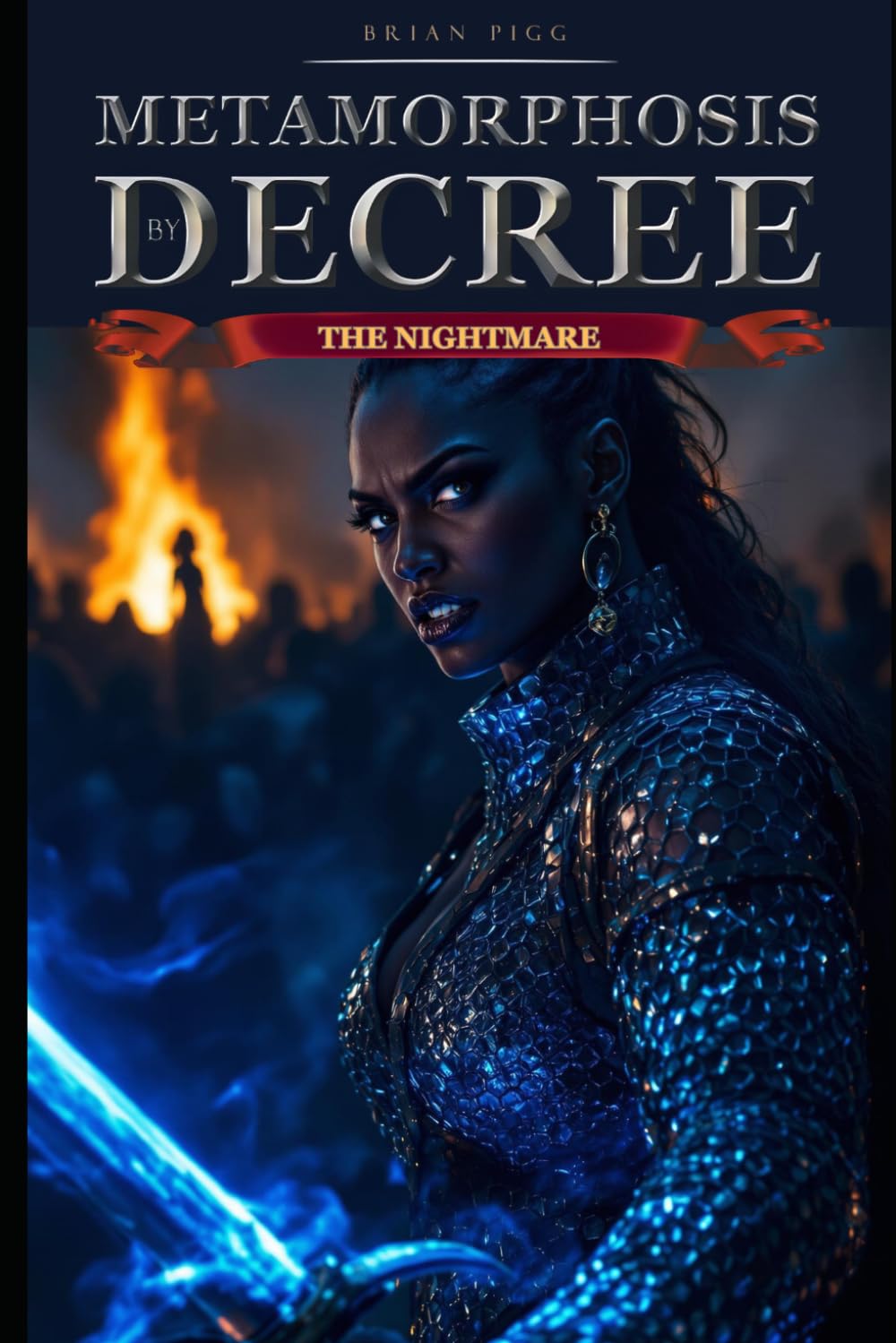

The Nightmare is a dark fantasy novel that mixes epic fantasy, fantasy adventure, political intrigue, and horror into a story built around fear and the damage people can do when they’re pushed toward their worst impulses. The story begins in the aftermath of the raid on the Black Tower, with the ancient mage Galen looking for a way to punish Katelarin, better known as Kate, and her companions without openly attacking them. His answer is clever and cruel: find their fears and encourage them to create their own nightmares. That idea gives the book a strong organizing theme, because nearly every major character winds up confronting some version of the life they’re most afraid to live.
Kate remains the emotional center of the novel even as the story expands into several points of view. She’s a young priestess with genuine divine power living inside a religious and political system that has become obsessed with authority, tradition, and control. Her growing realization that the Code governing society is a lie turns the book’s dark fantasy conflict into something much larger than a struggle against monsters and Black Mages. Kate wants change without simply replacing one tyrant with another, and that makes her clashes with the Council especially compelling. Her friendship with T’az, her feelings for Hedlvin, her devotion to Mirsha, and the constant physical pain of her scars keep those larger questions grounded in a very personal story. When the Council finally moves against her, the resulting sequence is brutal, emotional, and central to everything that follows.
The second half broadens into an epic fantasy adventure about grief, revenge, survival, and a world whose history has been deliberately buried. T’az becomes especially important as anger over Kate sends her down a violent path while her bond with the magical sword Thoradon pulls her toward something much bigger. Bear and Thervan develop in different directions, with battles, refugees, haunted fortifications, witches, spirits, undead soldiers, and old magic steadily widening the scope. Pigg spends a lot of time on relationships and ordinary camp life alongside the supernatural material, which gives the world a lived-in quality. Characters argue about loyalty, sex, religion, family, leadership, and what freedom actually requires, often in the same chapters where they’re fighting monsters or trying to survive political collapse.
What makes The Nightmare interesting as dark epic fantasy is the way its title keeps gaining meaning. The nightmares aren’t simply visions or magical attacks. They’re fears turned into choices, and those choices reshape nations. By the closing chapters, the conflict has expanded beyond the Council, the Code, and even the Black Mages into revelations about the Sundering, the Emperor, the High King, the mysterious powers manipulating entire civilizations, and the Stone of Onterach. The ending deliberately points the fantasy adventure toward a much larger struggle while still giving the characters meaningful transformations along the way. It’s a sprawling, character-driven fantasy story full of gods, demons, magic swords, political rebellion, buried history, and people discovering that the world they’ve inherited is far stranger than anyone taught them.
Pages: 362 | ASIN: B0FNR8ZDHY


