Blog Archives
Motivated by Revenge

The First Law Is Survival centers around a young officer raised in an orphanage whose skills in engineering and strategy repeatedly place him in dangerous situations where only his ingenuity can turn the odds in his favor. What was the inspiration for the setup of your story?
My first inspiration was the opening passage (which actually occurs midway through the book). A general sitting in his tent contemplating the failures of all his plans, with his new wife clutching a knife as she lies with her back to him in her bed. Everything progressed from there: how did the general find himself at this point, what is the looming threat that the general must overcome, and just what kind of world the characters are operating in.
How did you decide which historical elements to preserve and which to reinvent?
I really wanted to avoid “world-building”. I really hate that phrase. Placing the characters in a facsimile of the ancient Roman Empire was my solution. The attitude of the rulers (have army, will conquer), class systems (I did jettison the slave trope), layout of the capital, loyalty to tribe, references to ancient religions, and the effectiveness of the Legions are already built in for the reader. After that, I just had fun jumbling up history (and adding witches and wizards – not to mention flying females). A student of ancient history will recognize the final two major battles in the book immediately. I also lifted the one speech Marcus gives to his troops from one of them. Even some of the names are stolen from history. The General of the Grand Army and Tertius’ wife, for example.
The most important element I wanted to preserve was people’s attitudes. They do not think like us: no one is shocked when a younger son starts removing his competition, Legionnaires do not suffer PTSD, and Marcus may not agree with his orders, but he doesn’t hesitate in carrying them out. There is only a single character who ever wonders if she is losing her moral compass.
Did Marcus’s character or role in the story change from your original conception as you wrote the novel?
Marcus’s character and role remained consistent throughout. A young man burdened by responsibilities he never sought and promises he means to keep. It did surprise me that revenge is a prime motivation for Marcus by the end of the novel. Actually, many of my protagonists turned out to be motivated by revenge. Not sure what that says about the author.
The epilogue suggests that the trouble isn’t necessarily over. How much of the larger world and its future did you have planned while writing this book?
While writing, I had almost nothing planned out besides leaving unfinished business between some characters. Unfortunately, as of today, I do have most of the second book mapped out. I will need to start writing soon. This time around, I might even describe an Anemoi’s wings.
Author Links: GoodReads | Website | Amazon
In the aftermath of a Barbarian invasion that had only been defeated at the walls of the Capital, the Empire benevolently establish an orphanage for boys – an orphanage run by the Legions. Marcus d ’Ostia is aging out and is signing up as a military engineer. He believes this is the best path to realize his ambition of becoming a master architect. His oldest friend, Septimus, thinks his brilliant friend is making the biggest mistake of his life (Septimus is not wrong). Septimus is signing up with a criminal syndicate (no one thinks he is making a mistake). The third friend, Timolen, is giving nothing away as he plots vengeance.
Our young Triumvirate belong to a cruel and dangerous world. A world where the powerful strive for glory: the most privileged girl in the Empire struggles to escape her gilded cage and achieve real power, the third son of the Emperor plots to move up in the ranking, and a Barbarian Witch initiates her plans of conquest.
The common people have a more practical outlook and live by their first law – survival. The boys from the orphanage have added a few of their own laws – laws that will have unintended consequences for the Empire.
The First Law Is Survival (We Have a Few More)


Magnus Baikie’s The First Law Is Survival (We Have a Few More) is a sprawling historical fantasy novel that drops Roman-inspired military culture, Celtic kingdoms, Huns, dwarves, winged Anemoi, witches, assassins, and powerful wizards into one deliberately remixed ancient world. Baikie openly embraces the historical liberties, using the familiar framework to get straight to the people, politics, battles, and schemes. At the center is Marcus d’ Ostia, an orphanage-trained young officer whose talent for engineering and strategy keeps putting him in situations where the odds are terrible and somebody has to come up with a plan. Around him grows a large cast whose loyalties, promises, rivalries, and friendships eventually connect military campaigns, Imperial succession, organized crime, assassination, and the return of the Hun threat.
What gives this historical fantasy its personality is the rotating first-person narration. Baikie moves among soldiers, criminals, royalty, dwarves, Anemoi, Celts, Magyars, Huns, and others, sometimes changing narrators inside a chapter, so major events are often seen from several very different angles. That structure turns what could have been a straightforward military adventure into something much more character-driven, which was also the author’s stated intention. Marcus’s dry practicality plays especially well against Septimus’s criminal charm, Timolen’s unsettling competence, Mistral’s temper and loyalty, and the ruthless ambition of Krekka. The humor comes naturally from those personalities. Even when armies are being destroyed or someone is plotting a murder, there’s usually a sarcastic observation, an argument over rank, or a character quietly realizing that another supposedly brilliant plan is probably going to get everyone killed.
The novel is also very much military historical fantasy, with sieges, battlefield tactics, Legion politics, engineering, logistics, magic, and command decisions forming a huge part of the story. Fort Edge establishes that approach early, but the scale keeps increasing through the Celtic campaign, the struggle over the Imperial succession, the siege of Ynys, and the Hun invasion. By the later chapters, political intrigue and warfare are tightly intertwined, so victories on the battlefield matter just as much as what happens in the Senate, the Palace, or the back streets of Subura. The book’s strongest recurring idea is contained in those COB Laws introduced near the beginning: survival matters, but so do loyalty, family, promises, and protecting the people you’ve decided are yours. Those rules start as the rough code of abandoned boys and gradually become a moral framework for decisions that affect an entire empire.
The First Law Is Survival (We Have a Few More) has the scope of epic historical fantasy, but its voice stays informal and quick on its feet. Baikie favors conversation, tactical problem-solving, and character interaction over long scenic description, so the story keeps moving even as the cast and stakes expand. The ending pays off relationships and promises that have been developing since the early chapters, while the epilogue keeps the book’s mischievous streak alive and suggests that power, ambition, and trouble will continue in this world. Readers who enjoy historical fantasy novels with large casts, Roman-style Legions, military strategy, political maneuvering, magic, dark humor, and found-family bonds will find plenty to dig into here. It’s an ambitious, energetic story that treats empires and wars seriously while still letting its characters be funny, stubborn, dangerous, affectionate, and wonderfully human.
Pages: 474 | ASIN : B0HB5XT2VL

Emotional Journey

The Weapons We’re Born With is an epic fantasy about breaking free from inherited identities and forging one’s own destiny. What was the inspiration for the setup of your story?
I had written several books throughout my life that I shelved after not being quite satisfied with the final result, giving myself time to just work on my craft and my prose so that I could properly convey the stories I had in my head on the page. Coming into 2026, I felt my writing was much more polished and promised to give everything I had into actually taking a real shot at becoming an author.
I have played TTRPG’s for years and created a ton of nations and cultures for use in my games that laid the foundation for the world of Solara. I had done so much world-building over my years of DMing that I knew I could utilize a lot of that as inspiration for my novel setting.
My main inspiration for this story itself actually came from another TTRPG source, the Critical Role mini-series Calamity. I was so pulled in by the epic scale, powerful characters, and world-changing cataclysmic events that took place that I thought that could be an extremely cool take on Epic Fantasy, which historically features a more rags-to-riches type cast instead of characters. I wanted to explore the extreme pressure put on the “heroes” of each side of an epic conflict like that.
How do you think Shara, Marysa, Callum, and EM4022 each represent different aspects of identity and self-discovery?
I’ve always felt great characters will stand above great plots everytime so I approach my writing with a ton of the focus on the characters and their arcs. I wanted to craft distinct, interesting characters that dealt with true human emotions readers could relate to, so those emotional journeys are the first thing I truly hammered out and tried my best to make compelling. Theme for me often comes up naturally, and it’s something that you can highlight as it develops, and that’s what I did here, which helped to connect each character to each other with similar threads such as identity and self-discovery, as you mentioned. As I saw that appearing in each of their arcs, I leaned into it and tried to highlight it where possible to show that pretty much everyone can go through that type of journey while dealing with very different things, but internally and externally.
How did you balance the more intimate character moments with the larger-scale fantasy conflict?
I mentioned before, but I always think great characters are much more important than a great plot. I say that because I think a plot can come together more easily as long as the emotional stakes and character arcs are there beside it. I distinctly outlined what I believed to be a compelling and exciting plot, but once I had that mapped out, my focus shifted largely to the characters and their emotional arcs for much of the writing. If you have a character whom you feel emotionally attached to and want to succeed in their emotional journey, how will it not be exciting if they start engaging in epic battles? Whereas, if you have a character you don’t feel connected to, it doesn’t matter how epic the plot is – it will feel dull.
Can you give us a glimpse inside the second book in the Currents of War series? Where will it take readers?
The second book is well underway and will take place a year after the conclusion of The Weapons We’re Born With, as both sides of the conflict scramble to gain ground in the aftermath of Book 1. The world and cast will be expanded, as the story takes on a grander scale, which naturally occurs after many of the main characters ended in separate locations and with separate immediate goals.
Marysa navigates motherhood as she tries to escape an inescapable war. Callum struggles to maintain his cover with the Nightshades while secretly helping the Resistance. Ronin faces a new level to their choices as killing everyone associated with the Nightshades starts to feel wrong. Nikolai travels with a band of Ironborn as he tries to right the wrongs of his past and free their kind from enslavement.
Several new POVs enter the fold as well, including Kymus, Captain Mallory from the Grove, Jacinda the High Magus, and Aggie, who has been rising the Nightshade ranks.
A preview chapter for Book 2 is available at the end of The Weapons We’re Born With in all formats.
Author Links: GoodReads | Website | Amazon
Fifteen years ago, the Nightshade Empire launched a brutal campaign to eradicate all but a select few magic users, plunging the world into an all-consuming war. Now, the fate of all who draw on the Current hangs by a thread.
Marysa and Nikolai serve in the Sunburst Legion, the Resistance’s most elite strike force. They are among the only people capable of turning the tide—if their own secrets and doubts don’t destroy them first.
Darian Blackburn, general of the Nightshade Army, seeks more than just victory. He has a vision of a new world—and will sacrifice anything to see it through.
Meanwhile, three unlikely souls fight to survive the chaos: Shara, an orphan whose power to wield the Current makes her very existence a crime; Callum, a bitter outcast chasing revenge and riches; and EM4022, a killing machine realizing they may be more than just a weapon.
The Weapons We’re Born With is just the start of an epic dark fantasy saga chronicling the emotional aftermath of war on everyone from generals to orphans. Though the battlefield is sure to shape Solara’s future, the wars raging within can change its course just as easily…
Awakening (Goremage Book 1)


Goremage Awakening, by L. Vernon, is a dark fantasy set in Atlamaria, an underwater nation of domed cities where class violence, political rot, and blood-soaked magic pressurize every life. The story follows Elio, a former quarterguard turned reluctant killer-for-hire, as he is pulled into the Bishops’ rebellion alongside the elegant, embittered Atlas and the sheltered but idealistic Aurelius. Their mission begins as a job to stop an exsanguinator and uncover the Triarch’s schemes, but it becomes something larger and more harrowing: a journey through a collapsing society where gods, governments, and personal guilt all demand payment in blood.
I was immersed in this world’s wonderful atmosphere. Vernon gives Atlamaria a grimy grandeur: artificial sunrises beneath the sea, rusted ports, jazz clubs, political broadsheets, poisoned institutions, and rooms where elegance sits inches from butchery. The world feels lived-in. I especially admired how the novel treats magic as both power and wound. Blood magic, compulsion, divine ichor, and exsanguination are not decorative systems; they are bodily, costly, and morally abrasive. There is a wonderfully unpleasant intimacy to the violence, and the novel is at its best when it lets beauty and revulsion share the same sentence.
My strongest reaction, though, was to the characters’ bruised interior lives. Elio could have been a familiar hard-drinking antihero, but his shame, gallows humor, and terrible tenderness make him feel more volatile and more human. Atlas brings a sharper, more aristocratic ache to the story, and his hidden identity and impossible attachment to Sybil give the political plot a private pulse. Aurelius adds a useful friction: privilege trying to become principle, sometimes clumsily, sometimes bravely. The book is dense, bloody, and occasionally sprawling, but it suits its subject. This is a novel about a country coming apart, so it should not feel overly polished or polite.
The target audience is adult readers who like dark fantasy, grimdark fantasy, political fantasy, horror fantasy, and ensemble fantasy with moral corrosion baked into the setting. Readers who enjoy the brutality and political cynicism of Joe Abercrombie’s First Law books, but want stranger magic and a more gothic, underwater world, will likely find plenty to admire here. Goremage Awakening is vicious, elaborate, and tender in places.
Pages: 277 | ASIN : B0GHH4JSNP

Resonance Portal Wars Book One
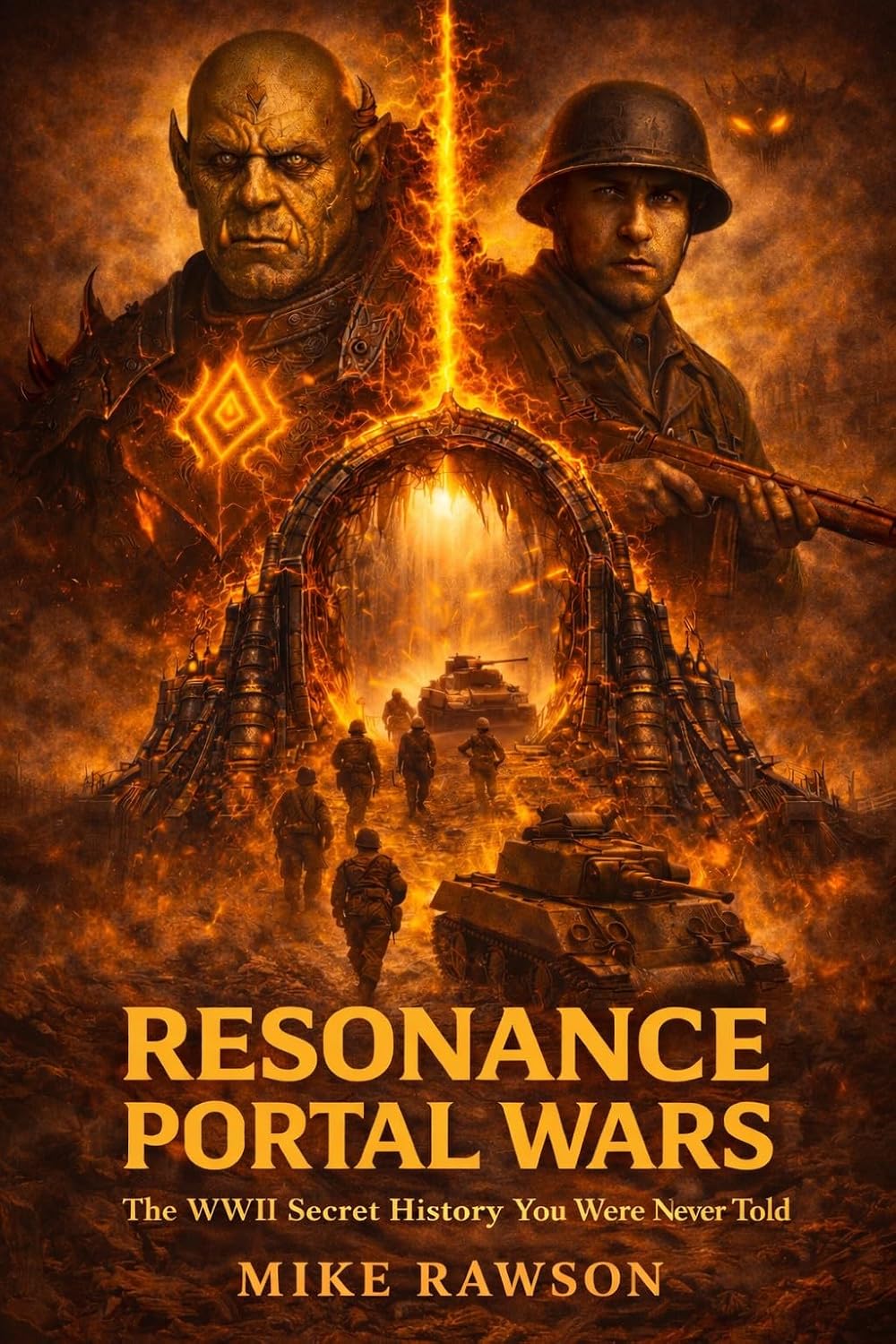
Resonance Portal Wars by Mike Rawson is a maximalist alternate-history war fantasy that reimagines World War II as a secret multidimensional conflict: Nazi occult science, Antarctica UFO lore, Element 115, Die Glocke, portals, orcs, elves, leylines, and Allied commandos all collide in a hidden war behind the war. The book opens with British commandos hunting Otto Skorzeny in occupied France, only to discover the Reich has monsters in its arsenal, then widens into a sprawling struggle involving Hans Kammler, Ilyndor, the Watchers, the Hive, and a victory that feels less like triumph than a scorched threshold.
I enjoyed the book most when it leaned fully into its own outrageous conviction. It doesn’t tiptoe into genre blending; it kicks the portal open and marches through with a Bren gun in one hand and a rune-etched axe in the other. The action has a blunt, pulpy force, especially in the early Grimfang sequences, where the familiar grammar of commando fiction is suddenly mauled by dark fantasy. That collision gives the book its charge: history becomes less a museum corridor than a booby-trapped underworld.
The book often chooses acceleration over pause, and at times I wanted more time to sit with the human cost before the next cosmic mechanism began to grind. Still, the ambition is difficult not to respect. Rawson is clearly fascinated by the shadow shelf of World War II mythology: Nazi occultism, secret weapons, Antarctica, UFO rumor, and the novel’s best passages make those obsessions feel feverish.
This is a great book for readers who enjoy alternate history, World War II fiction, military fantasy, portal fantasy, science fantasy, and pulp adventure in one oversized, bloody package. I’d compare it to a louder, more conspiracy-soaked cousin of Hellboy or Harry Turtledove filtered through a war-gaming fever dream. This is not a subtle book, but it is heartily entertaining.
Pages: 505 | ASIN : B0GJM6QRTW

Templar of Archaea


Templar of Archaea tells the story of Augen, a young initiate in the Templar Order, who quickly finds himself tangled in a brutal mission that spirals into violence, regret, and soul-crushing doubt. The world of Archaea is painted in storm-lashed skies, colossal cities, and shadowy orders that blur the line between protector and monster. The novel begins with a raid gone wrong, where Augen kills an innocent priest, one he once knew, and it sets him on a painful journey of guilt, loyalty, and questions about faith, power, and destiny. The book is a dark, sprawling tale about a man caught between his duty as a weapon and his humanity as a flawed soul.
I found myself pulled in by the sheer energy of the writing. The world feels alive, hostile, and dangerous, and the author has a gift for cinematic description. The opening storm over Pallerheim is one of the best scene-setters I’ve read in a while, and the pace rarely lets up after that. Augen is both compelling and frustrating, which is exactly what I want in a protagonist. He is powerful yet riddled with insecurity, and the way he wrestles with guilt over killing a childhood friend hit me hard. The conversations with Zhatka, his terrifying half-brother, stood out as some of the most gripping passages, with menace dripping off every page. There are moments where the prose is heavy, and the dialogue is densely packed with exposition, but I still enjoyed the story.
Emotionally, the book left me uneasy in a good way. Augen’s inner turmoil is brutal to witness. His doubts about Deos, his fractured relationship with Christine and her father, and his brushes with death all left me feeling that I was not reading a hero’s journey so much as watching a man crumble under the weight of impossible choices. I liked that. It felt honest. There’s no clean redemption arc here, at least not yet. Instead, we get blood, betrayal, and painful reminders of what happens when power is mixed with grief. It made me pause more than once and think about what I would have done in his place, and not many fantasy books make me do that.
Templar of Archaea is a powerful, heavy, and at times unsettling story that will resonate with readers who enjoy gritty, morally complex fantasy. If you like your worlds grim and your heroes flawed, this book will be right up your alley. It’s not light reading, and it’s not meant to be. But for those who want to sink into a dark tale of loyalty, guilt, and the search for meaning in a broken world, it is more than worth the ride.
Pages: 347 | ASIN : B0FS4TQQYX
An Age-Old Dilemma

Emergence: The Orbit Stone Saga follows a young man recruited into an ancient order of protectors who must learn how to navigate a world of ancient magic, political intrigue, and try to prevent a genocide. What was the inspiration for the setup of your story?
Ottix’ arc was mostly inspired by my own journey into law enforcement. Much as I did, Ottix has a desire to help others, protect the innocent, and make Orbis a better place. His story is not a rags-to-riches tale though. Other characters like Glacea and Armin follow this classic trope. Ottix however, was born into a good family that cared about him and gave him opportunities. I wanted to emphasize that bad situations or upbringings do not always create good characters. Ottix came from an upper-middle class situation and through hard work, ascended further beyond that station. The elements surrounding Ottix such as magic, politics, and genocide were inspired by classic fantasy stories and real history.
I find the world you created in this novel brimming with possibilities. Where did the inspiration for the setting come from, and how did it change as you were writing?
My settings were inspired by a variety of things and places, as Orbis is a large world. I’ll start with Palagr, since it was the first region I developed. Palagr is based on my home, the southeast U.S. I wanted to share the beauty of this area with my readers. The towering pine forests and bountiful marshes are a sight few get to see and one I thought was worth sharing. Next came Mwantamba. At the time I began writing Emergence, my sister was traveling to Africa to study elephants for a college project. I researched the country’s wildlife, cultures, and history. Mwantamba is home to many fantasy creatures based on real ones. The Watu were inspired by Zulu, Maasai, and Swahili. Next came the icy homeland of the Visoibri, Vorigheim. This nation was developed with Iceland in mind. Many ancient Visoibri words are based on old Norse, such as Vorigheim which means “origin home.” I imagine the structures of Towerton to be norse inspired, though the culture relies more on magic than sea raiding as the vikings did. Every story needs a villain, and Emergence’s live in Metusol. The central land of the Azeri has a varied climate. On the west it is arid but has access to the ocean and plenty of trade routes. On the east side it is more temperate with most of the country’s agriculture. I wanted to reflect the Azeri’s split ideologies with this difference. Many of the people in Metusol just want to live a fair and happy life. But the rulers use the citizens for their own gains. My next creation was the Jah’kuls of The Paw. As I created the map, I ended up drawing an island in the southeast that kind of looked like a paw. Later on, I added an entire race, the Jah’kul, to the island. This race was inspired by the Khajit from the Elder Scrolls series. I figured if there are cat-people, why not make dog-people! Next came my favorite group of characters, the Marinites. These creatures were inspired by many things including the Zora from Zelda, Kitt Fisto from Star Wars, and Abe Sapien from Hellboy. I wanted Orbis to be connected by a large ocean, and the Marinites helped complete that goal. The other thing that connects the world is of course, the Orbit Stone ring. The magic ring of stones is the source of all magic on Orbis.
What were some themes that were important for you to explore in this book?
Throughout history there have been many examples of religion or politics creating opposing groups that are pitted against one another. I wanted to incorporate this age-old dilemma into Emergence. I also wanted to explore the themes of duty and loyalty. Characters are often torn between their loyalties to their family or nation and the greater good. I also wanted to explore how magic could be used other than in the traditional sense. The prevalence of magic and Azeri technology makes for a unique setting in which ancient magic and modern technology collide. Finally, I wanted to write about war and peace. Emergence delves into the fragility of peace and the brutal consequences of war, contrasting the ideals of unity and cooperation with the destructive nature of hatred and ambition.
Where does the story go in the next book, and where do you see it going in the future?
The second book, Convergence, will continue the story, focusing more on Razi as the new leader of the paladins. An ancient secret is revealed which changes everything. The truth about what happened to the ancient Visoibri comes to light. And the war against the Azeri rages on and eventually concludes. The second book dives deeper into the relationships between characters and even some romances. The third book, Transcendence, will take place 15 orbits after Convergence, and will focus on the paladin’s new mission after the war.
Author Links: GoodReads | Facebook | Website
The Paladins, an ancient order of protectors, rise up to counter the Azeri threat. Among them is Ottix, a young man recruited into their ranks, determined to fight for his world’s survival. As war erupts across Orbis, the Paladins lose their greatest weapon, and the future of the Republic hangs in the balance.
In the face of impending chaos, the heroes of Orbis must navigate a world of shifting allegiances, ancient magic, and political intrigue. With the stakes higher than ever, it’s unclear who will emerge victorious—and who will be lost forever.
The Orbit Stone Saga 1: Emergence is a high-stakes adult fantasy filled with complex characters, dangerous magic, and a world on the brink of war. Will Ottix rise to the challenge, or will Orbis fall into ruin?
The Orbit Stone Saga 1: Emergence

Emergence is the first entry in The Orbit Stone Saga, a sweeping fantasy tale set in the fractured world of Orbis. The story follows a host of characters, mercenaries, paladins, merchants, warriors, prophets, and rulers, who are all caught up in the struggle for powerful Orbit Stones, magical fragments that shape the balance of nations. The novel moves from shadowy deals in taverns to bloody tournaments in coliseums, from visions of looming wars to quiet moments of doubt and reflection. The backdrop is one of political tension, cultural clashes, and moral compromise, where every choice carries consequences that ripple far beyond the characters themselves.
Reading this book, I found myself pulled in two directions. On one hand, the worldbuilding is rich and textured, with a sense of history and myth that feels lived in. The Orbit Stones themselves are a fascinating magical device, both a source of wonder and a catalyst for corruption. Daughtrey has a knack for making small details matter: the way a Marinite’s speech rolls like seawater, the tension of a paladin hiding his true identity, the quiet fear of a warrior before stepping into the arena. On the other hand, the writing can be heavy at times. The pacing sometimes lingers, and I occasionally wished for less explanation. Still, the story kept me turning the pages, eager to see how the tangled threads of power, betrayal, and prophecy would tighten.
Emotionally, the book left me intrigued. There are moments of wit and charm, yet the undercurrent is one of looming dread. I admired how flawed the characters are, heroes with secrets, leaders with frailty, villains with conviction. The paladin Razi in particular made me feel a mix of admiration and frustration. He is noble, yet deceptive, and I couldn’t decide if I liked him or pitied him. Ottix’s trials in the coliseum gave me goosebumps; his battles were brutal, yet they carried a strange beauty. The prophetic visions of Aeryka, layered with fear and urgency, reminded me of the weight of foresight in a world stumbling toward war. I often found myself pausing, caught between excitement and a quiet sadness, because the book carries the sense that things will only get darker from here.
By the time I closed the final pages, I felt that Emergence is less about victory and more about survival in a world that is both wondrous and cruel. It is not a light read. Daughtrey aims for depth, and the ambition shines through. I’d recommend this book to readers who crave sprawling fantasy worlds, those who like the grit of moral ambiguity, and anyone who enjoys seeing political maneuvering and mystical forces collide. If you’re ready to lose yourself in a world that feels both harsh and alive, Emergence is worth your time.
Pages: 443 | ASIN : B0FDQKW65M


