Blog Archives
I’ve Lived It

Stoic Empathy is a sharp and heartfelt exploration of how two seemingly opposing traits, stoicism and empathy, can be merged into a potent tool for influence, resilience, and personal growth. Why was this an important book for you to write?
Because I’ve lived it. I’ve had to. I grew up in war-torn Tehran, navigating missile strikes and ideological oppression, and then started over as a refugee in Canada. Years later, I was leading high-stakes negotiations in sleek boardrooms as a corporate lawyer in America. Through it all, I found myself constantly reaching for two tools: my ability to stay calm and principled under pressure (stoicism), and my deep desire to understand and connect with others (empathy). People often see these as opposites, but in my life, they were partners—my survival tools, my leadership compass, my parenting strategy. I wrote Stoic Empathy because I wanted to offer a roadmap for others who are trying to live with power and integrity at once, in a world that often tells them they have to choose.
What were some ideas that were important for you to share in this book?
One was that self-control is not about suppression—it’s about clarity.
The other was that empathy doesn’t have to make you soft; it can actually make you sharper.
I wanted to challenge the misconception that empathy is merely emotional absorption. In truth, it can be tactical, discerning, and fierce. I also wanted to speak to people who feel deeply but don’t know what to do with that depth—especially those in leadership positions. And lastly, I needed to share the idea that influence doesn’t require dominance; it requires alignment—between who we are, what we believe, and how we show up.
Did you find anything in your research of this book that surprised you?
Yes—how many ancient philosophers were deeply attuned to what we now call emotional intelligence. I expected to pull heavily from modern psychology and neuroscience, and I did, but what surprised me was how relevant the writings of Epictetus and Marcus Aurelius felt when filtered through the lens of human connection. I also discovered fascinating neurological evidence that validated what I’d experienced instinctively as a survivor of oppression and war, but also as a lawyer and a mother—that our brains are wired to both mirror and regulate emotions, and that mastering that dance is what gives us real power.
What is one thing that you hope readers take away from Stoic Empathy?
That strength and sensitivity are not at odds. In fact, our most effective leaders, partners, and creators are often those who can feel deeply but act with discipline. If there’s one thing I hope readers take away, it’s this: You are allowed to feel everything—but you don’t have to do everything those feelings suggest. Power lies not in shutting down or giving in, but in standing calmly at the center of it all, discerning what matters, and choosing how to move forward with grace.
Author Website
Stoicism combined with empathy may sound like a contradiction in terms. But when these seemingly opposing forces are harnessed together, they have the power to change your life.
From surviving missile attacks and political oppression in Iran to leading high-stakes legal teams and negotiations in corporate America, Shermin Kruse’s journey fuels her mission to merge empathy and stoicism as tools for navigating power, justice, and human connection in every facet of life. In this eye-opening book, she offers you this radical perspective shift—anchored in up-to-the-minute research—to help you navigate life’s challenges with power and principles.
We often think of empathy as an emotional stance: we feel what someone else is feeling. But Kruse outlines a form of empathy that’s based in cognition, not emotion—a way for us to understand what the other person is thinking and feeling while keeping a distance from their feeling state—and shows us how we can strategically maneuver our level of engagement from “emotional empathy” to “cognitive empathy” in different circumstances. Then she utilizes Stoic philosophy and modern science to outline the how of emotional regulation and control. The bridge she builds between Stoicism and empathy gives us the knowledge and discipline we need to:
Calmly assess the power dynamics of any situation
Understand and manage our own emotions as well as the emotions of others
Defuse danger and turn conflict into connection
Skillfully steer a challenging conversation toward the result we want
Whether you’re a leader striving to succeed in your role with integrity, an educator seeking to guide curious minds with compassion, a parent nurturing resilience in your children, or simply facing a personal or professional crossroads, Stoic Empathy is an essential toolkit for negotiating success in every area of your life.
Stoic Empathy: The Road Map to a Life of Influence, Self-Leadership, and Integrity
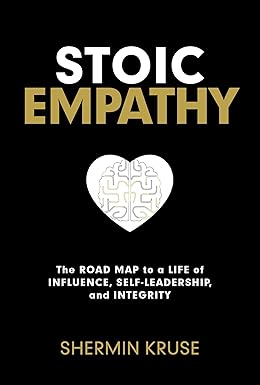

Shermin Kruse’s Stoic Empathy is a sharp and heartfelt exploration of how two seemingly opposing traits, stoicism and empathy, can be merged into a potent tool for influence, resilience, and personal growth. The book mixes personal history, ancient philosophy, neuroscience, and practical advice to introduce the concept of “Stoic Empathy,” the intentional blend of emotional awareness and emotional control. Kruse breaks down cognitive and emotional empathy, offers techniques from both domains, and delivers them through compelling stories, case studies, and reflections from her own turbulent journey from Iran to North America. The message is clear: you can be strong without being cold, and kind without being soft.
What struck me right away was Kruse’s voice. She doesn’t hide behind academic detachment or preach from a mountaintop. Instead, she lays her life bare—stories of war, immigration, trauma, injustice, love, and ambition. And she does it in prose that is raw but composed, often poetic but never indulgent. I felt moved, more than once, not just because of what she lived through, but how she translated those scars into strength. Her writing is both precise and deeply emotional, a difficult balance she pulls off with skill. Kruse somehow made a guidebook feel like a memoir.
Now, in terms of the ideas, some of them hit like a lightning bolt. The way she differentiates cognitive and emotional empathy, then teaches you when to use each, is flat-out brilliant. I’ve read plenty of books on leadership and emotional intelligence, but few are this actionable and easily understood. She doesn’t just give you theory, she shows how it plays out in hard rooms with high stakes. There’s pain in this book. There’s injustice. But Kruse doesn’t wallow. She’s honest about the ugliness in the world, but relentless in her belief that we can navigate it ethically, if we keep both a cool head and a warm heart.
I’d recommend Stoic Empathy to anyone who leads, whether that’s in a boardroom, a classroom, a household, or a movement. It’s especially relevant for folks juggling high-pressure decisions with a desire to stay kind and ethical. But more than that, it’s for anyone who’s ever felt torn between being tough and being tender. Kruse shows you how to be both, and more importantly, how to use that combination to change your world.
Pages: 288 | ASIN : B0D3YVPRX6




 LITERARY TITAN