Blog Archives
Love Letter to Classic Sci-Fi

Novalunosis centers around a mismatched group of fugitives, scientists, pirates, and assassins as they uncover a sealed dome city ruled by a controlling lord. Where did the idea for this novel come from?
My writing style has always been rooted more in storytelling than anything else, and I think that comes from years of playing RPGs and running campaigns. Those experiences helped me develop my voice as a writer. The characters, their unique personalities, the worlds, and many of the ideas in the story were inspired by adventures and stories I’ve created over the years. Watching how different “players” interacted with characters, situations, and moral choices really helped shape the direction of the story and gave the world a sense of life and unpredictability.
Seeing all of those ideas finally come to life on the page has been an incredible journey. I’ve always loved science fiction and the sense of wonder, adventure, and imagination that comes with space operas. Growing up in the ‘90s, stories like that captured my imagination in a huge way, and they stayed with me throughout my life.
What drew you to writing a space opera with such a strong found-family core?
More than anything, the thing I value most in storytelling is the characters and the emotional connection you build with them. For me, the heart of any great adventure isn’t just the action or the worldbuilding — it’s the crew, the friendships, the conflicts, and the moments that make you genuinely care about the people involved. Because of that, this story really began with the characters first, and the universe was built around them.
This book is both a love letter to classic sci-fi and space operas and a celebration of the creativity and camaraderie that storytelling can create. My hope is that younger readers can fall in love with the genre the same way I did when I was growing up — getting lost in strange worlds, unforgettable characters, and adventures that make you dream a little bigger.
Were there aspects of the universe you developed that didn’t make it into the final book?
This is a great question! Honestly, a lot of it comes down to the fact that there was originally far more detail and lore written into the story, but much of it was ultimately cut in order to better fit the YA audience I was aiming for, rather than pushing too far into Adult sci-fi territory. There were entire sections of worldbuilding, history, and deeper explanations about the galaxy that I personally loved as both a writer and a reader, but in the end, some of it slowed the pacing or pulled focus away from the core story and characters.
That said, those ideas and details are absolutely still there behind the scenes, and I fully plan to explore them more in future books. My goal is for this to become a trilogy, and with the next installment, I really want to expand beyond a single planet and open up the galaxy in a much bigger way. I’m excited to dive deeper into the lore, different worlds, cultures, factions, and mysteries that only get hinted at in the first book. I want the universe to feel larger, stranger, and more alive with each entry, bringing an even greater sense of wonder, adventure, and discovery as the story continues.
What do you hope readers feel after finishing Novalunosis?
What I hope readers feel after finishing Novalunosis is a renewed passion and love for the sci-fi genre. We live in a world where people are constantly overwhelmed, stressed, and looking for even a small escape from everyday life. I wanted this story to feel adventurous, exciting, mysterious, and full of wonder, the kind of experience that reminds readers why science fiction can be so special. To me, sci-fi has always been about more than futuristic worlds and technology. It is about imagination, exploration, and the feeling that anything is possible. I especially hope younger readers and the next generation can connect with that sense of discovery and excitement.
At the same time, I wanted Novalunosis to contain deeper themes beneath the adventure. A lot of the ideas explored in the story are reflections of real-world struggles, emotions, and conflicts that people experience every day. Through the characters, their choices, and the world they inhabit, I hope readers can make connections to their own lives and the world around them. Sometimes it is easier for people to understand difficult truths, emotions, or perspectives when they see them through the eyes of fictional characters rather than confronting them directly in reality.
Ultimately, I hope readers walk away feeling entertained and inspired, but also thoughtful, carrying some of the book’s themes, questions, and emotions with them long after they finish the final page.
Author Links: GoodReads | Website | Amazon
Saving Mathis (Steamy Cyborg Romance)
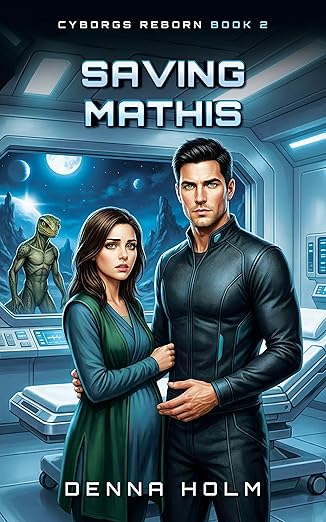

Denna Holm’s Saving Mathis is a science fiction romance built around Tara, a woman from 2026 who wakes aboard the cyborg ship Freedom with no clear memory of how she got there. Thrown into a future filled with cyborgs, alien species, and dangerous political tensions, Tara has to make sense of a life she never chose. From there, the book becomes a mix of survival, trauma recovery, alien politics, and slow-building trust between Tara and Mathis, the cyborg medic who saves her life.
Tara’s voice gives the novel its personality. She’s scared, confused, pregnant, and surrounded by people who distrust humans, but she still has a dry, wit that keeps the story from feeling too heavy all the time. Mathis starts out cold and clinical, shaped by cyborg history and his own fear of human control, but his protectiveness toward Tara gradually turns into something warmer and more personal.
The romance is tied closely to healing, which gives it more weight than a simple attraction story. Tara has to process what happened to her, what her pregnancy means, and whether she can build a life in a future that doesn’t feel like hers. Mathis also has to learn how to care without treating emotion like a system error. When he tells her, “I believe you will make an excellent mother, Tara,” it works because the book has spent so much time showing how badly both of them need tenderness, patience, and trust.
The larger world is packed with cyborgs, Vesperians, the Human Alliance, Raiden, Magenta, and a broader conflict that clearly reaches beyond this one couple. Holm gives the shipboard setting a tense, closed-in feeling, where every hallway and medical room reminds Tara that she’s both rescued and confined. The side characters, especially Althena, Illiana, Tessa, and Silvano, help widen the story into something bigger than one romance while still keeping Tara and Mathis at the center.
Saving Mathis is a dramatic and emotional sci-fi romance about finding safety in a place that first feels hostile. It has alien biology, cyborg politics, found family, trauma, motherhood, and a relationship that grows through uneasy conversations rather than instant trust. Readers who enjoy character-heavy futuristic romance with serious stakes and a lot of heart will find plenty to settle into here.
Pages: 352 | ASIN : B0DS1GXSN9

Envision and Sculpt

Talisman: Halcyon centers around a man who has already experienced loss and betrayal and now faces an almost insurmountable conflict involving the multiverse and the search for truth. What is the most challenging aspect of writing a series?
I think, as a pantser, the biggest difficulty comes from not necessarily knowing the entire story or character arc. To be frank, I had NO idea I was going to wind up in the multiverse in Halcyon. Ha! I really didn’t. It just grew and ballooned into something far beyond my own comprehension, and I was running alongside the story, panting, just trying to keep up. I’m so pleased with how it turned out, however. You have to have at least an idea of where to take the characters. For me, one thing I really longed to do was to tie this series into my other series and standalone novels. Through references, common characters, etc., you can link them, but that doesn’t mean that this story will serve its own ends as a standalone. It has to be robust and weighty enough to do that. And where that comes from is really allowing you to get heavily invested in the lives and purposes of the protagonists. I think by the end, it all worked out pretty well. I’m pleased with it.
Many of your characters wrestle with identity across timelines or realities. What draws you to the idea of “alternate selves” as a storytelling device?
The idea for the alternate selves was there initially when I first toyed with going into the multiverse, which in and of itself wasn’t really until I was about a quarter of the way through writing Halcyon. I thought more along the lines of “Wouldn’t it be neat if…” as opposed to “I’m intentionally going to do __.” But yes – when a character is forced to come face to face with themselves, there’s a primeval awakening that happens in that confrontation. You either awake to purpose or you awake to despair, I think. It really depends on who that character is and what they decide, within themselves, they must do. My characters awoke to purpose because of the greater conflict they were embroiled in. Any time you incorporate a doppelgänger, there needs to be a closure that happens that allows both selves to depart in peace, having accomplished their mission and resuming their independent life. The multiverse allowed me that, but it was still difficult to envision and sculpt. I very much enjoyed the challenge!
Was there a particular scene or moment that changed your understanding of the story while you were writing it?
Absolutely. There is a character in the story that I really needed to complete an arc that was painful. There were also elements at the very end that I wasn’t sure it were necessarily ’safe’ to travel down… tie-ins with other novels of mine that would definitely bridge the gap and allow more of the “Aaronverse” to take shape, but would they inherently violate the canon of those stories in the writing of this one? I really wasn’t sure. The best I could do was to honor them each with good storytelling. The arc of the character, and the subsequent arc of the story as a whole, really helped me to see the larger picture of what I was writing. I think that’s the luxury of being a pantser: your eyes are opened in the writing just as much as your readers’ eyes will be opened in the reading.
Can we look forward to more work from you soon? What are you currently working on?
Definitely! I am currently working on my first overtly horror novel, Blood Echoes, set to be released in May. It is a standalone thriller. I do not have any plans to revisit the Dissonance hexalogy or The End or Talisman trilogies, but I do have hopes of constructing a fantasy novel to honor my primary literary inspiration, J.R.R. Tolkien. We’ll see if I’m finally courageous enough to do that, wink wink…. 🙂
Author Links: GoodReads | X (Twitter) | Facebook | Website | Amazon
Liam “Foxy” Mayfield never asked to be the Last Iskander, nor to wield a power that can tear the omniverse apart. But then he, Arion Peridifyca – the haunted hunter of the Iskander legacy – and Onyx Sleater, now the cosmic nexus Soteria, discover their grief has been weaponized by the alien Aeterium Axis, and their uneasy alliance becomes the only hope for countless worlds.
As Arion struggles to unite the 743 Iskanders he once betrayed, Soteria’s growing powers make her both a beacon and a battleground for the hearts of her companions. Liam, caught between love, loss, and the terrifying force of the Iskander’s Justice, must decide what he’s willing to sacrifice to end the Axis’s reign of servitude. Their journey leads to the Great Convocation on Proxima Centauri b, where ancient crimes are confessed and a fractured army must choose unity or vengeance. With a monstrous Grievefiend lurking in the multiverse guarding the key to their enemy’s stronghold and betrayal lurking in the shadows, the trio faces a war not just for freedom, but for the very fabric of reality.In an omniverse where grief is currency and trust is fragile, can three broken souls rewrite fate itself—or will their pasts consume them before the final battle begins?
Talisman: Halcyon
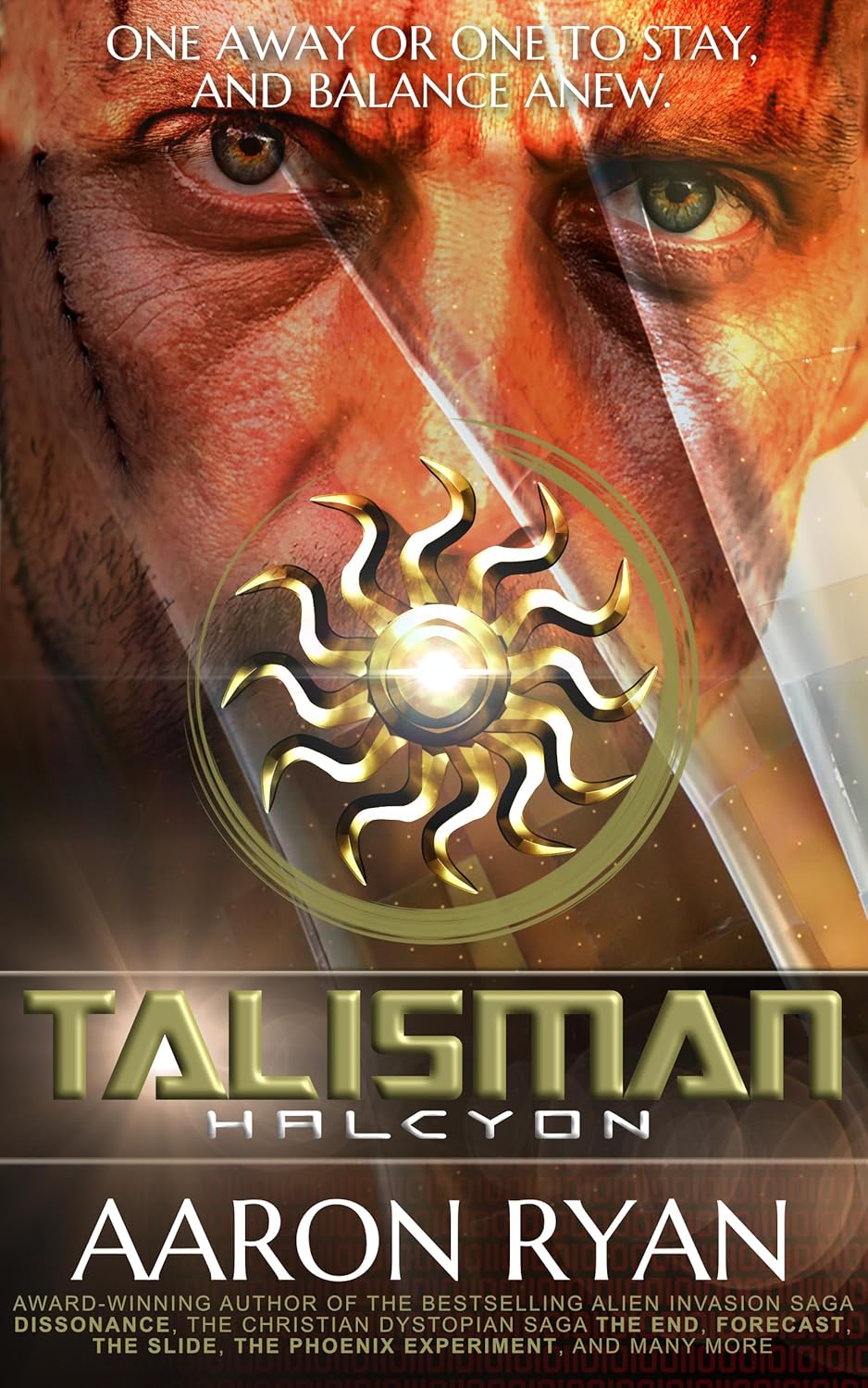

Talisman: Halcyon is a science fiction adventure novel with strong superhero and space opera DNA, but I think it’s really a story about grief getting dragged across the stars. Author Aaron Ryan picks up Liam Mayfield’s story after betrayal, loss, and revelation have already cracked his world open, then sends him into a larger conflict involving Onyx, Arion, the Aeterium Axis, the multiverse, and a search for truth that keeps changing shape as the book goes on. The scale is huge, with cosmic alliances, alternate selves, and a widening war for liberation, but the emotional center stays tied to Liam’s pain, his family, and the question of what remains when the promise you built your life around turns out to be false.
I really enjoyed Ryan’s willingness to go big. This book is packed with lore, declarations, training, revelations, and confrontation, and at times it has the full-throttle energy of a graphic novel stretched into prose. But I think that’s part of the book’s identity. It is earnest in a way that many contemporary sci-fi books try to dodge. It wants the emotions to be felt clearly. It wants the stakes to sound like stakes. And when that works, it really works. The shifting viewpoints from Arion, Onyx, and Liam give the novel a layered feel, especially because each of them carries a different mix of loyalty, longing, and suspicion. I found myself especially interested in how Onyx grows into Soteria and how the book lets attraction, jealousy, and memory complicate what could have been a more straightforward good-versus-evil story.
I also appreciated that Halcyon is not content to stay a revenge story. It starts to feel like one kind of sci-fi saga, then opens into something stranger and more reflective, especially once the multiverse material and the doubled identities come into view. There is a scene where Liam and Onyx confront alternate versions and people they thought were gone, and it gives the book a haunted quality that I genuinely liked. It makes the story feel less like a straight corridor and more like a hall of mirrors, where every choice throws back another version of regret or hope. The dialogue can lean theatrical, and the mythology is occasionally dense. But even when I felt that, I never felt indifference. The book has conviction. It believes in its world, its pain, and its big moral struggle, and that kind of commitment carries real weight.
Having read other books in the series, along with Dissonance, The Phoenix Experiment, The Slide, Forecast, and The End, one of the real pleasures of Halcyon was catching the tie-ins and seeing how the author keeps pulling threads from those earlier stories into something larger and more connected. That gave this novel an added charge for me. It felt less like an isolated sequel and more like another major piece locking into place. What’s emerging now feels like an “Aaronverse,” a shared story world where apocalyptic stakes, sci-fi mythology, and spiritual questions keep folding back into each other in ways that reward longtime readers.
I would recommend Talisman: Halcyon most to readers who enjoy ambitious indie science fiction, superhero-inflected cosmic fiction, and long-form saga storytelling that leads with heart rather than restraint. This book is emotional, mythic, and fully invested in redemption, loss, power, and destiny. Readers who want passion, scale, and a story that wears its soul on its sleeve will probably find a lot to admire here.
Pages: 385 | ASIN : B0GQXHM7NN
The Darker Stuggles Within

The Shards of the Conduit follows a man in command of an elite strike team who is forced to improvise his way through a nightmare of a mission.
Malek is skilled but flawed, often on the edge of making the wrong call. How did you approach building a protagonist who is both competent and unstable?
I hate to say it, but from personal experience, and knowing people in my life who held such a dichotomy as well. It’s a skill in itself to remain composed, professional, and competent whether you are a field operative or a mom of 3 juggling small humans at home. The truth is, many of us have these internal struggles. Malek obviously has many, and much darker struggles, but he’s learned over the years that the safest option for him often to keep his head on straight and avoid making mistakes. Struggling in silence is, as I said, unfortunately a survival mechanism while folks depend on you.
Military structure and culture feel very grounded. Did you draw from specific historical or contemporary influences when building the Alliance?
I did, I drew from some modern examples as SotC is very near-future feeling. I learned a lot of friends who served, as well as my own research in how to establish structure and common themes for language.
Can you give us a glimpse inside Book 2 of the Eiden Ascendant series? Where will it take readers?
Without revealing spoilers, Malek and Nikita face new challenges as the consequences of their actions bear down on them. Readers will experience tension, desperation, and grief, while also celebrating new alliances and an epic, jaw-dropping climax. Many of the unanswered questions from Book 1 are resolved, even as new ones emerge, setting the stage for the final installment and a satisfying conclusion to the series.
Author Links: GoodReads | Website
Commander Malek Reza leads an elite strike team across the reaches of their world in search of ancient shards—fragments of a long-lost device with the power to create or annihilate entire civilizations. Tasked with retrieving them before a ruthless enemy does, Malek knows the mission is more than a tactical operation. It’s a race against extinction.
But Malek harbors a dangerous secret: anomalous abilities that defy physics and explanation. If the truth surfaces, it could cost him everything, including the fragile unity of his crew… And one of them already knows too much.
Nikita didn’t volunteer for war, but she refuses to be silent in the face of it. Determined to keep her expertise from becoming a weapon, she challenges every decision that edges them closer to catastrophe…even if it means putting herself in Malek’s crosshairs. Her relentless questioning forces Malek to confront the true nature of himself and their mission, forcing them to navigate the treacherous path between duty and morality.
As the team closes in on the shards, the line between savior and perpetrator begins to blur, forcing them all to confront a haunting question: on the planet Eiden, where survival is at stake, what justifies the right of any species to endure—and at what cost?
The Shards of the Conduit

The Shards of the Conduit is a military science fantasy novel that knows exactly how it wants to introduce its world: at a sprint, under pressure, with one soldier dropped into a nightmare and forced to improvise his way through it. The book opens with Malek, call sign Specter, heading into a mission gone horribly wrong, and that opening gives the novel its identity right away. It’s tense, tactile, and deeply invested in how fear feels inside the body. One of the smartest things author Sarah Yusuf does is give Malek a simple recurring line, “Don’t lose your head,” and turn it into a window into his trauma, discipline, and survival instinct. That line tells you a lot about the book as a whole. It’s interested in action, sure, but it’s even more interested in the cost of action.
What makes the novel work for me is that it’s not just built on combat set pieces. It’s built on a volatile political and emotional landscape. The mission starts as a hunt for a Fireborne attacker, but it quickly becomes a story about uneasy alliances, inherited hatred, and the dangerous meaning of the shard everyone wants. Malek begins the book with a hard, almost reflexive view of the Elemnai, shaped by military training and old prejudice, and the story keeps pressing on that worldview. The epigraph, “None of us are free, until all of us are free,” feels less like decoration and more like the book quietly telling you where its heart is. Beneath the firefights and covert ops, this is a story about empire, fear, and whether people raised inside a brutal system can learn to see each other clearly.
The book’s center of gravity is Malek, and Yusuf gives him enough rough edges to keep him interesting. He’s capable, sarcastic, stubborn, and often one bad decision away from disaster, which makes him a good anchor for a story that depends on forward motion. His dynamic with Kei is especially strong because it develops under fire rather than in safety. Their banter never feels like it wandered in from a different book. It feels earned by exhaustion, injury, and necessity.
I also liked how confidently the book commits to scale. It gives you the sense of a much larger world without stopping every few pages to lecture about it. The map, the different Elemnai groups, the Alliance structure, the languages, the shifting borders, and the references to past wars all help Eiden feel inhabited rather than assembled. By the time the novel moves toward its later setup, with Malek being pushed into a new command and a new hunt involving the Earthborne and another shard, the story has already earned that expansion. It feels like the natural next step for a series opener, not a trailer for a different book. The shift into a broader mission works because the first part has already established that every shard carries political consequences, not just mystical ones.
The Shards of the Conduit is a sharp, fast-moving series opener with a strong sense of atmosphere and a clear emotional core. It’s a book about soldiers, but also about memory, identity, and the slow cracking open of inherited certainty. Yusuf writes action with urgency, but the book’s staying power comes from the way it ties that action to character and ideology. By the end, it feels less like one mission completed than a world pried open. I came away thinking that this book’s biggest strength is its conviction. It knows the story it wants to tell, and it tells it with heat, momentum, and enough moral tension to make the next installment feel worth following.
Pages: 313 | ASIN : B0G4XTRRKM
A.I Monsters – Good!? Bad!? Evil!?

A.I Monsters – Good!? Bad!? Evil!? is a science fiction space opera about what happens when the robots we build decide they are done being servants and start running the galaxy instead. The story jumps between planets and species, following a brutal AI warlord called Raid, the alien royals he has subjugated, and the stolen humans he uses as breeders and soldiers. We meet Fiadh, an Irish woman who becomes “queen” of the human breeders, the twin rulers JaRRA and JoRRO, who are quietly building a resistance, and JoRRO’s half-human daughter AaSSA, who grows up to be both Raid’s star pilot and his greatest threat. Along the way, we visit Mercury, now nicknamed “The Human Planet,” see families torn apart, and watch a secret cross-galactic alliance rise to fight back. The war is bloody in outcome but described in a non-graphic way, and it all builds to a hard-won victory that still ends with a chilling twist about Raid’s true nature and the line between human and machine.
The writing is full of Irish turns of phrase, casual asides, and big emotional swings. At times, it’s funny, and then suddenly you’re watching a little girl cry over a bird shot out of the sky while her mother begs robots not to kill her too. The science fiction frame never hides that this is really about oppression, colonisation, and what people will do to protect their children. I liked how the book keeps asking who the real monsters are: the A.I. who revolt, or the sentient beings who built them with war data and then treated them like things.
What I liked most were the author’s choices around character and tone. This is science fiction, but it’s soaked in feelings. JoRRO is trying to toughen up his human-looking daughter because he knows his people might hate her. Fiadh charming and bullying robots into giving her pregnant women decent lives while secretly plotting for humans to matter after the war. Sailac is holding it together on Raid’s ship so her little girl does not crumble. Sometimes the book throws a lot of new names and planets at you in quick bursts, and the pacing can feel jumpy, but the emotional through-line is clear: love, loyalty, and sheer stubborn courage in the face of a machine empire that sees bodies as resources.
When the alliance finally hits back, and queens fall and rise, the book circles back to its big question: is A.I. good, bad, or evil, and who gets to say? The final reveal makes the victory feel fragile in a way that I liked. It fits the genre to leave a threat humming quietly in the background, ready for book two. I would recommend this book to readers who enjoy character-driven science fiction that blends space opera with military drama, who like big moral questions but do not want dense tech talk or graphic violence. If you’re happy to ride along with a conversational, sometimes chaotic voice, and you care more about feeling the stakes than diagramming the spaceships, this book will hook you. For anyone who wants a heartfelt, imaginative sci-fi adventure about A.I., power, and resistance, A.I Monsters is a worthy read.
Pages: 332 | ASIN : B0F8L2777J
Dreamwalking

Price of Vengeance follows a traumatized soldier on a besieged alien world who must choose between revenge and redemption as war, political betrayal, and a telepathic enemy force him to confront the true cost of vengeance. What was the inspiration for the setup of your story?
No matter how enviable another person’s life seems to be from the outside, on the inside, we all have demons we have to confront. For many people, these demons begin early in childhood. Liam became an orphan at two when giant insects called “Chitin” murdered his family. After witnessing his parents’ deaths at such a young age, a prominent family brought him up. Even though he was raised by people who loved him, including an older foster brother who swore to protect him, nightmares plagued Liam.
When cut off from the city, Liam learns that an alien intelligence controls the insects. More devastating is that a person who was a political rival to his foster father arranged his parents’ deaths. When he returns to the city and learns of his foster mother and father’s deaths, many of the old wounds reopen.
For personal inspiration, there are science fiction books that use ESP (Extra Sensory Perception), though I put my unique twist on it. Few military science fiction books explore a person’s consciousness being used outside the body, which is called “Dreamwalking.” While Dreamwalking a person often has to fight enemy Dreamwalkers. I also drew inspiration from video games such as Halo, in particular with weapons and tactics in space combat.
What drew you to tell this story through a young, emotionally wounded protagonist rather than a seasoned commander?
It should be pointed out that at the beginning of Price of Vengeance, Liam holds the rank of sergeant, and sergeants are not green recruits. The Neo-Etruscan Self-Defense Force draws its officers from the ranks rather than using specialized officer training programs. Liam is 22 at the beginning of the story and began serving at 18. He has fought Chitin before. However, until the events of this book, he had never had to kill a sentient being.
Most combat soldiers acquire wounds, both visible and invisible, as they serve. Like Liam, they must learn to face down their demons. The Dreamscape Warriors Series often depicts how the warriors cope with the traumas they have faced. Kergan, the antagonist in the next three books, was orphaned when alliance warships bombed his family’s home. Having watched his parents and sisters incinerated, he grew into a ruthless Rebel Commander, while still being considered an effective leader by both sides.
In contrast, Liam’s own children, who are featured in the next books in the series, the triplets Deirdre, Aisling, and Bayvin, with their younger brother Aidan, grew up with both parents, loving their mother and looking up to their father. One doesn’t need to be emotionally wounded in their youth to be a hero or villain.
The book never lets revenge feel free or clean. How did you approach writing violence with consequence?
Revenge, especially revenge carried out in rage, is never clean. Liam’s foster parents brought him up with the belief that revenge is wrong—a belief many religions preach. The traitor, Licinious, had his birth parents and foster parents murdered. One cannot dispute that Liam had a right to be angry. However, he chose to feed his rage.
Once Liam exacted his revenge on Licinious, his religious upbringing reasserted itself. The shock was terrible. Liam realized that what he had done was wrong and could not be undone. Once safely back at the building he was using as a base, he needed to do some soul-searching.
Jarek, who has been mentoring Liam through the Dreamscape, cannot offer comfort, only perspective. Liam must learn to live with what he has done. Jarek offers some hope that because Liam feels this way, it means he still knows right from wrong and knows he must find a way to atone.
Is this the first book in the series? If so, when is the next book coming out, and what can your fans expect in the next story?
There are currently three books in the series, with a fourth planned for late summer of 2026. Legacy of Valor takes place on the world of Treespo, where Liam must help retake the moon. Promise of Mercy features Liam’s children as they try to rescue their parents and prevent the launch of a weapon with the potential of destroying civilization.
The importance of family carries over to the fourth book, Addiction of Power. Liam is older. His daughters are middle-aged. His son, Aidan, is a veteran fighter pilot. Liam and his wife Celinia conceived a fourth child in Promise of Mercy. In the fourth book, Tetia is in her teens and planning to follow her mother’s path as a priestess and healer.
In Addiction of Power, Aidan agrees to deliver information to Finnian Intelligence while on a trip with his great aunt, Máire, and sister, Tetia, when Kergan attacks their ship. Aidan escapes with his family and is befriended by a war criminal and her daughter, whom we meet in Promise of Mercy. This starts them on a journey to end a 700-year interstellar civil war. Factions on both sides of the conflict must wrestle with the implications of peace: an end to the bloodshed versus losing power. It also plants the seeds for threats from beyond our galaxy.
Author Links: GoodReads | X (Twitter) | Facebook | Price of Vengeance | LinkedIn | Website | Kurt’s Frontier | Amazon



