Blog Archives
Childhood Trauma’s Lifelong Impact

Dispatches from the Couch is a raw and fiercely intelligent memoir about the enduring scars of childhood sexual abuse and the intricate, often agonizing process of healing. Why was this an important book for you to write?
Writing the early drafts gave me permission to spend as much time as I needed to interrogate my memories and the intrusive thoughts they manifested. I was in such a dark place that I didn’t believe I deserved to talk to my therapist repeatedly about particular memories or challenges. I’d put myself on a healing schedule with a ridiculously short timeline. Writing suspended that clock. In later drafts, the editing process required I interrogate every description of my experiences that I was developing. It allowed me to revisit and reconsider what our therapy sessions revealed. Editing my manuscript with the goal that readers could better understand childhood trauma’s lifelong impact and perhaps identify how their or a loved one’s story might relate to mine ultimately allowed me to understand it and myself as well.
What was the most challenging part of writing your memoir and what was the most rewarding?
The most challenging part was deciding what to keep and what to cut. Therapy is a slow, repetitive process. One that sometimes was made even slower by my scientific mind’s penchant to step outside what I was experiencing and overanalyze things. We can feel stuck in the mud for weeks, even months. The two steps forward, three steps back, one step forward nature of the process is difficult to convey in a way that keeps a reader engaged. It was challenging but ultimately rewarding to retain the truth of what it feels like to slog one’s way through therapy that doesn’t read as a slog. This is where candid but gentle editors and beta readers are essential. My first developmental editor, author Tessa Fontaine, was vital to this effort. As was my ongoing relationship with Melissa Walker of HeyDay Coaching as my writing coach.
How has writing your memoir impacted or changed your life?
It answered a question I first articulated as a teenager: Who might I have been had the man I call Mr. Jay never been a part of my life? The six bouts of therapy prior to working with my current therapist, identified as Piper in the book, helped. They allowed me to process the trauma of child sexual abuse and keep going. However, working with Piper as I wrote out the dialogues of our sessions and later worked and reworked them into a coherent story created opportunities for us to revisit an issue until I felt I had exorcised it from my brain and body. It gave us the chance to think more critically about the more nuanced ways trauma shaped my understanding of the world and my place in it. We went from asking the question: What happened to you? to the question: What did it do to you? Today, I no longer see myself as damaged goods making the best of the scrap heap a pedophile left me to work with. I am a woman with a voice and the privilege of an education that allows me to understand trauma through a unique combination of scientific knowledge and personal experience.
What do you hope is one thing readers take away from your story?
Fight the unkind things your brain tells you, along with the sadness, fear, or frustration they bring. We live in an overwhelming world. Accept help. We so often feel like burying ourselves under the covers in isolation and loneliness. Whatever might cause you to think no one cares or no one could possibly understand, challenge those beliefs however you can. Give it everything you’ve got. Not one person whom I eventually reached out to averted their eyes or walked away. Had I written the Acknowledgements of my book before I wrote the book, I might not have needed to write it. (I am still glad I did!) There are people, whether through professional or personal relationships, who want to and can help you find your way through whatever your brain is telling you will be impossible to overcome.
Author Links: GoodReads | Instagram | Facebook | Website | Amazon
As Professor Hettes, her classes focus as much on neuroscience’s beauty and wonder as its facts and theories. Fellow faculty members see her as a fair but outspoken leader on a campus steeped in the blended patriarchies of academia and southern gentility.
At an emotionally charged forum on sexual violence, she takes a stand against a colleague’s reckless verbal assault, outing herself as a sexual abuse survivor in the process. Professor Hettes must continue her work even as Stacey finds herself resubmerged in the sights, sounds, and smells of her memories with Mr. Jay, a Pentecostal church deacon.
With exceptional candor, Dispatches from the Couch invites readers to take a seat beside her in the office of her new therapist, Piper. This debut memoir reveals the laborious, complex, but promising work of revisiting the past in order to extract its remnants of shame and loneliness from the present.
Dispatches from the Couch: A Neuroscientist and Her Therapist Conspire to Reboot Her Brain
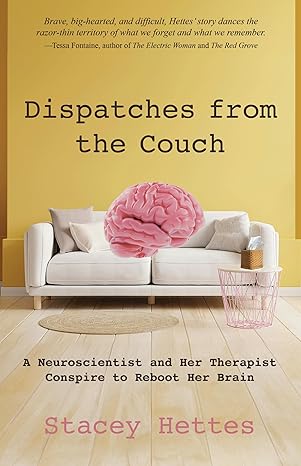

Stacey Hettes’ Dispatches from the Couch is a raw and fiercely intelligent memoir about the enduring scars of childhood sexual abuse and the intricate, often agonizing process of healing. Told from the perspective of a neuroscientist navigating the wreckage of trauma with the guidance of her therapist Piper, the book interweaves personal narrative with scientific insight, exploring how trauma rewires the brain, hijacks memory, and resurfaces across time and context. Structured in therapy sessions and personal reflections, it chronicles Hettes’ journey from silence to voice, from academic achievement to emotional reckoning.
What grabbed me first was the voice. It’s wry, self-aware, cutting through pretense like a scalpel. Hettes doesn’t just tell us she’s hurting. She shows us vividly and unflinchingly. The scene where she recounts the morning after “Breakdown Saturday” and calls her mother sobbing was brutal in its honesty. I loved how she didn’t let herself off the hook, even as she tore into systems and people who failed her. Her relationship with her inner child—at times full of rage, shame, and fierce resistance—is explored with aching detail. In Session 1, she admits, “I full-on loathe her,” when asked to revisit the child self who was abused. That line stuck with me. It’s not the sanitized survivor story; it’s messier, truer.
I also appreciated how Hettes uses her neuroscientific background not as a crutch but as a lens. She doesn’t over-intellectualize the trauma—she complements it. When she explains in the prologue how trauma disrupts memory circuits, or how the limbic system reacts before the thinking brain does, it’s not for show. It’s not jargon. It’s deeply personal, almost like she’s trying to convince herself as much as she is educating us. That balance between head and heart made this memoir something special. Her account of how trauma impacted her at work—especially in Chapter 3, when a university administrator tried to use her “authentic voice” to cover institutional cowardice—was rage-inducing, and familiar. It’s not just about what happened to her as a child. It’s about what keeps happening in a world that still doesn’t know how to hear survivors.
But it wasn’t all darkness. There were so many flickers of light. Piper, her therapist, is rendered with such care and nuance. She feels real—not a savior, but a steady presence who knows when to speak and when to let silence hold space. And then there’s the humor. Hettes’ dry wit shows up even in the bleakest moments. Her description of therapy offices smelling like “mint, ink, and warm paper” actually made me laugh. She’s not just surviving. She’s still herself—sharp, funny, stubborn, and deeply human.
Dispatches from the Couch left me shaken, moved, and strangely hopeful. It doesn’t promise neat closure—just better, not all better. And that felt honest. This is a book for survivors, certainly, but also for anyone who’s ever felt like they’re supposed to be fine when they’re falling apart inside. It’s for therapists who want to understand their clients better. It’s for educators, feminists, and truth-seekers.
Pages: 362 | ASIN : B0DQG8KWNH




 LITERARY TITAN