Blog Archives
One-Man Minority Opinion

In Dissenting Opinion, a federal judge manages to hide his liberal beliefs in order to secure a seat on the Supreme Court. What was the inspiration for the setup of your story?
In The West Wing episode “The Supremes,” one of the characters remarks that the Court is at its best when justices dissent and passionately argue the law. “Who writes the extraordinary dissent? The one-man minority opinion whose time hasn’t come…” For me, this was a powerful scene, a powerful episode. I imagined a Court where there was one lone justice who disagreed with the majority, and from that Dissenting Opinion was born.
What kind of research was required in order to put this novel together?
I tried to stay away from anything that was too technical about the workings of the Supreme Court; I relied heavily on my memory of government and economics from high school and simple internet searches.
Do you have a favorite scene in this book? One that was especially enjoyable to craft?
As a fan of political and legal fiction, I thoroughly enjoyed the whole book, but I think my favorite scene to write was the television interview where I borrowed a quote from The West Wing. Jason is in the television studio and is asked if he thinks he should practice some tolerance toward those who disagree with him and he replies “As long as Justice Reynolds remains intolerant toward women, Black people, gay people, poor people, immigrants and the First and Fourteenth amendments, I will remain intolerant toward him.” Jaws drop, the studio goes silent. I love it.
What is the next book that you are working on, and when will it be available?
I’m working on a psychological thriller, that I hope to have done later this year. It’s about an overworked psychiatrist who begins noticing patterns between his patients, and as he explores these patterns he finds that he is putting himself at risk. As he gets closer to the truth, his own world starts to unravel and he discovers that perception is fragile, reality is shifting and the truth is more terrifying than madness itself.
Author Links: GoodReads | Facebook | Website | Amazon
Dissenting Opinion
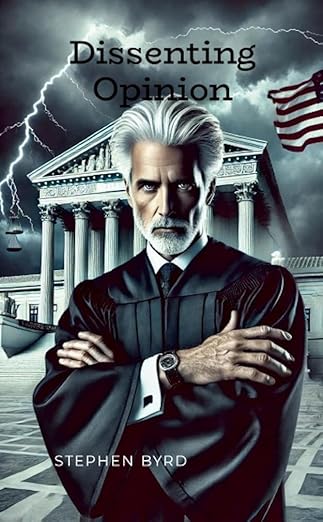

Stephen Byrd’s Dissenting Opinion is a sharp, clever, and wildly timely political-legal thriller that dives headfirst into the shadowy intersections of law, power, and identity. The novel follows Judge Jason Simpson, a respected federal judge tapped to fill a vacant seat on the Supreme Court by a conservative President who assumes Jason is one of their own. But Jason harbors a secret—his true beliefs align more with the liberal camp. What follows is a strategic dance of subterfuge, legal integrity, and ideological rebellion, all wrapped in wit, tension, and some laugh-out-loud moments courtesy of press secretary Vicki Smith’s PR disasters. It’s part courtroom drama, part political satire, and part character study of a man walking the tightrope between truth and survival in a world that expects allegiance above honesty.
I loved how Byrd played with tone. He bounces from biting satire to tense legal sparring without missing a beat. The opening scene with Vicki bungling the death announcement of Justice Egley had me laughing—lines like calling it a “standard, ordinary, everyday expiration of human life” hit with pitch-perfect awkward comedy. But then Byrd shifts gears in the courtroom scenes, like when Jason grills the government lawyer in the Argus Pipeline case. That whole back-and-forth about “potential” environmental harm and due process felt like reading a modern-day Aaron Sorkin script. It was fast, cutting, and quietly enraging. Byrd knows how to build a speech that punches through the page.
What stuck with me the most, though, was Jason’s internal conflict. His private monologues were some of the most honest writing I’ve read in a political novel. When he’s sitting in his study, weighing the morality of accepting the nomination under false pretenses, it’s not just good drama—it’s real. Like when he fears letting “the wrong kind of judge” take the seat instead. Byrd doesn’t shy away from that ethical gray zone. He leans in, and it makes Jason’s choices feel earned, not just symbolic. And the Supreme Court scenes where the other justices slowly start to realize Jason isn’t the conservative clone they expected? Absolutely delicious. It’s the quiet chaos of watching a system unravel from the inside out, led by someone who just refuses to be predictable.
If you like fast-paced political thrillers with brains, bite, and a moral center, this one’s for you. Fans of The West Wing, Scandal, or even Suits will be right at home. It’s not just for legal nerds or political junkies either—this book is for anyone who’s ever wondered what might happen if the person in power decided to put country and conscience before party. It’s smart. It’s brave. And it’s a good time.
Pages: 105 | ASIN : B0DZTRHP6C




 LITERARY TITAN