Blog Archives
A Tricky Topic

The Doctor’s Perspective unpacks the science of testosterone, performance-enhancing drugs, and men’s health, separating fact from fiction while offering practical, evidence-based insights into optimizing wellness. Why was this an important book for you to write?
I think writing this book gave me an opportunity to provide a physician’s viewpoint on these topics that combines real-world clinical experience with evidence-based reviews. Many times, interpreting the literature helps us provide guidance on what to do next. But often times the real-world clinical experience is what really can help someone make decisions, especially when there is a lot of subjectivity involved.
Another important point is that anabolic steroids and performance-enhancing drugs are truly a topic of their own and are essentially not really covered in medical textbooks or online medical platforms. There is simply a complete lack of familiarity with these topics in the medical world. My book helped bridge that gap and provides a useful reference to other physicians.
I provide expert guidance to other physicians on a daily basis on the eConsult platform in Ontario and this really helps build on that.
What was the biggest misconception about testosterone that you wanted to clear up in this book?
I would say that knowing it’s a tricky topic without black-and-white answers. Every person is different and we should really personalize the approach on when or when not to use it.
In your research, what was the most surprising fact you discovered about TRT or PEDs?
Over the years I’ve discovered two very interesting facts.
One is that I’m surprised by the level of side effects some patients see even at low doses whereas others use incredibly high doses yet never experience any side effects and maintain fully normal blood work. The variability is very interesting.
Second, many PEDs have such novel and unique side effects that need to be picked up on early to prevent long-term harm.
How do you think social media and fitness influencers have shaped public perception of testosterone and supplements?
By far the biggest perception is that the term “TRT” has become simply another term for low-dose testosterone use. I think it’s important to distinguish these two topics. TRT is by definition the replacement of low testosterone. That is completely different than supplementation of low-dose testosterone for someone who has normal levels. Social media has definitely been the driving factor in this.
Author Links: GoodReads | Website | Instagram | Amazon
The Doctor’s Perspective: A Look at Testosterone, Wellness and Performance
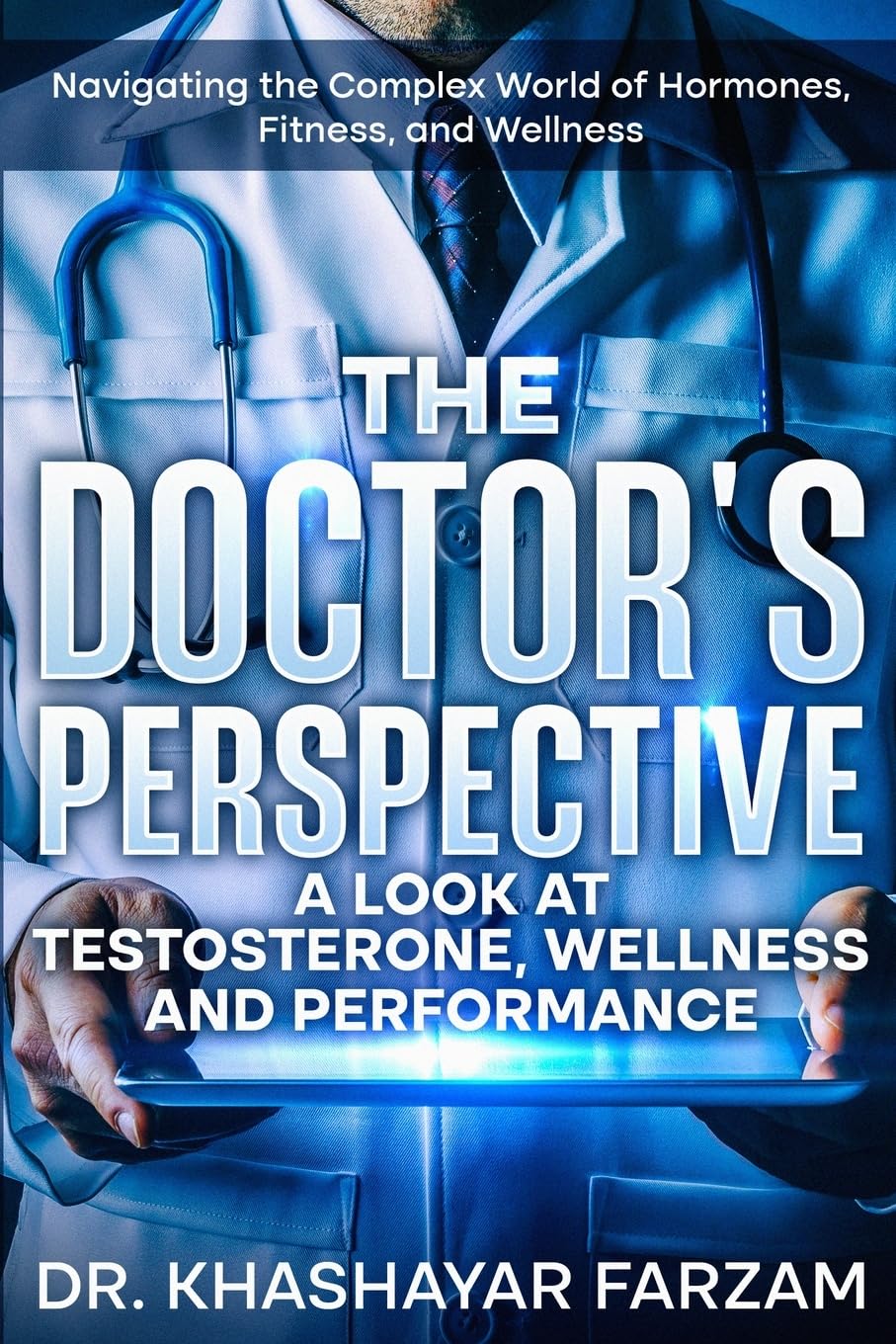

Dr. Khashayar Farzam’s The Doctor’s Perspective dives deep into testosterone, performance-enhancing drugs (PEDs), and the broader realm of men’s wellness. The book does a fantastic job explaining these complex topics in clear terms, focusing on evidence-based practices while challenging the myths that have permeated the fitness and wellness industries. Farzam unpacks testosterone’s physiological importance, the controversies surrounding its medical use, and the nuances of its role in overall health. Whether discussing testosterone replacement therapy (TRT), the murky ethics of PEDs, or practical advice for optimizing health, the book provides a thorough, engaging exploration for both novices and professionals.
I found the chapter on “Science vs. Broscience” especially refreshing. Farzam dissects the fitness world’s penchant for unscientific advice, like the myth that “carbs at night turn directly into fat.” These sections are both entertaining and informative, as Farzam carefully separates truth from fiction. His distinction between anecdotal evidence and peer-reviewed research is a wake-up call for anyone relying on forums or gym folklore for health advice. The detailed examples he provides not only clarify the misinformation but also show how to approach health topics critically.
Another standout section is the discussion on TRT. Farzam approaches it with sensitivity and depth, covering its benefits, risks, and the common pitfalls of self-administering testosterone. The historical context, tracing TRT back to the early 20th century, adds a layer of richness that made me appreciate the strides—and setbacks—in this area. His breakdown of administration methods, from injections to gels, is pragmatic, with pros and cons laid bare. Yet, his cautious emphasis on the importance of medical oversight really hit home. The stories of misuse and misunderstanding around TRT, particularly in fitness circles, serve as a cautionary tale.
Farzam’s dive into supplements and performance-enhancing drugs is equally compelling. His no-nonsense take on testosterone-boosting supplements, many of which he deems ineffective, resonates with anyone weary of exaggerated claims. Chapters on anabolic steroids and PEDs, though technical, are gripping. I appreciated the honest look at why people turn to these substances despite the known risks. Farzam doesn’t judge; instead, he informs, encouraging readers to make educated decisions.
The Doctor’s Perspective is a solid read for anyone curious about testosterone and men’s health. The book balances clinical depth with approachable language, making it ideal for both healthcare professionals and fitness enthusiasts. I’d recommend it to anyone seeking clarity in a world awash with conflicting health advice. It’s not just about testosterone or supplements—it’s about empowering people to make informed, thoughtful choices. This is a book I’ll be revisiting.
Pages: 283 | ISBN: 1069199702




 LITERARY TITAN