Blog Archives
Reacting to the Reality of Lowell

Q: The Fraud of Eternity is a compact, bleakly beautiful collection of poems that circles death, suffering, and spiritual exhaustion in the industrial landscape of Lowell, Massachusetts. Was this always intended as a thematic collection, or did it evolve organically?
Darryl Houston Smith: Honestly, it started from the ground up—literally. I didn’t sit down with some grand master plan to write a bleak treatise on spiritual exhaustion.
It was just me, reacting to the reality of Lowell. When the cold brick of the mills surrounds you, the gray teeth of the Merrimack, and that heavy quiet in the cemeteries, that kind of everyday decay gets into your blood.
At first, I was trying to capture that visceral darkness with as much raw honesty and sharp imagery as I could muster.
But as the pieces started piling up, all that chaotic emotion needed a cage. That’s where the thematic unity really took over. I found myself leaning heavily into strict ABAB and ABCB quatrains, using really dense, hyper-metric lines to rein it all in.
The project naturally evolved into an obsession with dualities—the tension between the sacred and the rotten, the living and the dead. So, while it absolutely began as an organic reaction to my surroundings, enforcing that rigid structure is what ultimately hammered it into the thematic foundation for the rest of the trilogy.
Q: Was there a specific emotional progression you wanted readers to feel?
DHS: Absolutely. The whole point was to make them feel the crushing weight of the oncoming reveal. I didn’t want to offer a gentle, healing arc—it had to feel like a slow, suffocating build. From the very first line, I wanted the reader to experience a creeping dread, a visceral sense that the floorboards of their faith are rotting out from under them.
It’s an emotional progression anchored tightly in those dualities I constantly return to.
You’re pulling the tension tighter and tighter between the sacred and the profane, between the living and the dead, until it simply snaps. By the time that final reveal hits, I want the reader to feel completely, physically exhausted—as if they’ve been dragged through the same heavy, industrial dark that birthed the poems in the first place.
Q: Were there any poets or other writers who influenced your work on this collection?
DHS: Oh, without a doubt. You can’t write about the rot of the modern soul without standing on the shoulders of the masters. Baudelaire and Rimbaud were constantly in my head—they understood how to drag unflinching truth and terrible beauty out of the gutter, which is exactly what I was trying to pull from the industrial ruins here in Lowell.
Then there’s Blake. He is the ultimate architect of dualities, that vicious tension between heaven and hell, which feeds directly into the dyads and strict structures I use to lock my poems together. Poe, naturally, gave me the blueprint for that creeping, psychological dread—the slow, suffocating build toward the dark reveal we just talked about.
And, of course, Jim Morrison. His influence is the bleeding edge of it all, bridging raw, visceral chaos with deliberate poetic intent. Since this collection is the bedrock of the entire trilogy, Jim’s shadow was always going to stretch across these pages. I wanted to take their collective darkness and compress it into something heavy, metric, and entirely my own.
Q: What does the phrase “fraud of eternity” mean to you personally?
DHS: To me, the ‘fraud of eternity’ is the great, comforting lie we’ve all been sold about salvation. We are taught to quietly endure the suffering of the present—the cold, the grit, the spiritual exhaustion of the daily grind—in exchange for the promise of some peaceful, golden forever. But it’s a scam. Eternity isn’t a transcendent afterlife; it’s the dirt of the cemetery. It’s the cold brick of the mills outlasting the flesh of the people who bled into them.
That phrase is about confronting the duality between the lie of heaven and the visceral truth of the grave. People want the romanticized comfort of the divine, but as a poet, my job is to look at the rot and call it what it is. The ‘Fraud’ is the false hope we use to numb ourselves to the present darkness. This collection is about stripping that hope away and forcing the reader to sit with the unflinching reality of our own decay.
Author Website: darrylhoustonsmith@gmail.com
The Fraud of Eternity
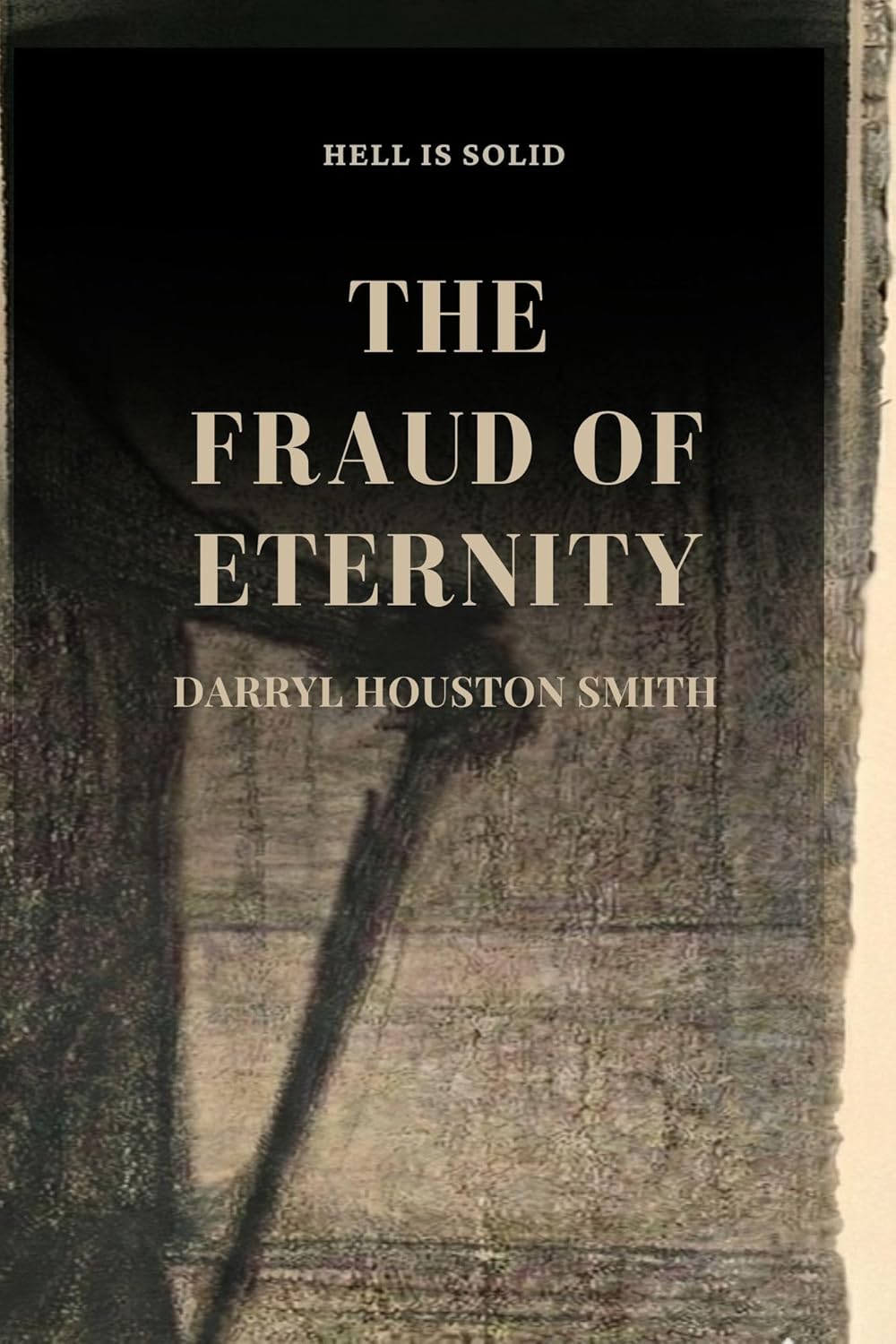

The Fraud of Eternity is a compact, bleakly beautiful collection of poems that circles around death, suffering, and spiritual exhaustion in the industrial landscape of Lowell, Massachusetts. The book moves through four sections, from the cosmic brutality of “The Slaughterhouse” to the brick mills by the Merrimack, then into personal hauntings and finally toward a kind of hard, earthbound acceptance. The voice keeps reaching for images of slaughter, mud, ice, and machinery, and it does that through very strict rhyme and meter, what the author calls “The Dyad,” mostly ABAB patterns that hold the emotion inside tight little cages. References to Baudelaire, Rimbaud, and the French Symbolists appear both directly and through the tone, and the notes at the end make that lineage explicit.
As a reader, I was first grabbed by the sheer force of the language. The images have teeth. “The Monolith,” “The Wheel And The Knife,” and “The Venom Of Thought” all hit with a kind of controlled violence. The clock shaving off skin, the river turned into steel, the falls chewing the water like granite jaws, scenes like that stay with me. The strict rhyme and meter work well here. They act like restraints, and the emotion pushes against them until it starts to vibrate. I appreciate that discipline. In a time when so much poetry goes loose and drifty, the choice to stay formal feels bold and very deliberate. At times, I caught myself reading lines aloud just to feel the rhythm click into place, and that is usually a sign that the craft is doing its job.
The book insists again and again that heaven is empty and that the real, honest place is the “slaughterhouse” of the earth, the warm mud, the mills, the graveyard on a cold Sunday. Poems like “The Morning Star Rejected” and “The Warmth Of Hell” lean hard into that stance, and I felt both fascinated and unsettled. It is a defiantly anti-transcendent vision. No soft afterlife, no comforting light, only heat, soil, and repetition. For me, the most moving pieces are where that philosophy meets human tenderness. “Edson Cemetery (Sunday)” has a quiet envy of the dead that cut deeper than the louder cosmic lines. “The Dyad” turns a metaphysical idea into an intimate portrait of love as two pillars holding up one roof, never merging, still sharing the strain. The pairing of “Fear Not Death (Original)” and “Fear No Death (Eulogy)” adds another twist, one dark and nihilistic, the other gentler and consoling. That contrast made me feel like I was watching the poet argue with himself, and I liked that tension.
I would recommend The Fraud of Eternity to readers who enjoy dark, formally structured poetry, and to people who already feel at home with Baudelaire, Poe, or Jim Morrison’s more apocalyptic writing. It suits anyone who wants a serious, unflinching look at despair, religion, industry, and the body, and who does not mind walking through a very shadowy landscape to get there. If you want poems that stare straight into the night and refuse to look away, this collection will feel like exactly the right kind of trouble.
Pages: 38 | ASIN : B0GF9T4RCZ



