Blog Archives
Isn’t that why any of us write?

The Intrepid: Dawn of the Interstellar Age follows two space crews investigating a potential planet for colonization who discovers a mystery that could alter the course of the human race. What was the inspiration for your story?
It is a big challenge, sitting down to construct a story world and a plot that are not only compelling and fresh but that also have something meaningful to say. My initial inspiration was not for the story itself; it was to write a story that could express the ideas that I believe are the most important for us to be thinking and talking about, as Earthlings. Of course, I then had to find inspiration for the actual story.
I wanted to write hard sci-fi that was as scientifically accurate as possible because, as a scientist, it often bothers me how Han Solo and Captain Kirk manage to avoid the effects that Relativity should have on their relationships with everyone in their lives who is not traveling with them — or aging at the same rate.
I am also passionate about science and believe in promoting scientific literacy. While my background does include the entertainment and technology industries, I was also a science teacher for over a decade, teaching Chemistry and Environmental Science. I am also the co-founder of an international scientific think-tank called The Quantum Bicycle Society (Quicycle.com), where we are making interesting progress in understanding the electron and magnetism at the sub-quantum level. So I wanted my science fiction to reflect the most up-to-date scientific concepts, as well as to show how cool, interesting, and intuitive so many aspects of real science and engineering can be. In fact, I sometimes like to call this S.T.E.M. fiction rather than science fiction.
When it came to the story itself, I wanted one that was not only fun, surprising, and compelling, but that also spoke loudly to many of the central issues surrounding our humanity and the global socio-economic and geo-political interactions that shape our world — today and moving into the future. Human nature and the state of our race is something I have been contemplating for many years. It is the subject of a non-fiction book that I hope to release soon, called The Animal In The Mirror. In it, I seek to unmask our instinctive nature and the way that our fears and emotions govern our thoughts and actions. It is the precise cause of all of our individual and societal dysfunction, and creating a story world provides a wonderful opportunity to present such a message exactly the way I want to say it. In my estimation, the truth of our biological nature is the single most important message about humanity that humanity needs to hear. It is the reason I am writing The Animal In The Mirror, and it is also the reason I wrote this novel.
Although I had not intended to write novels at all, I very much do intend to put these ideas out into the world. A novel seemed like one more logical avenue to employ for the purpose. It also allows these ideas to be presented to those who might not pick up a non-fiction book about human behavior and its evolution as soon as they would an interesting sci-fi novel.
I wanted my story world to bring together some of my favorite sci-fi elements, to write the kind of sci-fi that I would enjoy to read (or watch). I’m a big fan of Asimov, of movies like Contact or Passengers, and shows like The Expanse. My main concern was that it is difficult to approach story elements like the existence of extra-terrestrial civilizations or space colonization without it becoming cliched, cheesy, or implausible, and I really wanted to avoid that if I could.
That is why I decided to write about what our world might be like in 50 years from now, what might be in store for us en route to that future, and how we might react as we reach towards the stars. In reality, how will we humans approach such an interstellar step? Will we manage to achieve and to maintain a stable and peaceful world order? Or will our biological nature get the better of us?
And what if, on our journey, we encountered something REALLY unexpected?
The science inserted in the fiction, I felt, was well-balanced. How did you manage to keep it grounded while still providing the fantastic edge science fiction stories usually provide?
Firstly, thank you. I appreciate you describing it like that. I think a gripping story can occur in the context of any level of science or technology. As a long-time fan of NASA, I wanted to explore what it might be like — what it might really be like — on the first manned mission of exploration to the closest star system — Proxima Centauri, and without employing any ‘fantastical’ science. (Except for one or two story details, like the propulsion speed, for example, but even that I attempted to base upon real physics concepts.)
As I mentioned before, one of the reasons for writing this book was not only to promote scientific literacy but also to bring more attention to the scientific breakthroughs made by members of our Quicycle group. In addition, as a science teacher, I always prided myself on being able to convey scientific concepts in an intuitive and compelling way, making them accessible even to those who don’t see themselves as the ‘science type.’ Science is, after all, a description of the universe around us, and the cosmos is nothing if not super interesting. And science should be intuitive; our own experiences of the world should enable us to relate to the concepts. The fact that many people don’t know the parametric equations that describe a sphere does not mean that they do not have a clear understanding of exactly what a sphere is.
So I don’t think sci-fi needs to dumb down the science in order to be compelling. I think, science is so cool that, if it is incorporated correctly, it can make the story even more compelling. That was my hope. The fact that you asked how I managed to keep it grounded and well-balanced makes me very happy that, at least in your estimation, I succeeded.
What were some themes that were important for you to explore in this book?
The most important theme was how we humans must evolve our behavior and consciousness in spite of our biology — in spite of the fear-based emotional imperatives that hold us back and slow our (psychological) progress, no matter our technological advances. If we choose to, we can evolve our society far more quickly and far less painfully than our instinctive nature would otherwise cause us to endure. But in order to choose it, we must first recognize and accept it.
There are also many misconceptions and unscientific ideas that pervade popular culture regarding important scientific ideas. One example is the Big Bang. It is an idea that violates many basic laws of physics, yet has become a fixed idea — dare I say, a dogma — in the minds of many scientists, and as a result, in the minds of the layman. Fortunately, observations of the James Webb Space Telescope are helping to change that. I also believe it is important that we all understand that our instinctive nature affects our science as much as it affects any other arena of human thought and interaction. It affects our biases and perspectives, and when money or influence are at stake, they corrupt the efficacy of our science. It would be naive to pretend otherwise.
To me, one of the most important things to be concerned with in this life is our deeper purpose. In this book, I try to explore that question on a larger scale. Is it about biological evolution, the evolution of consciousness, or even the idea of galactic community?
It is my deepest hope that, after finishing this book, the reader will continue thinking about it for a long time to come.
Isn’t that why any of us write?
Will this novel be the start of a series or are you working on a different story?
I am very pleased with the way this story world came out. It presents many possible opportunities for sequels and prequels. I have started putting some ideas together for a sequel, and I find the prequel idea also quite compelling. As I mentioned above, I am also working on the non-fiction book about human behavior, The Animal In The Mirror, and I hope to have that finished soon. (I have never found it easy to focus on only one thing. There are just far too many fascinating things out there!)
Author Links: Website | GoodReads | Facebook | Twitter
3rd place Winner, 2023 London Book Festival Awards (Science Fiction)
When crews on the first two interstellar missions confront the same confounding mystery, their dispute over what it means could alter the trajectory of the entire human race.
Thirty years after the last war, in a world of plentiful energy, Lunar and Mars bases, and a global federation of nations, an international crew of exceptional men and women sets out to explore the closest potentially habitable planet in the Alpha Centauri star system.
The stakes become elevated by the unexplained presence of another ship from the solar system, a ship with weapons. When the two crews interpret a perplexing find on the surface quite differently, it brings them into a conflict that threatens to lead to a nuclear showdown — with consequences more far-reaching than they could have imagined.
They may be over 4 light years from Earth, but the implications could not hit closer to home.
And they are too far away for two-way communication.
More than just another space saga, this wild, hard sci-fi ensemble drama (with a touch of romance) digs deep into human nature and the animal instinct that keeps us from elevating our existence. The only question left — is humanity doomed to repeat its mistakes, or are we ready to take the next crucial step?
The Intrepid: Dawn Of The Interstellar Age
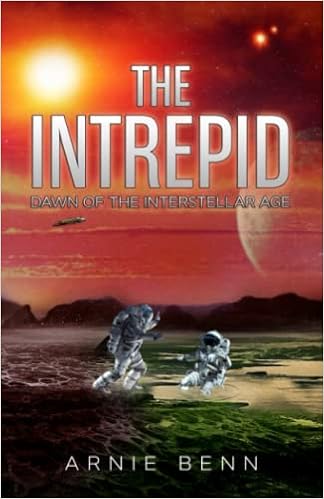

In The Intrepid: Dawn of the Interstellar Age, acclaimed author Arnie Benn masterfully constructs a narrative revolving around a team of astronauts voyaging on a multi-year mission to explore Earth’s closest potentially habitable planet. The plot intensifies as a secondary spacecraft is dispatched to lend a hand, culminating in escalating tensions amongst the crews as they encounter an enigmatic third ship near their intended destination. Upon landing and initiating their reconnaissance, they uncover perils that are not only natural but, to their profound astonishment, man-made, presenting challenges with the potential to unravel decades of peace on Earth.
From the outset, Benn goes to great lengths to emphasize the hard science fiction essence of his novel, as evident in his introductory note and the appendix. He takes pride in ensuring that the technology and scientific principles elucidated in his work have a plausible foundation, even going as far as including a comprehensive glossary of scientific terminology. Essential concepts are smoothly incorporated into dialogues, while additional complex details are artfully presented as optional reading for curious minds.
Benn meticulously devotes considerable time to his characters aboard their ships before catapulting us into the crux of the story. Although this deliberate pace initially might seem unhurried, it serves as an effective tool to foster a deep connection with the characters, ensuring the reader’s vested interest when the main storyline unfurls. The narrative’s pivotal moment, a startling discovery within a shell-like formation at the planet’s North Pole, is flawlessly delivered, validating the slow-burn storytelling method leading up to this point.
The Intrepid: Dawn of the Interstellar Age is a gripping hard science fiction novel that hits home with the plausibility factor. With exciting adventure and a mystery to solve, this story is more than your average space saga; it is a drama-filled look at what the future could hold for humans should we fail to learn from past mistakes.
Pages: 498 | ASIN : B0C1JB518G




 LITERARY TITAN