Blog Archives
When You Feel It, You Cannot Ignore It

The Play follows Harry as he survives a violent childhood and devastating loss, then transforms his grief into a grassroots, youth-led musical movement that fights bullying and bigotry. What made you choose a story that refuses to soften the early trauma and what did you want readers to understand by feeling how raw it is?
I chose not to soften the trauma because too many young people are living it every single day — and society often prefers not to look at it.
Knife carrying. Gang grooming. Bullying that doesn’t end at the school gates because it follows them home through their phones. Loneliness that sits quietly in bedrooms behind closed doors. Mental health struggles masked by bravado. Children vaping at 12. Drinking at 13. Being pulled toward drugs because someone older made it look like belonging.
When we dilute trauma in fiction, we dilute reality. And reality for many young people is not polished — it is raw, frightening and confusing.
I grew up around violence and instability. I saw what happens when pain is ignored. But it became painfully personal when my own son experienced bullying. As a parent, that is your worst nightmare. You feel helpless. Angry. Protective. You replay every conversation wondering what you missed. I realised then that bullying is not just a “school issue.” It is a mental health crisis. It can plant seeds of shame, isolation and self-doubt that last for years.
I wanted readers — especially adults — to feel that discomfort. To feel the claustrophobia Harry feels. The fear. The grief. The injustice. Because when you feel it, you cannot ignore it.
Harry’s trauma is not there for shock value. It is there so young readers who are suffering quietly know this: you are not weak, you are not alone, and your pain is real. And adults reading it — teachers, youth workers, police, parents — must understand that behaviour often comes from unprocessed trauma.
When a young person carries a knife, it is rarely because they want to harm. It is often because they are afraid.
If we do not confront the rawness, we will never address the root.
Several “villain” characters are given room for accountability and change. What did you want to say about harm, systems, and redemption through Mathew Jones and Liam Harris?
Mathew and Liam are not monsters. They are products of broken systems, poor role models, peer pressure and unaddressed trauma.
That does not excuse their behaviour — but it explains it.
In my work around youth intervention, I have seen the pattern repeatedly. A young person bullies because they were bullied. They join a gang because they crave protection. They intimidate because it makes them feel powerful in a world where they feel small.
Society is quick to label young people as “thugs,” “feral,” or “lost causes.” But labels don’t rehabilitate — opportunity does.
Through Mathew and Liam, I wanted to show that accountability and redemption can exist in the same space. They must face what they have done. They must feel the weight of it. But they must also be offered a door to walk through.
That door, in The Play, is the stage.
When young people rehearse together, write lyrics together, perform together — something shifts. Hierarchies dissolve. Identity changes. The “bully” becomes the backing vocalist. The “troublemaker” becomes the lead guitarist. The “quiet kid” becomes the lyricist whose words move an audience to tears.
Redemption is not weakness. It is strength.
If we want to reduce gangs, knife carrying and youth violence, we cannot rely only on enforcement. We need creative alternatives that give young people status, belonging and identity without crime.
Mathew and Liam represent hope — not naïve hope — but structured, accountable second chances.
The book blends prose, lyrics, and a behind-the-scenes build of a show. How did you approach writing the songs so they carry emotional weight?
Every song in The Play was written from lived emotion.
I didn’t approach the lyrics as entertainment. I approached them as conversations young people are often too afraid to say out loud.
When I write a song like “Laura’s Song,” or a redemption anthem within the show, I ask:
What is the child who is being bullied thinking at 2 am?
What is the young boy pressured to carry a knife really feeling?
What is the girl being cyberbullied scrolling through comments in silence?
The songs had to feel honest — not polished pop lyrics, but confessions.
Music reaches places that speeches cannot. A workshop discussion may open dialogue, but a song can unlock tears. It bypasses ego. It allows young people to sing what they cannot say.
Structurally, I ensured that each lyric serves a psychological purpose:
- Validation – “You are not crazy for feeling this.”
- Accountability – “We must own what we’ve done.”
- Belonging – “You are part of something bigger.”
- Empowerment – “You can choose a different path.”
When young people perform these songs, they are not just acting — they are reclaiming their voice.
And in a world where cyberbullying silences and gangs recruit through fear, voice is power.
What do you most hope teens (and the adults who work with them) take away from Harry’s choices?
For teens, I hope they see that pain does not have to define them.
Harry could have chosen anger. He could have chosen revenge. He could have chosen gangs. Instead, he chose leadership. He chose art. He chose to build something.
I want young people to understand that vulnerability is not weakness. Asking for help is not weakness. Walking away from a gang is not weakness.
It is courage.
For adults — teachers, parents, police officers, youth workers — I hope they understand that prevention must be creative, not reactive.
When we only respond after violence, we are too late.
Young people need:
- Safe spaces.
- Mentors.
- Creative outlets.
- Structured belonging.
- Mental health support without stigma.
When my son experienced bullying, it shook me deeply. I realised that if it could happen in my family, it is happening everywhere. I did not want to complain about the system. I wanted to build something that changes it.
The arts are not a luxury. They are intervention.
When a child is rehearsing, they are not on a street corner.
When they are writing lyrics, they are not scrolling hate.
When they are performing, they are not vaping behind a bike shed.
They are seen. Heard. Valued.
If The Play inspires even one young person to drop a knife, leave a gang, or speak up about bullying — then it has done its job.
Author Links: Spotify | GoodReads | X | Facebook | Website
At school, he was the kid everyone picked on. At home, he was the kid who learned to stay quiet when fists flew and bottles smashed. He was hungry more often than not, exhausted all the time, and somehow still expected to protect the one person who mattered more than anything else – his seven-year-old autistic little sister, Sara, and her one-eyed teddy bear, Bear.
Sara didn’t understand the shouting, the chaos, or why home never felt safe. She didn’t understand fear the way Harry did. But Harry understood it all too well, and he learned quickly that if he didn’t stand between her and the world, nobody else would.
Then came the day everything changed.
The day Harry lost Sara at the hands of the very people who were meant to keep her safe.
Her death didn’t just break him – it lit a fuse.
Years later, carrying grief like a constant ache in his chest and clinging to his promise to look after Bear, Harry finds a way to turn pain into purpose. What starts as a fragile idea becomes something bigger than he ever imagined: THE PLAY(c) – a raw, fearless youth musical where kids like him don’t sit quietly at the back anymore. They step into the spotlight. They rehearse. They sing. They dance. They perform. And, for the first time, they are truly heard.
But THE PLAY(c) is more than a performance.
Built into the heart of the project are trauma-informed mental health workshops, giving young people safe, structured spaces to talk about what they’re carrying – bullying, cyberbullying, racism, loneliness, domestic violence, gangs, antisocial behaviour, grief, anxiety, anger, and the desperate need to belong. Through creativity, shared experience, and guided support, the cast begin to understand themselves and each other in ways that school, social services, and the system never managed.
Told in Harry’s raw, funny and heartbreakingly honest voice, THE PLAY(c) is the first book in a powerful YA series where every cast member has a story worth telling – and every story matters. It’s about broken kids finding strength, about chosen family, and about learning that survival doesn’t have to be the end of the story.
With two live productions already completed and the project gaining momentum far beyond the page, THE PLAY(c) is no longer just a novel – it’s a movement, and one that is already attracting serious interest as a future TV drama.
This is a story about pain, yes – but more than that, it’s about hope, courage, and what can happen when young people are finally given the space to speak.
Once the curtain rises, there’s no going back.
The Play: Harry’s Story
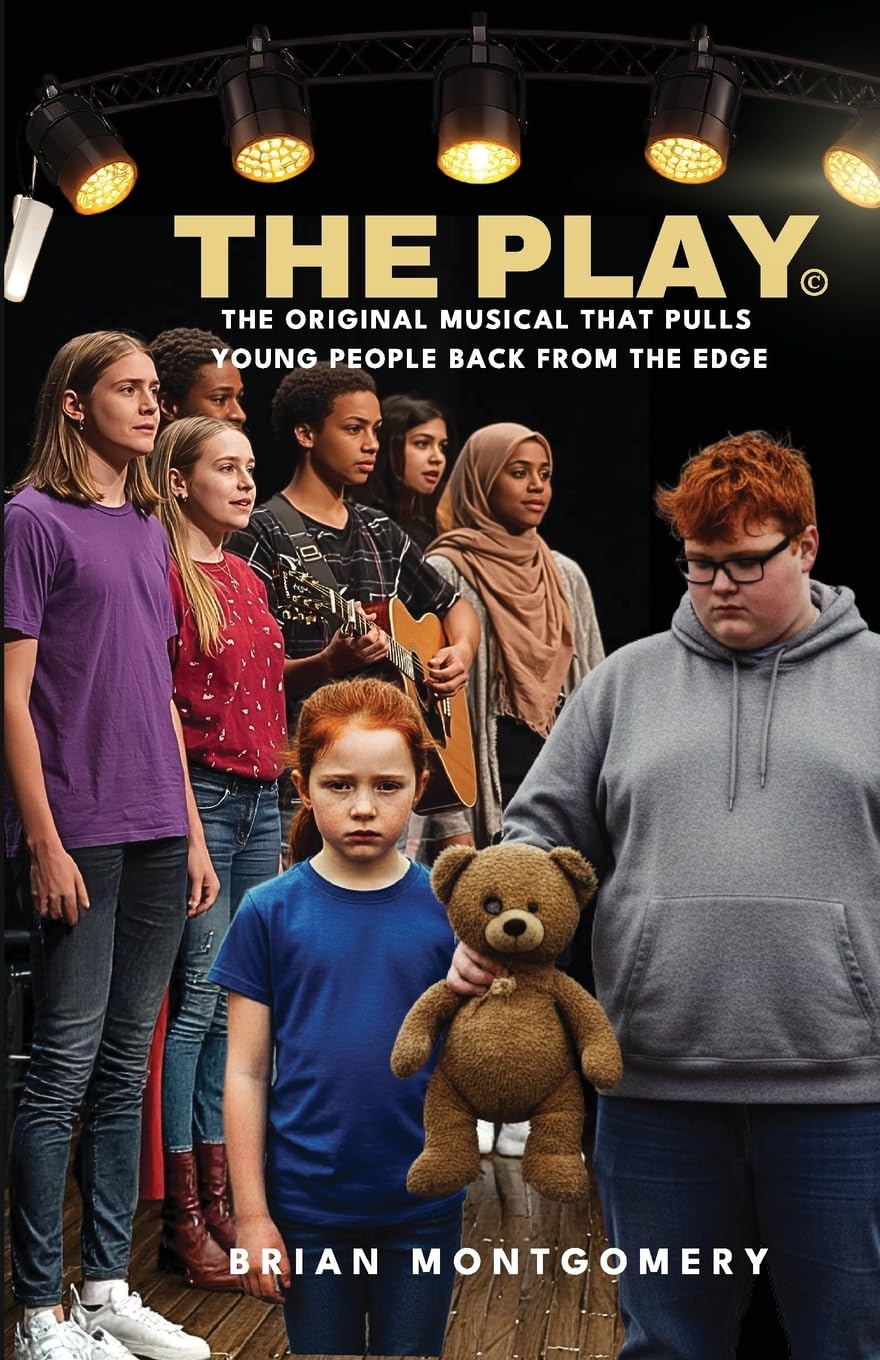

The Play: Harry’s Story by Brian Montgomery follows Harry Groves from a brutal childhood in a violent, neglectful home through years of bullying at school and then into the creation of “The Play”, a grassroots musical project that turns his pain, and the pain of his friends, into something hopeful and loud. The book moves from Harry’s life with his little sister Sara, through her death at the hands of their parents, into foster care, healing, and eventually a youth-led performance movement that tackles bullying, racism, homophobia, transphobia and mental health head on, both on stage and in real life. It starts in a damp social housing unit and ends on the road with a touring show and an epilogue that stresses survival, persistence, and responsibility to the next generation.
Reading it, I felt like I was being dragged into a storm right alongside Harry. The early chapters are very emotional. The scenes of abuse at home and the cruelty at school are not softened. They feel raw and, at times, hard to look at. I found myself angry at the adults who look away, and at the same time very protective of Harry and Sara. The moment when Sara dies, and Harry learns what happened in that small office at school, left my stomach in knots. The writing there is simple, direct, and emotional, and that choice makes it land even more. Later, when Harry begins to write “for Sara” and then turns that grief into a musical project, I felt a real lift. The book does not pretend that art magically fixes everything. It shows a long, messy grind full of small wins and big setbacks, which made Harry’s eventual success feel earned rather than easy.
I also connected with the way the book treats the wider cast and the bigger ideas. The bullying in this story is not one-note. It covers racism, religious abuse, queerphobia, class, disability, and online cruelty, and it lets those kids have voices, songs, and arcs instead of keeping them as background. Chapters like “Bullies Not Welcome Here,” “Redemption”, and “The Reformed Trio” shift the lens and allow room for change and accountability, even for characters like Mathew Jones and Liam Harris, who start as almost pure villains. That choice won me over. It shows how harm comes from systems and pain, not only from “bad kids”. I liked the mix of prose, bits of lyrics, and the behind-the-scenes feel of building a show. Sometimes the narration tells me what to feel instead of trusting the scene, but the honesty behind it comes through so strongly that I was willing to go with it.
By the time I reached the epilogue, with Harry looking back on the funding fights, the rejections, and the moment he turns down a big film deal to protect the “heart” of The Play, I felt proud of him. The project has grown into something bigger than one boy’s story. It becomes a touring movement that belongs to every young person who steps on stage or sits in the audience and finally feels seen. That final note of “still standing” feels earned.
I would recommend The Play: Harry’s Story to teens and adults who want a frank and heartfelt story about abuse, bullying, grief, and recovery, and who can handle some very heavy scenes along the way. It’s a good fit for youth workers, teachers, and parents who want to understand what some kids are living through, and for young readers who feel invisible or silenced and need to see that their stories matter and can be turned into something powerful and public. If you are ready for a story that hurts, then reaches for hope and community and the power of performance, this book is worth your time.
Pages: 328 | ISBN: 1764489438

Presence, the Play

Presence, The Play is an intellectually invigorating tale that plays with the imagination and words itself. Script is a Brother in Estillyen’s Sacred Order of Storytellers, an ancient order of monks dedicated to telling the stories of the world and creating them. Script’s play, Presence is about to open in the Theatre Portesque, but tragedy strikes. Script is thrust into a world in which not everything is clear to see and he is tasked with a very important mission that will place him in Hell itself.
The concept of Presence, The Play is similar to Alice in Wonderland in the complete creation of a new world with its own laws and wording that can be literal and metaphorical. However, the book is not the typical Alice in Wonderland story in that our hero, Script, controls his own fate and learns to navigate this new world. There are hidden meanings within Script’s journey that he unravels and applies to life. Another element of the book that makes it so interesting is its religious aspect. The religious ideas never become overly didactic, but it is applied in a unique perspective, particularly as it relates to the power of words and stories. Another element of the Alice in Wonderland style narrative is that in the end, the reader is left questioning how much is real or imagined.
The themes explored in this contemplative novel are intriguing. The book is a great reminder of the power and importance of words and stories. The religious undertones enhance this message as well by emphasizing the power of ancient stories and lessons. Furthermore, the book seems to impart the lessons of rejoicing in art and literature and sharing them with others or being kind to others in this age of social media. In a world where the power of art is diminished by media every day, this book is a powerful reminder of the potent messages art carries.
Presence, the Play is a thought-provoking story that is well-written, has great characters, and a great message. If you enjoy uniquely expressive novels then this imaginative story is for you.
Pages: 257 | ASIN: B08X6B7RHF



