Blog Archives
Women Trying to Find Solutions

We Should Not All Be Feminists follows two women traveling to India with feminist aspirations who learn the real meaning of feminism from the people they meet there. What was the inspiration for the setup of your story?
First let me thank you for giving me the privilege of addressing the readers of Literary Titan through this interview.
Even though no Western feminists, to my knowledge, came to India with feminist aspirations, my interest in the lives of literary theorists like Kate Millett, Rebecca Walker, and others was probably a reason why I constructed such a story. I had read that under the influence of Western feminism, groups such as the Women’s India Association (WIA) and National Council of Women in India (NCWI), West-educated Indians thought in terms of helping Indian women after World War I. This could have been an additional reason for the initial idea of the story.
I have not said that the women who travel to India learn the real meaning of feminism here, but perhaps the reader sees a distinction between fake and genuine feminism because of their visit to India.
Your characters go on a journey of self-discovery in this novel. Were you able to achieve everything you wanted with the characters in the novel?
The two women find what they want in India. Emelia finds Neville, who had deserted her in America. When she comes to India, she also learns a great deal about rebirth, something she was always interested in. Clarissa finds a woman who she takes to England to help her in more ways than one, both professionally and personally.
A London literary agent once said that my novel was the reverse of A Passage to India. In that novel, the two women who came to India go back without finding what they had come here for. But in my novel, the two women do get what they have longed for.
I tried my best to create characters who would be both types and individuals in different parts of the novel. I wanted them to provide humor, seriousness, wit, and satire. I think I achieved those aspects for my novel.
What were some themes that were important for you to explore in this book?
I have always loved to write about women. All my earlier books are intimately connected with women’s experiences. I have felt that knowing what a man would feel in a given situation is not enough. It is more important to know what a woman would feel when faced with problems. Similarly, women must know the same regarding men. It is only then that society will be a positive institution.
The novel reveals the emotional side of two entirely different women, one Brit and the other American. A third woman, an Indian, places herself between these antipodal positions. She escapes from an unpleasant home and finds a kind of freedom that most women would not want. But then that is her fate, the best option she has. A central theme is women trying to find solutions to their problems.
Another theme results from the magical realism supporting the novel. It relates to lives beyond this present birth in which we are placed.
[This novel will be an audiobook too by the end of this year.]
What is the next book that you are working on and when can your fans expect it to be out?
My next book is From a Writer’s Blog: Facets of the Novel Today. I hope to publish it by the end of 2024, if not earlier. I have compiled my blog posts on fiction or related topics for the decade.
Writers and students of fiction, which could number millions, are still trying to discover the finer points that cannot be ignored when writing or studying fiction. There are so many books on the theory of the novel and novelists for professors. However, there is quite a void when you think of novelist professors explaining the art and craft of fiction. It is like saying what is shown cannot be stated. Here is a novelist-professor showing what goes on in his mind. This book contains theory, criticism, and the creative process concerning the novel. It also focuses on reading, writing, and publishing the novel today.
Author Links: GoodReads | X | Facebook | Website | Book Review
In this novel, humor and high seriousness take you through the literary tourism of India.
WE SHOULD NOT ALL BE FEMINISTS
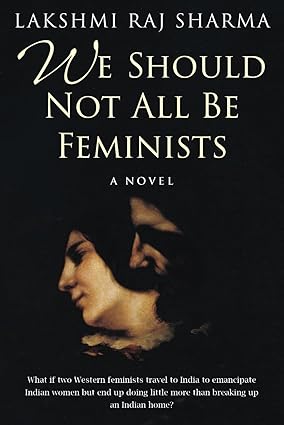

We Should Not All Be Feminists by Lakshmi Raj Sharma explores the lives of several women and their complex relationships with men, their personal struggles, and the societal expectations imposed on them. The story revolves around Emelia, a thoughtful and introspective woman navigating her identity, personal losses, and ideas of feminism. The novel also introduces Rajni, Vibha, and Clarissa, among others, each representing different facets of womanhood, relationships, and the feminist movement. Through their interconnected lives, the novel delves into themes like empowerment, love, and the often contradictory expectations placed on women.
The emotional depth with which Emelia’s inner thoughts are portrayed really draws you in, especially as she contemplates her relationship with Neville and her self-worth. Her reflections, like those following her dreams or the loss of her mother, feel raw and real. Emelia’s journey as she tries to reconcile her romantic life with her growing political awareness is incredibly engaging, particularly her thoughts on Lady Jane Grey and her budding feminist outlook.
What stood out the most for me was the novel’s handling of relationships and power dynamics. Emelia’s relationship with Neville, Vibha’s marriage, and the tumultuous connection between Rajni and his wife all reveal different aspects of the struggle for balance in love and autonomy. For example, Rajni’s attempts to reconnect with his wife after arguments are portrayed with a painful realism. It’s awkward, uncomfortable, and relatable. Similarly, Vibha’s struggle within her oppressive marriage and her attempts to find solace and solidarity in the Women’s Emancipation Cell poignantly reflect the real-life frustrations many women face. The contrast between Vibha’s personal challenges and Emelia’s internal battle between her past with Neville and her feminist awakening made me feel like I was exploring a mosaic of modern womanhood.
I would recommend this book to anyone interested in nuanced depictions of women’s inner lives and the complexities of relationships. I think it’s especially suited for readers who enjoy exploring feminist themes without wanting a straightforward or preachy narrative. We Should Not All Be Feminists offers rich insights into the lives of women trying to find themselves in a world that often seeks to define them.
Pages: 244 | ASIN : B0DCVFVQTJ




 LITERARY TITAN