Blog Archives
Poetry Thrives on a Mystery

What We Hold No Longer is a collection of poems that circle around memory, aging, identity, and the haunting void that lies beneath it all. What inspired you to write this particular collection of poems?
I’ve recently become an avid reader of psychoanalyst Adam Phillips. Last year, one of his books introduced me to Jacques Lacan. Specifically, how our subconscious impacts language, and in turn, how we use language shapes desire. For a poet, what could be more delicious to explore? Ineluctably, even mentioning Lacan brings up his theories on the Void (The Thing) and religion. This, in turn, led me to Lacanian scholar Richard Boothby (Embracing the Void). Along the way, I also read a book by Phillips on our ambivalence towards transforming our lives (On Wanting to Change). Transformation is a particularly important topic at this stage of my life. What I did not anticipate in reading this book was the evocation of so many memories. As a pediatric psychoanalyst, Phillip’s description of childhood, particularly the excruciating years of adolescence, flooded me with things I’d long forgotten (eg, seeing my grandfather’s corpse at age 9, the inchoate sense of frustration, and seeking revenge on my parents’ reputation with a can of red spray paint, etc.).
Can you share a bit about your writing process? Do you have any rituals or routines when writing poetry?
I’m trying to understand my writing behavior. I appear to have a natural rhythm, whereby I’ll write a dozen poems over a month or two and then go silent for just as long. During the quiet months, I read more and pay attention to what I see and listen to: all the things popping up as thoughts and feelings. The poems “The False God’s Lullaby” and “New Year’s Day” were brief glimpses of people, just a few moments of an image that resonated deeply, and unexpectedly.
What moves me from outside triggers something poignant nesting deep inside: “The I of my other who moves silently with me” (The False God’s Lullaby). Also, I love editing. Paul Valéry once said: “A poem is never finished, only abandoned.” I think he meant you can always refine and improve a poem. I try to limit my revision window to six months. Once a poem reaches structural stability (ie, I know what I want to say and the confines to say it in), I put it away for several days or weeks at a time. It’s important to understand that during initial composition, the poem’s neural map is being built using high stores of neurotransmitters. This is how we learn. However, it also prevents us from seeing inherent weaknesses when we’re still trying to get our thoughts written down. Taking a break for days or weeks reduces neurotransmitter stores. This removes the blinders to our writing, so we can see problems more readily and find better ways to say what we’re trying to convey.
How do you approach writing about deeply personal or emotional topics?
I think it is important during initial composition to just let things rip, because that is likely to be the most truthful. However, there is a balance to be struck. I’m reminded of a phrase from the Upanishads: “The path to salvation is narrow. It is as difficult to tread as the razor’s edge.” I view confessional poetry as an attempt to achieve psychic salvation. To shy away from powerful emotions creates a sense of falsity impossible to ignore. Yet, in the passion of writing, we can also say too much. Poetry thrives on a mystery, on what is left unsaid. That’s part of the art form I’m still working on improving.
How has this poetry book changed you as a writer, or what did you learn about yourself through writing it?
I have the sense in writing What We Hold No Longer that I’m beginning to mature as a poet. I’m not sure anyone else would agree. But there was something about the Lacanian cycle of poems that shifted my writing in a way I haven’t fully grasped. At this moment, I can’t imagine writing anything more profound or better composed than those poems. Time will tell. Every book I’ve written so far has enriched my sense of self and given me a sense of being more at peace with myself. Something that had eluded me before I’d written The False God’s Lullaby.
Author Links: GoodReads | Amazon
Such topics have been the foundation of his poetry explored in his previous works and have been expanded upon in “What We Hold No Longer.” As in his other works, poems are grouped together in themes. These themes approached from a deeply psychic perspective and include: personal transformations throughout life, existential encounters with “Nothingness,” the rise of fascism, loss, and the realm of an interior life (both our conscious narratives and our river of unconsciousness). What Gedaliah refers to as “the I of my other, who moves silently with me” (The False God’s Lullaby).
The poems in this current collection maintain characteristics that reviewers of his previous works have consistently noted. That “Gedaliah seamlessly blends philosophical depth with artistic expression, offering a deeply reflective journey through identity and human complexity, striking a perfect balance intellectual exploration and emotional resonance.”
What We Hold No Longer
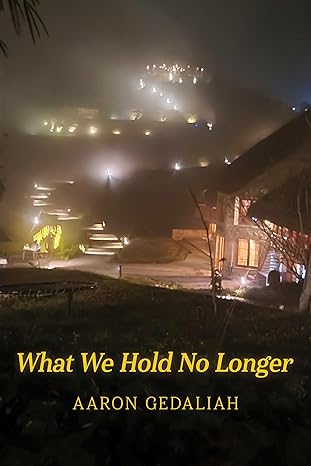

Aaron Gedaliah’s What We Hold No Longer is a collection of poems that circle around memory, aging, identity, and the haunting void that lies beneath it all. The book moves through phases of transformation, wrestles with the Lacanian “Thing,” looks at the unraveling of society, and then slips into reflections on love, loss, desire, and imperfection. It blends the deeply personal with the philosophical, balancing childhood recollections with meditations on mortality, politics, and the quiet strangeness of being human.
Some of the poems struck like sudden jolts. They’re raw, unfiltered emotions that left me uneasy in the best way. Others drifted, slow and lyrical, catching on the edges of memory. Gedaliah doesn’t shy away from pain, whether it’s private grief or public horrors, and I respected that. I thought the psychoanalytic undertones and references added a fascinating depth to the collection. They gave the poems a layered richness that invited me to think as much as feel. What made the book especially strong, though, was the way those ideas blended with moments of plain vulnerability. The balance between theory and raw emotion kept the work dynamic, and the times when the language leaned into honesty and looseness stood out all the more because of that contrast.
The book feels like someone holding a mirror up to both his own past and the chaos of the present world. He talks about adolescence with brutal honesty, aging with rueful wit, and political violence with fury. I connected with the tenderness in “Birds on a String,” the ache in “Paradise Lost,” and the weary warning of “When the Shelves Are Empty.” There’s something relatable in the way he lets contradictions live side by side, rage and love, despair and beauty, the personal and the universal. It made me stop more than once and just sit with my own ghosts.
I’d say What We Hold No Longer is best for readers who like poetry that wrestles hard with ideas yet still finds room for confession and story. It would suit anyone interested in memory, loss, or the philosophical edges of spirituality.
Pages: 85 | ASIN : B0FPG8MLQ9



