The Girl with Free Feet
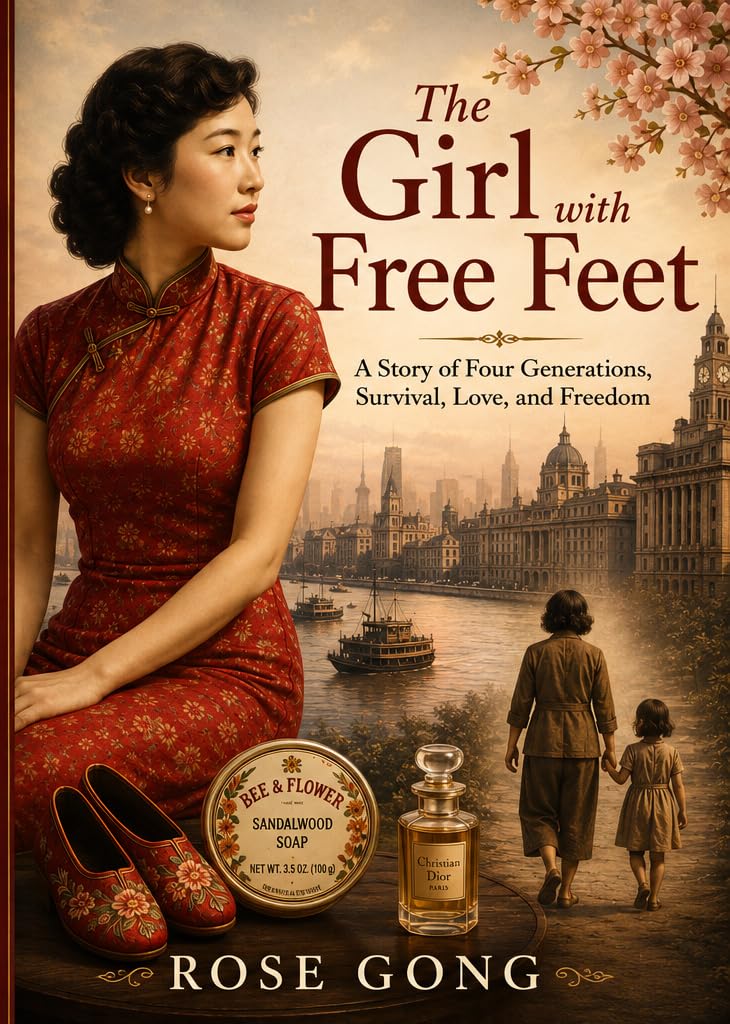

Rose Gong’s The Girl with Free Feet is an intimate family narrative about women’s freedom and the complicated work of claiming it. Drawing on family history and personal memories, Gong tells the story through reconstructed scenes and dialogue, with her mother, Rita, at its center. We meet Rita as a curious, quick-witted teenager in Shanghai, growing up in a household where education, elegance, and obedience carry considerable weight. Her mother Rong’s bound feet give the title its immediate meaning, while Rita’s questions introduce a wider concern: how much say does a woman have over her own life? That question connects the book’s treatment of love, motherhood, political upheaval, and immigration. Its emotional pull comes from seeing those concerns take shape within one family, through everyday conversations and competing expectations.
The book’s strongest feature is its feel for domestic life. Steaming breakfast buns, the scent of sandalwood soap, a carefully fitted qipao, and music drifting through a house give these memories texture. Objects carry associations that deepen as the story progresses, making the family’s past feel tangible. Rita herself brings plenty of energy to the page. She’s funny, impatient, proud, and eager to learn, and her teasing exchanges with relatives keep the early chapters lively. I especially appreciated the attention Gong gives to the women around her, including her sister and the people whose care sustains the household. Affection often appears through practical gestures: preparing food, adjusting clothing, sitting beside someone, or making room for a difficult conversation. Those details make the relationships feel close enough to recognize.
As the story moves through periods of fear and upheaval, Gong keeps her attention on how people experience them at home. History affects what families can say, which possessions they value, and what parents hope to preserve for their children. Education becomes particularly moving in this context, both as an opportunity and as a habit of questioning. The book also gives personal choice a complicated emotional life. Desire, loyalty, guilt, and gratitude can occupy the same relationship, and Gong acknowledges the responsibilities that accompany independence. Her prose is accessible and strongly shaped by dialogue, short paragraphs, and recurring images. At times, repeated reflections on feet, wings, movement, and freedom explain a scene’s meaning so fully that they soften its impact. Some conversations also have a polished, almost proverbial quality. The sensory details and family tensions are where the writing feels most convincing.
I’d recommend The Girl with Free Feet to readers who enjoy family memoirs, stories centered on women across generations, and accounts of Chinese immigrant experience. People interested in how political change enters private life will find plenty to consider, especially in the book’s attention to parenting, education, and the ways fear alters ordinary routines. It would also make a thoughtful book-club choice, with room to discuss the relationship between freedom and responsibility, the expectations daughters inherit, and the difficulty of understanding our parents as people with desires of their own. Its openly emotional style will appeal to readers who like warmth, humor, and reflection alongside painful material. What stayed with me was the care behind the telling: a daughter trying to understand her mother’s life and preserve the experiences that shaped her family.
Pages: 329 | ASIN : B0HGB5XQJ1


Posted on October 9, 2026, in Book Reviews, Four Stars and tagged author, book, book recommendations, book review, book reviews, book shelf, bookblogger, books, books to read, ebook, goodreads, Historical Asian Biographies, indie author, kindle, kobo, literature, memoir, nonfiction, nook, novel, read, reader, reading, Rose Gong, story, The Girl with Free Feet, True Stories, women, writer, writing. Bookmark the permalink. Leave a comment.



Leave a comment
Comments 0