Blog Archives
A Journey Toward Independence

The Girl with Free Feet is a moving multigenerational narrative that celebrates the women whose courage, sacrifices, and difficult choices helped create new possibilities for their families. What was most important to you about preserving these experiences for future generations?
I was born during the Great Chinese Famine and grew up during the Cultural Revolution. I witnessed how quickly political upheaval could destroy families, separate loved ones, and take away freedoms we often take for granted.
But my mother’s life began in a very different China. She grew up in a privileged Shanghai family, surrounded by traditions that shaped women’s lives for generations. Her mother had bound feet, while my mother was fortunate enough to grow up with free feet. To me, that difference symbolizes much more than a physical change. It represents the beginning of a journey toward independence.
I wanted to preserve not only the suffering and sacrifices of these women, but also their love, courage, humor, and determination. History books record political events, but family stories reveal how ordinary people lived through them.
Most importantly, I wanted my grandchildren and future generations to understand where they came from and how much courage it took for their ancestors to give them the opportunities they enjoy today.
What did you discover about the relationship between mothers and daughters while exploring these generations?
I came to understand that mothers and daughters are connected by both love and expectations, and that love is not always expressed in ways we recognize at the time.
Each generation of women in my family wanted something better for the next. My grandmother lived within the restrictions of traditional Chinese society. My mother sought education, love, and greater independence. I eventually found opportunities in America that neither of them could have imagined.
As a daughter, I did not always understand my mother’s decisions. Writing her story helped me see her not simply as my mother, but as a young woman with dreams, disappointments, and difficult choices of her own.
I discovered that understanding our mothers requires looking beyond the roles they played in our lives and recognizing the women they were before we were born.
What parallels do you see between the struggles for independence experienced by the women in your story and the challenges women face today?
The circumstances have changed dramatically, but the desire for independence remains the same.
My grandmother’s generation struggled against traditions that literally bound women’s feet. My mother’s generation fought for education, the freedom to love, and the right to make personal choices amid political turmoil.
Today, women have far greater opportunities, yet many still struggle to balance family expectations, careers, relationships, and their own ambitions.
Freedom is not simply the absence of restrictions. It is the ability to make meaningful choices about one’s own life.
One lesson from my family’s history is that progress is never guaranteed. The freedoms women enjoy today were made possible by the sacrifices of earlier generations, and they must continue to be valued and protected.
What do you hope younger generations, particularly daughters and granddaughters, learn from Rita’s life and the experiences of the women in your family?
I hope they learn to be courageous, independent, and compassionate.
Rita’s life reminds us that we cannot always control history or circumstances, but we can choose how we respond to them. She experienced love, heartbreak, political persecution, and extraordinary changes, yet she never lost her independent spirit.
I especially hope my granddaughter Zoey understands that the freedom she enjoys today is a precious inheritance. Her great-grandmother had free feet, but she still faced many invisible restrictions. My generation crossed oceans to find greater opportunities. Zoey’s generation can walk even further.
That is the meaning behind my book’s title. Free feet are only the beginning. True freedom is having the courage to choose your own path.
Author Links: GoodReads | Facebook | X |
Born into a changing Shanghai, Rita grows up in a world suspended between old traditions and a new China. Her mother, Rong, walks on feet bound in childhood—a painful inheritance from a culture in which obedience was expected and freedom, especially for women, was limited.
Rita is different.
She wants an education. She wants independence. And she wants the freedom to choose whom she loves and what her life will become.
But history has other plans.
As political upheaval transforms China, Rita’s family is swept into forces far beyond their control. Love is separated by distance. Family security disappears. The Cultural Revolution brings fear, persecution, and loss. Yet through marriage, motherhood, heartbreak, and extraordinary change, Rita refuses to surrender the independent spirit that has always defined her.
Eventually, that journey carries the family across an ocean to America—and toward freedoms earlier generations could scarcely have imagined.
Inspired by family history and personal memory, The Girl with Free Feet is an intimate multigenerational story of women, family, resilience, sacrifice, and the complicated choices people make in order to survive.
Above all, it is a story about what one generation endures so the next can walk more freely.
The Girl with Free Feet
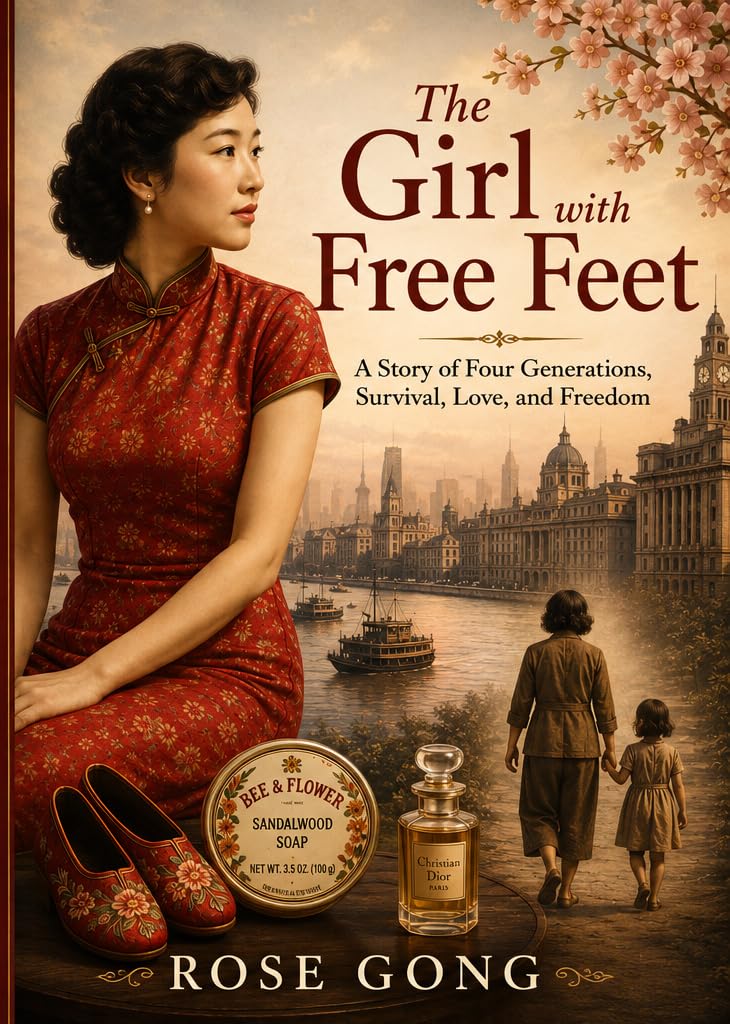

Rose Gong’s The Girl with Free Feet is an intimate family narrative about women’s freedom and the complicated work of claiming it. Drawing on family history and personal memories, Gong tells the story through reconstructed scenes and dialogue, with her mother, Rita, at its center. We meet Rita as a curious, quick-witted teenager in Shanghai, growing up in a household where education, elegance, and obedience carry considerable weight. Her mother Rong’s bound feet give the title its immediate meaning, while Rita’s questions introduce a wider concern: how much say does a woman have over her own life? That question connects the book’s treatment of love, motherhood, political upheaval, and immigration. Its emotional pull comes from seeing those concerns take shape within one family, through everyday conversations and competing expectations.
The book’s strongest feature is its feel for domestic life. Steaming breakfast buns, the scent of sandalwood soap, a carefully fitted qipao, and music drifting through a house give these memories texture. Objects carry associations that deepen as the story progresses, making the family’s past feel tangible. Rita herself brings plenty of energy to the page. She’s funny, impatient, proud, and eager to learn, and her teasing exchanges with relatives keep the early chapters lively. I especially appreciated the attention Gong gives to the women around her, including her sister and the people whose care sustains the household. Affection often appears through practical gestures: preparing food, adjusting clothing, sitting beside someone, or making room for a difficult conversation. Those details make the relationships feel close enough to recognize.
As the story moves through periods of fear and upheaval, Gong keeps her attention on how people experience them at home. History affects what families can say, which possessions they value, and what parents hope to preserve for their children. Education becomes particularly moving in this context, both as an opportunity and as a habit of questioning. The book also gives personal choice a complicated emotional life. Desire, loyalty, guilt, and gratitude can occupy the same relationship, and Gong acknowledges the responsibilities that accompany independence. Her prose is accessible and strongly shaped by dialogue, short paragraphs, and recurring images. At times, repeated reflections on feet, wings, movement, and freedom explain a scene’s meaning so fully that they soften its impact. Some conversations also have a polished, almost proverbial quality. The sensory details and family tensions are where the writing feels most convincing.
I’d recommend The Girl with Free Feet to readers who enjoy family memoirs, stories centered on women across generations, and accounts of Chinese immigrant experience. People interested in how political change enters private life will find plenty to consider, especially in the book’s attention to parenting, education, and the ways fear alters ordinary routines. It would also make a thoughtful book-club choice, with room to discuss the relationship between freedom and responsibility, the expectations daughters inherit, and the difficulty of understanding our parents as people with desires of their own. Its openly emotional style will appeal to readers who like warmth, humor, and reflection alongside painful material. What stayed with me was the care behind the telling: a daughter trying to understand her mother’s life and preserve the experiences that shaped her family.
Pages: 329 | ASIN : B0HGB5XQJ1

SOLAR COASTER: The Untold Story of the Solar Industry and One Man’s Journey Leading with Soul

SOLAR COASTER by Jared Schoch is part business memoir, part history of the modern American solar industry, and part reflection on faith, purpose, and leadership. Schoch traces his path from an ambitious young professional in high tech and corporate energy to an early leader in solar, eventually helping build TurningPoint Energy. Along the way, he explains why the phrase “solar coaster” fits an industry shaped by changing tax credits, politics, utility rules, interest rates, supply chains, technology, and public opinion. What gives the book its personality, though, is that Schoch treats all of those professional twists as part of a larger personal journey. From the beginning, he connects business decisions with the question of what makes work meaningful and argues that purpose should sit at the center of a career.
Some of the most engaging sections for me come from Schoch’s years at SunEdison, where the young solar industry feels unpredictable, competitive, and full of possibility. He describes losing major deals, learning how utilities actually make decisions, developing relationships in rural communities, and eventually winning projects that changed his career. His stories give the reader a useful insider’s view of how solar projects come together through a complicated mix of finance, land, regulation, politics, community support, and persistence. His account of SunEdison’s later collapse also becomes one of the book’s strongest business lessons. After watching rapid expansion, excessive spending, and executive pride undermine the company, Schoch sums up what he took from the experience in five words: “Ego kills great companies.” That line captures Schoch’s larger belief that character and judgment matter just as much as strategy.
The story becomes more personal as Schoch moves through the difficult SOLON years and eventually starts TurningPoint Energy. Building the company becomes the clearest example of his ideas about resilience, disciplined risk, teamwork, and what he calls soul-driven leadership. He recounts putting his own money into projects, enduring years-long development processes, abandoning projects that no longer made sense, and learning how to build a company around talented people who could eventually operate without him. He’s also unusually open about how demanding that kind of life became. The pandemic and his midlife struggles force him to reconsider his health, family life, work habits, and priorities. Those chapters make the business successes feel more complete because Schoch is willing to examine what all that striving required from him personally.
Faith is the thread connecting nearly every part of SOLAR COASTER. Schoch talks openly about prayer, discernment, Jesuit spirituality, generosity, and his belief that God has guided the major turns in his life. His recurring prayer, “Give me the wisdom to see the path, and the courage to walk it,” works almost like a summary of the book’s philosophy. Schoch doesn’t keep spirituality in a separate compartment from business. He presents it as the moral framework behind decisions about employees, partners, money, philanthropy, risk, and eventually his own exit from TurningPoint Energy. The later chapters make that framework even more explicit, with discussions of strengthening the soul, surrounding yourself with “A+ players,” recognizing the importance of timing, and developing a company culture that can survive beyond its founder. His decision to step away at forty-eight, after years of succession planning, gives those ideas a practical conclusion.
What I liked most after reading SOLAR COASTER is how closely Schoch connects the growth of an industry with the growth of a person. The book covers more than two decades of solar development, from an emerging technology struggling for credibility to a major part of America’s energy system, while showing a career changing alongside it. Schoch clearly loves the solar business, including its maddening uncertainty, and his firsthand experience gives the industry sections energy and authority. At the same time, his final measure of success has less to do with megawatts, money, or titles than with whether his work helped other people and whether he followed the purpose he believed he was given. By the end, his exit from daily management, his renewed attention to family and spiritual life, and his continued concern about climate change all feel like natural extensions of the same question that drives the entire book: what should we do with the opportunities, talents, and time we’re given? SOLAR COASTER answers that question through the story of one career, but its real subject is how a person builds a life around work that feels worth doing.
Pages: 272 | ASIN : B0H8DYN9MB
The Diaries of a Teenage Pilgrim: The Early Journey

I found The Diaries of a Teenage Pilgrim: The Early Journey to be, at heart, a coming-of-age memoir about spiritual identity under pressure. Lydia Friend begins in the warm, enclosed world of Spooner, Wisconsin, then is swept into a family move to Israel that feels at once providential and deeply destabilizing. What follows is not a tidy overseas faith ministry narrative but a long, uneven apprenticeship in exile: Jerusalem and Metulla, homesickness and fervor, poetry and loneliness, the ache of being pulled between the Ozarks and the Galilee, and finally a devastating car accident that becomes a hinge point rather than a climax. The book keeps returning to one question in different forms: what does it mean to belong when every earthly home feels provisional, and when faith asks not for certainty but for surrender?
I liked the book’s emotional candor. Friend has a gift for rendering memory through texture and atmosphere, so that a white cat in an airport carrier, a farewell quilt from a small church, or a frantic run through Atlanta with a harp on her back can carry real emotional voltage instead of merely serving as anecdote. I admired the way she lets adolescent intensity remain intense. She doesn’t flatten her younger self into someone wiser or more ironic than she was. That gives the memoir a rawness I found moving, especially in the sections where she feels caught between two worlds and can’t tell whether she’s being formed or simply undone. The prose has a luminous, devotional quality. It lingers over rain, cedar, songs, hospital fear, and the strange tenderness of being cared for after catastrophe. There were moments when the language tipped toward repetition or overstatement for me, but even then I felt the pressure of a real inner life behind it.
I also found the book’s ideas both compelling and specific. Friend’s central vision of pilgrimage, displacement, and what she calls being “Stranger Lovely” gives the memoir its theological spine. She reads exclusion, longing, and even creative repression as part of a larger divine romance, and whether or not a reader shares every article of that belief, it’s hard not to feel the force of how fully she has lived inside it. I was especially struck by the way the accident and recovery chapters reframe suffering not as abstract lesson material, but as something bodily, terrifying, and humiliating before it becomes meaningful. That sequence gave the book real gravity.
The Diaries of a Teenage Pilgrim is a sincere memoir, and sincerity here is not a small thing. What I valued most was its refusal to separate spiritual formation from embarrassment, adolescence, longing, family history, art, or pain. Friend writes like someone trying to recover her own song while she’s still hearing its echoes, and that gives the book an intimacy I found affecting. I’d recommend it especially to readers who are drawn to faith memoirs, overseas faith ministry childhood narratives, and stories of displacement that are as inward as they are geographical. It will likely speak most powerfully to readers who have felt out of place in the world and have tried to make meaning of that estrangement without denying its cost.
Pages: 322 | ISBN : B0FP31B2LW
Motion Dazzle: A Memoir of Motherhood, Loss, and Skating on Thin Ice
Motion Dazzle is a memoir about a daughter trying to keep her life steady while everything around her seems to slide in unpredictable directions. The book shifts between her years as a competitive figure skater and the present day as she juggles early motherhood, a marriage, and the slow, heartbreaking decline of her own mother. The chapters move in short, vivid pieces that echo the idea of dazzle camouflage and the incomplete way memory works. What unfolds is a layered story of love, loss, identity, and grit. The author’s voice is warm and sharp at the same time, and the result feels honest in a way that hits straight in the chest.
I was pulled into her world. The skating scenes are full of pressure and sparkle and fear, and Jocelyn Jane Cox writes them with such clarity that I felt like I was watching from the rink boards. The early chapters show her constant push to perform, to smile when she is hurting, to carry herself with poise even when she feels anything but composed. Later, watching her try to shape a first birthday party while her mother is in the hospital had me tensing up in real time. The tiny details of the zebra books, the blue painter’s tape, the quiches cooling on the counter caught me off guard because they were so tender and so fraught at once. I could feel her heart splitting open as she tried to make something lovely for her son while her grief pressed in from the edges.
The portraits of her mother are what stayed with me the most. The way she describes their twenty-year daily phone call, the quiet jokes, the listening, the stories from childhood that finally spill out in fragments. Grief shows up in the book like a tide that rises slowly, then all at once, and I found myself rooting for her to catch her breath. The writing feels bright, then raw, then bright again, and I loved that. It felt real. Not polished grief, but grief that stumbles and snaps and softens. I could feel her longing for more time and her guilt and her fierce love drowning each other out in waves. It made me think about my own family more than I expected.
Motion Dazzle would be a powerful read for anyone who has cared for an aging parent or anyone who has tried to grow a new life at the same time another one is fading. It would also resonate with former athletes or anyone who knows what it means to chase perfection even when it costs more than it gives.
Pages: 273 | ASIN : B0FHF95RKB

Creciendo Juntas: Narrativas de Empoderamiento de las Mujeres
Leí Creciendo Juntas y me encontré con una antología que une las voces de quince mujeres que exploran sus luchas, sus pérdidas, sus revelaciones y la forma en que reconstruyen sus mundos. Desde duelos profundos hasta despertares personales, cada autora narra su vida con una honestidad que no se esconde y con una fuerza que se siente desde el prólogo, donde se plantea que estas historias son pequeñas revoluciones que parten de lo cotidiano y avanzan hasta el alma misma.
Mientras avanzaba, sentí que el libro me hablaba desde muchos lugares a la vez. Hay textos que duelen y otros que despiertan una chispa de esperanza que llega cuando menos lo esperas. Me sorprendió la forma tan sencilla en la que varias autoras expresan emociones complejas. Nada se siente disfrazado. Todo es directo y sin ruido. A veces la vulnerabilidad me golpeó de lleno y tuve que detenerme porque una idea se quedaba dando vueltas en mi mente. Otras veces solté una sonrisa porque reconocí en sus palabras la terquedad de seguir adelante a pesar de todo.
También me gustó cómo cambia el ritmo entre historias. Unas hablan con suavidad. Otras cortan como si todavía ardiera la herida que cuentan. Esa mezcla crea una lectura que no se puede vivir de forma plana. Me llevó de la mano por caminos inesperados y me hizo pensar en las veces que yo también he tenido que romper algo en mí para poder construir algo nuevo. No todo me identificó, claro, pero sí sentí respeto por cada historia que se compartió con tanta apertura. El libro no pretende complacer ni adornar. Más bien se siente como un espacio donde la verdad tiene permiso de ocupar todo el cuarto.
Al terminarlo pensé en quién podría disfrutarlo más. Creo que sería ideal para mujeres que atraviesan cambios grandes y buscan un espejo donde verse sin filtros. También para quienes disfrutan de historias reales que no siguen un molde y que nacen desde el deseo de entender la propia vida. Yo lo recomendaría sin dudarlo. Es un libro que acompaña, que sacude y que, de alguna forma, invita a crecer con calma y con valentía.
Pages: 211 | ASIN : B0DHV7MT4L
I Have to Laugh So I Don’t Cry

Adventures in Online Dating is a humorous chronicle of your plunge into the unpredictable world of online dating, sharing the good, the bad, and the utterly bizarre encounters you have had while swiping. What inspired you to share your journey into the shallow end of the pool?
Honestly? I needed to laugh about it or I’d cry! After diving into online dating, I quickly realized I wasn’t alone in experiencing the absurd, awkward, and occasionally wonderful moments that come with swiping through profiles. Every bizarre encounter felt like a story that needed to be told — not just for entertainment, but to help other women feel less alone in the chaos.
I wanted to create something that said, “Hey, this is messy, it’s weird, and sometimes it’s downright ridiculous — but you’re not crazy for trying.” If my misadventures could make someone laugh while they’re navigating their own dating journey, then every awkward coffee date was worth it.
How did you decide what stories to include and leave out in your book?
Great question! I focused on stories that highlighted the full spectrum of online dating — the hilariously bad, the surprisingly good, and everything in between. I wanted readers to see themselves in these experiences, so I chose encounters that illustrated common themes: catfishing, ghosting, first-date disasters, unexpected connections, and those moments where you question your life choices.
I left out anything that felt mean-spirited or too personal to the other person involved. The goal was to share my perspective and lessons learned, not to embarrass anyone (except maybe myself! Okay, and Steve – F*ck that guy!). If a story made me laugh out loud while writing it or taught me something valuable about dating or myself, it made the cut.
What advice do you have for women who are looking to jump into the dating pool?
Keep your sense of humor and your standards high. Online dating can be overwhelming, but remember — you’re not shopping for a discount couch; you’re looking for a genuine connection. Don’t settle just because you’re tired of swiping.
Here’s my practical advice:
● Trust your gut. If something feels off, it probably is.
● Meet in public places. Always. Safety first.
● Don’t take rejection personally. It’s not about your worth; it’s about compatibility.
● Take breaks when you need them. Dating fatigue is real.
● Laugh at the absurdity. You’ll have stories to tell, I promise.
● Know your dealbreakers. And stick to them.
Most importantly, remember that you’re already whole. You’re not looking for someone to complete you — you’re looking for someone to complement the amazing life you’re already building.
What do you hope is one thing readers take away from your story?
That you can laugh your way through life’s messiest moments — and come out stronger on the other side. Online dating is just one chapter in the bigger story of figuring out what you want and who you are. Whether you find love, find yourself, or just find some hilarious stories to share with friends, the journey is worth it.
I hope readers close the book feeling less alone, more empowered, and ready to embrace whatever comes next — whether that’s another swipe, another date, or the decision to take a break and focus on themselves. Life’s too short not to laugh at the chaos.
Author Links: Website | Facbook | GoodReads | X | Instagram | New York Blog | Tik Tok | SELINN FINE ART STUDIO
By S.E.Linn
Forget saving the world—she’s just trying to survive dating apps.
Join author S.E. Linn on a wild and hilarious journey through the chaotic world of online dating in her new memoir, “Adventures in Online Dating.” From the cringe-worthy encounters with a man and his cat-hair-covered adult toy, to the emotionally unavailable “Viking” with a wife and spa plans, this book is a rollercoaster ride of modern love. But amidst the laughter and relatable moments, lies a cautionary tale of the dangers of swiping right.
Meet the fearless and unapologetic main character as she navigates the treacherous waters of online dating, armed with biting wit and brutal honesty. If you’ve ever said, “there are no normal men left,” or Googled “how to exit a date without faking your death,” this book will make you feel grateful for never going on that second date.
And for those who have survived the trials of dating apps, you will feel less alone and less likely to respond to that guy holding a fish.
Rock and Roll Heroes: Hendrix / An Illustrated Look at the Life of Jimi Hendrix
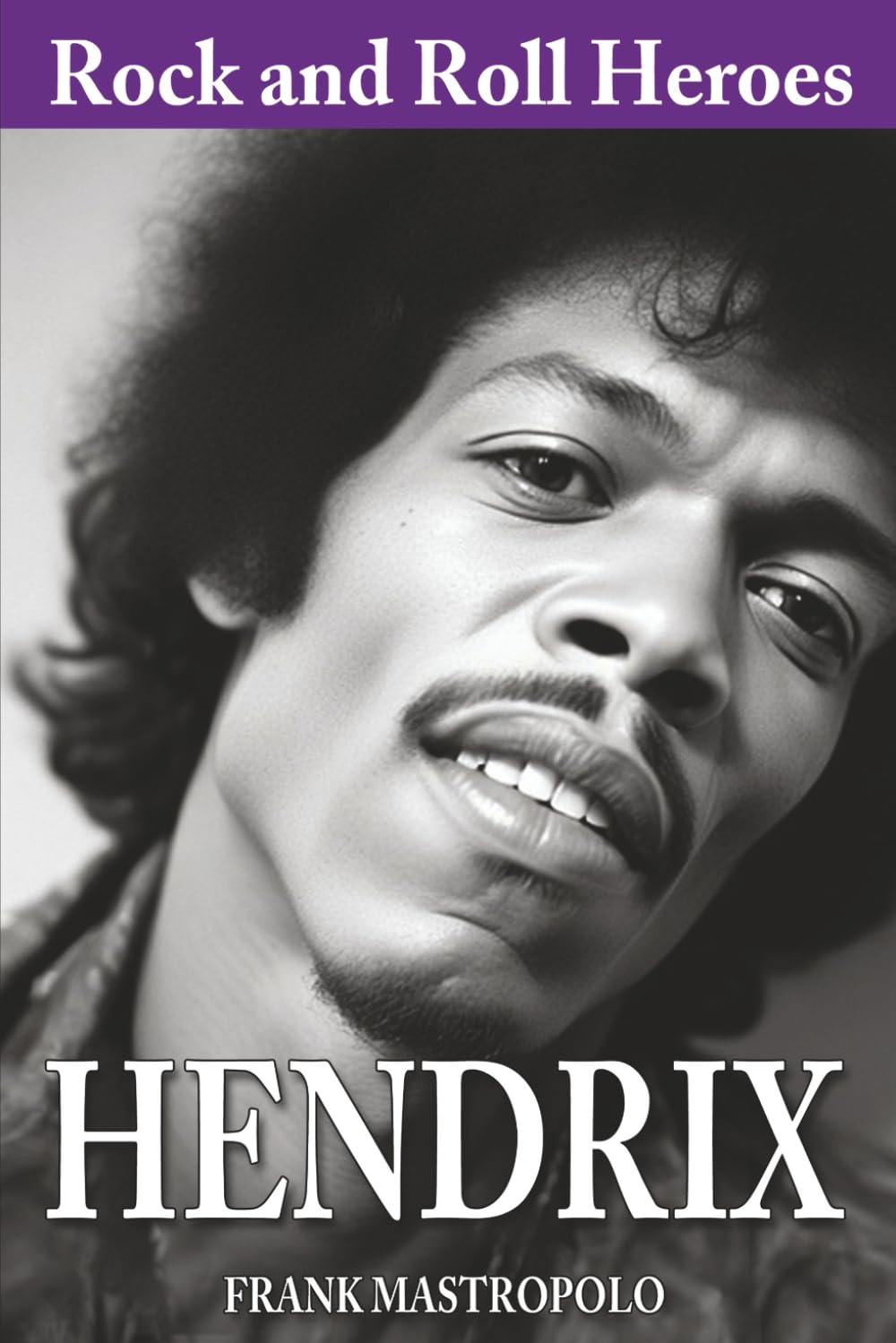
Frank Mastropolo’s Rock and Roll Heroes: Hendrix is a vivid and fast-moving look at Jimi Hendrix’s life, stitched together through sharp stories, rare details, and the voices of those who knew him. It begins with Hendrix’s tough Seattle childhood, where he strummed on broomsticks before getting his first cheap guitar, and carries us through his years of hustling gigs, the whirlwind fame in London, the legendary Monterey fire ritual, and the sound-shaking triumph of Woodstock. The book pulls no punches about the chaos that came with the fame, drugs, legal messes, endless tours, and the tragic burnout that ended his life at 27. Yet, threaded throughout is Hendrix’s relentless drive to make sounds no one had ever heard before.
I loved how Mastropolo leaned on eyewitness accounts. It made me feel like I was sitting in smoky clubs or watching jaws drop in London when Hendrix blew the local scene away. The language is crisp, not academic, which fits because Hendrix wasn’t an academic kind of genius. The book shows him as a shy kid who became a performer who could burn down the stage, literally and figuratively. It also gives plenty of attention to the small things: the busted cheap guitars, the clashes with managers, the sleepless recording sessions. Those details made me feel close to the man, not just the legend.
I felt sad about how badly Hendrix was managed and how little control he often had over the packaging of his own work. Mastropolo doesn’t glorify the tragedy, but he doesn’t soften it either. The tension between Hendrix’s huge imagination and the limits of the business world comes through on every page. I sometimes wanted more of Hendrix’s own voice, his own words, but maybe that distance actually makes the silences louder. It feels right that he comes across as unknowable in parts, like his guitar solos. The accompanying illustrations throughout the book are detailed and sharp, adding a striking artistic layer that brings Hendrix’s story to life with the same energy and clarity as the writing.
I was left with admiration but also a bit of heartbreak. Hendrix’s music still feels like it belongs to the future, and this book makes you feel the rush of that innovation and the cost it took from him. I’d recommend it to anyone who loves music history, but especially to readers who want to see the human being behind the myth. Fans of Hendrix will get new insights, and newcomers will understand why he’s still called the greatest.
Pages: 79 | ASIN : B0FN6TX6ZV


