Blog Archives
A Journey Toward Independence

The Girl with Free Feet is a moving multigenerational narrative that celebrates the women whose courage, sacrifices, and difficult choices helped create new possibilities for their families. What was most important to you about preserving these experiences for future generations?
I was born during the Great Chinese Famine and grew up during the Cultural Revolution. I witnessed how quickly political upheaval could destroy families, separate loved ones, and take away freedoms we often take for granted.
But my mother’s life began in a very different China. She grew up in a privileged Shanghai family, surrounded by traditions that shaped women’s lives for generations. Her mother had bound feet, while my mother was fortunate enough to grow up with free feet. To me, that difference symbolizes much more than a physical change. It represents the beginning of a journey toward independence.
I wanted to preserve not only the suffering and sacrifices of these women, but also their love, courage, humor, and determination. History books record political events, but family stories reveal how ordinary people lived through them.
Most importantly, I wanted my grandchildren and future generations to understand where they came from and how much courage it took for their ancestors to give them the opportunities they enjoy today.
What did you discover about the relationship between mothers and daughters while exploring these generations?
I came to understand that mothers and daughters are connected by both love and expectations, and that love is not always expressed in ways we recognize at the time.
Each generation of women in my family wanted something better for the next. My grandmother lived within the restrictions of traditional Chinese society. My mother sought education, love, and greater independence. I eventually found opportunities in America that neither of them could have imagined.
As a daughter, I did not always understand my mother’s decisions. Writing her story helped me see her not simply as my mother, but as a young woman with dreams, disappointments, and difficult choices of her own.
I discovered that understanding our mothers requires looking beyond the roles they played in our lives and recognizing the women they were before we were born.
What parallels do you see between the struggles for independence experienced by the women in your story and the challenges women face today?
The circumstances have changed dramatically, but the desire for independence remains the same.
My grandmother’s generation struggled against traditions that literally bound women’s feet. My mother’s generation fought for education, the freedom to love, and the right to make personal choices amid political turmoil.
Today, women have far greater opportunities, yet many still struggle to balance family expectations, careers, relationships, and their own ambitions.
Freedom is not simply the absence of restrictions. It is the ability to make meaningful choices about one’s own life.
One lesson from my family’s history is that progress is never guaranteed. The freedoms women enjoy today were made possible by the sacrifices of earlier generations, and they must continue to be valued and protected.
What do you hope younger generations, particularly daughters and granddaughters, learn from Rita’s life and the experiences of the women in your family?
I hope they learn to be courageous, independent, and compassionate.
Rita’s life reminds us that we cannot always control history or circumstances, but we can choose how we respond to them. She experienced love, heartbreak, political persecution, and extraordinary changes, yet she never lost her independent spirit.
I especially hope my granddaughter Zoey understands that the freedom she enjoys today is a precious inheritance. Her great-grandmother had free feet, but she still faced many invisible restrictions. My generation crossed oceans to find greater opportunities. Zoey’s generation can walk even further.
That is the meaning behind my book’s title. Free feet are only the beginning. True freedom is having the courage to choose your own path.
Author Links: GoodReads | Facebook | X |
Born into a changing Shanghai, Rita grows up in a world suspended between old traditions and a new China. Her mother, Rong, walks on feet bound in childhood—a painful inheritance from a culture in which obedience was expected and freedom, especially for women, was limited.
Rita is different.
She wants an education. She wants independence. And she wants the freedom to choose whom she loves and what her life will become.
But history has other plans.
As political upheaval transforms China, Rita’s family is swept into forces far beyond their control. Love is separated by distance. Family security disappears. The Cultural Revolution brings fear, persecution, and loss. Yet through marriage, motherhood, heartbreak, and extraordinary change, Rita refuses to surrender the independent spirit that has always defined her.
Eventually, that journey carries the family across an ocean to America—and toward freedoms earlier generations could scarcely have imagined.
Inspired by family history and personal memory, The Girl with Free Feet is an intimate multigenerational story of women, family, resilience, sacrifice, and the complicated choices people make in order to survive.
Above all, it is a story about what one generation endures so the next can walk more freely.
The Girl with Free Feet
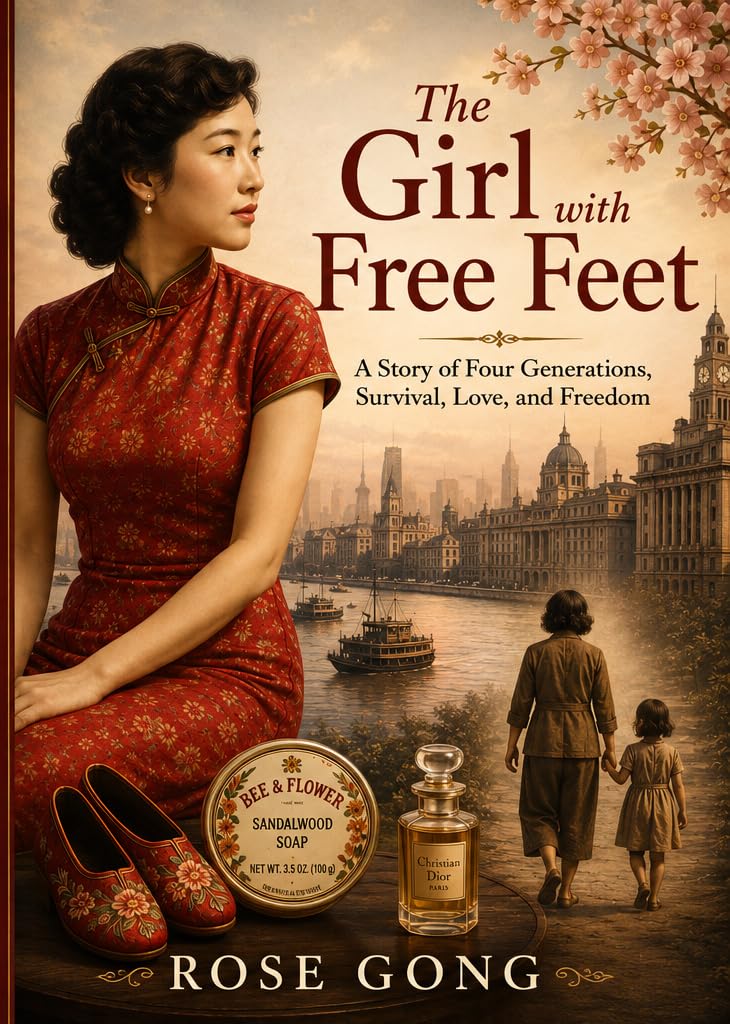

Rose Gong’s The Girl with Free Feet is an intimate family narrative about women’s freedom and the complicated work of claiming it. Drawing on family history and personal memories, Gong tells the story through reconstructed scenes and dialogue, with her mother, Rita, at its center. We meet Rita as a curious, quick-witted teenager in Shanghai, growing up in a household where education, elegance, and obedience carry considerable weight. Her mother Rong’s bound feet give the title its immediate meaning, while Rita’s questions introduce a wider concern: how much say does a woman have over her own life? That question connects the book’s treatment of love, motherhood, political upheaval, and immigration. Its emotional pull comes from seeing those concerns take shape within one family, through everyday conversations and competing expectations.
The book’s strongest feature is its feel for domestic life. Steaming breakfast buns, the scent of sandalwood soap, a carefully fitted qipao, and music drifting through a house give these memories texture. Objects carry associations that deepen as the story progresses, making the family’s past feel tangible. Rita herself brings plenty of energy to the page. She’s funny, impatient, proud, and eager to learn, and her teasing exchanges with relatives keep the early chapters lively. I especially appreciated the attention Gong gives to the women around her, including her sister and the people whose care sustains the household. Affection often appears through practical gestures: preparing food, adjusting clothing, sitting beside someone, or making room for a difficult conversation. Those details make the relationships feel close enough to recognize.
As the story moves through periods of fear and upheaval, Gong keeps her attention on how people experience them at home. History affects what families can say, which possessions they value, and what parents hope to preserve for their children. Education becomes particularly moving in this context, both as an opportunity and as a habit of questioning. The book also gives personal choice a complicated emotional life. Desire, loyalty, guilt, and gratitude can occupy the same relationship, and Gong acknowledges the responsibilities that accompany independence. Her prose is accessible and strongly shaped by dialogue, short paragraphs, and recurring images. At times, repeated reflections on feet, wings, movement, and freedom explain a scene’s meaning so fully that they soften its impact. Some conversations also have a polished, almost proverbial quality. The sensory details and family tensions are where the writing feels most convincing.
I’d recommend The Girl with Free Feet to readers who enjoy family memoirs, stories centered on women across generations, and accounts of Chinese immigrant experience. People interested in how political change enters private life will find plenty to consider, especially in the book’s attention to parenting, education, and the ways fear alters ordinary routines. It would also make a thoughtful book-club choice, with room to discuss the relationship between freedom and responsibility, the expectations daughters inherit, and the difficulty of understanding our parents as people with desires of their own. Its openly emotional style will appeal to readers who like warmth, humor, and reflection alongside painful material. What stayed with me was the care behind the telling: a daughter trying to understand her mother’s life and preserve the experiences that shaped her family.
Pages: 329 | ASIN : B0HGB5XQJ1



