Blog Archives
Life Is Going To Life – Keep Going

Demystifying the Doctorate is a practical guide that helps doctoral students navigate every stage of their academic journey, from choosing a program to completing a dissertation and planning their next steps. What inspired you to write this guide?
My doctoral defense event was excruciating, but after I graduated, I spent a month writing up everything I learned about earning my doctorate at the University of North Texas. Writing about my entire experience from start to finish, including the insider knowledge I gained and knew many of my peers lacked, was therapeutic. Writing up the experience allowed me to overcome the trauma of the defense event and see my 3.5-year experience as transformative.
By the time I had coached about 50 dissertants to success, my clients began pushing me to write a book. They seemed to know that whatever I wrote would be “great,” their word. For years, I ruminated over what content I would put in a book. I struggled to approach the content in a way that mirrored my relationships with my clients. I found David Sternberg’s 1981 book How to Complete And Survive a Doctoral Dissertation, in which he noted the same issues I’ve seen year after year in faculty acting more as gatekeepers than mentors who could teach all doctoral students about the Community of Scholars, or “Club of Doctors,” as I like to call their culture. After reading this book, I spent another few years fuming over “the more things change, the more they stay the same.” Honestly, dissertation students chronically and mythologically believe their major professors are mentors who spend ample time with them to teach them how to do their chosen study well.
In 2019, I revisited that end-of-my-experience guide I wrote for reflective therapy and shared it with dissertants in my department in the next several years after I finished. What I had written nearly 15 years earlier felt like the version of me my clients experience in every meeting. I demystify the major-professor-as-mentor idea by stating reality: The major professor is a critic and gatekeeper. At this point, I knew I could write as an honest mentor who wants dissertants to join me in the Club of Doctors. Granted, what you see in the book is only a fraction of what my clients experience when they ask me questions, need a pep talk, or answer my questions about their material.
I mentioned in the book the importance of staying passionate during this arduous process. I truly hope I have torn down the curtain and displayed the keys to completing a dissertation. The dissertation process has operated under cloak and veil since the first doctorates were awarded. I hope the book inspires and empowers dissertants, particularly when the challenges of the dissertation process seem insurmountable, for decades to come.
What are the most common misconceptions students have about pursuing a doctorate?
- All their years of undergraduate and graduate study prepared them for handling the dissertation or doctoral capstone process.
- Their major professors mentor them and are readily available to answer questions and guide them.
- The papers they wrote in their courses prepared them to write the type of literature review professors expect in a dissertation or doctoral capstone.
- They have been taught proper academic writing and socialized to meet their major professors’ expectations while in their doctoral coursework.
- Their research methods courses prepared them for managing institutional research boards and other dissertation oversight committees.
- They learned to do the statistics they need to perform for their dissertation in their required quantitative methods courses.
Your book includes timelines, outlines, and presentation checklists. Which planning tools tend to make the biggest difference in helping students stay on track?
I want to say all the above. However, the reality is that concrete examples of what a proposal or a final five-chapter dissertation written for the same major professor as chair by another student, as well as an example proposal or final defense slide deck designed, again, for the same major professor by another student, tend to have the greatest influence on a dissertant’s confidence in completing the process. Unfortunately, I could not include those examples in the book. I encourage readers to look up dissertations advised by their major professors using the advanced advisors search in the dissertation database to find a model dissertation to analyze and emulate.
Most dissertants do not design a timeline-to-goal list of tasks and deadlines. Instead, they rely on their institutions’ published deadlines or their major professors’ preferences for when to submit what chapter. Also, they tend to assume they are getting the necessary information for completing tasks without asking about the definitions and details of the chapters they need to submit, how many rounds of revisions each element might require, or the average time to completion for the dissertants directed by their major professors. I hope doctoral students see my suggestions as planning tools and use the ones that best support their time to completion.
What do you wish you had understood about doctoral study before beginning your own journey, and how has that lesson influenced your work as a coach?
As a vicarious learner, I would have benefited from another student telling me what to expect after coursework ended and how life could get in the way of managing the dissertation process. I was fortunate to work on campus during the fall and spring of each year, which kept me connected to professors and my department. That access helped me stay comfortable with visiting professors in their offices and handling the proposal-writing process without feeling lost or alone.
However, I came to understand how difficult managing the dissertation could be during the summer after I finished classes and the comprehensive examination, when my mother’s family faced several crises, and I found myself prioritizing their issues over writing my dissertation proposal. My mother believed I had time for her and the family’s problems, even though I was the mother of two early elementary-aged boys and needed to write my proposal. Wasting that one semester of tuition without making progress toward my doctoral goal made it clear that I either needed to get my extended family on board with my goal or ignore them until I defended my dissertation. When my in-laws had multiple medical crises during my semester of collecting data and writing the last chapters, I helped them but also did my work in front of them to make sure they saw what I was working on and how I made sacrifices for them. All my family obligations pushed my final defense a semester past my original timeline-to-goal plan.
These lessons influence my encouragement to keep family informed and ask for help. Dissertants need support when classes end because their doctoral work is not done. Additionally, I constantly encourage my clients to adopt the attitude I wrote in my book: “Nothing is going to get in my way” when it comes to reaching the dissertation defense. One client noted in their acknowledgments that “life is going to life,” and keeping her “eye on the prize” sustained their dissertation momentum during fundamentally life-changing events that tend to stop the average dissertant from progressing for quite some time.
Author Links: GoodReads | Facebook | Website
Do you feel untethered from the university’s academic lifeline—set adrift just when the stakes are highest? Does navigating doctoral studies or writing a dissertation proposal leave you feeling as though you are sinking fast, surrounded by expectations, deadlines, committee feedback, and unseen academic hazards?
Demystifying the Doctorate challenges the myth that earning a doctorate is a solo, independent endeavor. Dr. Cody Arvidson offers realistic, experience-based guidance for accessing and using campus resources, understanding what dissertation advisors and major professors expect, and sharing the doctoral journey with family, friends, classmates, and support networks.
Practical, direct, and encouraging, this book helps clear the fog around the doctoral process, offering strategies to avoid feeling bogged down, stuck, or alone. With the right skills, support, and determination, dissertants can move forward with the attitude: “I’m not letting anything get in the way of finishing my doctoral degree.”
Demystifying the Doctorate


A doctorate comes with plenty of formal requirements, but students also have to learn how to work with the people and systems that control their progress. Cody Arvidson’s Demystifying the Doctorate addresses both sides with the voice of a coach who expects you to ask questions, keep records, and take your own work seriously. Drawing on her experience as a doctoral student, professor, and dissertation coach, she follows the process from choosing a program through completing a dissertation and preparing for what comes next. Her emphasis on preparation makes the work feel specific enough to plan, even when the surrounding expectations feel confusing.
The book’s greatest strength is its attention to the details that can consume a student’s time and confidence. Chapter outlines, sample timelines, and presentation checklists make her suggestions easy to put to work. Her discussion of academic writing pays close attention to how a research problem, questions, methods, and findings fit together, and she explains why consistency matters when a document passes through several readers. She also covers the everyday work of following up, organizing feedback, and finding support. These sections are useful because they translate a demanding project into decisions and tasks you can actually picture doing. You can imagine keeping the book nearby while planning your week or preparing for a meeting with your advisor.
Arvidson’s voice is protective, funny, and occasionally combative. She’s especially attentive to the loneliness of dissertation work and the importance of keeping partners, children, friends, and peers involved. Those chapters give the book warmth and recognize the lives students are trying to maintain while pursuing a degree. Her descriptions of professors can be sweeping, though, and the repeated emphasis on faculty egos and institutional self-interest sometimes gives the advice a defensive edge. Some reminders also recur often enough to slow a continuous read. That repetition makes more sense when you treat the book as a reference and return to the section that matches your current stage. It’s an opinionated guide shaped by years of coaching students through difficult situations.
I recommend Demystifying the Doctorate to working doctoral students in education, the social sciences, and other fields that use a conventional dissertation structure. People balancing a career, caregiving, and study will recognize the pressures Arvidson describes, and students who feel stalled or poorly supported may appreciate how directly she argues for their ability to act. Prospective students can also use it to think more carefully about program fit and advising relationships. It works best read alongside your own institution’s requirements, with room for differences among disciplines and faculty. If you like a coach who combines encouragement with pointed questions about what you’ll do next, you’ll likely find her company helpful. Her commitment to getting students moving gives the book its energy and purpose.
Pages: 258 | ASIN : B0HHTF2BSK

Growth and Resilience

The Feedback Blueprint: Unlocking the Power of Constructive Insights is an essential guide to using feedback as a tool for positive transformation, empowering readers to foster growth, develop resilience, and drive continuous improvement. What inspired you to write this book and share this information?
The inspiration for The Feedback Blueprint: Unlocking the Power of Constructive Insights comes from my years of experience with leaders and teams who, like many, found feedback challenging but essential. I’ve seen how the constructive insights model can create transformative moments—not just for individual growth but for organizational resilience and team dynamics. Yet, feedback is often approached with vacillation, sometimes even fear.
I wanted to write a book that provides a practical, supportive framework for anyone aiming to build a feedback-company culture. My goal is to help others see feedback not as a hurdle, but as a powerful way to connect, inspire, and grow. I hope this guide serves as a resource for turning everyday interactions into moments of positive change.
What were some ideas that were important for you to share in this book?
One of the most important ideas I wanted to share in The Feedback Blueprint is that feedback, when given with insight and empathy, can truly be a transformative tool. I wanted to move beyond the typical feedback model, which often focuses only on performance concerns, and instead introduce what I call “constructive insights.” This approach goes deeper, offering feedback and coaching that helps people understand not just what to improve, but why and how it can support their short/long-term growth and resilience.
Another idea was to make feedback a continuous, positive practice rather than a dreaded event, I included frameworks that make it easier for readers to offer feedback in a way that is clear, actionable, and centered on coaching techniques to improve staff performance. Finally, I wanted to emphasize the role of self-awareness and empathy in feedback. Understanding our own responses and creating space for the other person’s perspective can make feedback not only more effective but also a tool for building trust and stronger connections. I hope these ideas help readers see feedback as an opportunity for development at every level.
Did you find anything in your research of this book that surprised you?
Researching The Feedback Blueprint revealed some surprising insights about the psychology of feedback that really shaped the book’s direction. One of the most striking “scientific” findings was how deeply our emotions and personal biases can influence both the way we give and receive feedback. Many people, myself included, often assume that feedback is a purely rational process. Yet, I discovered that emotions, past experiences, and even body language play a huge role in how feedback is perceived and whether it will lead to growth or defensiveness.
Another insight (based on case studies) was how powerful empathy and active listening are in the feedback process. Studies consistently show that when feedback is delivered with empathy and an understanding of the other person’s perspective, the likelihood of a positive response increases dramatically. This finding, in addition to my experience as an HR practitioner, inspired me to emphasize strategies in the book for developing emotional intelligence alongside feedback skills, helping readers create a balanced approach that fosters trust and openness.
Finally, I was struck by the realization that feedback doesn’t always have to be about correcting or improving something. Sometimes, the most impactful feedback is simply acknowledging and reinforcing positive behaviors. This aspect isn’t highlighted enough in traditional feedback frameworks, so I made it a priority to include strategies for delivering affirming, constructive insights that boost confidence and morale. These surprises not only enriched my understanding but also made me even more passionate about sharing a feedback approach that empowers and uplifts.
What is one thing that you hope readers take away from The Feedback Blueprint?
If there’s one takeaway I hope readers gain from The Feedback Blueprint, it’s the realization that feedback, at its best, is a powerful tool for connection and growth—not just a means to correct mistakes or give direction. I want readers to see feedback as an opportunity to support, inspire, and elevate those around them.
We often approach feedback with hesitation, fearing it may cause discomfort or be taken the wrong way. But when done with empathy, clarity, and a genuine desire to help someone develop, feedback can build trust and foster resilience. My goal is for readers to walk away feeling confident and equipped to offer feedback in a way that’s constructive and empowering, recognizing it as a skill that can unlock personal and professional transformation. If this book helps even one person turn a challenging conversation into a moment of insight and growth, then I feel I’ve achieved what I set out to do.
Author Links: GoodReads | Instagram | Website | Amazon
Are you ready to transform the way you lead? The Feedback Blueprint isn’t just another leadership book—it’s a dynamic toolkit for leaders looking to truly thrive. Imagine a space where you can reflect, refine, and elevate your leadership approach with practical strategies and real-world insights. This book is your personal coach, guiding you to sharpen your instincts, master feedback, and cultivate a mindset of continual growth.
In The Feedback Blueprint, you will: Build a foundation of self-reflection: Develop habits that enhance your awareness, helping you uncover insights that drive personal and professional growth.
Master feedback to elevate performance: Learn how to give and receive feedback with confidence, turning challenging conversations into opportunities for connection and growth.
Lead with innovation: Break free from conventional thinking, take calculated risks, and inspire creativity in your team.
More than just advice, The Feedback Blueprint equips you with actionable tools, reflective exercises, and real-life examples to create lasting change. Whether you’re a seasoned leader or just starting your journey, this book will help you build a culture of continuous improvement and lead with purpose.
Step into The Feedback Blueprint—where leaders reflect, refine, and thrive.
The Feedback Blueprint: Unlocking the Power of Constructive Insights
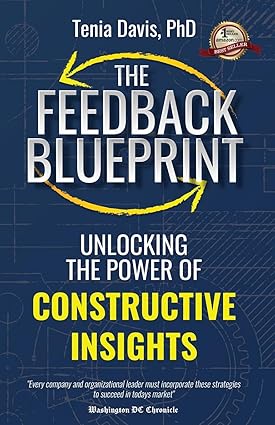
The Feedback Blueprint by Tenia Davis is a meticulously crafted exploration of the transformative power of feedback, both in personal and professional spheres. Davis delves deep into how aligning self-perception with external evaluation makes feedback an indispensable tool for self-improvement. She articulates how feedback not only shapes behavior but also strengthens emotional intelligence, boosts self-efficacy, and fosters motivation. This book is a rich resource, offering readers a wealth of knowledge grounded in foundational theories like Cognitive Dissonance, Social Cognitive Theory, and Neuroplasticity while weaving in practical frameworks such as Nudge Theory and Self-Regulation.
Davis’ ability to blend research with clarity and accessibility stands out, making her work both scholarly and engaging. The structured yet fluid writing draws readers in, effortlessly building a comprehensive understanding of feedback’s multifaceted impact. She distills complex concepts into digestible insights, appealing to a broad audience, from academics to general readers. Her skill in weaving together theory and practical application is nothing short of inspiring. The practical advice Davis offers is another highlight of the book. She seamlessly integrates academic research with relatable, real-world examples, keeping the reader both engaged and informed. Whether in education, workplaces, therapy, or personal development, feedback can be applied in numerous contexts. Davis enriches the reader’s understanding by including compelling case studies, such as the barista’s journey in “The Feedback Loop,” illustrating the tangible, transformative power of feedback in action. These case studies bring her theories to life and allow readers to envision their own experiences mirrored in these scenarios. One of the standout elements is her emphasis on “constructive insights” as a natural evolution of traditional feedback. Particularly noteworthy is her exploration of the emotional responses feedback elicits—ranging from pride and joy to anxiety and frustration. Davis stresses the importance of empathy and support in delivering feedback that inspires rather than discourages. This emotional intelligence component adds another layer of depth to her work, highlighting how feedback, when given thoughtfully, can uplift and motivate.
The Feedback Blueprint is an essential guide to using feedback as a tool for positive transformation, empowering readers to foster growth, develop resilience, and drive continuous improvement. Tenia Davis has crafted a blueprint for leveraging feedback in the most constructive and empowering way possible, making this book a must-read for anyone looking to harness the full potential of feedback.
Pages: 163 | ASIN : B0DJWQYCY1


