Blog Archives
Knowledge is Power

Sisters of Twelve follows a woman known as the final Custodian who must determine if the world is prepared for what the Voynich Manuscript contains. What was the inspiration for the setup of your story?
The story really began with the Voynich Manuscript itself. Like many people, I became fascinated by the fact that it has resisted explanation for centuries. But instead of focusing only on how to decode it, I found myself asking different questions: Who could have created something like this, and more importantly, what was it actually for?
I wanted to approach the manuscript not simply as a puzzle, but as part of a larger system. From there, I became interested in the kinds of people history tends to overlook, especially those who preserve knowledge quietly in the background while others receive recognition for it. I began imagining a lineage of women whose role was not just to protect information, but to determine when humanity was ready to receive it.
In many ways, the novel also became an homage to the strong women in my own life and to the countless individuals throughout history whose contributions were never fully acknowledged. Many of them were not seeking recognition at all, yet their work became part of the invisible foundation upon which later discoveries and institutions were built. That idea stayed with me throughout the writing of the book.
The novel treats knowledge as a burden as much as power. Was that one of the central ideas you wanted to explore?
Yes, absolutely. Knowledge is power, but power without wisdom or timing can become dangerous very quickly. One of the central ideas I wanted to explore in Sisters of Twelve is that possessing knowledge is only part of the burden. The greater burden is deciding when, how, and even if it should be shared.
For generations, the Custodians of the Sisterhood preserved accumulated discoveries and systems of knowledge, but Gia is the first to fully realize that time itself is running out. Previous Custodians had the luxury of patience. Gia does not. She understands that revealing certain discoveries too early could destabilize civilizations in ways history has repeatedly shown us, while withholding them for too long could deny humanity gifts that might alleviate suffering or fundamentally improve the world.
That tension becomes deeply personal for her. At times, the responsibility of deciding what humanity is ready to receive becomes almost suffocating.
The novel argues that women have often preserved culture, memory, and knowledge without recognition. What historical examples most influenced that idea?
As a college student, I remember first hearing the idea that much of history is really “His Story,” not “Her Story.” That concept stayed with me. History is often written by the winners, and historically, those winners were usually men whose names filled textbooks, monuments, and institutions.
But the survival of knowledge has rarely depended only on the visible people history remembers.
Across centuries, there were always others working quietly in the background. Archivists preserving fragile documents, translators carrying ideas across languages, assistants organizing the work of scholars, daughters inheriting memory when no formal record remained. Many of these people, especially women, lived and died without recognition, even though the ideas they protected survived because of them.
That became one of the emotional foundations of Sisters of Twelve. The book is fiction, but the spirit behind it comes from a very real truth: if knowledge from the past has reached us at all, it is because someone chose to carry it forward, often quietly, often without credit, and sometimes without anyone ever knowing they had done so.
In many ways, the novel is dedicated to those unseen custodians of knowledge.
Did you want readers to leave the novel feeling hopeful, unsettled, or intellectually uncertain?
At times, it feels like we are constantly being conditioned to believe the world is always on the verge of collapse. Maybe it is, or maybe it only feels that way because uncertainty has become such a constant part of modern life. I didn’t want Sisters of Twelve to reinforce the idea that humanity is doomed or incapable of growth.
I wanted to tell a story that acknowledges the world will probably never be perfect, but that does not mean it cannot become better. The ending is meant to leave readers with a sense of cautious hope. Not the kind that arrives overnight or solves everything at once, but the belief that people are still capable of learning, adapting, and choosing something better for the future.
If readers walk away from the novel feeling that maybe, just maybe, humanity still has the capacity to get things right, then I think the story succeeded.
Author Links: GoodReads | Amazon
A hidden sisterhood that has safeguarded its meaning for two thousand years.
And a world rapidly approaching the moment it was never meant to reach.
Sisters of Twelve
For centuries, the Voynich Manuscript has defied every attempt at translation. Historians, cryptographers, scientists, and codebreakers have all failed to explain its meaning.
Because the manuscript was never meant to be read in the conventional sense.
In Sisters of Twelve, the Voynich Manuscript is revealed as the current vessel of a system preserved across generations by a hidden lineage of women known as the Sisterhood. Their purpose has never been to conceal knowledge forever, but to control its release, ensuring that discoveries capable of reshaping civilization enter the world only when humanity is ready to survive them.
Now that responsibility belongs to Dr. Gia Braccia, the Sisterhood’s newest Custodian.
As technological advances begin to erode centuries of secrecy, Gia realizes the system can no longer remain hidden indefinitely. The manuscript and its ancient counterpart, the Roman dodecahedron, exist in a world of artificial intelligence, distributed data, 3D imaging, and limitless replication. Time, once the Sisterhood’s greatest advantage, is running out.
What the manuscript contains could transform medicine, science, language, agriculture, and human longevity.
Or it could destabilize governments, deepen inequality, weaponize scarcity, and fracture a civilization already struggling to hold itself together.
As pressure mounts from institutions, private actors, and factions within the Sisterhood itself, Gia must confront the question her predecessors spent centuries avoiding.
Not whether the world deserves the truth.
But whether it can survive it.
Blending historical intrigue with speculative science and philosophical suspense, Sisters of Twelve explores the hidden systems that preserve knowledge across generations and the unseen people history rarely remembers.
From the author of Time Lines comes a story about memory, stewardship, and the dangerous moment when the future arrives before humanity is prepared for it.
Sisters of Twelve
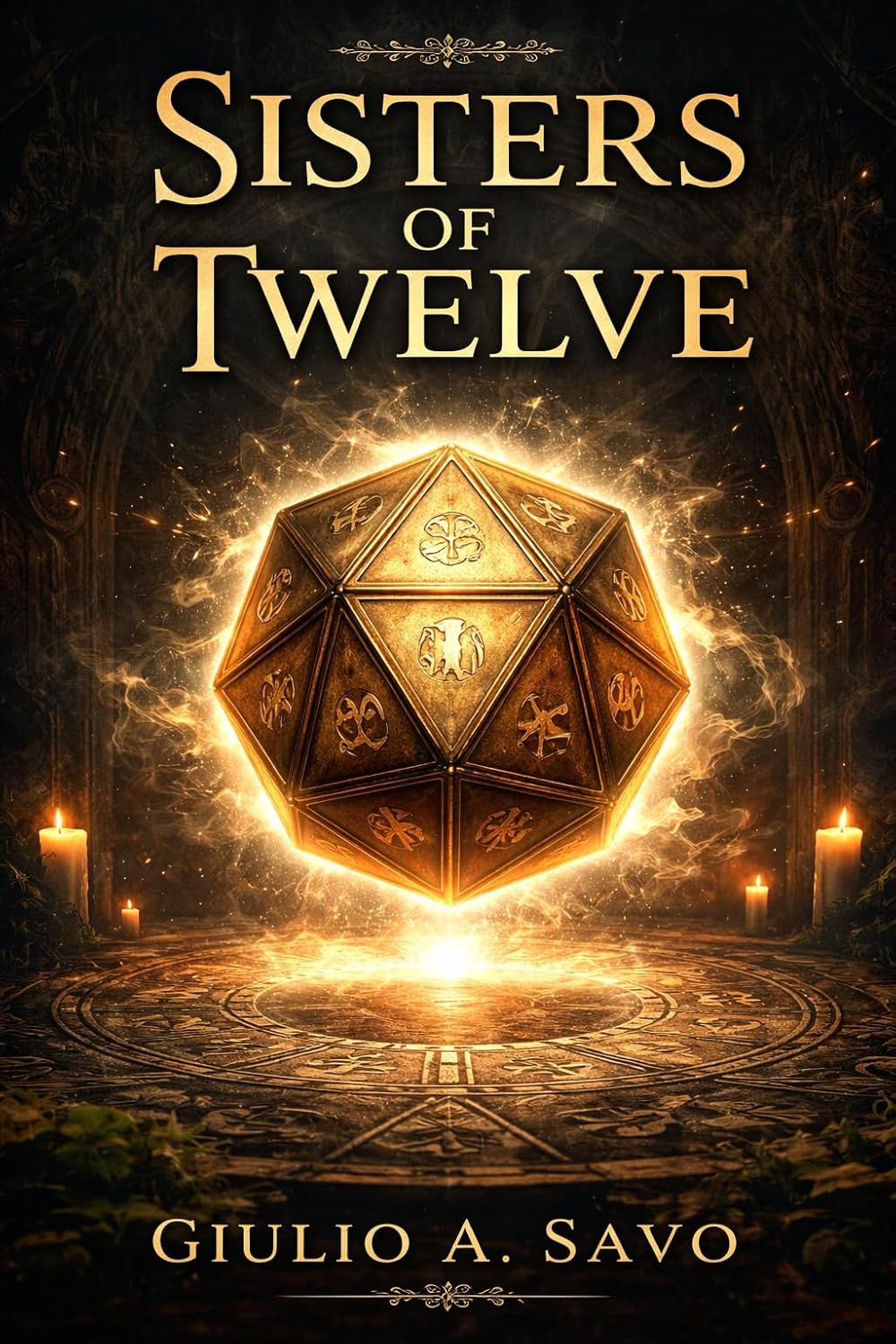

Sisters of Twelve is a historical mystery thriller built around the Voynich Manuscript, imagining that its unreadable pages are not a failed puzzle but a deliberately protected vault of knowledge, carried across centuries by a hidden lineage of women called the Custodians. At the center is Gia Braccia, the final Custodian, who must decide whether the world is finally ready for what the manuscript contains—and whether preservation has become its own kind of captivity. The novel braids real historical figures, archival intrigue, secret societies, scholarly obsession, and speculative systems into a story about women who kept knowledge alive when history preferred them nameless.
The book doesn’t rush toward revelation; it understands that secrecy has texture, procedure, dust, paperwork, and dread. The scenes inside libraries and archives have an almost mineral stillness, and I liked how the novel makes bureaucracy feel thrilling, not through car chases or melodrama, but through delayed emails, loan agreements, box numbers, and the soft violence of institutional language. Its best passages treat knowledge not as treasure, but as burden: something that must be timed, guarded, doubted, and eventually released.
I also found the book most compelling when it resisted the easy glamour of conspiracy. The Sisterhood is not simply a clever hidden order; it is an argument about history’s missing hands. The novel’s emotional current comes from its insistence that preservation is work, and that women have often done that work without signatures, monuments, or applause. The scale of the mythology can feel heavy, but that weight is also part of the book’s design. It wants to feel like a codex being opened slowly, page by page, with each layer asking whether understanding is always a gift.
This book is for readers who enjoy mysteries, thrillers, historical fiction, and the intrigue of the Voynich Manuscript. Fans of The Da Vinci Code may recognize the pleasure of symbols, suppressed histories, and dangerous knowledge, but Giulio A. Savo’s approach is quieter and more contemplative, closer in spirit to Umberto Eco’s fascination with texts, interpretation, and the peril of certainty. Sisters of Twelve is a novel about the moment a secret stops being protected and starts becoming responsible to the world.
Pages: 509 | ASIN : B0GTW2FJ1P



