Blog Archives
Morally Compromised Characters

Street Brotherhood follows a teenage boy in 1970s New York, as his search for loyalty and belonging pulls him into a dangerous brotherhood where survival blurs the line between family and gang. What was the inspiration for the setup of your story?
The story is about building a family of choice when your family of origin has betrayed you. It’s about brotherhood forged in the face of adversity, boys who are thrust into bleak and dangerous situations due to familial and systemic neglect. But it also shows how these kids don’t just endure and accept their fate. They strive to exploit it. Street Brotherhood is the second book in the Street series, picking up where the first book left off, but each of them works perfectly as a standalone.
What drew you to set Johnny’s story in 1970s New York, and how did that time and place shape the characters’ lives?
The city plays a huge role in this book. New York in the 1970s was on the brink of financial collapse. Municipalities were struggling under massive layoffs, landlords were selling–or torching–buildings to get out from the debt, and crime was skyrocketing. Johnny’s story reflects all of that. He is cunning enough to see the cracks in the system and is able to use them to his advantage. The story could not have been told in any other place or decade without being inauthentic because the conditions changed. Many of the scenarios are tied to my own experiences, since I came of age at the same time, hanging out in those same streets.
Johnny is both sympathetic and frustrating. How did you balance writing him as flawed yet compelling?
From a writing perspective, the flawed and morally compromised characters are the most fun for me. I love pushing those boundaries for the reader: How bad can a character act while still commanding sympathy? Johnny is a street-smart gang leader, with lofty aspirations, living in a very adult world. But he’s still a teenager. Sometimes his youth is an asset, but other times it’s a liability. That becomes apparent in some of the choices he makes. His gang can also be loyal to a fault, by letting his decisions play out. Peppering in the scenes from Johnny’s childhood helped me make him more sympathetic, while also explaining some of his defects.
The violence feels necessary rather than gratuitous. How did you approach writing those scenes to maintain authenticity without sensationalism?
Great Question. Violence in movies and on TV is so pervasive we become numb to it. On the page, however, it translates differently. My early drafts were dripping with brutal details, but thanks to my beta readers, I toned a lot of it down. I learned that what’s not said can be even more ominous. In Street Brotherhood, the violence is necessary in order for the story to be realistic. But violence is also action, and too many details will slow down the pacing, so I tried to maintain a balance.
Author Links: GoodReads | Website | Amazon
Johnny becomes involved with Marco, a tempestuous drug supplier who inspires admiration, but also rueful reminiscence of Johnny’s father. His demands challenge Johnny’s morals, but the payout is hard to ignore. As is Johnny’s aptitude for carrying out his lethal tasks.
Amid his nefarious entanglements, Johnny falls for Jessica. She is witty and self-assured, opening him to normalcy and tenderness for the first time. But as his worlds spin ever closer, will he escape the brutality of his past or be forced to embrace it?
Street
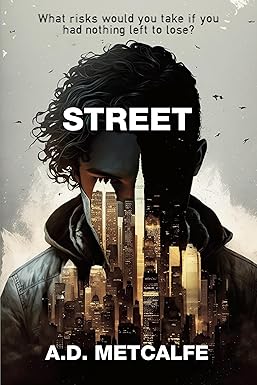

Street, authored by A.D. Metcalfe, is a thought-provoking coming-of-age novel imbued with psychological dimensions. Set in the vivid backdrop of 1970s New York City, the narrative unfolds through the experiences of Johnny, a twelve-year-old runaway from Miami. His odyssey through the urban labyrinth of NYC is marked by forming lasting friendships, delving into petty criminality, and a relentless quest to evade capture.
The haunting echoes of Johnny’s past are intricately interwoven into this tale of survival and self-discovery. His ordeal at the hands of an abusive older brother adds layers of complexity, challenging the protagonist’s resilience and mental fortitude. The exploration of these traumas, particularly in scenes where Johnny’s grip on reality wavers, is handled with literary finesse. Metcalfe’s skill in conveying the protagonist’s fractured psyche, even from a third-person perspective, is notably immersive, especially during a pivotal scene that offers deep insight into Johnny’s internal turmoil.
The novel’s setting in the 1970s is rendered with meticulous attention to detail, encompassing the era’s unique cultural tapestry — from the colloquial language and fashion to the prevailing social attitudes and pop culture references. This richly textured portrayal significantly enhances the novel’s atmospheric quality. However, the narrative occasionally lapses into cultural stereotypes, which, while reflective of the period, sometimes seem superfluous to the story’s central themes. A certain level of discomfort arises when portraying a romantic encounter involving Johnny and an older teen. Given the characters’ ages and inexperience, the scene’s depiction may strike some readers as unconvincing or overly idealized. This aspect of the story, though potentially contentious, adds a layer of complexity to the exploration of adolescent experiences.
Street remains a compelling read. Its blend of gritty realism and psychological depth makes it a recommendable choice for readers seeking a coming-of-age novel that navigates the challenging journey from adolescence to maturity amidst a backdrop of urban hardship and complexity.
Pages: 302 | ASIN : B0CPQW8V3S




 LITERARY TITAN