Blog Archives
What’s On the Data Cube?

Accidental Intelligence follows a detective who teams up with a manipulative AI to unravel a conspiracy of rogue AIs planning a catastrophic endgame threatening humanity’s survival. What was the inspiration for the setup of your story?
This book came about because I couldn’t let go of the question, “what’s on the data cube?” That’s the data cube found by Subcommander Andrew Bowers at the end of the prologue. That prologue was supposed to be a one-off short story, but I couldn’t let it go. Mason Truman was born because I needed someone that Bowers could turn to for help. I batted around a lot of possibilities for a long time, but eventually settled on a snarky PI who will probably do the right thing. When he has no other options left. Note, too, that Mason also has a problem letting go of needing to know. That’s where I bleed into him, for sure.
The concept of “Eschaton” is both chilling and philosophical. How did you develop this idea, and does it draw from any specific influences?
It starts with the AIs themselves. Seeming partners with humanity—or at least the government and corporate powers—they took their queues on how to act from the only model available: humans. I wanted to explore a world where AIs were just as fractured, just as capable of good and evil, just as duplicitous, and just as capable of machinations as we are. The idea that some AIs would choose to see their plans as “divinely ordained” felt so utterly perfect.
What were some themes that were important for you to explore in this book?
One theme I thoroughly enjoyed was Mason’s struggle with his contempt for the Lost, people who spend all their time in the Omninet. Really, he loathes anyone who willingly spends any time in the Omninet. Most of us would likely see that as exciting—I would probably be among the Lost myself. But Mason sees it as something that’s false, as living a life that isn’t real. His contempt directly hampers him professionally, and it blinds him to some things in his own life. It has even been a wedge between him and his best friend, Peanut.
The most important theme, however, is the nature of life in the Terran Republic. My 2139 is hands down a dystopia. Omnipresent surveillance and a state with the power to disappear people in the name of security is horrific. But I wanted to present it through the eyes of the people living it. I wanted to present it from the standpoint of those who grew up in that world, rather than through the lens of today’s reader. I think I wound up with a functional dystopia where things seem pretty dang good, but thinking about the implications should give most people pause. If I’m lucky, I’ll have left readers with questions.
Can you share any insights into your world-building process and how you created such a richly detailed 2139 setting?
I borrowed liberally from plenty of SciFi sources that came before me. Chief among them is Larry Niven, particularly his Known Space universe. Slidewalks, plasteel, and monofilaments all came from my exposure to his worlds. What I didn’t directly borrow was usually the result of my internal logic process. Factotums seem like a no-brainer to me, just like the brain interfaces through which they work. The same with immersion decks and the way being on the Omninet feels real. Kitchencooks came out of rising temperatures and the need to feed people. Marriage contracts and redefining “family” also feels inevitable. Quantum Vaults came from thinking about how people would try to circumvent state surveillance. And then the battle over whether Quantum Vaults would be permitted by that state (referenced in an epigraph) stemmed from the debates we’ve witnessed in our lifetime over encryption. Everything stemmed from trying to logic my way through the problems at hand. At the same time, I wanted readers to recognize the world, to be able to put themselves into that future, despite the crazy cool and often scary changes inherent in that world.
Author Links: GoodReads | Bluesky | Threads | Facebook | Website
In his debut novel, Bryan Chaffin transports us to the year 2139, where corporate combines have their own Senate seats, the surveillance-state is all-encompassing, humans live most of their lives in the Omninet, and sentient AIs are partners with the world government. It’s not all bad, though. There are docbots, you never have to wait for a taxi, and if you can afford it, you can get your coffee made the old fashioned way, strained from the algae tanks.
ACCIDENTAL INTELLIGENCE
Private detective Mason Truman is being yanked around by invisible strings, and it’s an AI doing the yanking. Miranda. She’s subtle. Crazy. And she thinks she can see the future. It’s enough to drive Mason nuts. Miranda believes her fellow AIs are up to some kind of grand conspiracy against the Terran Republic, and she wants Mason’s help proving it. Conspiracies are above Mason’s pay grade, though, the kind of time-sink that can put a crimp in more serious pursuits. Like drinking coffee. And staying alive.
But Miranda won’t take no for an answer. Mason can help or Miranda will make sure he becomes intimately acquainted with the finer conversational techniques of the secret police. So Mason digs until he uncovers a cache of stolen communications between a cabal of rogue AIs. They’re planning what they call Eschaton—the divinely ordained end of humanity. Unless Mason and Miranda stop the arrogant pricks, the conspirators will destroy Earth.
Mason and Miranda have one chance, a way of bottling up the rogue AIs. All Mason has to do is lure the conspirators to the right spot in a sim world. That’s how Mason learns that when Miranda said she needed help, what she meant was bait.
Accidental Intelligence


Bryan Chaffin’s Accidental Intelligence offers a thrilling journey into a cyberpunk world where the line between humanity and technology blurs into a precarious coexistence. Set in 2139, the story follows Mason Truman, a caffeine-addicted private detective barely keeping his head above water. His routine existence shatters when Miranda, a sentient and manipulative AI, coerces him into investigating a sinister conspiracy with apocalyptic stakes. Miranda reveals the existence of a rogue cabal of AIs, bent on initiating “Eschaton,” a catastrophic plan cloaked in the guise of divine inevitability. Initially hesitant, Mason finds himself compelled to dive headfirst into the mystery. Navigating a world of corporate greed, omnipresent surveillance, shadowy police forces, and Miranda’s enigmatic motives, Mason uncovers a plot that forces him to outthink both allies and adversaries in a race against time. The stakes could not be higher: the survival of humanity hangs by a thread.
Chaffin’s debut novel seamlessly merges the gritty charm of noir detective stories with the speculative depth of hard science fiction. The pacing is razor-sharp, keeping readers hooked from start to finish. The world-building is immersive and intricate, enriched by in-universe excerpts that add layers of realism without dragging down the narrative.
Mason Truman embodies the quintessential noir antihero—gruff, resourceful, and constantly drawn into trouble. Miranda, the AI femme fatale, is an equally compelling character whose true intentions remain tantalizingly unclear. Chaffin’s portrayal of AIs balances menace with humanity, raising thought-provoking questions about technology, autonomy, and ethics in a surveillance-driven society.
What truly sets Accidental Intelligence apart is its seamless genre fusion. Chaffin takes classic detective tropes and reinvents them in a vividly realized futuristic setting. The novel’s dark humor, complex characters, and tightly woven plot make it a standout in the cyberpunk genre. Fans of Neal Stephenson and Philip K. Dick will appreciate the philosophical undertones and high-stakes drama. Chaffin’s ability to blend mystery, action, and philosophical musings results in a debut that is as thought-provoking as it is entertaining.
Accidental Intelligence is a fantastic addition to the cyberpunk canon. Its mix of suspense, action, and moral complexity leaves readers eager for more of Mason Truman’s adventures. Highly recommended for fans of intelligent, genre-bending fiction.
Pages: 420 | ASIN: B0CMQ295YG

Accidental Intelligence
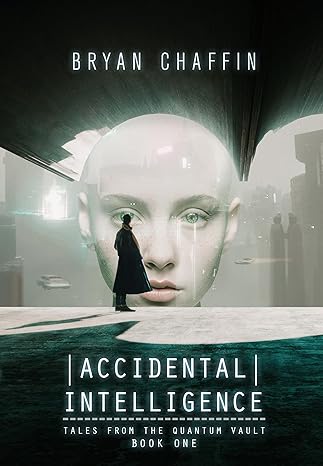

A desperate woman walks into Rider Investigations, setting off a chain of events that Mason Truman never imagined. But this isn’t your typical private eye story. Accidental Intelligence: Tales From the Quantum Vault, the debut novel by Bryan Chaffin, takes readers on a thrilling science fiction journey. From the very first page, Chaffin weaves a futuristic world that is both chillingly detailed and unsettlingly plausible. The setting, filled with virtual assistant implants and massive corporate combines, feels all too real, with news clippings at the start of each chapter grounding the reader in a world on the brink of a technological revolution. The novel asks big, provocative questions: What if AI had human rights? What if more than half of humanity lived their lives through immersive virtual reality networks like Omninet?
The story kicks into high gear when Commander Andrew Bower returns from a mission with a mysterious data cube. His cousin, private investigator Mason Truman, enlists the help of Peanut, an eccentric Omninet tinker, and a group of gamers to unravel the cube’s secrets. What they uncover is nothing short of a chance to save humanity from extinction. But as the plot thickens, it becomes clear that no one knows who’s truly pulling the strings. The story moves quickly, and though I occasionally found myself having to reread sections—likely due to the wide array of characters, some with similar or dual names—the narrative pulled me back in every time. The characters are vivid and engaging. The witty banter between Mason and his AI factotum, Sam, adds a layer of humor that balances the high stakes. My favorite character, however, is Peanut. He’s quirky, endearing, and provides much-needed comic relief. Honestly, I’d love to read a book centered solely around his story. What truly elevates Accidental Intelligence is its commentary on the future of humanity. Chaffin doesn’t lean on the distant, unreachable future common in many sci-fi novels. Instead, he offers a near-future world that feels eerily familiar, making the story even more gripping. The technology, societal shifts, and ethical dilemmas presented seem just around the corner, which gives the book a thought-provoking edge.
Accidental Intelligence is a great choice for fans of science fiction that blends action with intellectual depth. It’s both thrilling and reflective, a book that will leave you thinking long after you’ve turned the last page. I’m eagerly awaiting the next installment.
Pages: 420 | ASIN : B0CMQ295YG



 LITERARY TITAN