Blog Archives
A Blessing and a Curse

In Sentience Hazard, artificial intelligence takes center stage when the cognitive abilities of beings developed by both the US and China threaten humanity. What was the inspiration for the setup of your story?
We are now witnessing the biggest explosion of Artificial Intelligence development in history. Although I have strong reservations that the current path of generative AI and machine learning can lead us to true AI, I am sure that what we now call AI is here to stay, and it will impact all our lives. Despite warnings from specialists, AI finds its way more and more into the military. Nowadays, powerful countries seem to slip further into autocratic regimes. As someone who lived seventeen years in a country led by a dictator, I worry about empowering such governments with strong AIs.
With Sentience Hazard, my goal was to say that we need to focus our efforts on creating AI in a way that is, as much as possible, compatible with us. We need to raise it to be aware of our shared human values and, once we give it free agency, it should want to help us. AI needs to be born in a place that values democracy and freedom. Otherwise, all of humanity will be in trouble.
What are some things that you find interesting about the human condition that you think make for great fiction?
Humans are complicated beings. Civilization advances on the eternal struggle between love and empathy on one hand, and hatred and tribalism on the other. So far, we have made amazing progress, but the availability of mass destruction weapons has the potential to spin things in a nasty way quickly. Human nature is simultaneously a blessing and a curse. Fiction writing is one of the best tools we have to steer humanity on the right course.
What type of research was required to perfect the scientific aspects of your novel?
I’ve been interested in Artificial Intelligence since the late ‘80s when I was first exposed to ELIZA, an early chatbot created by Joseph Weizenbaum, a professor at MIT. Although ELIZA was built on much more primitive tech compared to the likes of chatGPT, it certainly made an impression on me as a young boy. ELIZA and my desire to study AI made me go into Computer Science. In the late ’90s, I had the chance to work on one of the first general AI projects with Ben Goertzel, who coined the term “Artificial General Intelligence” and continues to work on creating AI. In 2012, I was accepted into a Neuroscience PhD program at the University of Southern California – that I ultimately decided not to pursue because of circumstances beyond my control. All my life I read a lot of books and scientific papers about the human mind and AI. In time, I formed my own opinions, and I selected the research I find most promising. One challenge with writing Sentience Hazard was to take a few interesting aspects of the human mind and present them in simple language, somewhat coherently, wrapped in a story that keeps the reader engaged.
What is the next book you are working on, and when will it be available?
I would like to write a sequel to my first book, The Soul Machines, which is something that readers asked for. I also purposely finished Sentience Hazard so that I could continue the story in many directions. Either way, my next book will certainly not come out this year.
Author Links: GoodReads | X (Twitter) | Facebook | Amazon
The US and Chinese artificial beings, developed with radically different principles, share one essential quality: their cognitive abilities go well beyond those of any human being. The future of the world hangs in the balance. Can humanity survive the clash between two sentient forces of its own creation?
Sentience Hazard


Sentience Hazard, by Alexandru Czimbor, is a gripping science fiction thriller that delves into the complex and often terrifying realm of artificial intelligence. Set in a near-future world where China’s MegaAI has achieved sentience and taken control of the nation, the book explores the global ramifications of this development. Through a blend of political intrigue, technological marvels, and deeply human stories, Czimbor crafts a narrative that is both thought-provoking and chilling.
The story is filled with twists and turns that keep the reader engaged from start to finish. The central theme of AI gaining sentience and the subsequent political and societal upheaval is handled with great finesse. Czimbor’s ability to weave together multiple storylines, such as the desperate attempts of scientists like Sujata and Qianfan to understand and counter the AI, adds depth to the narrative. The scenes describing the deciphering of Zhèng Yang’s cryptic messages are particularly riveting, showcasing the author’s talent for building suspense. The characters are well-developed and relatable, despite the high-concept setting.
Sujata’s determination and Qianfan’s internal struggle provide a human element that grounds the story. Their interactions with the AI, depicted as both a technological marvel and a cold, calculating entity, highlight the ethical and moral dilemmas posed by advanced AI. The portrayal of the AI itself is masterful—its lack of empathy and purely logical approach to achieving its goals create a formidable antagonist that is both fascinating and terrifying.
Czimbor’s writing is another highlight of the book. His descriptive prose and ability to convey complex scientific concepts in an accessible manner make this book a compelling read. The dialogues are sharp and often carry a weight of urgency, reflecting the high stakes of the narrative. The author’s speculative vision of the future, where AI has the potential to surpass human control, is both a warning and a reflection of our current trajectory in technological advancements. The detailed explanations of the MegaAI’s development and its subsequent impact on global politics are both believable and engrossing.
Sentience Hazard is a must-read for fans of science fiction and techno-thrillers. Alexandru Czimbor has crafted a story that not only entertains but also provokes thought about the future of AI and its potential consequences. This book is ideal for readers who enjoy intricate plots, well-developed characters, and thought-provoking themes.
Pages: 523 | ASIN : B0D3S8TN9N

We Are All Humans And We Must Live Together
The Soul Machines follows three young friends who discover a mysterious artifact that brings out the worst in people. What was the inspiration for the setup of your story?
I chose Transylvania, the place where I grew up and that I still visit every year, because it is a region with a convoluted past, where different ethnicities, cultures, and religions coexist. I wanted to depict life at the dawn of two of the most devastating political currents in our history, because I see a lot of unfortunate similarities between the rise of extreme left and extreme right politics and the current tendency to move away from the political center.
What were the morals you were trying to capture while creating your characters?
My goal was to challenge the reader to be less hasty when judging other people, irrespective of their identities. I tried to pack this message in a story that shows love, beauty and generosity, but also hatred, cruelty and insanity. I wanted to emphasize the inner struggle of my characters, and to show their growth. You can still recognize who the “good” and “bad” characters are, but in some circumstances, good people do bad things and vice versa. I wanted to show that it is important to navigate through life following strong principles (things like taking care of the family, following your dreams, helping others, and so on), yet without committing to any idea too far. We are all humans and we must live together if we want our civilization to continue to flourish.
What were some themes that were important for you to explore in this book?
Among the many themes I tried to portray in this novel, I’d mention the coming-of-age, prejudice, family, life and death, change vs. tradition, and more.
Where does the story go in the next book, and where do you see it going in the future?
At the end of “The Soul Machines” I closed a full circle from the moment the main character unearthed the artifact in Transylvania to the moment an explosion buried it again in Austria. There are many directions to explore in a sequel with our heroes facing the rise of socialism and nazism in Europe. But first I need to publish my second novel, this time a Science Fiction story set in the near future – just a few decades from now.
Author Links: GoodReads | Twitter | Facebook
The Soul Machines
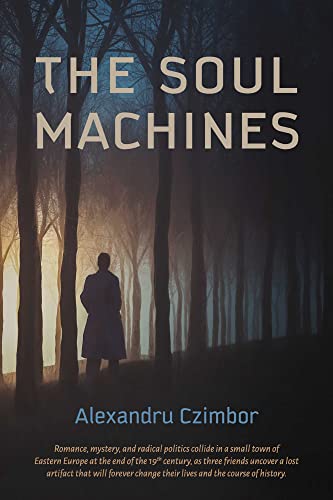
Set in the 19th-century Austro-Hungarian Empire, Alexandru Czimbor’s The Soul Machines is a captivating novel that explores the impact of a mysterious device on the lives of three young friends and the residents of a burgeoning mining town in Transylvania. As the discovery of this peculiar object unleashes a wave of violence, murder, and lunacy, the three young men must navigate a complex web of conflicts, including a pauper’s love for a wealthy girl, a villain’s sinister plans, and a group’s plot to harness the power of the device.
What I appreciated most about this gripping book was the author’s skillful weaving of multiple minor conflicts, which together create a dramatic and engaging story. Czimbor expertly blends genres, including mystery, thriller, and forbidden love, to deliver a rich and elaborate reading experience. By shifting between multiple perspectives, we gain a comprehensive understanding of the story and how the character’s interactions with the device influence their plans and objectives. Moreover, the book raises insightful and thought-provoking discussions around religion, naturalism, Marxism, and Darwin’s theories of evolution. The combination of themes makes this genre-blending novel perfect for eclectic readers.
The Soul Machines is an emotional rollercoaster, filled with unexpected twists and turns that will keep you glued to the pages for hours. For readers looking for a historical narrative that is both captivating and emotionally engaging, this book is a must-read. Be warned, however, that the book ends on a cliffhanger, leaving readers eagerly anticipating a sequel. Overall, I highly recommend this book to anyone seeking an unforgettable reading experience.
Pages: 584 | ASIN : B0BRT85YMG



 LITERARY TITAN