Blog Archives
Truth is Fundamentally Important

A Remembrance of Death follows a young man navigating loss, physical limitations, and the British Empire’s complex legacy in the aftermath of WWI. What was the inspiration for the setup of your story?
I wanted to write a story where the main protagonist is not an obvious hero. He is kind, courteous, and principled; he will not lie and understands right and wrong. At the outset, he is an observer of the events around him. He watches as his friend is thrown into a river and is helpless as his marriage falls apart. At the lowest point in his life, he goes to Nuremberg rather than stay with his wife because this is required of him. After Nuremberg, he must make a choice between loyalty to his country or exposing the truth. My inspiration for this story came about because I believe there is a growing trend for our news and history to be manipulated and that the truth is fundamentally important, no matter how uncomfortable it may be.
How did your research into historical events like the Mau Mau uprising and the Nuremberg Trials shape the narrative?
The two events are closely linked for the purposes of the story. My main protagonist, Basil Drewe, is shocked when confronted with the horrors of Dacau and Nazi atrocities and helps with the prosecution of Nazi War Criminals. Nine years later he must look into the Mau Mau uprising, where he learns that the British have closed their eyes to the torture of detainees and that nearly a million natives of the Kikuyu tribe have been resettled forcibly. Until this point in the novel Basil has mainly been a passive observer and now must make a choice as to whether to tow the British establishment line or not. From this point in the narrative Basil changes as does his life, particularly the trajectory of his relationship with his wife.
Laxman Choudhury is a memorable character. What motivated you to include his perspective and cultural experiences?
I was motivated to include Laxman’s perspective and cultural experiences to give a different perspective to the novel. Throughout the novel, there are instances of how foreigners, who are culturally different, are treated. For example, the Chinese workmen who built the railway across America, ‘The Dunera’ boys who were transported to Australia, the Kikuyu who were forced into unsanitary villages, and the detention and killing of Jews during WWII. Laxman Choudhury’s experiences show what it is like to be a foreigner in a time when a country does not respect someone else’s culture. He then returns to India where the tensions between the Hindu and Muslim communities are at breaking point. While he sees the faults of the British, he struggles to see what it is like being a Muslim in a Hindu-dominated society.
If readers take away one lesson or emotion from A Remembrance of Death, what do you hope it will be?
To learn from your mistakes and not to repeat them.
Author Links: GoodReads | X (Twitter) | Facebook | Website | Amazon
As he arrives at Oxford in 1917, Basil Drewe is coming to terms with the recent death of his brother Adrian in the Great War. Meanwhile at Ojai in America, Celia Lutyens and her illegitimate son Robert struggle to find their place in a foreign country. On returning to England, Celia renews her acquaintance with Basil and finds she must deal with the mistakes of her past and the constraints placed upon her by society and its expectations. Their journey takes them to India, Vienna, London, Nuremberg and Kenya. Finally, they return to Castle Drogo, the place where they first met, however, the castle no longer represents the ideal it once did for Celia but is now a mausoleum.
A Remembrance of Death was short-listed for the Yeovil Literary Price and received a high commendation. It was described as, “prose with a classic sensibility … evoking a clear and present time and place, the characters lifting effortlessly from the page with authentic dialogue and engaging set pieces.”
A Remembrance of Death


Andrew Tweeddale’s A Remembrance of Death is a richly woven historical novel that deftly combines personal tragedy with broader societal failings. Set against the backdrop of the First World War and its aftermath, the story follows Basil Drewe, a young man grappling with the loss of his brother, his own physical limitations, and the complicated legacy of the British Empire. Through Basil’s experiences at Oxford and his interactions with friends, family, and diverse characters, the book explores themes of grief, resilience, and the impact of colonialism, all while maintaining a compelling narrative.
What I loved most about the book was Tweeddale’s ability to bring the era vividly to life. From the description of Oxford’s spartan college rooms to the detailed portrayal of cricket matches and dinners, the setting felt authentic and alive. In one memorable scene, Basil wrestles with his past and present as he sits beside the ruins of Godstow Abbey, reflecting on his family history. The descriptions are rich yet not overwhelming, making the historical elements immersive without overshadowing the characters.
However, the book’s strength also lies in its character dynamics. Basil’s relationship with Laxman Choudhury, an Indian student, stood out as particularly poignant. Laxman’s quiet dignity and resilience offer a stark contrast to the more brash and entitled Jonathan Bruton. One of my favorite moments is when Basil organizes a vegetarian meal for Laxman, going to great lengths to honor his dietary needs and cultural background. It’s a small yet significant act of friendship that highlights Basil’s growth and the importance of understanding and empathy in bridging cultural divides.
There were moments where the narrative leaned a bit more toward explanation than immersion, particularly in its discussions of colonialism and British imperial guilt. While these themes are essential and thought-provoking, they occasionally feel more prominent than the flow of the plot. Even so, these instances were brief and didn’t take away from the story’s overall impact.
A Remembrance of Death is a thoughtful and emotionally resonant novel that will appeal to fans of historical fiction and those interested in stories about personal and cultural reconciliation. Tweeddale’s writing is evocative, and his characters are relatable in their flaws and virtues. I would recommend this book to anyone who enjoys exploring the intersection of history and human experience, especially through a lens of self-discovery and resilience.
Pages: 414 | ASIN: B0DLNQGKH4

The Devastation of War

Of All Faiths & None is a coming-of-age tale focusing on the relationships of the characters and how they fall victim to the tragedy of a needless war. What was the inspiration for the setup to your story?
I marched against the Iraq war and wanted to write a novel that showed the needlessness and brutality of war. The following year I visited Castle Drogo on Dartmoor. There is a room in the castle that is a shrine to the memory of Adrian Drewe, the eldest son of the tea baron who commissioned the castle in 1910. It seemed to me to be the perfect setting to tell a story about war. I wanted to introduce the reader to characters they would grow to like and then have each of these characters deal with the effects that war has on people’s lives. I therefore created a fictional story set around Castle Drogo that led up to the final tragedy of a lost generation.
Your characters are intriguing and well developed. What were some driving ideals behind your character’s development?
Thank you. I did not want to create stereotypes but rather rounded characters with flaws. I wanted to take ideals such as faith, duty, conscience and honour and see what would happen to characters when faced with the devastation of war. In many cases the ideals that the characters believed in are questioned or lost by the effects of the war on their lives.
What were some themes that were important for you to explore in this book?
The necessity of war and its consequences on those caught up by it. However, I also wanted to look at what drove people to enlist and how people dealt with tragedy.
What is the next book that you are working on and when will it be available?
The book I am currently writing looks at the Mau Mau uprising in Kenya and considers whether it is ever right to use torture and oppression to stop an enemy who uses the bloodiest tactics imaginable. It has a working title of ‘The Nuremberg Paradigm’ and should be completed within the next two years
Author Links: GoodReads | Twitter | Facebook | Website
The novel moves to 1914, and the start of the Great War. Christian Drewe returns from Austria where he has been working as an artist. He has reservations about joining up, unconvinced that the war was either necessary or right. He meets a nurse, Rose Braithwaite, when he is stuck at a railway station by fog. They subsequently meet again when Rose invites Christian to a party she is having for her birthday. Despite them being of different classes, there is a mutual attraction and during the evening they kiss. However, Rose is engaged and a fight breaks out between Rose’s fiancé, who arrives much later, and Christian. Both Rose and Christian decide never to see each other again. Christian’s moral conflict about enlisting comes to a head when he is handed a white feather – the sign of a coward. Eighteen months later, during the war, Christian is injured and is treated by Rose at a hospital on the front line. Both realise their mistake of following their heads rather than their hearts. Christian is sent back to a rehabilitation hospital in England where Celia is now working.
Adrian, when on leave, visits Christian and again meets Celia. The relationship is now one of equals. Celia, a headstrong young woman, decides that she must try and develop the relationship or risk losing Adrian. Adrian is torn between his desire for Celia and his need to protect his family, who are now having financial problems. The story moves from the battlefields of Flanders to Castle Drogo, where the characters are reunited for brief periods. Faith and love are stretched to their limits as each character is affected by the relentless brutality of the war. Of All Faiths & None is the story of a lost generation. It is a novel that focuses on the relationships of the characters until those relationships are shattered. It is a coming-of-age tale and a social commentary on the tragedy of a needless war.
Of All Faiths & None
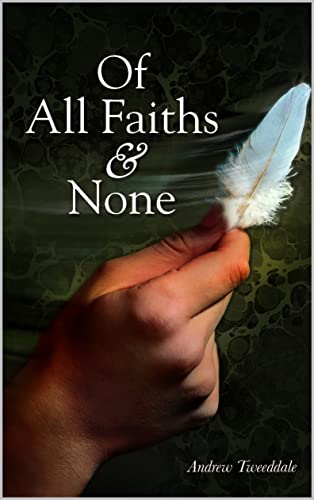

Of All Faiths & None by Andrew Tweeddale is a historical fiction novel set during the Great War between 1910 and 1918. This compelling novel begins with Julius Drewe, who hires a famous architect, Edwin Luytens, to design a castle. Drewe’s goal is to establish and preserve his legacy with the construction of Castle Drogo, which later symbolizes the nature of the war, and how the younger generation of the Drewes and Luytens become entangled in the war, which breaks out in 1914. The plot quickly develops when the setting shifts from the families’ residence in London to the various battlefields and their connections to each other and Castle Drogo.
The author explores many essential topics during the early 1900s, including the age of enlightenment, the suffragette movement, and the impact of war. It’s an emotional rendition of the history of western society and how significant changes in the world challenge different religions and belief systems. Tweeddale does a great job developing each character and evolving them throughout the book in well-structured chapters and well-written descriptions of their individual experiences.
Throughout the book, Tweeddale explores the themes of duty, vanity, romance, and spirituality and how they evolve during the war. Readers get a glimpse into the political system of this era, and the consequences of war on all levels of society, from the ordinary people to the elites. The author brilliantly showcases the horrors of war and how it capitalizes on the arrogance and vanity of humans while humanizing war casualties so that they are not merely seen as numbers or statistics but as soldiers who are also brothers, sons, and spouses.
I profoundly enjoyed Of All Faiths & None by Andrew Tweeddale. I recommend this impassioned historical romance novel for the author’s ability to highlight the tragedies of war and how it is the ultimate equalizer, impacting everyone regardless of faith or lack of it. It is a well-told tale of love, faith, and war, and is perfect for fans of historical fiction.
Pages: 352 | ASIN: 1739612205



 LITERARY TITAN