Blog Archives
The Inheritance of Light


Charles L. Templeton’s The Inheritance of Light is a work of historical fiction that braids together the stories of two family lines, the Templetons and the Sewells, across generations of war, migration, labor, marriage, grief, and survival. It begins in the Revolutionary era and moves forward through the War of 1812, the Civil War, and into the twentieth century, using linked episodes, family memory, and a strong sense of inheritance to ask what exactly passes from one generation to the next: blood, certainly, but also courage, stubbornness, tenderness, damage, and a way of seeing the world.
Templeton is not trying to be slick, detached, or fashionably ironic; he is trying to honor people. That choice gives the novel an unusual warmth. I felt it especially in the letters, the battlefield passages, and the domestic scenes where homes are being built even as history keeps barging through the door. At its best, the prose has a weathered musicality to it. It’s full of smoke, mud, river, iron, and lamplight, and the book understands that endurance is rarely glamorous. It is usually repetitive, familial, and half-invisible until someone remembers it properly.
I also admired the ambition of the structure. This is not a narrow historical novel but a generational mosaic, and mosaics always risk becoming static. Here, though, the book keeps finding pulse through recurrence: fathers and sons, brothers and wives, duty and homecoming, violence and mercy, the old ache of leaving and the old ache of return. I respected the scale of the undertaking. I finished the book feeling that Templeton had written not just toward the past but toward obligation, toward the belief that family history, however ragged, is a kind of lantern.
I’d recommend The Inheritance of Light to readers of historical fiction, family saga, multigenerational fiction, Southern historical fiction, and genealogical fiction, especially anyone drawn to novels where lineage matters as much as plot. Readers who enjoy the rootedness of Wendell Berry, or the generational reach of books in the vein of Jeff Shaara’s war-centered historical storytelling, will likely find something to admire here. This is a book for people who like their history human-scaled and their memory hard-won. I think The Inheritance of Light argues, persuasively and with heart, that what survives a family is not just blood, but light.
Pages: 323 | ASIN : B0GGJQS3FC

Sugarcane Saint: The First Book of Ruth

Sugarcane Saint: The First Book of Ruth is a hard-hitting family story set in early twentieth-century Georgia. It follows young Ruth Shurlington as she grows up under the shadow of Stone Mountain, in a house full of siblings, chores, church talk, war news, and quiet fear. In another county, we also see Leonidas Brantley, a machinist with pride, shame, and a cruel streak that spills into his small home. The book lays out how war, poverty, religion, and everyday racism shape these families and tighten around the girls in them. By the time the author’s opening note and the prologue click together, it is clear this is the “seduction” phase of a bigger cycle of abuse, and the first part of a planned trilogy about hurt that runs through three generations.
I felt the writing was vivid and sensory. The author has a knack for small details. The sagging porch, the smell of lamp oil, the ash that looks like strange white snow, the way chickens move when a child scatters feed. The dialogue is thick with Southern rhythm and slang, but it is easy to follow, and it gives each person a clear voice. I liked how scenes jump from quiet domestic work to sharp danger in just a line or two. One moment Ruth is playing in the hen run. The next she is walking through a burned town that used to feel safe. The Bible verses at the start of each section set the mood without feeling like a lecture, and they fit the way these families actually talk and think. The prose is controlled, but it still feels authentic.
The opening scenes of violence and the picture of a mother holding her own daughter down are sickening. They are also written with a cool, steady eye that refuses to look away. I could feel the author wrestling with the question she states up front. How can a woman be gentle and loving and still help terrible things happen in her home. The pacing leans into that slow dread. We see the fire in the town, the boys treated like little men, the girls pushed back to the edge of the room, the casual racism in everyday talk, the constant reach for God as if He is the only safety net around. That build-up made the heavy scenes hit even harder, because by then I cared about Ruth, her brothers, her cousins, even the flawed adults who are already bent by their own history.
What stayed with me most was the book’s idea of how harm grows inside a family and inside a culture. The story keeps tying the private wounds in the house to bigger forces outside. Old men still raging about the Civil War. Lost land. New wars that pull sons away. A system that tells white men they should rule everything and everyone. A church world that talks about mercy while kids hide from belts and fists. The book does not excuse any of the abuse. It also does not flatten people into simple monsters or saints. A father can work himself to the bone for his farm and still break his children. A mother can pray and bake birthday cakes and still turn her face away when her daughter begs for help. I appreciated that the author is open about building this from family stories and from research, and about her own need to understand rather than just to punish. That gives the whole thing a searching, haunted feel instead of a neat, moralizing tone.
I would recommend Sugarcane Saint to readers who want historical fiction that looks straight at family violence, racism, and faith without soft focus. It is a good fit if you like long family stories, rich settings, and morally messy people, and if you can handle graphic scenes of abuse and emotional distress. This first book feels like the start of a brave and painful journey, and it left me wanting to follow Ruth’s story through the rest of the trilogy and see what kind of healing, if any, can come after so much harm.
Pages: 410 | ASIN : B0F94MTK18
Female Agency

Lady of Lincoln follows noblewoman Nicola de la Haye, who defies gender, betrayal, and political chaos to defend Lincoln Castle during one of England’s most violent and unstable eras. How did you balance staying true to the historical record while giving Nicola a vivid inner life?
I was first introduced to Nicola de la Haye’s story when I visited Lincoln Castle as a tourist, and they talked about their famous constable, ‘The Woman who Saved England,’ and the first ever female sheriff. I was determined to write about her, but realised fairly quickly that it would be a mammoth task.
I started by immersing myself into her story, that of England in the hundred years before her time (the Norman conquest, and ‘the Anarchy’ and her family’s involvement in both, as well as the history of England, Normandy, and the Angevin empire over the whole of her life and just after. I paid particular attention to her family, neighbours, the city of Lincoln, and the royal and church infighting at the time.
Having, after months of careful research, enough to go on, I mapped out the whole character story and arc that would fit with the known facts and that would explain her motivations for what she did.
Only then did I start to write. But with every chapter, there was the need for more research – what did the abbey it was set in look like? What was happening in the city England, or with the dispute with the church, at that exact time? How did the chroniclers describe the appearance (if at all) of the characters, and what personality traits did they assign to them?
I don’t believe I wrote anything that conflicts with the known history, and I tried to record that known history if it was relevant to the story. The art was to fill in the gaps, determine the personalities involved, and their motivations.
Nicola is both dutiful and defiant. What aspects of her personality felt most important to get right?
Nicola would be a woman who was considered exceptional by chroniclers. She defied conventions by ruling a castle, becoming the first female sheriff, holding out in important sieges, and commanding the loyalty of her vassals and her garrison. She also stayed loyal to a king who had been abandoned by most of his barons. She didn’t take the easy path, and she didn’t shirk her responsibilities. To me, that meant she needed a unique mix of loyalty, obligation to duty, and an ability to defy and stand her ground. That is the woman who Nicola became, and that is what the story in Lady of Lincoln, the first in the series about her, would help her become.
What were some themes that were important for you to explore in this book?
Female Agency in a Patriarchal World: The novel explores Nicola’s struggle to exert authority and make her own choices in a society where women are viewed as little more than property. Her journey from a girl who must be “taught her duty” to a woman who commands a castle siege exemplifies this theme.
Duty vs. Desire: Nicola is torn between her duty to her family name, her people, and the King, and her personal desires for love, freedom, and self-determination.
The Nature of Honour: The story contrasts different interpretations of honour. For Nicola’s father and Gerard de Camville, honour is tied to loyalty, duty, and justice. For characters like William FitzErneis, Ralph de la Haye, and Alured of Pointon, honour is a flexible concept, often sacrificed for personal ambition, wealth, or status. This conflict shapes Nicola’s understanding of true leadership.
How does this first book set the stage for the rest of Nicola’s journey?
In Lady of Lincoln, Nicola discovers her agency both as a baroness but also with her relationships. She is challenged by the effect of the Great Rebellion (a civil war) on her family, her people, and her inheritance. In the next two books she will be further challenged in terms of both her relationships (the middle years of a marriage, growing children, and widowhood) and the effect of significant external events (the Third Crusade, the plot by Prince John against King Richard the Lionheart, then Magna Carta, the Baron’s War, and the French invasion) that impact directly on herself and all that she holds dear. By the time she holds out against the French invasion, she has truly grown into the person who was ‘the Woman who Saved England.’
Author Links: GoodReads | X (Twitter) | Facebook | Website | Instagram | BookBub | Books 2 Read | Amazon
12th-century England. Nicola de la Haye wants to do her duty. But though she’s taught a female cannot lead alone, the young noblewoman bristles at the marriage her father has arranged to secure her inheritance. And when an unexpected death leaves her unguided, the impetuous girl shuns the king’s blessing and weds a handsome-but-landless knight.
Harshly fined by Henry II for her unsanctioned union, Nicola struggles to salvage her estates while dealing with devastating betrayals from her husband… and his choice to join rebels in a brewing civil war. Yet after averting a tragedy and gaining the castle garrison’s respect, she still must face the might of powerful men determined to crush her under their will.
Can she survive love, threats, and violent ambition to prove she’s worthy of authority?
In this carefully researched and vividly human series debut, Rachel Elwiss Joyce showcases the complex themes of honour, responsibility, and freedom in the story of a remarkable heroine who men tried to erase from history. And as readers dive into a world defined by violence and turmoil, they’ll be stunned by this courageous young woman’s journey toward greatness.
Lady of Lincoln is the gritty first book in the Nicola de la Haye Series historical fiction saga. If you like richly textured female heroes, courtly drama, and fast-paced intrigue, then you’ll adore Rachel Elwiss Joyce’s gripping true-life tale.
Buy Lady of Lincoln to celebrate ‘the woman who saved England’ today!
The Communist Question

Jeanne The Woman in Red is a work of biographical fiction based on the life of Jeanne Tunica Y Casas, a fiery, uncompromising political activist, feminist, communist, and a woman of courage. What was the inspiration for the setup of your story?
If I had written a non-fiction account of Jeanne’s life and work, it would have sounded robotic and lacking in truth. Fiction was the only way to delve deep into her life and times. Many people she knew and worked with had passed away or were reluctant to speak or give any information. I understand and respect that, but facts, figures, and exact dates would have been missing. There is not much out there in English, and the work done, predominantly by a New Caledonian historian, provided a solid foundation from which to write. I had access to her articles, tracts, and speeches, and I was able to integrate this into the story as they had been written—typos and all.
I have always been inspired by strong characters in fiction and non-fiction. I was drawn to Jeanne straightaway. I had just arrived in New Caledonia for three years, and I was browsing its history, and I came across Jeanne. I wanted to visit her at the cemetery, pay my respects, but I discovered she had been buried in a common grave. I could not believe it. Disheartened but determined, I contacted the administration and decided that writing the book is only half of it. I wanted her recognised with a plaque. She fought for the rights of exploited peoples, and I wanted to fight for her legacy. Her remains were located, and a plaque now recognises her at a local cemetery. It has been a hard but satisfying journey.
What were some ideas that were important for you to share in this book?
Her relationship with her lover turned husband, Paco. The communist question. How much or how little did she know about Stalin’s atrocities? The right of women to vote. I wanted back-and-forth chapters where her life in the nursing home meets the past.
Did you find anything in your research of this story that surprised you?
I was surprised that she had lived in Australia for a while and opened up a restaurant in Sydney. Her continual battle with the authorities. She never gave up. I was also disappointed with a few reactions as if writing about a communist makes the writer a communist. This is not the case, and I could never have placed 2020 eyes on Jeanne’s life and get away with writing her story.
What is one thing that you hope readers take away from Jeanne The Woman in Red?
That she, like many others, must be remembered for inspiring and encouraging change without violence, and that history, far from being cancelled, should be remembered and studied – the good and the bad and learn the lessons on how to move forward. I am not just talking about feminists and politicians, but people who did not have a public role but were instrumental in shaping future generations.
The book has been translated into French and will soon be released.
Author Links: GoodReads | Amazon
Humble, Conservative Origins

In the Shadows of the Blue Ridge is a portrait of rural life colliding with political and economic change in Loudoun County, Virginia, and how what was once a sprawling community of dairy farms was urbanized by the construction of Dulles Airport. What inspired you to write this story?
As a native of Loudoun, I’ve witnessed its development over the past 30 years firsthand. In shocking contrast to its current frenzied level of activity, when I was a child, not much happened west of Leesburg, and there weren’t yet any wineries. Indeed, I remember slower, kinder days in Loudoun – long, summer days and nights when all that could be heard were tumbling brooks, crickets, and tree frogs. That memory stands out in stark opposition to today’s traffic, retail shops, and human activity here. I suppose before too much more “progress” occurs, I wanted to remind my readers of Loudoun’s humble, conservative origins in its not-so-distant past, and also discuss the policy and political changes Loudoun County (actually the entire country and planet) is grappling with, which required a deep dive into the classical philosophies on which the U.S. was founded.
As someone who lives just outside Loudoun County, I found your book fascinating. While fictional, it brings the rich history of this area to life and shows awareness of how much it has changed in a relatively short period. What were some ideas that were important for you to share in this book?
The country has experienced rapid cultural change over the past 30 years, specifically since the introduction of Critical Theory into public colleges and universities in the mid-90s. I wanted to chronicle these changes in order to understand how we have arrived at this point of contentious divide between parties. Also, I wanted to emphasize the crucial role of parents in the education and rearing of their own children, who are tomorrow’s citizens.
What is one thing that people point out after reading your book that surprises you?
I suppose I’m surprised about the emotional connection my readers experience with my main character, “Red,” including anger, pity, and pride (the latter over his clandestine political achievements). This feeling unites me with my readers. I find it interesting that our connection is emotional, rather than academic or intellectual.
What experience in your life has had the most significant impact on your writing?
I was raised by old-world aristocratic Germans before the computer chip, when all we had was a piano, a full set of Encyclopedia Britannica, horses, chickens, and a garden. This afforded me time to dream and contemplate life’s mysteries in nature, when, as a child, I myself wandered over Loudoun’s creeks and fields. Due to my childhood, I have experienced the differences of perception and identity under European feudalism vs. American capitalism.
Author Links: GoodReads | Facebook | Amazon
The narrative includes detailed accounts of Loudoun County’s political landscape, featuring figures such as Scott York, Phyllis Randall, Dave LaRock, and Eugene Delgaudio. It highlights political conflicts, cultural shifts, and controversies over social issues, reflecting the tension between conservative and progressive values within the community. The story of Red’s involvement in local politics, legal battles, and personal vendettas illustrates the complex interplay of power, identity, and morality in Loudoun.
Originally a farming community with a focus on livestock, agriculture, and dairy farms, Loudoun County experienced rapid urbanization starting in the 1960s, especially due to the construction of Dulles Airport. This shift led to a decline in dairy farms and an increase in real estate development, significantly altering the county’s landscape and economy. The county became a technology hub, known as “Data Center Alley,” hosting major tech companies and data centers that handle approximately 70% of global internet traffic.
The book delves deeply into the philosophical underpinnings of Western law and morality, tracing ideas from Socrates, Plato, Aristotle, and Cicero to the founding principles of the United States. It emphasizes the role of Natural Law, the Cardinal Virtues (prudence, justice, fortitude, temperance), and the theological virtues (faith, hope, charity) in shaping legal and ethical frameworks. The Founding Fathers of the U.S. are portrayed as influenced by these classical and Christian ideas, embedding them in documents such as the Declaration of Independence and the Constitution.
The history of education in America, particularly in Loudoun County, is outlined, noting early religious instruction and the evolution toward compulsory public education. The document discusses contemporary debates over educational policies, including diversity, equity, inclusion (DEI), and critical theory, highlighting controversies in Loudoun County Public Schools. It also introduces Patrick Henry College, founded to prepare Christian leaders grounded in biblical values and American founding principles.
A detailed profile of George Soros is provided, including his background, philosophy, and economic theories such as reflexivity. Soros’s influence on global politics and progressive movements is discussed, with attention to his support for causes that challenge traditional biblical morality, including LGBTQ rights and abortion. The document contrasts Soros’s views with classical moral philosophy and critiques the progressive rejection of traditional virtues.
The book presents biblical narratives and teachings that emphasize natural law, the Noahide Laws, and the importance of filial piety, empathy, and moral virtue. It recounts stories from Genesis, such as Adam and Eve, Cain and Abel, and the destruction of Sodom and Gomorrah, linking them to contemporary moral debates. The role of forgiveness, reconciliation, and spiritual salvation through Christian faith is underscored as essential to personal and societal well-being.
Throughout, the book acknowledges the struggles with addiction, family dysfunction, and societal change experienced by individuals like Red. It explores themes of identity, abandonment, and redemption, and situating these personal stories within the broader historical and cultural transformations of Loudoun County.
To Inspire and Enrich

Growing Up O’Malley is a Historical Fiction novel, based on true stories from your family, of an Irish immigrant couple raising seven boisterous children in Ohio during the early 1900s as they face famine, war, love, heartbreak, and rebirth. Why was this an important book for you to write?
It’s a gentle reminder of life’s simplicity before the onslaught of technological advances. Stories passed down from my parents, and interviews of their remaining siblings (some passed before my journey as an author began) reveal lives searching for purpose and a quest for truth. They highlight the importance of a common sense approach to life’s dilemmas as a universal convergence present throughout history. Reliance on faith, love, and empathy applied to everyday life serve as mainstays toward understanding one another. Life has become divisive and Growing Up O’Malley transports the reader to a time highlighting the application of these principles in our search for individual peace.
Since you based this book on true events from your family history, how did you decide what to include and leave out in your book?
The goal of my writing is to inspire and enrich the reader, hopefully uplifting those facing insurmountable odds. The majority of stories in Growing Up O’Malley are based on facts with a touch of blarney to make them enjoyable. One example is the 1923 birth of my aunt, Veronica O’Malley Collins, clearly before my time. My aunt, Marge O’Malley DuChez, told me two important facts: (1) a bundle was placed on the kitchen table and Marge, the oldest, believed it was a doll until it moved. Her iconic response, “It’s a bay-by” was included exactly as she relayed; and (2) William O’Malley was heartbroken because his father promised him the next baby would be a boy—upset with yet another girl in their abode, he tried to ignore her. With these two facts, I mentally travelled back in time and imagined my own mother’s response at the age of three! I could feel my mother’s smile from heaven as I relived life more than a century past. Although negative incidents are mentioned, I attempted to offset them in two ways: humor or the power of faith to combat problems, many of them universal and inescapable.
What were some goals you set for yourself as a writer in this book?
I had two primary objectives: (1) create a book where the reader felt they were either part of the story or could identify with its characters; and (2) include historical events without making the reader feel they were being schooled (like the series “Beyond the headlines” revealing background facts without sensationalism). I conducted a brief informal history quiz on Gen Z kids and was shocked to discover they were unaware of many important events shaping our history (one example is McCarthyism). If my book has enriched even one person’s life with facts no longer covered in today’s curriculum (and shared those with others), my goal would be achieved.
What is the next book that you are working on, and when can your fans expect it to be out?
I’m actually working on two books: When I Grow Up: A Collection of Short Stories and Never Truly Alone, a psychological thriller. My goal is a release of short story compilations in 2026 and, hopefully, my thriller in 2026 as well.
Author Links: Website | Amazon | Facebook | Instagram | GoodReads | X | LinkedIn
Growing Up O’Malley is a poignant story of an Irish immigrant couple raising seven boisterous children in the early 1900s. Their antics provide the backdrop for a story filled with humor and determination to navigate life’s challenges—the Great Depression, kidnapping, deadly illness, and World War II. Their journey focuses on optimism, Irish wit, and faith to provide inner strength hidden until tested by fate.
GROWING UP O’MALLEY
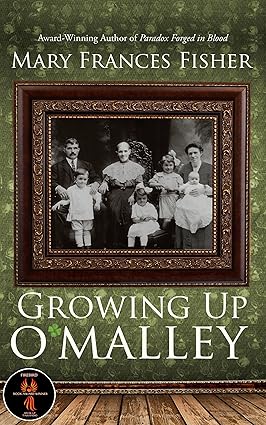
Growing Up O’Malley by Mary Frances Fisher is a sprawling historical saga rooted in family, Irish heritage, and the immigrant experience in America. Set primarily between Ireland and Cleveland, Ohio, the story traces generations of the O’Malley family as they face famine, war, love, heartbreak, and rebirth. Blending fact with fiction, Fisher brings to life the struggles of Irish immigrants, their fierce pride, and the everyday resilience that shaped not just a family but a community. Anchored by matriarchs like Elizabeth Ginley and spirited descendants like Mary Ginley and Michael O’Malley, the novel is a love letter to enduring spirit and cultural identity.
Fisher’s prose is heartfelt and raw, sometimes poetic, and often tinged with a gentle humor that softens the blows of hardship. I was taken by the way she wrote about poverty, not with pity, but with grit and beauty. The characters are deeply real, layered with flaws and love and history. I cared about them, especially Mary, whose emotional journey from innocent girl to heartbroken woman to strong matriarch stuck with me. Sometimes the dialogue leaned heavily on dialect, but it added charm rather than distraction. I found myself rooting for these folks like they were my own distant cousins.
With over a hundred chapters, a multitude of characters, and detailed events packed into nearly every page, it sometimes felt overwhelming. That said, it’s clear Fisher wrote this with love and reverence—each anecdote, each trial, each joyful reunion rings with authenticity. The blend of fact and fiction is seamless. It’s history with a beating heart. And her sense of humor, especially in the small asides and character quirks, offers a delightful balance to the more sobering passages.
Growing Up O’Malley is a heartfelt and relatable tale that will resonate with anyone who’s ever felt the tug of heritage or family duty. If you enjoy sweeping family sagas, stories about resilience, or have Irish blood in your veins, this one’s for you. It’s not a quick read, but it’s a rich one that is best read slowly. For fans of Angela’s Ashes or Brooklyn, this book will feel like coming home.
Pages: 482 | ASIN : B0CK8YJ1YT

Hatfield 1677

Hatfield 1677 is a vivid historical novel rooted in the real-life events of King Philip’s War. The story centers on Ben and Martha Waite, a Puritan couple whose lives are ripped apart by conflict between English settlers and Native tribes in colonial Massachusetts. When Martha and her children are captured by Native warriors, Ben sets out on a perilous mission to bring them home. Through alternating perspectives, including that of a Nipmuc sachem, the novel explores survival, love, loss, and the brutal toll of war.
From the first chapter, where Ben says goodbye to his wife and children before riding off to war, the writing has this warm, steady heartbeat. It’s historical fiction, but it never feels dry or overly formal. Rader’s prose strikes a compelling balance between lyrical and grounded. She captures intimate, sensory moments with remarkable clarity, Martha rinsing her hair in lavender water, Ben riding through the ruins of Deerfield, the tense stillness before a storm. The detail is immersive without becoming excessive. Even in the opening chapter, as Ben says a quiet, emotional goodbye to his daughters, the writing evokes a tenderness and fear that is both deeply human and hauntingly real.
What really struck me, though, was the moral weight Rader builds into the action. She doesn’t sugarcoat anything. The chapter on the Falls Fight was gutting. When Ben storms a Native camp and ends up sparing a young mother and child, it’s not some triumphant moment; it’s raw and messy. He throws up afterward. His pistol shakes in his hand. He can’t even speak about it when he gets home. It’s that emotional honesty that makes the violence and grief in this book hit so hard. And then you get Ashpelon’s chapter, a Native leader telling a parable about greedy squirrels, and suddenly, the whole war feels even more tragic. It’s layered and thoughtful without being preachy.
One thing I didn’t expect and ended up loving was Martha’s voice. She’s not just “the wife back home.” She’s smart, she’s tough, and she’s trying to survive just like everyone else. Her scene with Hannah, when they talk about love, abuse, and the impossible choices women face, felt painfully modern. There’s one line, when Martha’s holding her daughter and watching her husband ride off, where she says, “Your fair beard will need a trim when you return.” That crushed me. Because it’s not really about his beard, it’s hope, and fear, and trying not to fall apart.
Hatfield 1677 is a love story wrapped in a war story, with sharp writing and real emotional stakes. If you’re into historical fiction with heart and teeth or if you just want a book that’ll leave you thinking about it long after the last page, this one’s for you. Fans of Cold Mountain, The Last of the Mohicans, or even Outlander (minus the time travel) would feel right at home. I highly recommend this book to readers who like stories that are as much about people as they are about history.
Pages: 410 | ASIN : B0CW18FWXS


