Blog Archives
Hunting the Red Fox


Hunting the Red Fox by W. Kenneth Tyler, Jr. is the kind of novel that feels like sitting down with a gifted, slightly mischievous older man who casually mentions that he once stole a 200-carat diamond, fought behind enemy lines during World War II, played professional golf with legends, knew Hollywood stars, and spent a good portion of his younger years charming women and breaking rules. Roger Mace, an aspiring writer looking for extraordinary stories from ordinary people, meets eighty-two-year-old Perry Barnes on a golf trip and quickly discovers that Perry could fill a book by himself. From there, Perry takes Roger through a life shaped by Depression-era Savannah, the violent loss of his father, petty crime, specialized Army training, wartime missions, professional golf, jewel theft, romance, and eventually the hunt for a criminal known as the Red Fox. Tyler wisely gives Roger a skeptical voice throughout, so the reader gets to share his recurring thought: can one man really have lived all of this? That tension between disbelief and fascination becomes part of the fun.
Perry is what holds the sprawling story together. He’s charming, vain, observant, funny, reckless, sentimental, and far more complicated than his polished gentleman routine initially suggests. His childhood talent for reading people, gambling on golf, and stealing eventually combines with military training in languages, sabotage, infiltration, and survival, creating a man whose legal and illegal talents are almost impossible to separate. That becomes especially entertaining when Perry returns to jewel theft in the 1950s, convincing himself he’s behaving like Robin Hood by stealing from wealthy people who mistreat their employees and secretly directing the proceeds to those workers. The thefts aren’t simply side adventures. They reveal something essential about Perry. He craves the intellectual puzzle and adrenaline almost as much as he wants to believe he’s doing the right thing. Tyler also has a fondness for detail, whether he’s describing a golf hole, a mansion, a military operation, a piece of jewelry, or a complicated theft. That gives the novel the texture of a long story told over drinks, where one memory leads naturally into another and the storyteller enjoys the telling nearly as much as the listener enjoys hearing it.
There’s something of Winston Groom’s Forrest Gump in the novel’s approach to history. Like Groom, Tyler sends a fictional man wandering through real twentieth-century America and lets him brush shoulders with people readers already know. Perry encounters figures such as Winston Churchill, Howard Hughes, Jackie Gleason, Dean Martin, Frank Sinatra, and some of professional golf’s biggest names, and he treats those encounters with an amusing casualness. Where Groom gives Forrest innocence and happenstance, Tyler gives Perry calculation, swagger, appetites, and a con man’s eye for opportunity. That makes Hunting the Red Fox feel part historical adventure, part crime caper, part golf novel, and part exaggerated fireside memoir. The later arrival of Sophia Toscana gives all of those threads a satisfying place to meet. She’s a talented jewelry detective pursuing the Red Fox, while Perry is a former jewel thief who can understand the criminal precisely because he thinks like one. Their investigation turns the final portion of the book into a genuine cat-and-mouse story, culminating in the theft of the Mecklenburg Diamond, Perry’s confrontation with Clarence Desmond, and a dangerous showdown that finally forces Perry to decide what he values more than excitement.
What stayed with me most, though, wasn’t the diamond or even the Red Fox. It was the way Perry’s entire story gradually becomes an argument about growing up. At the beginning, he tells Roger that returning the Mecklenburg Diamond marked the end of his life as a thief and con man because love and family had finally become more important to him. The rest of the novel spends hundreds of pages showing how difficult it was for him to reach that conclusion. Sophia matters because she presents Perry with something none of his adventures can provide: a reason to stop roaming. Even then, he nearly ruins it by falling back into old habits and running away from commitment. The final revelation that Sophia became Mrs. Barnes, that they built a family and founded a successful detective agency together, gives the book a warm and fitting payoff. Perry doesn’t simply abandon his unusual talents. He finally figures out where to put them. That makes Hunting the Red Fox a big, talkative, frequently funny life story about a man who spends decades mastering how to escape almost anything before realizing that the best part of his life begins when he finally finds something he doesn’t want to escape from.
Pages: 300 | ASIN : B0F1FW1KKQ

Pivoting From Blue – One Year of Death, Divorce & Discovery
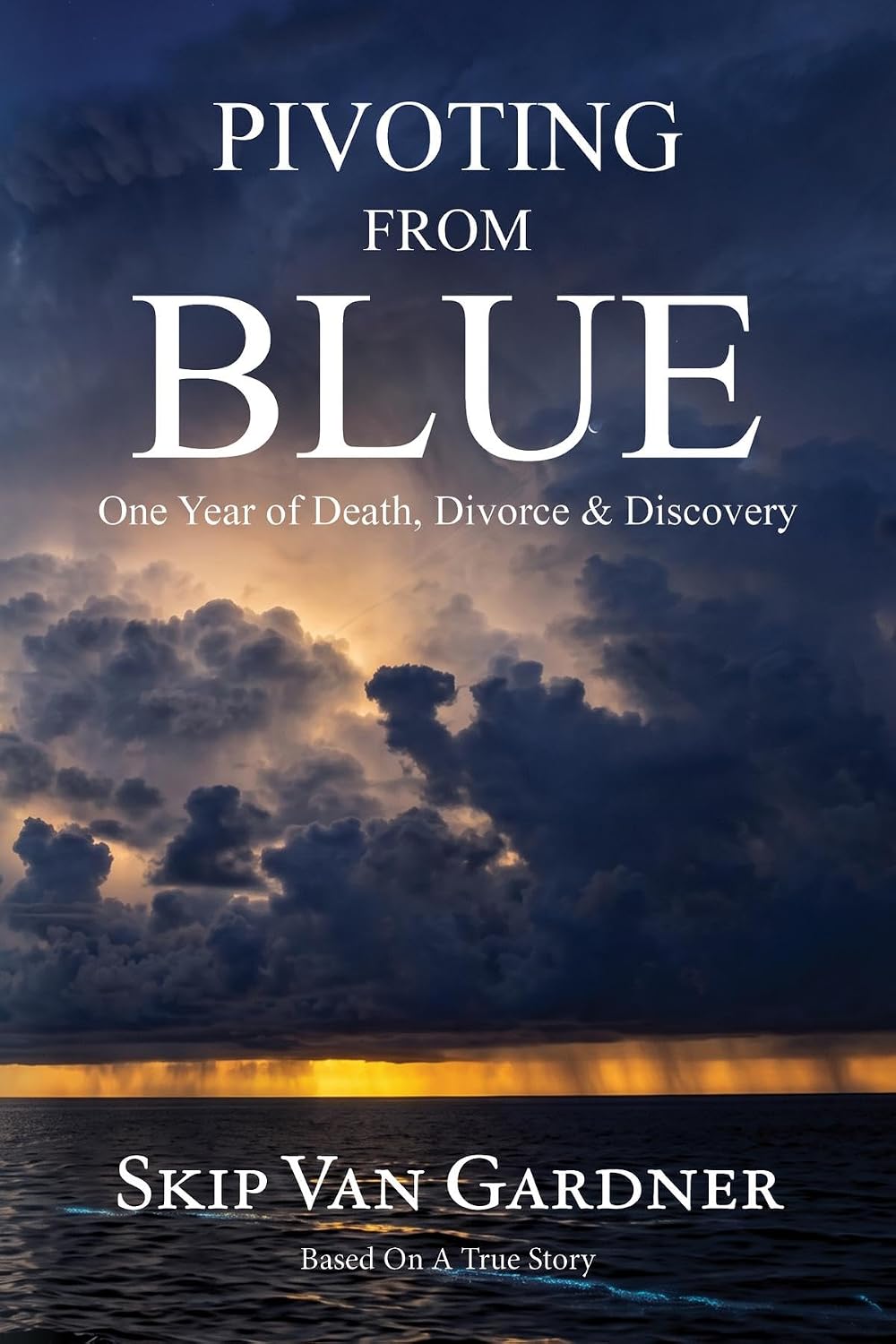
Pivoting From Blue by Skip Van Gardner is a deeply personal work of autobiographical fiction, family drama, and grief fiction built around one chaotic, transformative year in its narrator’s life. Divorce, aging parents, a father nearing death, family conflict, parenthood, physical and emotional upheaval, and a terrifying boat trip across the Gulf Stream all pile into what Van Gardner simply calls “The Year.” The novel moves back and forth through those experiences, which makes sense because that’s how the narrator experiences them. One problem changes how he sees another, and an event that initially feels disastrous can look completely different months later. The result reads less like a neatly plotted sequence of events and more like someone trying to understand, in real time, how his entire life arrived at a breaking point and what might be waiting beyond it.
Van Gardner’s first-person voice gives this novel most of its personality. He’s profane, funny, angry, sentimental, self-critical, spiritual, and occasionally all of those things within a page or two. There’s very little distance between the narrator and what he’s feeling, so arguments, panic attacks, walks through the neighborhood, divorce mediation, hospice visits, dinners with his parents, and moments with his children can all carry surprising weight. Some of the book’s most memorable writing comes from the contrast between ordinary details and enormous emotions. A fruit tree, a song, a sunrise, a recliner, a plate of fried conch, or a final handshake becomes part of the narrator’s way of processing change. Music is especially important throughout the novel, functioning almost like an emotional map of the year. That openness also gives the book an intentionally sprawling quality. Van Gardner circles back to ideas, people, and grievances because the narrator himself is still working through them, and that repetition becomes part of the experience of being inside his head.
At the center of this grief and spiritual fiction novel is a growing fascination with what happens when a person’s familiar way of seeing the world collapses. The dangerous Bahamas crossing becomes the book’s major turning point, leading to what the narrator calls “The Compression,” an altered way of experiencing memory, color, sound, time, relationships, and faith. From there, walking, therapy, prayer, nature, and writing become tools for rebuilding his life. The book’s spiritual passages, particularly his experiences involving the Courts of Heaven, are presented with the same conviction as the family and marital events surrounding them. Van Gardner isn’t especially interested in separating the emotional, physical, and spiritual parts of his transformation. They’re intertwined. That approach gives the novel its distinctive identity and turns a story about divorce and death into a broader examination of forgiveness, accountability, love, mortality, and the strange clarity that can arrive when circumstances force someone to confront himself.
The final stretch brings the book’s major threads together through the death of the narrator’s father, the struggle over his mother’s care, and his changing understanding of his marriage and family. Those chapters contain some of the book’s sharpest anger, but they also reveal why so much of Pivoting From Blue has been concerned with memory. Van Gardner keeps returning to the question of what remains after a life is reduced to photographs, possessions, legal documents, stories, and the memories held by other people. By the end, writing itself becomes his answer. This contemporary family drama is ultimately about choosing to participate fully in life while there’s still time to do it. Van Gardner closes “The Year” with plenty of scars still visible, but also with a much clearer sense of what deserves his attention. That makes Pivoting From Blue an intimate, messy, frequently funny, spiritually charged story about a man discovering that surviving upheaval is only part of the journey. The harder and more meaningful work is deciding how to live afterward.
Pages: 284 | ASIN : B0H6Y5S3XP
Jeanne la femme en rouge


Jeanne la femme en rouge, by Isabelle B.L., is a historical novel about Jeanne Tunica y Casas, a fierce political agitator, teacher, artist, wife, and aging woman whose life stretches across Nîmes, Paris, Nouméa, Sydney, and Santo. The novel frames Jeanne in her later years, confined to a retirement home in 1967, while memory keeps pulling her back to Paco, her beloved husband, and to the decades she spent writing, organizing, arguing, teaching, and defending exploited workers in New Caledonia. It is a story of love and ideology, but also of erasure: a woman who fought to be heard now has to fight against institutional silence, old age, and the soft violence of being managed.
What struck me first was the book’s refusal to make Jeanne easy. She is not softened into a saint of justice or tidied into a tragic widow. She is abrasive, brilliant, difficult, lonely, funny, and sometimes exhausting. I admired that. The prose keeps returning to objects, vinyl chairs, folded handkerchiefs, flowers, newspapers, Paco’s clothes, an ugly institutional room, and these details become emotional detonators. Jeanne’s mind is never still; it attacks, remembers, mourns, judges, and revises. The novel makes consciousness feel like a crowded room where history, grief, and political conviction are all speaking at once.
I also appreciated the way the book treats politics as something lived in the body, not merely debated in pamphlets. Jeanne’s communism, pacifism, and anti-colonial anger are not decorative backstory; they shape how she sees chairs, labor, flowers, language, and even the manners of nurses. The novel can be rhetorically intense, and some readers may find Jeanne’s interiority sharp-edged or relentless, but that relentlessness feels honest to the character. The book is most moving when it lets tenderness and fury occupy the same sentence: Paco’s death, Jeanne’s memories of teaching children, her refusal to be patronized, and her terror of dying alone all gather into a portrait that is both intimate and insurgent.
This book is best suited for readers of historical fiction, biographical fiction, feminist fiction, political fiction, and novels about aging, memory, and social justice. Readers who appreciate the moral seriousness of Isabel Allende or the politically charged intimacy of The Book of Night Women by Marlon James may find a similar urgency here, though this novel is quieter, more interior, and more elegiac. Jeanne la femme en rouge is a tribute to a woman history nearly misplaced, and it burns brightest when it lets her remain inconvenient. A vivid, unsentimental novel about a woman who would not become quiet simply because the world preferred her that way.
Pages: 214 | ASIN : B0GHG89KSB
Adelaide: Painter of the Revolution


Janell Strube’s Adélaïde: Painter of the Revolution follows Adélaïde Labille-Guiard from her girlhood in Paris through her ascent as an artist, her struggle to be taken seriously in institutions built to exclude women, and her entanglement in the upheaval of the French Revolution. The novel binds together artistic ambition, political violence, love, rivalry, and survival, while keeping its eye on one central question: what does it cost a gifted woman to insist on making work, and making a life, in a world determined to reduce her?
I admired how fiercely this book inhabits its subject. Strube doesn’t treat art as a decorative background; she makes it feel physical, exacting, almost perilous. Studios, pigments, patronage, gossip, and public reputation all matter, and that gives the novel a grainy authority I found deeply persuasive. What I liked most was Adélaïde’s will: not a modernized swagger, but a hard-earned, thinking persistence. She’s often cornered, sometimes thwarted, sometimes heartbreakingly visible only when she is useful to men or history, and yet she keeps returning to the easel. That repetition becomes its own kind of heroism.
What I responded to even more was the novel’s refusal to make triumph easy. This isn’t a lacquered tale of genius effortlessly recognized; it’s a story of doors opened a crack and then slammed shut again. The emotional texture comes from that bitter rhythm. Even the romance and companionship in the book carry the pressure of unequal worlds. By the end, I felt I had read not just a historical novel, but a study in erasure: who gets remembered, who gets relabeled, who gets demoted after doing the real work. The afterword sharpened that ache by showing how thoroughly women artists were pushed to the margins, even after everything they achieved.
I would hand this to readers of historical fiction, biographical fiction, feminist historical fiction, art historical fiction, and French Revolution novels, especially anyone who likes books where craft, intellect, and social danger share the same room. Fans of Tracy Chevalier will likely recognize the pleasure of watching an artist’s interior life rendered with tactile care, though Strube’s novel feels more combustible, more crowded by politics and public consequence. Adélaïde: Painter of the Revolution is a novel for readers who like their beauty singed at the edges.
Pages: 420 | ASIN : B0FSNZ4Y49

Rituals and Prayers

Under Two Flags follows a young Jewish woman who leaves Boston for Berlin in search of an amazing new life, but instead finds herself in the throes of World War I. Where did the idea for this novel come from?
I discovered Josephine Marzynski’s memoir, With Old Glory in Berlin, when my brother showed up on my doorstep with an original 1918 edition he’d pulled from his bookshelf, and tucked alongside copies of our grandfather’s novels. Although Josephine’s name graced the cover, the foreword was written by the book’s editor, Eliot H. Robinson, our grandfather. As I read the book, it became clear he had done far more than edit. The voice, cadence, and style mirrored his fiction so closely that I surmised he had essentially ghostwritten the memoir.
Josephine’s voice — literally her singing voice — functions as both passion and protection. What does opera represent to you in this story?
Whenever Josephine dared to use her voice, on and off the stage, she spoke and sang of her passions. The arias I chose to include in different scenes underscored the tension and emotional responses of the characters. Josephine found her solace in the beauty of those arias. I sprinkled them in to give her comfort during dark times. For example, I had Josephine sing “Habanera” from CARMEN during her first class at the conservatory in Berlin. The aria is written for a mezzo-soprano, which was within Josephine’s range as a confident and strong woman. Within the libretto, the words mirror Josephine, “Love is a rebellious bird – that none can tame.” Her rebellious nature shines through even with the choice itself. She sings Bizet’s opera in its original French, a language forbidden in Germany at that time during the war.
Were there moments in your research that surprised you or changed the direction of the novel?
After reading Josephine’s memoir, With Old Glory in Berlin, I was struck by what Josephine didn’t include, namely, any reference to her faith. In my research, I discovered she identified as a Jewish woman. Whether she felt it wasn’t relevant or chose to omit it amid the growing undercurrents of antisemitism in 1918, we can’t know. But I found that silence fascinating. In moments of fear and homesickness, people often reach for the rituals and prayers of their faith to anchor them. It felt authentic that she would have done the same, so I wove those quiet expressions of faith into the story to deepen her emotional landscape and sense of identity.
What is the next book you are working on, and when will it be available?
Although I can’t reveal too many details because I’m deep into the research phase, I can share that a hint of the historical event I’ll be writing about is alluded to in Under Two Flags. It’s also set during World War I, alternating between Boston and a foreign city. The expected release date is December 2, 2027. The date is significant in Boston.
Author Links: GoodReads | Facebook | Website | Amazon
In October 1916, eighteen-year-old Josephine Therese Marzynski leaves Boston for Berlin to pursue her dream of studying opera at Germany’s most prestigious music conservatory. Living with family friends and immersing herself in German culture, she finds unexpected beauty and friendship in the heart of enemy territory.
But when America enters the Great War in April 1917, Josephine’s world transforms overnight-from welcomed student to enemy of the state. Trapped in Berlin as rationing tightens and suspicion mounts, Josephine must navigate daily police check-ins, bureaucratic interrogations, and the constant threat of internment. Her survival depends on German friends who risk their own safety to protect her, while she struggles with divided loyalties between her American identity and the people who have become her chosen family.
Based on the true story from Josephine’s memoir and set against the backdrop of a city slowly starving under the weight of war, Under Two Flags is a gripping tale of resilience, moral complexity, and the transformative power of music in humanity’s darkest hours. As Josephine fights to secure passage home, she confronts impossible choices that will test everything she believes about loyalty, survival, and the true meaning of patriotism.
Ida Chatfield

The book follows the life of Ida Chatfield and tells her story from childhood on the Missouri River to her disappearance in Aspen in 1886. It mixes historical records with imagined moments that fill in the spaces between the facts. It feels like a full life unfolding, even though her real life ended at only eighteen. The book also weaves in real news articles that reported her missing and later confirmed her death. The mix of truth and imagination gives the whole thing a strange and lingering weight.
While reading, I often felt pulled into Ida’s voice. The writing felt warm at times and then cold in a way that mirrors frontier life. I found myself caring for Ida as if she were someone I’d once known. Her memories of Nebraska and Colorado felt vivid and earthy. The sadness around the deaths in her family hit me harder than I expected, especially the loss of her sister Jennie. The author sits close to Ida’s emotions and lets her tell the story in a plain and honest way. That plainness worked on me. It made the mystery of her final night feel personal.
The book pushes you to think about how people in the past were misunderstood, especially women. It shows how easily a person’s life can be shaped and misshaped by the stories others tell. The newspapers tried to fit Ida into neat explanations that never felt right. Reading those old clippings frustrated me. They felt careless and quick to judge, and it hurt to see how little room she had to define herself. At the same time, the fictional pieces brought her back to life with softness and patience. I loved that contrast because it made me think about how we all want to be remembered for who we were, not for the blur of a headline.
By the end, I felt a quiet ache for Ida and for every forgotten person whose life was cut short or brushed aside. The book works for readers who enjoy historical nonfiction but want more heart in the telling. It also works for readers who crave a mystery that will never be perfectly solved yet still offers something meaningful. I would recommend it to anyone who loves frontier history, family stories, and character-driven tales filled with emotion.
Pages: 280 | ASIN : B0FHJVCV7V
Sousanna: The Lost Daughter

In the aftermath of World War II, the world was in a state of flux. Countries devastated by the war faced the daunting task of rebuilding while their citizens grappled with profound changes in their lives. Greece, in particular, was further battered by the onslaught of a Civil War, compounding the struggle for survival. Amidst this backdrop of turmoil and rebuilding, America emerged as a symbol of hope and prosperity, an idyllic destination promising a life free from hunger and deprivation.
Sousanna: The Lost Daughter delves into this historical context, narrating the poignant tale of a young girl named Sousanna, caught in the crosscurrents of hope and despair. The memoir unfolds with Sousanna’s father, driven by a blend of hope and desperation, making the heart-wrenching decision to send his youngest daughter to America. This decision, born out of a belief in temporary separation, spirals into years of longing and heartache for Sousanna and her family back in Greece. The narrative poignantly captures the family’s clinging to the hope of Sousanna’s well-being, juxtaposed with her struggle to maintain her identity in a foreign land brimming with abundance.
Set between the 1950s and 1970s, the novel offers a compelling exploration of the complexities surrounding international adoptions, particularly from economically challenged countries. It insightfully presents the perspectives of the biological family, the adoptive family, and most crucially, the child at the heart of these life-altering decisions. The book sheds light on the controversial practices that led to the adoption of thousands of Greek children by American families, often under dubious circumstances.
Sousanna: The Lost Daughter, by Sousanna Stratmann, is a thought-provoking and relevant exploration of themes that resonate as much today as they did in the mid-20th century. The narrative is a testament to the enduring human spirit and the quest for identity in the face of overwhelming odds. This book is highly recommended for its insightful portrayal of a little-known chapter of history and its moving reflection on the human experience.
Pages: 272 | ASIN : B07JKBN66Y
Jeanne The Woman In Red

Jeanne The Woman in Red is a literary historical novel that follows the life of Jeanne Tunica Y Casas, a fiery, uncompromising political activist whose story unfolds across New Caledonia, the New Hebrides, France, and beyond. The book moves between her final years in a nursing home in the late 1960s and vivid recollections of her political battles, her marriage to Paco, and the people and places she loved. It’s a portrait of a woman who refuses to soften or apologize, even as age and loss begin to close in around her.
This book feels intimate. As if Jeanne were sitting across from me, telling stories that run on nerves and conviction rather than nostalgia. The writing has a rawness I didn’t expect. Scenes of the nursing home feel almost claustrophobic with their vinyl chairs, faint smells, and the slow drip of Jeanne’s frustration. Then the narrative swings wide open into her past, where she teaches children under mango trees, writes furious letters, argues politics with anyone brave enough, and paints scenes that reveal more about her spirit than any speech could. The author’s choice to weave Jeanne’s inner voice with historical detail gives the story both grit and tenderness. It is a quiet kind of political novel, but political all the same, carried by the force of one woman who refuses to be small.
What struck me most was how unapologetically the book stays with Jeanne’s contradictions. She is compassionate one moment and sharp enough to cut the next. She is grieving but stubborn. She is certain of her beliefs, sometimes to the point of alienating those who might have helped her. And yet the book never asks me to judge her. It just lets her be. Some passages read like memories folded in warm light, while others hit like sudden blows. The sensory details work best when they’re simple: a wooden floorboard Paco never fixed, a pot of chrysanthemums at a grave, the sound of children giggling through a vocabulary lesson. The author trusts these small images to carry weight, and they do.
This isn’t a sweeping epic or a fast-moving plot. It’s more like sitting with someone who has lived too intensely to fade gently. The genre sits somewhere between literary fiction and biographical historical fiction, and it will appeal most to readers who like character-driven stories, real history woven with imagination, and portraits of complicated women who challenge the world rather than charm it.
Pages: 213 | ASIN : B08CPNPNDV


