Blog Archives
The Girl Who Sold Time


V.S. Nelson’s The Girl Who Sold Time is a wild, clever, and surprisingly heartfelt ride through a world where time is not just something you experience—it’s something you can dig up and trade. The story follows Violet, a tough and resourceful young girl who mines for time marbles, which hold the power to freeze time for varying lengths. Alongside her sarcastic, robot-like companion Jackdaw, Violet navigates a dying world filled with desperate refugees, brutal thugs, and eerie mechanical beasts, all while searching for a way to fix the unraveling ecosystem. It’s a story about survival, ingenuity, and the consequences of power, and it wastes no time (pun intended) throwing you into its intricate world.
Right from the start, I was hooked by Nelson’s writing style. It’s fast, it’s sharp, and it knows exactly when to linger and when to push forward. The opening scene in the time mine, where Violet digs through dirt hoping for valuable marbles, sets the tone perfectly—it’s harsh, sweaty, and full of quiet desperation. I loved how Violet’s frustration builds, her hunger gnaws at her, and her friendship with Jackdaw is instantly clear in their banter. Jackdaw, by the way, is an absolute gem—think of the best sassy sidekicks in fiction, then make him a mechanical boy with a bit of a superiority complex, and you’ve got Jackdaw. There’s a moment where he sulks after an argument, and Violet says, “I was sulking,” to which he smugly replies, “It was a very good sulk, actually.” The dialogue feels natural and often hilarious, breaking up the bleakness of their world.
Speaking of bleak, the world-building is fantastic. The forest is mutating, trees are growing too fast to support their weight, and even the food is turning poisonous. The desperation in the village of Dean is gut-wrenching, especially when the refugees arrive, starving and hopeless. But it’s not just a grim dystopia—it’s layered with mystery and wonder. The time marbles themselves are an incredible concept, and the scene where Violet finds a year-long marble was one of my favorites. The way Nelson describes the eerie time confusion—how Violet sees herself pulling it from the ground before she even touches it—gave me chills. And, of course, there’s the terrifying moment when a sleek mechanical Pinscher appears out of nowhere, turning what was already a dangerous scavenging trip into a full-blown chase for survival. The action is intense, but it never feels over-the-top or exhausting. Every scene serves a purpose, either deepening the characters or pushing the plot forward.
The book left me craving more answers. The time marbles are fascinating, but the mechanics behind them remain a bit of a mystery. Maybe that’s the point—some things are just unknowable—but I kept hoping for a clearer explanation of their origins. And Caleb, the ruthless, manipulative antagonist, is chillingly well-written, but I wanted even more of him. His scene with Violet, where he recounts what happened to his ex-girlfriend in a casually horrifying way, made my skin crawl. He’s the kind of villain who gets under your skin, the one you love to hate, and I wish we got to see him even more unhinged.
The Girl Who Sold Time is a must-read for fans of imaginative sci-fi, strong female leads, and razor-sharp storytelling. If you like stories with survivalist grit, fast-paced adventure, and a touch of dark humor, this one’s for you.
ASIN : B0DXRFQ53R

The Adventures of Moly: The Time Traveling Dog: Visiting Teotihuacan
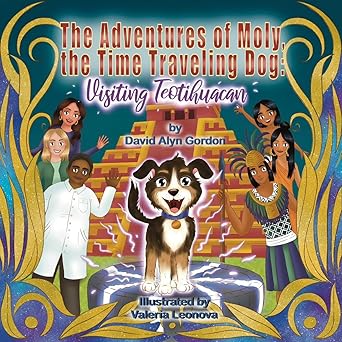
In The Adventures of Moly, The Time Traveling Dog: Visiting Teotihuacan by David Alyn Gordon, readers are introduced to Moly, a resilient Beagle Terrier who finds herself homeless and struggling to survive. Scavenging for scraps and drinking from lawn sprinklers, she roams the streets until a group of rescuers brings her to the Maricopa County Animal Care Shelter. It is here that she catches the attention of Director Ferrara and Technology Supervisor Chadwick, two employees of the Falcone Foundation, an undercover research facility hidden beneath Arizona State University. Their mission? To find the perfect canine candidate for a unique and highly classified program. Moly fits the bill. Ferrara takes her home, offering her the comfort and care she desperately needs, but Moly’s new life is far from ordinary.
Ferrara and Chadwick train Moly in not one but two extraordinary roles. By day, she becomes a therapy dog for children at the Renaissance Academy, where Ferrara works as a student counselor. However, her second role is even more astonishing; Moly is tasked with traveling through time to ancient Teotihuacan, now part of modern-day Mexico. Her objective: to document her encounters, capturing images and videos of the Aztec civilization. But as Moly embarks on this thrilling mission, questions arise. Can she navigate an unfamiliar world alone? Will she safely return to the present?
The concept of a time-traveling dog is undeniably unique, blending adventure with education. While I found the idea of Moly as a therapy dog heartwarming and well-suited for young readers, I was perplexed by the decision to send her unaccompanied on such a risky historical expedition. The logistics of her mission raised questions: Why would Ferrara and Chadwick entrust such a critical task to Moly rather than undertake it themselves? The uncertainty surrounding Moly’s well-being and the potential dangers of time travel left me with mixed emotions.
That said, Gordon masterfully incorporates historical elements into the narrative, making learning about the Aztec civilization an engaging experience for children. The storytelling is accessible, seamlessly weaving historical facts into Moly’s adventure without feeling like a lesson. Young readers will absorb knowledge effortlessly, drawn into the rich culture and daily life of Teotihuacan’s past inhabitants.
The vivid illustrations by Valeria Leonova, which appear on every page, add to the book’s charm. The colorful, dynamic artwork enhances the story, capturing the reader’s imagination while providing visual context to Moly’s journey. The illustrations perfectly complement Gordon’s storytelling, making the book even more immersive for young audiences.
David Alyn Gordon’s background as a social studies teacher, principal, and founder of the Grand Canyon College Preparatory Academy in Tempe, Arizona, is evident in his approach to blending entertainment with education. Through Moly’s adventures, children are introduced to historic landmarks and cultures in a way that feels organic and exciting.
The Adventures of Moly, The Time Traveling Dog: Visiting Teotihuacan is a creative and engaging read. It offers young audiences both an entertaining story and an insightful glimpse into history. With its vibrant illustrations and unique premise, this book will surely capture the hearts of children who love animals, adventure, and discovering the past.
Pages: 32 | ASIN : B0DHV8HVXB
Would It Be Weird?

Would It Be Weird? is a playful dive into a child’s wild imagination, where every dinnertime question is a ticket to an absurd and funny “what if” scenario. From piano-mouths to alien makeovers, the kid’s zany ideas keep the story moving with energy and charm. Mom’s patient but hilarious responses add to the comedy, making it a perfect blend of childlike wonder and parental realism.
What I loved most about this children’s book is how vividly it captures the endless curiosity of kids. The idea of dinosaurs taking kids to school and making them always on time (but ruining picture day) made me laugh. It’s these little touches that show author Edgar Garcia really gets how kids think. I also love how the book taps into universal childhood questions. Who hasn’t imagined fighting giant chicken pirates or being a dragon with a sweet tooth?
Mariano Epelbaum’s art truly shines in this picture book. It’s bright and lively and just an explosion of energy and detail that pulls you into every wild scenario. I loved how the emotions on everyone’s faces were so expressive and spot-on. What really stood out to me was how the illustrations perfectly captured what made each moment funny. It matches the whimsical and fun tone of the story perfectly. This attention to detail is what makes the book feel like a mini-adventure on every page. Epelbaum takes these absurd “what if” questions and brings them to life with so much humor and charm. It’s impossible not to get swept up in the silliness when the art makes the scenarios feel so vibrant.
The back-and-forth between the young girl and Mom is pure gold. Mom’s deadpan humor steals the show, especially when she calmly suggests finding a piano-fixing dentist or bringing a cat to scare mummies. The balance of her exasperation and indulgence in her child’s silliness is funny and heartwarming.
Would It Be Weird? is a perfect pick for kids with wild imaginations and parents who’ve heard it all. It’s funny, charming, and brilliantly illustrated. I’d recommend it for bedtime reading, classroom storytime, or any kid who loves to ask, “What if?” It’s a little weird, a lot wonderful, and is guaranteed to make you laugh.
Pages: 38 | ASIN : B0CX2YSDH9
The Aftertime


The Aftertime by L.L.H. Harms uses a magical healing knife as a powerful symbol, weaving a tale rich with struggle and history. The story moves between 18th-century Virginia and the present day, exploring the deep and complicated friendship between a Monacan boy and an English boy. Against the backdrop of English colonization, Harms paints a vivid picture of Monacan society and culture, showing us the trials these 12-year-old boys face as their lives collide. With careful attention to the customs and language of the Monacan people, the author brings to life the difficulties of cross-cultural bonds and the painful choices that come with loyalty to one’s heritage.
Harms addresses themes of conflict, morality, and cultural understanding, delving into the devastating impact of colonization on Indigenous communities. Yet, the novel also highlights the connections that can form when people from different backgrounds choose to find common ground. These themes resonate throughout, making the story not only historically significant but emotionally compelling. Nathan’s perspective was especially moving for me. His fear of the dark woods felt raw and relatable, giving his character a genuine vulnerability. As he wrestles with his fears and learns to face them, Nathan’s growth shines through. His protectiveness toward his family and his quiet empathy add layers to his character, making him feel both wise and deeply human. I admired how he navigated the tension between his evolving sense of self and the demands of his new life. On the other hand, Zack was a burst of energy and charm. His spontaneous storytelling, like the tale of the white deer, kept me captivated. He felt sweetly youthful, his rapid-fire thinking and fierce devotion to his family making him unforgettable. The writing style impressed me with its introspective and emotional depth. Harms uses rich imagery that makes the themes of the book come alive. I could almost feel the forests, sense the tension, and hear the whispers of the past. However, the pacing wasn’t always consistent. At times, the narrative lingered too long on small details, slowing the flow, while some emotionally crucial moments seemed to rush by too quickly. Even so, the author’s genuine respect for Native American culture was clear throughout. Harms invites readers into an often-overlooked world, offering an enlightening perspective on the effects of colonization.
The Aftertime is a beautifully written, thought-provoking novel that gives a voice to important cultural and historical themes. It’s perfect for readers who appreciate stories filled with emotional and cultural nuance. If you’re looking for a book that honors Indigenous traditions while exploring complex friendships and moral dilemmas, this one should be on your reading list. Harms has created a tale that stays with you, both haunting and hopeful.
Pages: 242 | ASIN : B0D4VWFWGT



 LITERARY TITAN