Blog Archives
Counterintuitive Truths

So You Want To Be A Deep Sea Diver is an illustrated guide that shows young readers that deep-sea diving is both an adventure and a serious, disciplined career. What is the most rewarding aspect of writing guides for young readers?
Children are the most honest readers. Adults will keep going out of politeness, or because they paid for the book, or because someone gave it to them. Children won’t. If a page bores them, you’ve lost them, and no amount of well-meaning framing will win them back. That’s not a problem; it’s a gift. It forces a writer to be useful on every page, to trust the reader’s intelligence, to leave out the throat-clearing that fills so much adult nonfiction.
The most rewarding part, though, is knowing that somewhere a child is sitting cross-legged on a bedroom floor, holding one of these books, reading about a job they didn’t know existed three days ago — and a small door is opening inside them. Maybe it stays open. Maybe they grow up and become the deep-sea diver, the archaeologist, the dinosaur hunter. Maybe they don’t, and the book just plants the idea that the world contains more possibilities than any one childhood can hold. Either outcome is enough.
Were there scientific concepts that were especially difficult to translate for younger readers without oversimplifying them?
The hardest one was the physics of breathing at depth — the strange truth that the same air you breathe safely at the surface begins to behave like a drug if you go deep enough. Nitrogen narcosis is one of the most peculiar phenomena in human physiology, and I wanted children to understand that, not just nod past it.
The second hardest was explaining why technical divers at extreme depth breathe gas mixtures with only three percent oxygen — a mixture that would put a person to sleep at the surface. The metaphor I landed on was a lock and a key: the gas has to match the depth exactly. Pressure changes the lock, and the gas has to change with it.
What I’ve learned, again and again across this series, is that children handle counterintuitive truths better than most adults assume. They don’t need the science softened, but they need it told well (which can be a challenge).
Notably, my first draft of this book was much drier than what eventually went to press, because in my attempts to delve into the science, I let safety and risk take over the narrative. The protocols are real, and they matter — but a book that leads with caution buries the very thing that makes a child want to learn the caution in the first place. If the child does not feel the wonder first and understand the draw, the precautions are just rules, and rules without reasons are the fastest way to lose a young reader. So I started over. The redraft was about putting the beauty back where it belonged: at the front of the story, where it lives in real life.
Was there one behind-the-scenes role in deep-sea operations that surprised you most?
The standby diver. On any serious dive operation, there is one person who suits up in full gear at the start of the dive and stays that way the entire time — fins, tank, regulator, ready to enter the water inside seconds. They (generally) never get to make the dive. Their job, as I came to think of it, is to be a goalkeeper: alert, watching, prepared, and hoping with everything in them never to be called.
I love that role because it captures something children don’t always learn from the stories they’re told about heroism. The standby diver doesn’t get the photograph. They don’t get the discovery. They don’t even get wet on most days. And yet without them, the dive doesn’t happen, because no responsible team enters dangerous water without someone ready to come after them.
That is one of the best lessons the ocean teaches: being ready is its own job. Some of the most important people in any operation are the ones whose value is measured by what didn’t go wrong.
What do you hope this book teaches children about adventure — that it is not only excitement, but preparation, teamwork, and learning how to face the unknown?
Yes — and one thing more. I hope it teaches children that fear is not the enemy. Panic is.
That distinction is one of the oldest lessons in diving, and it’s one I most hoped kids would carry out of this book and into the rest of their lives. Fear keeps you sharp; it tells you something matters. Panic makes your body move before your brain can stop it. The difference between the two is learning and training — the willingness to spend years preparing for a moment that might last seconds. A diver who trusts their training can be afraid and still safe. A diver who doesn’t can be unafraid and in real trouble.
Adventure, in the deep-sea diver’s life, is not the opposite of preparation. Preparation is what makes the adventure possible. I’d love for every child reading this book to grow up understanding that — for diving, and for everything else.
Author Links: GoodReads | Website | Amazon
So You Want To Be A Deep Sea Diver is an illustrated nonfiction guide for young readers ages 10 to 14 who want the true, complete answer to that question. It follows the path from a kid’s first fascination with the deep ocean all the way through open water certification, advanced dive training, saturation techniques, and the most extreme underwater operations on earth — welding, construction, salvage, scientific research, and marine exploration in conditions most people cannot imagine.
Inside, you will discover the real science of deep diving: how pressure works on the human body, why the wrong gas mixture at depth can be fatal, how decompression keeps divers alive, and what it means to live in a pressurized chamber for weeks while working hundreds of meters below the surface. These are not simplified facts stripped of their meaning. This is the actual physics and physiology, presented clearly and honestly for readers who deserve more than a surface-level overview.
You will also explore the world divers enter — a place of crushing cold, near-total darkness, and strange deep sea creatures and ocean animals that thrive where sunlight never reaches. You will learn about the teams of dive supervisors, saturation technicians, and support crews who make every descent possible, and the absolute calm that divers must bring to emergencies that can only be resolved in slow motion, because panic at depth costs lives.
This book does not talk down to kids. It brings them all the way in — into the training, the discipline, the wonder, and the weird and extraordinary reality of a career spent in the deepest places human beings can go. It is honest about the difficulty, specific about the science, and deeply respectful of the young reader who feels the pull toward something most people will never experience.
Most of the ocean remains unseen by human eyes. The divers who go deepest are going somewhere almost no one has ever been. Maybe one day, that diver will be you.
So You Want To Be A Deep Sea Diver
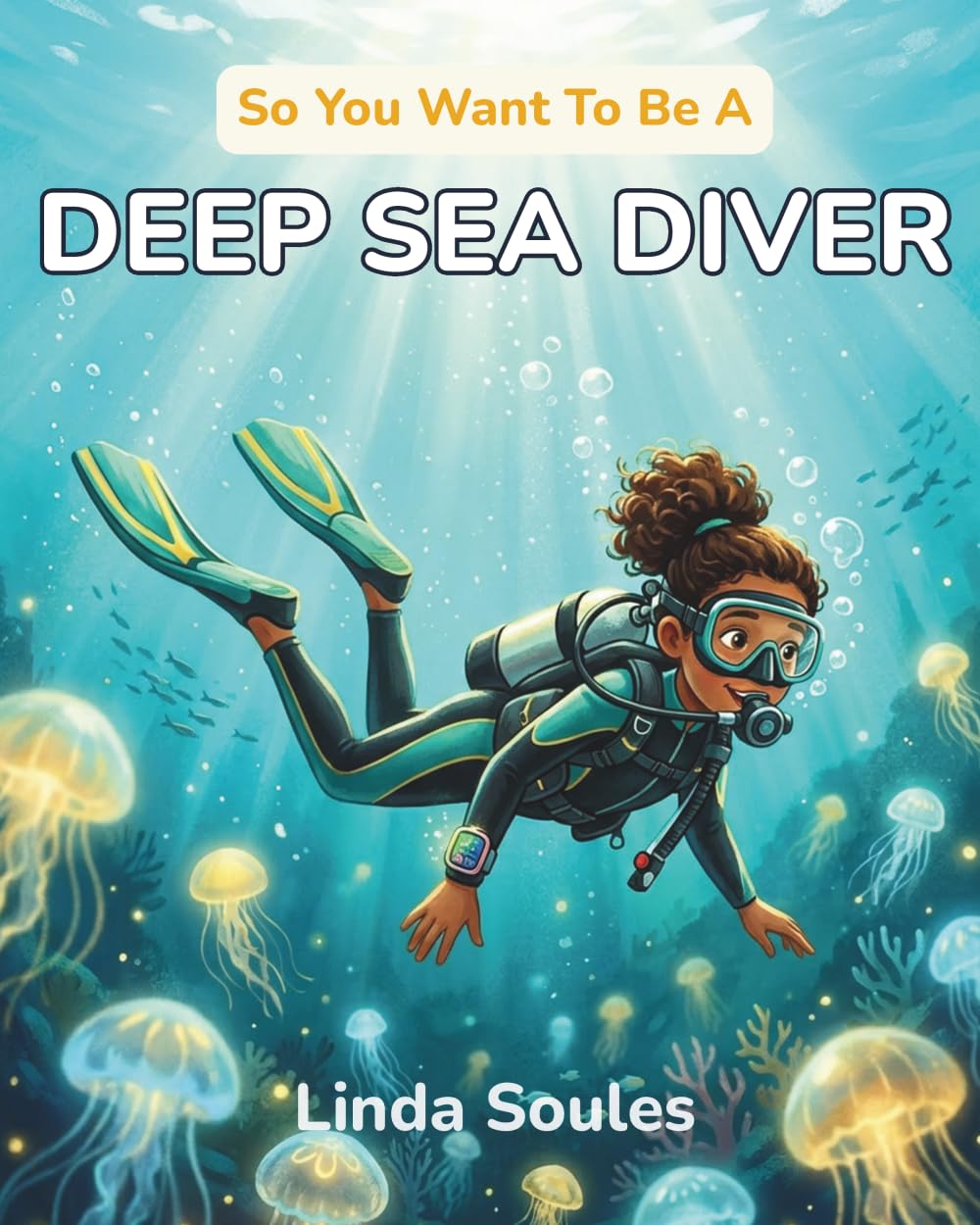

So You Want To Be A Deep Sea Diver is the kind of children’s book that makes you realize there is so much more to a job than what you see on the surface. Written for young readers around ages 9–14, this illustrated guide takes kids deep into the world of professional diving, from the first spark of ocean curiosity to the intense training, science, teamwork, and bravery needed to work far below the waves. I think it does a great job showing that deep-sea diving is an adventure and a serious career that takes discipline, focus, and a lot of knowledge.
I loved how much real information it includes without making the topic feel overwhelming. Readers learn about pressure, decompression, gas mixtures, saturation diving, underwater welding, shipwreck archaeology, cave exploration, and even what happens to the human body underwater. It explains complex ideas in a way that feels clear and exciting, while still respecting how dangerous and demanding this job can be. The glossary, career details, and real-world examples make it useful for reports, career day, or any child who is curious about ocean work.
The illustrations are another big highlight. They bring the deep ocean, the gear, and the divers’ work to life, especially for kids who are visual learners. The book also covers the people behind every dive, like supervisors, standby divers, medical technicians, deck crews, and scientists waiting topside. That teamwork element makes the profession feel even more real. I even learned something as an adult. I didn’t know that being in the deep sea “actually changes how your brain works, in ways scientists are still studying.”
This is an engaging, detailed, and surprisingly fun read, even for adults. You don’t have to want to become a deep-sea diver to enjoy it, because there is so much to learn about the ocean, science, history, and the hidden jobs that keep parts of the modern world running. This would be a great gift for a sea-loving kid, a useful classroom book, or a strong addition to a career exploration series. Linda Soules makes deep-sea diving feel mysterious, challenging, and possible, and that is exactly what makes the book so appealing.
Pages: 38 | ISBN : 978-1972766316



