Blog Archives
The Actual Experts

So You Want To Be A Toy Designer takes young readers inside the process of making the toys they love, from product testing to the teamwork and problem-solving required. What inspired you to write this nonfiction book for children?
Toys are the first objects in a child’s life designed entirely with them in mind, and I wanted to crack the magic open. Children deserve to see the hundred sketches behind the one toy, the prototypes that ended up in a drawer, the grown adults sitting around a table arguing about whether a teddy bear’s eyes might come loose. There is also something irresistibly humbling about a profession where one of the recurring occupational hazards is watching a child push aside the toy you spent six months on to play with the box it came in. A job that funny and that earnest deserved its own book.
A deeper reason is that kids are the actual experts on toys. They have spent every year of their lives studying the subject with total attention. They have opinions about which toys feel right in the hand and which feel cheap. They know exactly the moment a toy gets boring, and why. They have wished a hundred times that a particular toy did one specific thing differently. Those instincts are not preliminary versions of grown-up opinions — they are the real thing, and toy designers spend their careers trying to listen to children that closely. I wanted a book that handed that recognition back to the reader: you already know more about this than you think you do. The questions you ask about your own toys are exactly the questions designers ask. You are not preparing to enter the conversation. You are already in it.
I also wanted to dispense with the assumption that growing up means leaving toys (and fun) behind. The adults inside this profession are, in the most enviable sense, people who never stopped playing with toys. They build, sketch, prototype, play, and study play, and they get paid to do it. That isn’t a betrayal of adulthood; it is one of its better versions. Toy designers do work children take seriously, even when adults forget how to — and I wanted to take it seriously too.
The book is honest about the challenges of toy design, including failed ideas and redesign. Why was it important to show children that creativity involves trial and error?
Because the lie that good ideas arrive wholly formed and instantaneously quietly damages the children who can’t produce them on demand, which is all of us. The truth is, the thirtieth sketch is usually the good one. Toy designers fail in front of seven-year-olds for a living, and that isn’t a setback. That’s the job.
When a child learns that the toy they love was version fourteen, not version one, something loosens in them. They get permission to be on version three of their own thing and not feel behind. I wanted children to meet adults whose entire profession depends on being wrong, often, and in public — and to see that those adults love what they do. Iteration is not the obstacle to creativity. Iteration is creativity.
What kind of research did you do to show the day-to-day reality of toy designers?
I worked in three layers, because no single source could give me everything I needed.
The first was the historical record, which turns out to be one of the most charming bodies of biography in any industry. Ruth Handler watched her daughter give paper dolls adult roles and realized no toy let girls imagine themselves as adults. Barbie was the answer, named for her daughter Barbara. A navy engineer in 1943 knocked a tension spring off his workbench and watched it walk end-over-end across the floor; his wife named it Slinky. Eddy Goldfarb is 104, holds nearly 300 patents, and still walks out to his garage every morning to prototype on a 3D printer. These stories aren’t decoration. They are evidence of who toy designers actually are: curious, unembarrassed about play, often working at the edge of accident and intention.
The second layer was the present-day craft. I drew on industry reporting, accounts from designers at the major houses, the play-research literature, and — more interesting than it sounds — the ASTM F963 safety standard, which specifies the exact force a part must withstand before a small child can pull it loose. What struck me there was that constraint is not the enemy of creativity in this field; it is the medium designers actually work in.
The third layer was the texture of an actual working day, which neither history nor industry publication will give you. For that, I triangulated until I could build a composite that felt true: the morning safety lab report, the hour of fast sketching where forty-seven drawings get discarded, and three get pinned to the wall, the midday session behind one-way glass watching seven-year-olds pick up a prototype or — worst of all — get more interested in the box.
What I was reaching for, across all three layers, is what I reach for in every title: a portrait a working practitioner would recognize as their own.
What is the next book you are working on, and when will it be available?
The list is long — and continuing to grow! I tend to work on several titles at once and only release them when they feel finished, so the order is always evolving. Most recently, I was thrilled to publish So You Want To Be A Waterslide Tester and So You Want To Be An Astronomer & Exoplanet Hunter, which brings the series to thirty-seven published titles, and I am nowhere near slowing down.
The near-term lineup is one of the most fun stretches I’ve worked on. Several of the upcoming titles have what I think of as the “is that a real job?” factor — ice cream flavor inventor, candy scientist, professional taste tester — careers that delight children before they have even opened the book. I’ve also begun work on a fashion design title for near-term release, and my son is lobbying hard for me to move cryptographer and esports athlete (pro gamer) up the queue. He may well succeed. What I love about this stretch of the series is how wide it is reaching: from the timeless callings to the ones that reflect just how strange and wonderful the working world has become.
If I had to predict the next one to land based on where things currently stand, it would be So You Want To Be A Journalist. But new titles are rolling out continuously through the rest of 2026, and the full list — along with a sign-up for upcoming releases — lives at LindaSoules.com. I would love for readers to come find the one with their name on it.
Author Links: GoodReads | Website | Amazon
This is not a simplified, watered-down look at a fun job. It is a real, honest guide to what toy designers actually do — the years of industrial design training, the child development study, the materials engineering, and the iterative prototyping that happen long before a single toy reaches a shelf. You will discover how designers learn to see the world through a child’s eyes while solving complex engineering problems, and why that combination of imagination and technical skill makes toy design one of the most unique professions a young person can pursue.
Inside, you will follow the full design process from first sketch to working prototype to safety testing. You will learn how designers draw on child psychology to understand how play shapes learning at every age. You will see how teams of engineers, creative designers, and manufacturing specialists work together to turn an idea into something a six-year-old picks up, plays with for hours, and refuses to put down. And you will meet the visionary inventors whose toys became the defining objects of childhood for generations.
But this book goes further than most career guides for kids. It explores the real skills toy designers build — sketching, 3D modeling, materials science, understanding how small hands interact with objects — and shows what young readers can start doing right now to develop those same abilities. Whether you love to draw, build, tinker, or simply take things apart to understand how they work, this book helps you see how those instincts connect to a real profession.
Illustrated throughout with detailed, engaging artwork, this nonfiction guide treats its readers as equals. It brings the same depth and honesty that boys and girls ages 10-14 and up deserve when they ask a serious question about their future. No talking down. No sugarcoating. Just a clear, fascinating window into the craft behind the toys you grew up loving.
The toy that will define the next generation of childhood has not been designed yet. It is waiting for someone with the curiosity, the craft, and the joy to bring it into the world — and that someone might be you.
So You Want To Be A Diplomat


So You Want To Be A Diplomat is an engaging and eye-opening children’s educational book that introduces young readers to the fascinating world of diplomacy. Written for ages 10 to 14, the book explains what diplomats do, where they work, and why their quiet efforts matter so much. Rather than presenting diplomacy as dry politics, Soules turns it into an exciting behind-the-scenes journey through embassies, foreign ministries, international meetings, and the careful conversations that help countries solve problems without conflict.
One of the book’s greatest strengths is the way it combines real history with surprising and memorable stories. Readers learn about ping-pong diplomacy, diplomatic bags, pandas on diplomatic missions, and how a single mistranslated word influenced decades of the Cold War. These details make the subject lively and easy to remember, while also showing that diplomacy is full of unexpected moments. The book also introduces inspiring figures such as Eleanor Roosevelt, Ralph Bunche, Dag Hammarskjöld, and Kofi Annan, whose patience, courage, and dedication helped shape the modern world.
Soules writes with warmth and intelligence, treating young readers as thoughtful people capable of understanding serious ideas. The book clearly explains the skills a diplomat needs, including patience, discretion, curiosity, strong listening skills, a good memory, and respect for other cultures. I especially appreciated that it gives an honest view of the career, including both the exciting parts and the difficult parts. I learned a lot even as an adult reading this book, like how diplomats have to have a strong stomach because they’re going to be trying food in their host country, how they have to have a sense of humor for awkward moments, and how they have to have a good memory for names and faces (which I surely don’t).
So You Want To Be A Diplomat is an illuminating, inspiring, and highly readable introduction to an important career that many children may not have considered before. It is perfect for curious middle-grade readers, social studies classrooms, school libraries, Model UN clubs, and families who want to encourage global awareness. This book not only explains international relations in a clear and engaging way, but also shows young readers that peacebuilding is a skill they can begin practicing now. Highly recommended.
Pages: 38 | ISBN : 978-1972766378

So You Want To Be A Coder (Computer Programmer)

So You Want To Be A Coder, by Linda Soules, introduces children to the world of computer programming in a thoughtful and expansive way. The book explains what coders do, where they work, the tools they use, the joys and frustrations of the job, and the qualities that make someone suited to it. Rather than treating coding as a flashy mystery, it presents programming as a patient craft built from problem-solving, curiosity, communication, and a willingness to keep trying when things break.
What I appreciated most was the book’s honesty. As a parent, I’m used to children’s career books that make every job sound shiny and effortless, but this one gives coding texture. It talks about failure without making it feel scary, and it explains that much of programming is reading, testing, fixing, asking better questions, and learning how to sit with not knowing. The writing has a calm confidence to it, and at its best, it makes coding feel less like a secret language for a certain kind of kid and more like a patient conversation between a curious mind and a machine.
The artwork gives the book a warm, almost storybook glow that softens a subject that could have felt dry. I liked the cozy desks, city windows, libraries, bedrooms, and team spaces, because they make the work feel relatable and lived-in. Some pages are more text-heavy than I’d expect for a traditional picture book, so younger children may need an adult beside them to slow the pace and talk things through. But that also gives the book substance. It doesn’t just skim the surface. It respects kids enough to explain real ideas, from debugging and version control to open-source communities and the quiet importance of writing clearly.
I found this to be a sincere, intelligent, and encouraging children’s book that treats children as capable thinkers. It’s a book to read together, especially with a child who likes puzzles, games, building things, or asking how everything works. I’d recommend it to curious elementary and early middle-grade readers, particularly those who might enjoy computers but need a clearer picture of what coding actually feels like.
Pages: 332 | ASIN : B0GX2ZQG3V
So You Want To Be A Waterslide Tester
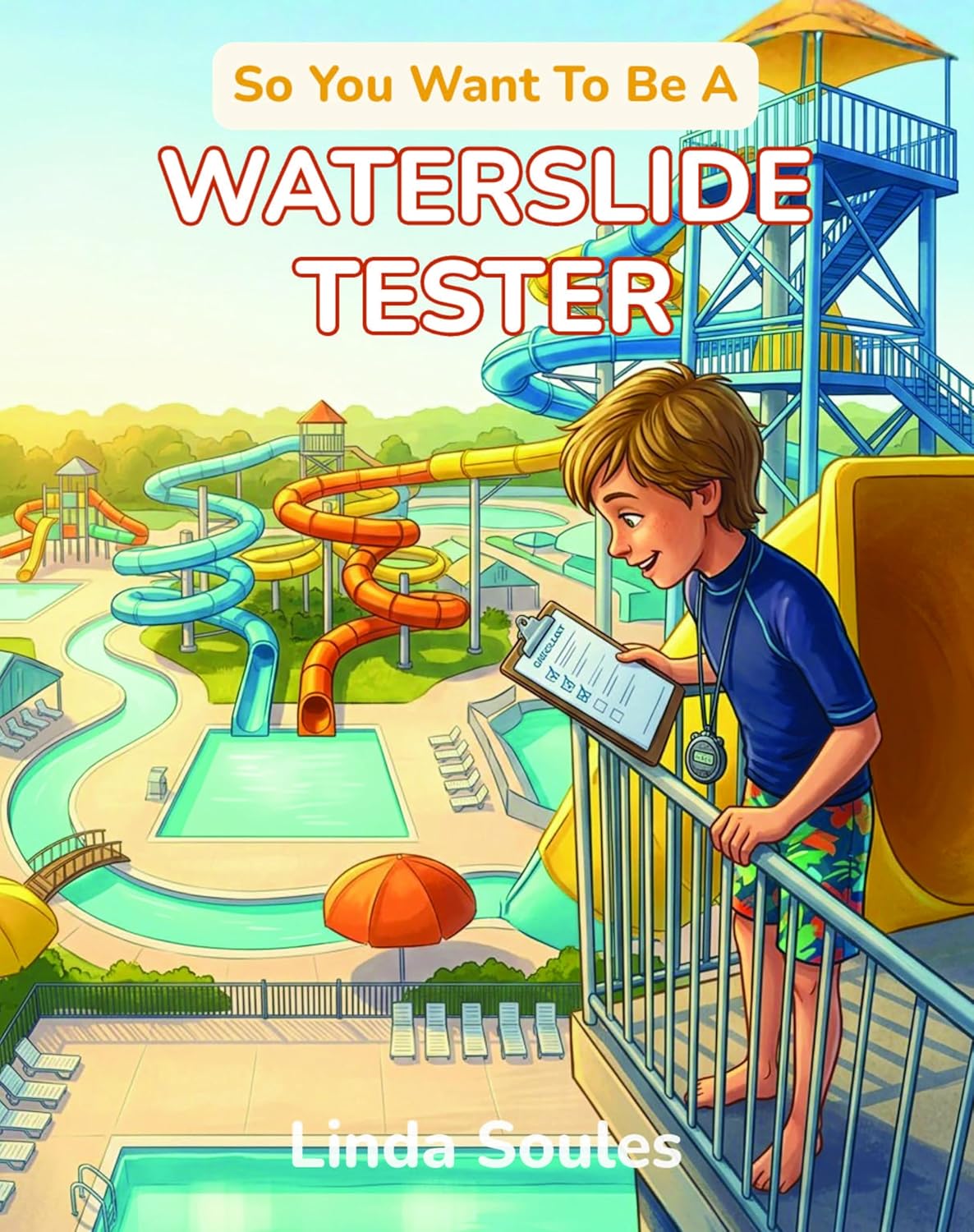
So You Want To Be A Waterslide Tester, by Linda Soules, is an engaging and informative children’s nonfiction book that turns a dream job into a fascinating STEM lesson. At first, waterslide testing sounds like nothing more than riding slides all day, but this book quickly shows young readers that the job involves physics, engineering, careful observation, and a serious commitment to safety. Soules presents the work of waterslide testers as both exciting and important, helping kids understand that the fun they experience at a water park is made possible by people doing detailed behind-the-scenes work.
One of the book’s strongest qualities is the way it explains complex ideas in language children can understand. Readers learn about water flow, speed, surface friction, G-forces, hydroplaning, banking angles, and landing impact without feeling overwhelmed. The book also makes the science feel practical by showing how testers ride slides repeatedly, checking every curve, transition, and splashdown area to make sure the ride is safe for real kids and families. The day-in-the-life structure, from the morning briefing to the final safety report, gives the book a clear sense of purpose and helps readers see how much preparation goes into opening a waterslide to the public.
I’ve read many books in this series, and I always appreciate the inclusion of “The Hardest Parts of the Job” section because it shows that the book is honest about the challenges of each career rather than presenting only the fun parts. In this book, the line “Testing the same slide two hundred times is also as repetitive as it sounds” is a great example of how it balances excitement with reality.
The colorful illustrations add to the appeal and help keep the subject lively for younger readers. They make the technical information easier to follow while maintaining the playful energy of a book about water parks and slides. The glossary, fun facts, and hands-on activities are also valuable additions, especially for children who enjoy asking how things work or who are curious about building, design, and unusual careers.
So You Want To Be A Waterslide Tester is a wonderful choice for curious kids, especially those between the ages of 10 and 14 who enjoy science, engineering, theme parks, or learning about jobs they may never have imagined existed. It captures the fun of waterslides while emphasizing that safety and joy are connected, not separate. Parents, teachers, and librarians will appreciate how the book encourages curiosity, observation, and respect for quiet, careful work that keeps people safe. This is an entertaining and educational read that makes science feel adventurous, memorable, and fun.
Pages: 38 | ASIN : B0H29FGGFX
So You Want To Be An Astronomer & Exoplanet Hunter

So You Want To Be An Astronomer & Exoplanet Hunter is a fascinating and beautifully presented nonfiction book for young readers who are curious about space, science, and what it really means to study the universe. Written for ages 10 to 14, this book goes beyond simple stargazing facts and gives readers an honest, exciting look at the real work astronomers do, especially those who search for planets beyond our solar system.
One of the book’s greatest strengths (as it is in the entire So You Want To Be… series) is the way it explains complex science in a clear and engaging way. Readers learn how astronomers detect exoplanets by studying tiny dips in starlight, measuring the wobble of distant stars, and using spectroscopy to understand the chemical makeup of alien atmospheres. These are big scientific ideas, but Soules presents them in a way that feels approachable without talking down to kids. The book trusts young readers with real vocabulary and real science, which makes the subject even more exciting.
The career-focused sections are especially strong. The book does an excellent job of showing that astronomy is not just about looking through telescopes. It involves math, physics, coding, patience, careful observation, data analysis, and problem-solving. And above all, it takes patience, as Linda puts it, “the timescales are humbling. An exoplanet… is found only by observing its star for at least one full orbit – which means years of patiently waiting.” The day-in-the-life section gives readers a realistic look at an astronomer’s work, from opening an observatory dome at sunset to dealing with weather problems and reviewing data the next morning. This realistic approach makes the career feel both challenging and inspiring.
The illustrations are another highlight. They are colorful and detailed, adding visual interest while also helping explain the science. The book also includes fun facts, a helpful glossary, historical profiles of important astronomers, and practical suggestions for kids who want to start learning more right away. Tips such as learning constellations, visiting a planetarium, trying a small telescope, exploring real datasets, and participating in citizen-science projects make the book feel empowering.
I also appreciated the strong representation of women in science. By highlighting female astronomers who made major contributions despite facing barriers, the book shows young readers, especially girls, that they belong in science too. This adds an important and inspiring layer to an already excellent educational book.
So You Want To Be An Astronomer & Exoplanet Hunter is an informative, engaging, and visually appealing guide for children interested in space or science careers. It’s short and accessible, but still packed with meaningful information. Young readers who dream of studying stars, galaxies, telescopes, or distant planets will find this book both exciting and useful. It’s a wonderful choice for upper elementary and middle-grade readers, classrooms, libraries, and families with kids who look up at the night sky and wonder what else might be out there.
Pages: 38 | ISBN : 978-1972766408
So You Want To Be A Ballet Dancer

I found Linda Soules’s So You Want To Be A Ballet Dancer to be a thoughtful and refreshingly honest introduction to the world children step into each time they come to ballet class. This illustrated guide doesn’t present ballet as a simple dream of tutus, applause, and effortless grace. Instead, it begins where real training begins: at the barre, with repetition, discipline, alignment, and patience. For young readers ages 10 to 14, Soules explains ballet in a way that is clear and inviting without hiding how demanding the art form truly is.
What impressed me most was the book’s respect for the dancer’s body. Soules explains concepts such as turnout, pointe work, flexibility, strength, stamina, and injury prevention with enough detail to help children understand that ballet dancers are artists and athletes. I especially appreciated the attention given to tools of the trade, from pointe shoes and rosin to mirrors and the dancer’s own muscles. Young dancers often see the finished product on stage, but this book helps them understand the years of conditioning, correction, and quiet effort behind every polished performance.
The book also captures something ballet teachers teach in every class: technique alone is not enough. Soules explores musicality, emotional expression, stage presence, and the mental resilience needed to perform under pressure. She also introduces readers to the many people who make ballet possible, including choreographers, directors, physical therapists, and fellow dancers. The sections on ballet history, from the court of Louis XIV to modern stages around the world, help students see that each plié and pirouette belongs to a much larger artistic tradition that continues to evolve.
So You Want To Be A Ballet Dancer is an excellent starter guide for children who are curious about ballet, whether they are brand-new beginners or already dreaming of performing in productions like The Nutcracker. Soules’s tone is encouraging but realistic, which is exactly what young dancers need. She shows that ballet welcomes dedication, curiosity, and artistry, while also making clear that it requires hard work, sacrifice, and perseverance. I would gladly recommend this book to ballet students and their families because it gives children a fuller understanding of ballet as a language of movement, discipline, beauty, and storytelling.
Pages: 38 | ISBN : 978-1972766354
The Unvarnished Truth
So You Want To Be An Actor is a guide for young readers that explores the real craft behind acting, showing how performers build characters, handle auditions, survive rejection, and turn imagination into truthful performance. Why did you feel it was important not to romanticize the profession?
Because children know when a book is performing for them instead of speaking to them, and the moment they sense it, they stop trusting you. My whole approach to this series is to meet a child eye to eye, and you cannot do that while hiding the hard parts of a calling behind a curtain of sparkle.
Acting in particular is romanticized to the point of distortion. Kids see red carpets and assume that is the job. The job is auditioning, hearing no, preparing fully again, hearing no again, and walking into the next room anyway. If a young reader is drawn to this work, they deserve to know that rejection is a permanent feature of the profession — not a phase to push through.
I want to be clear that this honesty is not meant to discourage. Quite the opposite. Telling a child the unvarnished truth about a calling is the highest form of respect I can offer them. It says: I think you can handle this, and I think you deserve to choose with your eyes open. The children this book is for are not fragile. They are exploring ideas that at some point will become important decisions. And a decision made on the basis of the real thing is sturdier than a decision made on the basis of the polished version. When a child learns about the auditions, the rejections, the years of training, the financial uncertainty — and still leans forward, still wants in — that is one of the most important pieces of information a young person can have about themselves. It tells them the pull is coming from somewhere real. That is the seed of a vocation, not a daydream.
I also believe the wonder of acting becomes more powerful, not less, when you set it next to the work. The standing ovation matters more when you understand what it costs.
You introduce major acting ideas, such as Stanislavski and Method acting, in a very accessible way. What challenges did simplifying those concepts pose without losing their meaning?
The hardest part of simplifying was deciding what must survive the compression. A children’s book has no room for a full tour of Stanislavski, Strasberg, Meisner, Adler, and the century of debate among their inheritors. So the question I kept asking was: if I can only carry a few things across the bridge, which ones cannot be left behind?
Three felt non-negotiable. First, that acting is a craft with technique, not a mysterious gift bestowed on the chosen few, which means it can be studied, practiced, and improved like any other skill. Second, that the great teachers were after truthful behavior, not the performance of big emotion; the kid who tries to summon real tears at 12 and feels broken when it doesn’t work needs to know that manufactured feeling was never the point, and their acting potential is not measurable by whether they can cry on command. And third, that there is more than one legitimate path into the work, and a young actor gets to find the approach that fits them rather than forcing themselves into the one the movies made famous.
Everything else — the lineages, the disputes, the technical vocabulary — I let go. The way through was to keep language plain and anchor every abstract idea in something a child can already feel. What does my character want? What are they afraid of? Those questions open the door to serious craft without requiring a 10-year-old to learn Russian, pick a specific school of thought, or cry on demand to prove they belong.
The book covers stage, screen, voice work, and physical theater. How did you decide how much depth to give each path, and which surprised you most when you researched its specific demands?
I gave stage and screen the most room because that is often where young readers first imagine themselves. But I wanted voice acting and physical performance to feel equally serious, because they are — and because a kid whose strengths lie there shouldn’t finish the book thinking they’ve only seen the side door.
The biggest surprise to me was Frank Welker. He is the highest-grossing actor in film history, but most readers have never heard his name. He’s earned around $8 billion at the box office, spent an entire career built inside a sound booth, and yet enjoys total anonymity at the grocery store. That single fact reframes what an acting career can be.
The other surprise was just how different stage and screen acting really are. They look like the same craft from the outside, but working actors will tell you they aren’t. The camera reads micro-expressions that the back row of a theater will never see. The stage demands a voice that fills a room the camera would find embarrassing.
You write that acting builds confidence, empathy, observation, imagination, and the courage to try something new. Which of those benefits do you think is most underrated and most useful outside the theater?
Really, all of the above, but if I had to narrow it down, I think listening is most underrated and underemphasized. Real listening — the kind actors mean when they say it. Most of us aren’t listening to the people in front of us; we’re waiting for our turn to speak, rehearsing our next line while theirs is still being said. Actors are trained to truly receive what the other person gives them and let it change what happens next. That is a skill very few professions teach directly, and almost every relationship needs.
Empathy gets the headlines, and rightly so. But empathy without listening is just imagination running in a private room. A child who learns to actually take in another person’s words, body, and silence — and respond to what is really there instead of what they expected — has been given a tool that will serve them in every friendship, every classroom, every argument with someone they love.
Author Links: GoodReads | Website | Amazon
So You Want To Be An Actor pulls back the curtain on one of the oldest and most demanding performing arts careers on earth — not the red-carpet fantasy, but the real one. Written for young readers ages 10 to 14, this illustrated nonfiction guide takes kids and tweens inside the rehearsal rooms, audition halls, and theater stages where actors learn their craft from the ground up. It’s honest, specific, and built for the curious mind that wants to know what this profession actually looks like before the applause starts.
Inside these pages, young actors and aspiring performers will discover how real training works — the voice and movement exercises that turn a body into an expressive instrument, the script analysis that reveals what a character is truly saying beneath the words, and the drama techniques that let a performer live truthfully in someone else’s circumstances. From stage to screen to voice work to physical theater, this book covers the full range of the acting world and what each path demands.
But this isn’t just a guide to technique. It’s a book about resilience. Actors face rejection not as a rare setback but as the daily texture of a working life. Young readers will learn how performers build the emotional strength to audition again and again, how they prepare scenes and monologues with discipline and imagination, and why the people who stay in this profession say that when a performance truly lands — when the room goes still and something shifts — nothing else comes close.
Whether your child has been cast in every school play since second grade or is quietly reading every part in every story they encounter, this book meets them where they are. It doesn’t talk down. It doesn’t oversimplify. It treats kids as capable of understanding the real demands of a career in acting — the physical, vocal, and psychological work that sits behind every performance that looks effortless.
Comedy or drama, stage or screen, the greatest performance anyone has ever seen began with someone who was willing to go somewhere true. For the young performer ready to find out if that someone might be them.
Ages 10 to 14. Illustrated nonfiction for kids who take their dreams seriously.
So You Want To Be An Animator

So You Want To Be An Animator is a fun, colorful, and surprisingly detailed look at what it really means to work in animation. Written for kids ages 10–14, this illustrated nonfiction book goes way beyond “animators draw cartoons” and shows readers how much patience, skill, teamwork, and imagination are involved in bringing a character to life. From hand-drawn animation and flipbooks to 3D computer animation, character rigging, storyboarding, and digital tools, the book gives young readers a clear picture of the many steps between a sketch in a notebook and a finished scene on screen.
One of the best things about this book is how honest it is. Soules doesn’t make animation sound easy or magical. She explains the actual craft behind it, including timing, squash and stretch, anticipation, follow-through, and the careful observation of how things move in the real world. In the section labeled The Hardest Parts of the Job the author states, “Animation is extraordinarily time-consuming… a single second of fully drawn animation needs twenty-four separate drawings.” I didn’t consider this even as an adult. Kids who love drawing will likely find themselves looking at movement in a whole new way after reading this.
The book also does a great job showing that animation is a team effort. Animators work with directors, writers, sound designers, riggers, and many other artists to build a world that feels seamless to the audience. I appreciated that the book talks about the hard parts too, like the long hours of practice, the technical learning, and the patience it takes to create even a few seconds of finished animation. The exercises, glossary, suggested websites, organizations, and further reading make it feel practical, not just inspirational.
So You Want To Be An Animator is an encouraging and informative book for creative kids, especially those who are always sketching in the margins or pausing animated movies to study how characters move. It’s easy to understand without talking down to readers, and it’s interesting enough that adults may learn a few things too. I would highly recommend it to parents, teachers, and young artists who want a realistic but exciting look at animation as both an art form and a possible career.
Pages: 38 | ASIN : B0H1LHQWTL


