Blog Archives
Fungus Theory of Conscious Growth


Fungus Theory of Conscious-Growth is a speculative science and philosophy-of-consciousness nonfiction book that argues all life on Earth is really one vast, ancient fungus that exists to grow consciousness to its maximum potential, with humans as the spore that eventually carries that consciousness off the planet and into space. The author starts with cosmology, describing a universe that hides our true origin, limits our lifespans, and ties us to fragile biospheres, then walks through biology, evolution, technology, and psychology to claim that everything from slime mold to smartphones is part of one continuous fungal system pushing us toward “maximum conscious growth” and eventual evacuation of Earth.
Mark L. Christensen mixes straightforward explanation with capitalized concepts and acronyms. Underneath the terminology, though, the core ideas are simple: the universe is built so we can never fully know where we came from, we all die, and we are stuck on a planet that will eventually cook us, and those three constraints are what force intelligence and technology to grow. I appreciated how the chapters loop back to the same framing, so you never forget what the author is trying to prove. The long passages on cosmic expansion, black holes, and the difficulty of tracing any “true origin” were a bit dense, yet they set a clear mood of mystery and frustration that fits the book’s central question.
Where the book got most interesting for me was in the biology, technology, and psychology sections, where the fungus metaphor gets fleshed out. The idea that all plants and animals are variations of the same original fungus, and that this fungus has slowly prepared the planet for a bipedal creature with a big, hungry brain, is truly compelling. I liked the image of early fungi and plants essentially “setting the table” with rich fruits and vegetables, so a future human brain could have the calories it needs.
The technology chapter frames every tool, from early adaptations to modern spaceflight, as a kind of informational mycelium spreading through minds, with certain thinkers as “spikes” in the network that accelerate the whole system. The psychology chapter leans into this even more, describing a “void of psychosis” that opens when humans become aware that they cannot know their true origin, and arguing that our drive for identity, conflict, communication, and eventually space travel all come from trying to fill that void. I did find myself thinking about how much of my own motivation comes from not knowing, and from not wanting life to feel pointless.
I see Fungus Theory of Conscious Growth less as a strict scientific thesis and more as a big thought experiment in speculative science. It asks you to imagine the entire history of life as one fungal organism trying to launch itself into the dark, and to see humanity as the spore that might carry that effort into the galaxy. If you like big-picture questions, cosmic timelines, and philosophical riffs on evolution and technology, there is a lot here to chew on. I would recommend this book most to readers who are comfortable living with unanswered questions, who like their popular science mixed with metaphysics, and who do not mind a bold, unified theory that sits somewhere between lecture and late-night conversation about why we are here at all.
Pages: 402 | ASIN : B0CVXCNBY7

Pay Less for College: The Must-Have Guide to Affording Your Degree

Pay Less for College lays out a clear and practical roadmap for cutting the true cost of a college degree. The authors walk through the entire financial aid system step by step, from how schools build their cost of attendance to how families can understand their Student Aid Index and estimate real net prices. The book breaks everything into simple pieces, and it shows families how to lower their costs with smart planning, better timing, and more strategic college lists. I found that the book blends explanation with action in a way that makes the whole process feel less scary and a lot more doable.
I was impressed by how clear and direct the writing is. The topic is heavy. It is full of numbers, rules, odd quirks, and deadlines. Yet the authors talk like they are sitting next to you at a table with a big cup of coffee and a stack of forms. The tone feels calm. It feels friendly. It made me relax. I liked how the book avoids pretending that financial aid is simple. Instead, it acknowledges the mess. It untangles it little by little. I appreciated that honesty. It made me trust the advice more. And the tables of information help a lot. They turn confusing ideas into something you can actually follow.
The book pushes readers to face real numbers, and that hit me. The constant reminder that net price is what matters feels like a splash of cold water. I kept thinking how many families get blinded by the sticker price or by vague encouragement from colleges. The authors challenge that. They show how much schools differ in generosity and how much strategy matters. That message stuck with me. It made me feel a bit frustrated about how complicated the system is, but also relieved to have a guide that feels grounded and realistic.
Pay Less for College is a great fit for families who want clarity, control, and a plan. It works for parents who feel overwhelmed and for students who want to understand how the money side really works. It is especially helpful for anyone who likes checklists, examples, and concrete next steps. I would recommend it to households at any income level because everyone can save something with the strategies in this book. It really does make the whole process feel manageable, and that alone is worth the read.
Pages: 362 | ASIN : B0FQQ3WWSW
Zen and the Art of Navigating College: An Inquiry into the True Nature of Education and the Power of Self-Discovery
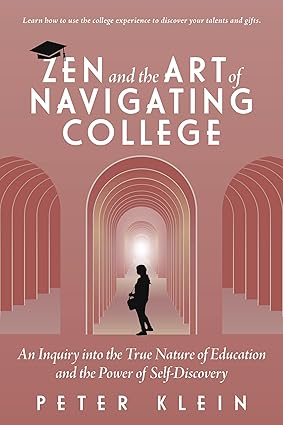
Zen and the Art of Navigating College, penned by Peter Klein, is a definitive guide that aims to not only optimize your college experience but harness it as a transformative journey. It offers a profound exploration of two overarching themes: the process of selecting an ideal college and the multifaceted nature of life on campus.
Klein supplements his discourse with an array of real-world examples, facilitating a richer comprehension of how higher education can be a transformative springboard. He provides an insightful critique of the college system while proffering valuable advice for students to unlock their potential.
Klein disseminates an abundance of knowledge essential for all prospective college students. He examines diverse college types and their distinct admissions approaches while imparting wisdom on how to transcend the traditional college experience. This includes aligning one’s choice of college with their personality type, leveraging the role of academic advisors, and contemplating internships. He also offers an authentic depiction of the challenges that freshmen face, comparing it to the magnitude of relocating to a foreign country.
One of the most compelling elements of Klein’s book is his candidness. He does not shy away from admitting that despite its numerous benefits, the college experience is far from perfect. Klein poses the question, ‘Is a college education worth the investment?’ and provides the reader with thought-provoking insights in response.
Initially perceived to be a handbook of college tips, it evolves into a comprehensive primer for college life and the world that awaits thereafter. It equips readers with the right mindset to confront college and the career landscape. This book transcends its obvious audience and extends to professionals considering a career pivot, offering valuable career insights.
Its practical guidance can significantly benefit potential students, current college attendees seeking to amplify their educational experience, and even graduates still on the hunt for a fulfilling job. In essence, it provides the third group with a compass to navigate their career path and instills in them the courage to persevere. Zen and the Art of Navigating College is an indispensable guide that transcends the college landscape, resonating with readers at various stages of their career journey.
Pages: 193 | ASIN : B0C6YGCZ6Z
From High School To Uni
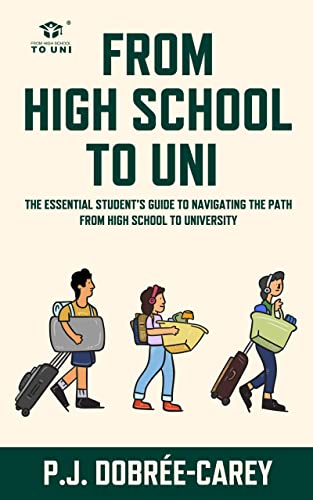
Navigating the transition from high school to university can present a multitude of challenges, from securing one’s first job to managing personal finances and transportation independently. Fortunately, P. J. Dobree-Carey’s From High School to Uni: The Essential Student’s Guide to Moving into University provides a wealth of insightful advice for students and parents alike as they embark on this pivotal life stage. This comprehensive guide is invaluable, covering topics from budget-friendly healthy eating to studying abroad, making it an ideal handbook for starting college and commencing young adulthood.
This guidebook is structured into easy-to-digest chapters that start from the fundamentals of organization, culminating in a “practice week” designed to simulate life independently. Authored by a mother with vast experience, the book offers accessible counsel on an array of subjects, including finances, securing one’s first accommodation, and the basics of safety and friendship. While the chapter on developing new relationships and dealing with romantic partners may prove slightly blush-worthy for some, the majority of the content is family-friendly and full of sound advice suitable for high schoolers and beyond.
While it has been crafted with a UK and European audience in mind, the guide can be beneficial for readers in the United States as well. As a reader, I was intrigued by the cultural nuances and divergences between countries, offering a unique glimpse into the process of transitioning to university life in Europe. Dobree-Carey further enhances the guide’s usability by including numerous practical checklists, aiding in maintaining order as one navigates the onset of independent adulthood.
This guide stands out for its user-friendly nature, commendable financial advice, and for providing a gentle initiation into a potentially overwhelming life phase. From High School to Uni: The Essential Student’s Guide to Moving into University is an excellent resource for mature readers on the cusp of a new life chapter. It offers a sophisticated introduction to the intricate process of transitioning to adult student life.
Pages: 139 | ASIN : B0B8HZKK76



 LITERARY TITAN