Blog Archives
Knowledge, Experience, Intuition

In The Two Oceans, you combine your memoir, philosophy, finance, and business knowledge to explore balance, resilience, money, work, relationships, and how to find meaning in everyday experience. How did the metaphor of the two oceans, the inner world and the external world, develop?
The metaphor developed from needing a book title that could encapsulate its wide breadth of contents. At one point, the book’s title was going to be Whales Outside Our Windows, the name of one of its chapters. However, it seemed to me that title puts the focus on the external world.
I arrived at the conclusion that what we can control – the aspects within ourselves – and what we cannot control – the factors outside of us – were equal halves in my manuscript. Consequently, both are important to recognize, understand, and navigate. From there, I made the connection to what would be the book’s eventual title and central metaphor.
The Two Oceans concept then guided the shape and structure of my book project, including the inspirations I pulled from. I hope that this collection of essays and short stories translates as a cohesive body of work to its readers.
Zen Buddhism, Stoicism, Taoism, Jungian psychology, and existentialism all appear throughout the book. Why was it important to connect philosophy to ordinary experiences rather than discuss it primarily in abstract terms?
This book started as a project with the intention to document some of my experiences in entrepreneurship, personal finance, and human society. At the same time, I sought to reflect on my emotions, thoughts, and ideas at this stage of life. Journaling allowed me to do both, while the study of various philosophical traditions helped me metabolize all these real-life events.
I didn’t set out to write a book about different philosophies; it just became its logical, natural, and organic progression. As I was writing, I continued this exploration, inspiration, and research into them.
I feel like making these stories grounded in present times and rooted in practical applications contextualizes these ancient and historic philosophies, making them more specific, relatable, and accessible in the process.
All of us begin to search for answers, meaning, or coherence at some point in our lives. I looked towards the named philosophies for my own edification. My intention with this book was to write it in a conversational or storytelling manner, like an old friend sitting across from you sharing a hot cup of tea.
You write about money and time as finite resources. How has that perspective influenced your own decision-making?
The perspective that everything in life is temporary or ephemeral has hopefully taught me to live in the present in moderation and with greater appreciation. Thus, I try to make decisions with greater awareness and intention.
Progress is not a straight line, and I am nowhere near being enlightened. Sometimes, I still catch myself falling back on old habits, making the same mistakes, repeating bad patterns, or experiencing dark gray skies. I continuously remind myself of these teachings through the importance of having ritual, routine, and rhythm.
Each of our decisions has consequences, both on ourselves and the people around us. Since there is no catch-all solution to every decision, the best we can do is make sound judgments informed by knowledge, experience, intuition, or a combination of these. It is about being purposeful and balancing perspectives, so we have a life without regret and a future with plenty of consideration.
What practices from the book can readers begin applying to their own lives without needing extensive knowledge of philosophy or finance?
First, cultivate personal virtues in our everyday lives, which are within our power — wisdom, courage, justice, temperance, resourcefulness, resilience, etc.
Take the opportunity to be a better version of yourself. It will pay great dividends.
Second, start simple and small, learn from your mistakes, and course-correct when necessary. Ask others, find resources, gain experience. The best time is now, and every journey starts with a single step.
Take the risk by putting yourself out of your comfort zone once in a while. If you are in a rut, try new or different things.
Third, individuation through introspection. Don’t be a stranger to your own self. Find out what works and doesn’t work for you. Stick to a plan that works, knowing that emotions and setbacks, though not optional, are momentary and impermanent.
Take the time to sit with yourself, look inside, and identify what would truly give you purpose or personal fulfillment, knowing that it is not the same for everyone, and everyone has their own journey to take.
Author Links: GoodReads | Website | Amazon
In The Two Oceans, the author draws on his lived experience to recount tales of empathy, kindness, suffering, resourcefulness, contentment, and happiness, reflecting on them through the lens of philosophical principles. These tenets are intended to guide us toward integrating the two halves of ourselves — the conscious Self and the unconscious Shadow.
This collection of twenty-five short stories explores philosophies such as Zen, Stoicism, and Jungian psychology, and proffers practical applications of their central concepts such as detachment, impermanence, resilience, virtue, response, individuation, and introspection. These simple lessons can be useful tools in both vast, equally turbulent oceans, helping us cross unfathomable depths as we sail through life’s treacherous waters, and guiding us safely back to shore.
The Two Oceans: A Personal Account of Life, Finance and Business Philosophies
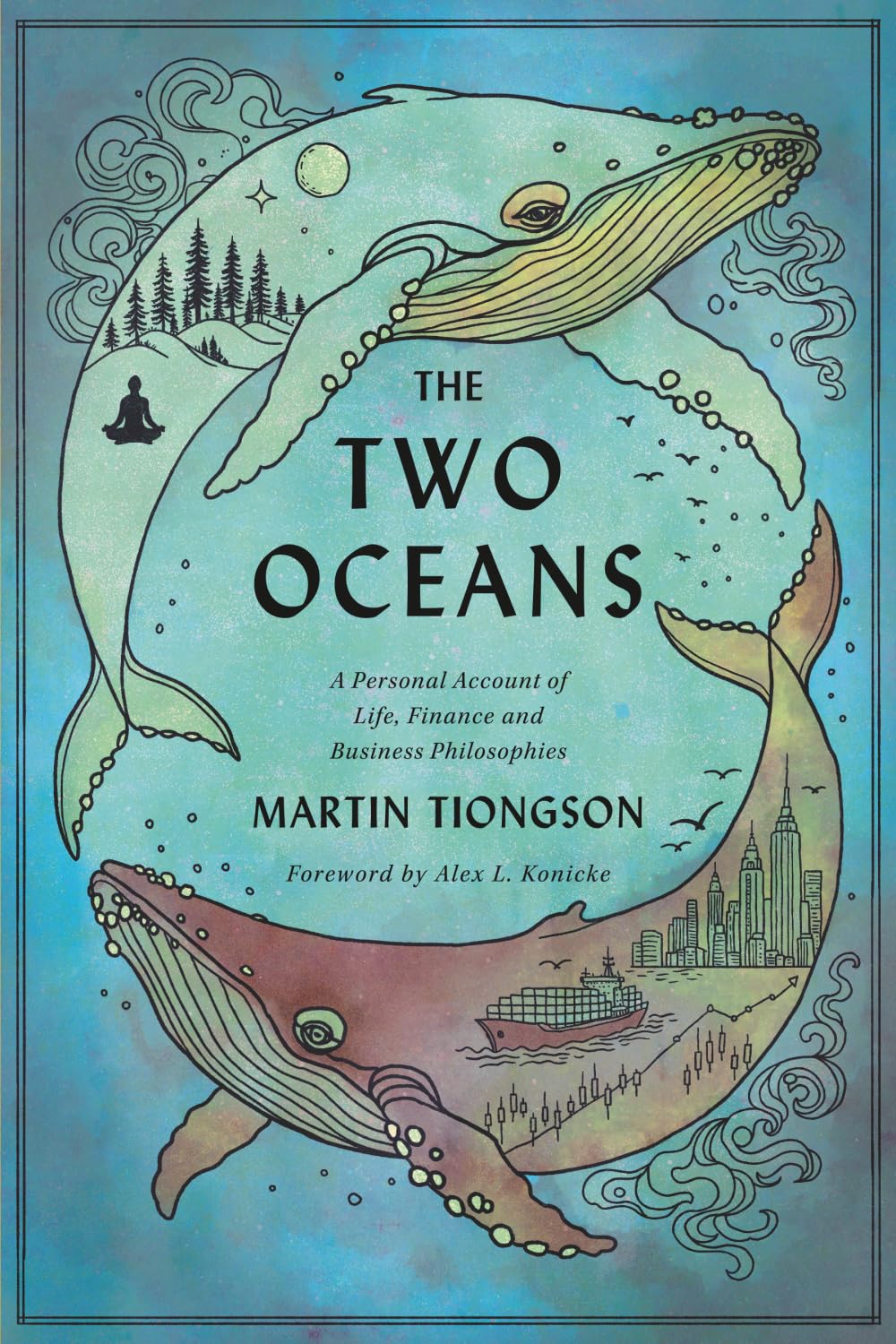

Martin Tiongson’s The Two Oceans: A Personal Account of Life, Finance and Business Philosophies is a hybrid of memoir, personal essay, financial reflection, and philosophical inquiry. Organized into five parts, “The Present,” “Finance,” “The Person,” “Business,” and “The World,” the book moves between outward experience and inward interpretation. That structure reflects the image introduced in the prologue, where two whales come to represent “the inside and the outside, consciousness and the unconscious, push and pull, yin and yang, and temperance.” Tiongson draws material from an unusually broad range of experiences: fostering an elderly cat, enduring a disastrous trip to Florida, whale watching in Mexico, navigating investments and taxes, pursuing business opportunities, facing rejection in a job search, dealing with insurance, volunteering, and observing the changing seasons of the Pacific Northwest. These episodes function as more than recollections. Each becomes a point of departure for considering how a person might approach uncertainty, money, work, relationships, adversity, and time.
The book’s defining quality is Tiongson’s habit of connecting ordinary experience to larger systems of thought. Zen Buddhism, Stoicism, Taoism, Jungian psychology, existentialism, and other traditions recur throughout the essays, giving the collection a consistent intellectual framework despite its varied subject matter. A cup of tea becomes an exercise in presence, a difficult vacation becomes a lesson in distinguishing what can and can’t be controlled, and a failed business acquisition becomes an examination of detachment, negotiation, and judgment. The chapter on gray whales offers one of the clearest expressions of the book’s central metaphor. Reflecting on the barnacles carried by the animals, Tiongson writes, “The whales are outside our windows, but there exists a sea within us, with all that it contains.” That sentence captures the book’s method particularly well. The external world supplies its stories, while the internal world gives those stories their significance. Tiongson’s descriptive passages about animals, landscapes, weather, cities, and changing seasons also give the philosophical material a physical setting, allowing abstract ideas to remain tied to lived experience.
The finance and business sections add another dimension by making the book practical as well as contemplative. Tiongson discusses savings accounts, certificates of deposit, Treasuries, index funds, risk levels, private investments, bookkeeping, budgeting, fraud prevention, grants, and business acquisition with the perspective of someone describing his own working methods. His recurring concern is disciplined stewardship of finite resources, particularly money and time. The chapters on entrepreneurship are similarly grounded in experience, including negotiations over the “Sugar and Salt” business, the mechanics of pursuing government grants, and lessons carried forward from years in small business. One of the book’s most concise statements, “Resourcefulness can, in fact, be our greatest resource,” develops into a discussion of preparation, adaptability, self-investment, and purposeful effort. This combination of concrete procedure and reflective interpretation gives the book much of its character. Financial planning, business decisions, emotional regulation, and philosophical inquiry are treated as related practices that depend on patience, attention, and the ability to respond thoughtfully to changing circumstances.
The Two Oceans is a record of a person attempting to make coherent meaning from experience while remaining attentive to the practical demands of everyday life. Its episodic form suits that purpose because the book develops through accumulation: cats, whales, birds, businesses, bank accounts, friendships, disappointments, journeys, storms, and routines gradually become parts of the same meditation on impermanence and balance. Tiongson explains in the afterword that the project grew from twenty-five stories written over twenty-five weeks, drawing on journaling, recent experiences, financial knowledge, and his study of philosophy. He later discovered connections among subjects that had initially seemed unrelated, particularly the ways different philosophical traditions addressed questions such as human suffering. That history is visible in the finished work. The Two Oceans reads as a personal philosophy assembled from observation and practice. Its strongest passages invite readers to notice how much meaning can reside in experiences that might otherwise pass without examination, and its enduring subject is the continuing effort to balance the world around us with the world within.
Page: 231 | ASIN : B0GY49CPBZ

Scams are the World’s Fastest-Growing Crime

Scams Are the World’s Fastest-Growing Crime is a straight-talking field guide to modern scams. Author Ken Ray walks through how scams evolved, why they work, and how they hit regular people in every channel of life, from phone and email to social media, crypto, fake stores, and in-person tricks. He starts with history and psychology, then gives a simple four-step model of every scam: setup, lure, attack, hook. After that, he moves into detailed profiles of common schemes, global impact, why victims stay silent, and how scammers pick their targets. He wraps it all up with danger scales, checklists, legal context, a glossary, and a very raw victim story, all tied to Scam Watchdogs’ mission to protect, educate, and expose.
What I liked most was the human focus. Ray keeps reminding me that scams are not about clever tech. They are about emotions and habits. He lays out trust, fear, greed, love, guilt, and overconfidence as levers that scammers pull, then shows how those levers show up in real situations like “grandparent” calls, romance cons, and fake tax threats. I felt angry reading the sections on shame and silence, and how victims stay quiet because they blame themselves or worry no one will listen. The chapters on the snowball effect and the global scale of the problem hit pretty hard too. They show how a tiny “test payment” can snowball into life-changing loss and how those losses add up across families, small businesses, and even trust in basic institutions. Reading that, I felt a mix of frustration and urgency, like this is not just sad stories; this is a public safety issue.
I liked how practical and plain the book feels. The tone is warm and professional but still sounds like a real person talking, not a legal brief. The early chapters give clear frameworks, then the scam profiles repeat the same structure each time with “setup, lure, attack, hook” and a danger rating. That rhythm made it easy for me to skim to what I needed. I also appreciated the checklists, the “Stay Safe” section, and the simple definitions at the back, since those are easy to share with less tech-savvy family members. The author’s note about using AI tools like ChatGPT as a helper, while taking responsibility for the facts, felt transparent and current, which I liked.
I came away feeling both rattled and oddly reassured. Rattled, because the examples show how easy it is for smart, cautious people to get pulled in, especially through investment and romance scams that mix money with emotion. Reassured, because the book keeps coming back to simple habits that anyone can build: pause, verify, talk to someone, report what happened. There is a steady compassion for victims that cuts through the usual blame, especially in the dedication and the closing message that every report turns a private loss into a public shield.
I would recommend this book to everyday readers who want to protect themselves and their families, especially people who do not live in the world of cybersecurity but still live on their phones and laptops all day. It is a strong choice for parents, caregivers, community leaders, and small business owners who need something they can hand to others without translation. People looking for a clear, empathetic starter guide and a reference you can dip into whenever a weird text or email pops up, it does the job very well.
Pages: 175 | ASIN : B0G35VCVP1

Pay Less for College: The Must-Have Guide to Affording Your Degree


Pay Less for College lays out a clear and practical roadmap for cutting the true cost of a college degree. The authors walk through the entire financial aid system step by step, from how schools build their cost of attendance to how families can understand their Student Aid Index and estimate real net prices. The book breaks everything into simple pieces, and it shows families how to lower their costs with smart planning, better timing, and more strategic college lists. I found that the book blends explanation with action in a way that makes the whole process feel less scary and a lot more doable.
I was impressed by how clear and direct the writing is. The topic is heavy. It is full of numbers, rules, odd quirks, and deadlines. Yet the authors talk like they are sitting next to you at a table with a big cup of coffee and a stack of forms. The tone feels calm. It feels friendly. It made me relax. I liked how the book avoids pretending that financial aid is simple. Instead, it acknowledges the mess. It untangles it little by little. I appreciated that honesty. It made me trust the advice more. And the tables of information help a lot. They turn confusing ideas into something you can actually follow.
The book pushes readers to face real numbers, and that hit me. The constant reminder that net price is what matters feels like a splash of cold water. I kept thinking how many families get blinded by the sticker price or by vague encouragement from colleges. The authors challenge that. They show how much schools differ in generosity and how much strategy matters. That message stuck with me. It made me feel a bit frustrated about how complicated the system is, but also relieved to have a guide that feels grounded and realistic.
Pay Less for College is a great fit for families who want clarity, control, and a plan. It works for parents who feel overwhelmed and for students who want to understand how the money side really works. It is especially helpful for anyone who likes checklists, examples, and concrete next steps. I would recommend it to households at any income level because everyone can save something with the strategies in this book. It really does make the whole process feel manageable, and that alone is worth the read.
Pages: 362 | ASIN : B0FQQ3WWSW
Forever Fly Free: One Woman’s Story of Resilience and the Power of Hope and Love

Forever Fly Free is the gripping, raw, and deeply human story of Jenny Brandemuehl’s life turned upside down after her husband Mark is severely burned in a horrific plane crash. Told in five parts that span panic, heartbreak, healing, and rediscovery, the book chronicles the emotional and physical toll of trauma, not just on the person injured but on the entire family. Jenny lays bare the sleepless nights, medical jargon, ICU beeps, and gut-wrenching decisions, all the while weaving in threads of love, humor, and a whole lot of grit.
Jenny’s voice is steady and clear, and even when she writes about the most painful moments like her husband’s bandaged, unrecognizable body, or the moment her son learns about the accident. There’s a grace in the way she keeps moving forward. Her writing flows naturally, like a close friend confiding in you. It’s not fancy, and thank God for that. It’s real. There’s also unexpected beauty tucked in the folds like a stranger’s prayer, a nurse’s quiet courage, or a joke Mark cracked in the ER that made me laugh through tears.
What I loved most was how this book is as much about healing as it is about survival. It’s not just medical updates and hospital visits. It’s about rediscovering hope when everything falls apart. Jenny lets us witness the mess of it all, like family tension, career stress, and the fear of the unknown, but she also shows how small acts of kindness and love carry her through. I was especially touched by the moments of spiritual reflection and how Jenny manages to hold space for both science and mystery. Her faith isn’t preachy; it’s personal and quietly powerful.
Forever Fly Free left me with tears, yes, but also with warmth. It reminded me how resilient people can be when they are fueled by love. I’d recommend this book to anyone facing loss, anyone caregiving for a loved one, or anyone simply looking for a true story that stirs the soul. It’s not just about burn recovery or trauma, it’s about the big stuff like love, family, and what it means to keep going when you’d rather not. I finished the last page and sat still for a while, grateful that Jenny let me into her story.
Pages: 352 | ASIN : B0F281H16L
Your Future Is NOW Your Blueprint for Solving Your Retirement Puzzle

Jeffrey Panik’s Your Future is NOW is a thorough and practical guide for anyone who’s within shouting distance of retirement. It covers everything from defining personal goals to calculating how and when to take Social Security, while also diving into often-overlooked areas like identity theft protection, debt elimination, and estate planning. It’s not just about money, it’s about preparing your whole life to change gears smoothly and confidently. Panik gives readers a methodical “blueprint” built around common-sense principles, all aimed at helping you make retirement work for your real life, not just your bank account.
I appreciated how Panik skips the fluff and gets right to the point without scaring you into panic. He lays things out in a step-by-step fashion, with examples, real-life stories, and checklists that make the whole retirement thing feel less like an unsolvable puzzle and more like a weekend project (a big one, sure, but manageable). His tone is calm, confident, and rooted in experience. One of my favorite sections was the part on taking a “test drive” with retirement goals like hobbies or travel. It’s practical advice with a personal touch. I also liked that Panik doesn’t assume you’re rich or debt-free. He acknowledges the stress and setbacks most folks deal with, and that made his advice feel even more trustworthy.
There’s a lot of ground to cover, and sometimes it reads like a to-do list more than a narrative. I think some chapters could’ve used a bit more warmth or storytelling to lighten the load. But overall, the value of the content outweighs any dryness. I found myself bookmarking pages and jotting down notes. The workbook-style approach makes it easy to take real action, not just think about it. I came away with a strong sense of control and clarity, and that’s no small thing when thinking about something as big and overwhelming as retirement.
This book is perfect for anyone aged 45 and up who wants a clear, no-nonsense roadmap for retirement. Whether you’re ahead of the game or just starting to wonder if you’ve saved enough, Panik’s guide meets you where you are. If you’ve ever felt unsure about Social Security timing, confused by Medicare options, or just worried about running out of money, this book can be a game changer. It’s not flashy, but it’s solid, wise, and incredibly helpful.
ISBN : 979-8-89138-541-2
Trust, Candor, and Accountability

Cultivate: The Power of Winning Relationships presents readers with a thoughtful and highly practical exploration of the critical role relationships play in achieving professional success. Why was Cultivate: The Power of Winning Relationships an important book for you to write?
Relationships are the heartbeat of business—and life. Early in my career in finance and leadership development, I saw time and again that it wasn’t technical skill that made or broke success. It was how people navigated the human side of work. Who they trusted. Who they avoided. Who had their back—or didn’t.
Cultivate was my way of capturing the patterns I saw in teams and leaders around the world—and offering a clear, practical path forward for building the kinds of relationships that elevate performance, trust, and impact.
The pandemic brought this need into even sharper focus. As we navigated remote work, hybrid environments, and the fundamental reshaping of our workplace connections, the principles in Cultivate became not just important but essential. That’s why I’ve expanded the second edition to address these new challenges and opportunities.
What ideas were important for you to share in this book?
First, that relationships are not a “nice to have”—they are mission critical. Second, that we all have a Relationship Ecosystem™—and whether we’re aware of it or not, we’re constantly influencing and being influenced by the people around us.
I wanted to help readers diagnose the health of their relationships, understand the dynamics at play (Ally, Supporter, Rival, or Adversary), and most importantly—equip them to shift those dynamics with intentional action.
The Ally Mindset at the heart of the book shows how five essential practices—Abundance & Generosity, Connection & Compassion, Courage & Vulnerability, Candor & Debate, and Action & Accountability—create the foundation for transformational relationships. These concepts were so powerful that we expanded them into their own book, You, Me, We: Why We All Need a Friend at Work (and How to Show Up as One!), which serves as a perfect companion to Cultivate.
What is a common misconception you feel people have about building relationships in a professional environment?
That it’s about being liked, or that it’s all just “soft stuff.”
In reality, the strongest professional relationships are rooted in trust, candor, and accountability. You don’t need to be best friends with everyone at work—but you do need to be willing to show up with integrity, listen generously, and have the tough conversations.
Another myth? That relationships happen organically. The truth is, high-trust, high-impact relationships are built intentionally. This becomes even more critical in our hybrid and remote environments, where the natural touchpoints of in-person interaction are limited. We must now deliberately create the conditions for connection that used to happen in hallways and break rooms.
Perhaps the most damaging misconception is that investing in relationships takes time away from “real work.” The data proves otherwise—teams with strong relationships are more innovative, more resilient, and deliver better results. As I explore in both Cultivate and You, Me, We, relationship-building isn’t separate from the work—it’s what makes the work possible.
What do you hope is one thing readers take away from Cultivate?
That you have more influence than you realize. Whether you’re an executive or a new team member, you have the power to shape the culture and health of your relationships.
It starts with one conversation, one check-in, one moment of courage. Start there—and the ripple effect can be profound.
In today’s workplace, where technology often creates the illusion of connection, I hope readers take away the understanding that genuine human relationships remain the cornerstone of success. We must all work to create cultures of connection in a world that often feels disconnected, one conversation and one relationship at a time. Because we truly are #BetterTogether.
Author Links: GoodReads | Website | LinkedIn
New & Updated Vibrant, Practical, and Unapologetically Real
Success in business isn’t just about what you know—it’s about how you connect. In today’s fast-paced, tech-driven world, genuine human relationships are the key to unlocking peak performance, strong teamwork, and lasting success. Cultivate is your go-to guide for turning everyday interactions into powerful, real connections.
Are you finding it tough to build trust in virtual and hybrid work settings? Do colleagues sometimes come off more like competitors than supportive teammates? And do those difficult conversations seem too risky to tackle? This book shows you how to break down those barriers and transform team and communication challenges into genuine opportunities.
In this expanded second edition, Morag Barrett – founder and CEO of SkyeTeam – introduces her groundbreaking Relationship Ecosystem™ model, giving you the practical tools to:
• Strengthen Your Communication: Cut through the noise and build authentic trust in every conversation.
• Tackle Tough Talks with Confidence: Learn how to approach challenging discussions in a way that clears up misunderstandings and builds stronger bonds.
• Transform Workplace Dynamics: Turn quick chats into lasting connections that boost your day-to-day impact and set you up for long-term success.
• Enhance Your Leadership Impact: Become the go-to colleague who not only drives results but also inspires others—fueling your success today and paving the way for a thriving career tomorrow.
If you’re ready to step beyond surface-level interactions and truly make a difference in your work life, Cultivate is here to help you build relationships that work as hard as you do.
Cultivate: The Power of Winning Relationships

In Cultivate, Morag Barrett presents a thoughtful and highly practical exploration of the critical role relationships play in achieving professional success. Barrett, drawing on her extensive leadership development experience, introduces the “Relationship Ecosystem,” a clear, actionable framework that categorizes workplace relationships.
What sets Cultivate apart is its balance between strategic insight and practical application. Barrett moves beyond theory, offering readers diagnostic tools, self-assessments, and concrete strategies to both strengthen beneficial relationships and repair challenging ones. Rather than focusing solely on building alliances, she emphasizes the importance of navigating difficult interpersonal dynamics, making the book both realistic and immediately useful.
Barrett’s writing style is clear, engaging, and conversational, making complex interpersonal concepts accessible to a wide audience. She supports her advice with real-world examples that resonate across industries and organizational levels. Particularly timely is her updated focus on relationship-building in hybrid and remote work environments, ensuring the book remains relevant in today’s evolving workplace.
Cultivate: The Power of Winning Relationships is an insightful, practical, and empowering read that offers lasting value for anyone serious about leading and thriving through the power of human connection. It is particularly valuable for executives, team leaders, and emerging professionals who recognize that technical skills are only part of the equation—relationship mastery is equally essential.
Pages: 270 | ASIN : B0F2NVKYNP


