Blog Archives
Peeling the Layers of an Onion

Crushed Azaleas gathers fragments of an international childhood into an intimate memoir about belonging, family wounds, cultural identity, music, and learning to understand the people who shaped us. The memoir unfolds through self-contained memories rather than a strictly chronological narrative. Why did that structure feel right for your story?
I chose the form of self-contained memories, or vignette-like scenes (as I refer to them in my introduction) because it was the only way to convey the beauty and power of each memory, and also the absence of a unifying theme linking these memories into a coherent whole. Longer chapters like “Roman New Year’s” and “A Monsoon Tale” present somewhat of a contrast because they portray entire worlds where festive and colorful surroundings take center stage.
Music appears throughout the memoir as an important emotional language. What has music allowed you to express or understand that words sometimes cannot?
Any answer to this question will be incomplete because you are asking me to describe a place beyond words. Toward the end of my chapter titled “Seeking a Spiritual Path,” I describe what listening to music does for me. It creates a sanctuary, a space beyond time where love received is perceived as light, a place of mystery, a home for my soul.
What was most difficult about writing honestly about people you loved while also acknowledging the pain within those relationships?
Writing this memoir has been like peeling the layers of an onion. Each layer has brought pain with it, and also a deeper insight. It has been an inward journey. Early on I decided to bare my soul to the reader and to show the beauty and pain inherent in loving relationships. In family, we are at our most loving and most vulnerable. I found resonance and affirmation in reading Thomas Moore’s “Care of the Soul” where he states “Family is a sometimes comforting, sometimes devastating, house of memory.”
After spending so much of the memoir searching for belonging, where do you believe our deepest sense of home ultimately comes from?
In answer to this question, I would like to quote a concept from Zen practice called “turning one’s light around.” It teaches that one’s true light (wisdom) isn’t waiting at the end of a long journey, it has been always at one’s own doorstep (within) if one simply stops looking outward. I lean towards this inward journey at the end of my first chapter titled Origins: “Maybe the way back home is to find the most intimate part of me, a part stretched thin by memory. A part that is beautiful, mysterious, and fragile, sustained by a love of dreams and origins.”
Author Links: GoodReads | Website
Born in Washington, D.C., and raised across Japan, the United Kingdom, Italy, and India, Moulik grew up amid constant motion—an outsider everywhere, yet belonging nowhere. Told through vivid vignettes, his memories capture the wonder of postwar cities, the rituals of diplomatic life, and the friendships that shaped a wandering childhood.
But beneath the cosmopolitan surface lies a more fragile world: a demanding father whose approval must be earned, a mother struggling with deep depression, and a boy searching for refuge in music, memory, and the cultures around him.
Evocative, intimate, and deeply reflective, Crushed Azaleas explores the quiet complexities of identity, family, and belonging—resonating with anyone who has ever lived between cultures or questioned where “home” truly lies.
Crushed Azaleas


Amal Moulik’s Crushed Azaleas is a memoir built from vivid, self-contained memories of a childhood spent moving among India, Japan, England, and Italy. The son of an Indian diplomat who later worked for the United Nations, Moulik grows up surrounded by travel, education, culture, and material comfort, yet his most persistent concern is the meaning of home. Early in the memoir, he describes himself simply: “I remained an outsider.” That sense of displacement gives the book its emotional continuity. Moulik presents childhood through episodes shaped by the way memory actually works: certain rooms, conversations, humiliations, landscapes, meals, and pieces of music remain sharply illuminated while the years around them recede. He moves easily from a sunrise accompanied by an Indian morning raga to childhood mishaps in Tokyo, school life in London, family holidays in India, and adolescence in Rome. The result is a memoir in which geography matters deeply, but place is always connected to an internal search for belonging.
The book’s strongest quality is Moulik’s ability to preserve a child’s perspective while allowing the older writer to understand what the child couldn’t. That dual vision gives seemingly small incidents surprising emotional weight. A young Amal can marvel at an earthquake, quarrel over a handkerchief, misunderstand religious customs, or lose his breakfast to monkeys, while the adult narrator recognizes the larger questions those memories contain. Humor appears frequently and keeps the memoir intimate, particularly when childhood logic collides with adult expectations. At the same time, darker memories accumulate around his family. His father, Baba, is intellectually formidable, culturally sophisticated, and capable of introducing his son to beauty, but he’s also controlling and intensely concerned with achievement and obedience. His mother, Ma, is loving and spiritually influential, yet increasingly withdrawn as depression overtakes her daily life. Moulik’s treatment of both parents gains force from its specificity. He remembers food, clothing, music, gestures, arguments, and silences, allowing family relationships to emerge through scenes. The title itself comes to represent this mixture of beauty and injury, a pattern that extends through much of the memoir.
As Moulik grows older, Crushed Azaleas broadens into a thoughtful account of identity formation. His experiences with racism at school force him to understand how others interpret the color of his skin, while friendships across cultures and religions encourage him to resist inherited prejudices. His spiritual curiosity develops in much the same way. Hindu prayers associated with his mother, Christian scripture and hymns at school, Catholic Rome, and his own questioning temperament become parts of an evolving personal spirituality. Music provides an equally important language of connection. Indian classical music, opera, church music, and eventually Mahler accompany some of the memoir’s most significant moments, giving Moulik access to emotional territory that his family often struggles to express directly. These themes come together particularly well in the later Rome chapters, where adolescence brings greater independence. He begins challenging his father’s assumptions, defending friendships his father disapproves of, pursuing his own interests, and discovering the city beyond the controlled boundaries of family life. The international setting therefore becomes more than background. It shapes the author’s moral imagination, teaching him to examine nationality, race, faith, loyalty, and prejudice through lived encounters.
The closing sections give the memoir its deepest emotional resonance. The death of Moulik’s friend Marc, who introduced him more fully to Mahler, transforms a youthful friendship into a lifelong meditation on grief, just as the earlier death of Ram, the devoted family servant who cared for him as a child, becomes inseparable from childhood guilt. Moulik writes of Ram, “Writing this now is an act of self-forgiveness.” That sentence also describes much of the memoir’s larger purpose. In “Heart to Heart,” he looks back at the emotional structure of his family with unusual clarity, recognizing his father’s need for control, his mother’s suffering, and his own lifelong search for unconditional love. The epilogue then carries the idea of home beyond childhood, tracing Moulik’s later movement through London, the United States, and Germany before his eventual return to the country of his birth. Crushed Azaleas is therefore both a record of an unusually international upbringing and an examination of how a person turns scattered memories into a coherent understanding of self. Its lasting achievement is the way it holds beauty and pain in the same frame: the music, cities, friendships, humor, and moments of kindness remain as consequential as the loneliness and family wounds. Moulik’s memoir suggests that home can be carried through memory, relationship, art, and the difficult work of understanding the people who shaped us.
Pages: 231 | ASIN : B0GZV79RFH

A Teacher, Evangelist, and Leader

Born Missionary tells the remarkable life story of Islay Walden, a man born into slavery who overcame blindness, poverty, and prejudice to become an educator, poet, and minister. What inspired you to tell the story of Islay Walden?
Islay Walden was the founding minister and teacher at the church and school where my maternal ancestors lived. I was aware that he was a poet, known as the “Blind Poet of North Carolina.” but when I began looking for information on his life, I noted that there was scant information published about him. Most of the information was repetitious and frequently inaccurate. In addition, none of the essays noted that his primary focus was to bring education and the gospel to his community. Poetry was a tool he would use to help him accomplish that. None of the biographical essays noted that he had begun two successful school programs, one in Washington, DC, and the other in New Brunswick, New Jersey before returning to North Carolina. However, his reputation as a teacher, evangelist, and community leader had not gone unnoticed during his lifetime or at his death. Thus, after reading an obituary that extolled his talent as a “born missionary,” I chose that for the title.
How much research did you undertake for this book, and how much time did it take to put it all together?
There was a section about his life primarily focused on his poetry in my previous book, From Hill Town to Strieby, which took about four years to research. This book was published four and a half years later. Once I began seeking research information beyond literary criticism, I found that there was very little official information available. I found that the best guide was Walden’s own poetry, which was heavily biographical, a fact not noted in any of the literary reviews or biographical essays.
What were some ideas that were important for you to share in this book?
It was important to be able to show that while Walden had been successful as a poet, he had used his poetry primarily to further his vocation as a teacher and minister. His desire to bring education and foster the faith of his community were his greatest desires. He believed those were the tools that would help all he encountered and especially his community in North Carolina prosper both materially and spiritually.
What do you hope is one thing readers take away from Islay Walden’s story?
I want people to know that his was a story of resilience and perseverance in the face of adversity. He overcame a legacy of slavery, financial challenges and physical disability to gain an education in order to help all he encountered to have a better life.
Author Links: Goodreads | Facebook | Instagram | LinkedIn | Website | Amazon
Born Missionary: The Islay Walden Story
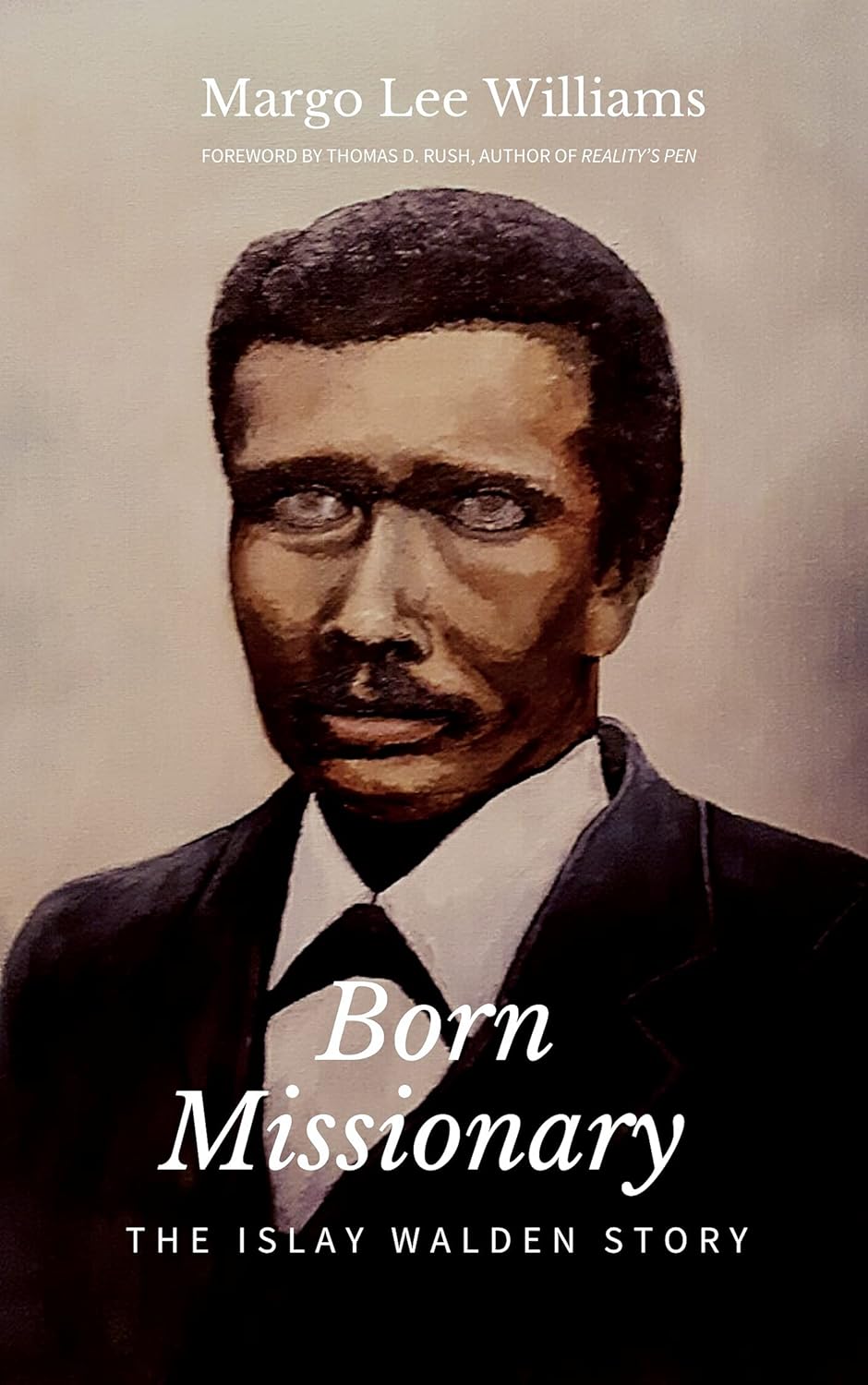
Margo Lee Williams’s Born Missionary tells the remarkable life story of Islay Walden, a man born into slavery who overcame blindness, poverty, and prejudice to become an educator, poet, and minister. The book traces his journey from the plantations of North Carolina to the halls of Howard University and the New Brunswick Theological Seminary, where he became one of the first African Americans ordained in the Reformed Church in America. Through meticulous research and a clear narrative voice, Williams reconstructs a life of faith and resilience. She doesn’t just recount events. She restores the humanity and voice of a man who was almost lost to history.
Reading this book stirred something deep in me. I could feel the grit in Islay’s story. His persistence through blindness and hardship hit me hard. The way Williams weaves letters, poetry, and newspaper clippings into a vivid picture of his struggles makes the past feel close. Her writing feels both scholarly and warm, and she lets the historical documents breathe. I’ll admit, there were moments when the detail slowed me down, but I didn’t mind. The care she took made me trust her. I found myself rooting for Islay, not as a distant historical figure, but as someone I might have known. Williams also captures the contradictions of his time, the faith that built him up, and the racism that tried to keep him small.
Emotionally, I found myself angry, proud, and sometimes just quiet after reading a passage. Williams doesn’t sermonize; she shows the quiet power of purpose. Her portrait of Islay’s devotion to teaching and preaching made me think about how education itself was a kind of rebellion. I liked how she handled the tension between his poetry and his ministry. You can sense that both were ways for him to see beyond blindness, to express what light looked like to him. It’s moving without ever feeling forced.
I’d recommend Born Missionary to anyone who loves history that feels alive. It’s perfect for readers interested in African American heritage, the Reconstruction era, or stories of perseverance that don’t sugarcoat the past. Teachers, pastors, and anyone who believes in second chances will find something here. It’s not just a biography, it’s a reminder of how one life, lived with courage and faith, can echo through generations.
Pages: 121 | ASIN : B091MF5B48
The Fifth Wife
The Fifth Wife by Soua Lee is a compelling and inspirational tale that follows the journey of Mai Cee, a Hmong woman who faces numerous challenges in her pursuit of independence and self-improvement. Upon arriving in America as a child, Mai Cee grapples with language barriers and cultural differences while attending school. Despite these difficulties, she excels as a student, and her family recognizes her potential.
Throughout the narrative, Mai Cee’s steadfast determination to better herself and support her family is commendable. Despite growing up in a troubled household, she sought to understand the meaning of love and to feel worthy of it. However, when she meets James, her life takes a dramatic turn, as her relationship with him is met with prejudice from her family. Despite her desire to be with James, she is constantly tormented by unfounded opinions and the lies of the past, leading her to question her emotions. Mai Cee shares numerous life lessons learned through pain and struggle, providing readers with insight into the complexities of the human experience. The detailed narration is a testament to the fact that no one is entirely good or bad, and everyone does the best they can from their perspective. Despite the arguments and challenges Mai Cee faces, her parents always had her best interests at heart. Moreover, The Fifth Wife explores how social influences can impact one’s dreams and aspirations. However, it also emphasizes the importance of self-awareness and the ability to overcome obstacles to move forward.
The Fifth Wife is a remarkable story, and while some of the explanations may appear repetitive, they are essential to understanding the intricacies of Hmong culture. The book will resonate with readers who value the significance of family and love, regardless of their customs. Mai Cee’s journey serves as an inspiration for anyone struggling to find their true self in challenging times, demonstrating the importance of not letting the past dictate one’s future. This engaging and thought-provoking memoir encourages readers to strive for a better future.
Pages: 353 | ASIN : B0BNCJZBLY



