Blog Archives
Life’s Transience

Exits is a collection of poems that moves in and out of nature, memory, and mortality with a sharp eye and an unflinching voice. What inspired you to write this particular collection of poems?
Nearly all of the poems in Exits were written between 2003 and 2021, before the idea of authoring a book ever came to mind. Three years ago, I decided to incorporate what I considered to be my best work into a book entitled Line Drawings. However, during the process of selecting poems, I noticed that a substantial number were related to various aspects of mortality. This led me to curate a more concise, themed collection, and Exits was born.
How did you decide on the themes that run throughout your poetry book?
I think my focus on life’s transience — the finite nature of our biological selves — derives from three sources. First, I was raised without any religious training, so from a very young age, I was left on my own to ponder the enormity of the universe, time and eternity, and the meaning of existence. I remember being cognizant of death as early as age five. Second, as a physician and neuro-ophthalmologist, I’ve cared for numerous patients with serious and/or life-threatening diseases. And third, since 1999, I’ve had to deal with the spinal cord variant of multiple sclerosis and the ramifications of that disease.
Did you write these poems with a specific audience in mind, or was it a more personal endeavor?
During the writing process, the intended audience was always me, or, to be more precise, the facsimile of me that constantly looks over my shoulder and critiques every word I draft. The word ecstasy comes to mind. It captures the elation I feel when a line finally comes together, but it derives from the Greek ek stasis ― to stand outside of oneself.
There’s certainly nothing wrong with writing for a defined audience, or respecting the conventions of a particular genre, or exploring themes and issues that are currently in the public eye. My approach happens to be different. What matters most to me are the words on the page, how they sound in air, and meeting the standards I set for myself.
What did you learn about yourself through writing this book?
The lessons I learned while writing the poems and designing the book (which are outlined below) may be of benefit to other debut authors and/or emerging writers:
- Write poems that reflect your unique aesthetic sensibilities. Try not to be overly influenced by prevailing trends or by contemporary poetic styles.
- Edit mercilessly over an extended period. Satisfying first drafts often begin to show their flaws only after sufficient time has elapsed to afford an objective assessment.
- Begin your foray into publication by submitting poems to literary journals. This will help you determine which of your poems resonates with experienced reviewers. Before each submission, make sure that your poem is a good fit for the journal.
- Be patient. Practically every aspect of the publication process moves more slowly than expected.
- Be persistent. Exits went through twenty-two revisions over the course of a year before I felt it was ready for publication.
Author Links: GoodReads | Website | Amazon
We live our lives counting moments, those we hope will last forever, and those we fear. In Exits, award-winning poet Stephen C. Pollock transforms these moments into sublime and magical music. With language both intimate and powerful, he explores the fragility of life, the cyclical truths of nature, and the mysteries of renewal that arise from even the darkest places.
Each poem is paired with evocative artwork, creating an immersive reading experience that lingers long after the final page. From myth to mourning, from dreams to decline, and from flora and fauna to the warming of our world, Exits reminds us that beauty is never far from loss, and that every departure leaves a door ajar.
Winner of the 2024 North Street Book Prize for Poetry, the 2023 Readers’ Favorite Gold Medal, and seventeen other literary honors, Exits is a masterful collection for those who believe that poems should move you, stay with you, and change the way you look at life.
Step into these pages. Lose yourself in poetry that’s both technically exquisite and emotionally arresting. And discover why every exit is, in its own way, an entrance.
Exits
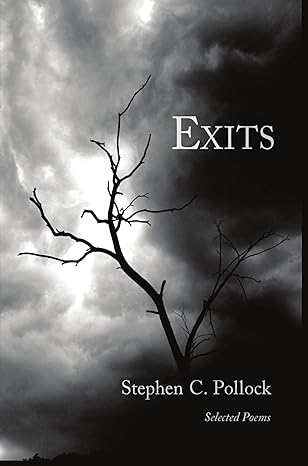

Exits is a collection of poems that moves in and out of nature, memory, and mortality with a sharp eye and an unflinching voice. Pollock balances images of birds, leaves, storms, and insects with meditations on illness, grief, and human cruelty. Each poem feels like an opening and a closing at once, a gesture toward beauty that never ignores the shadows pressing in around it. The artwork paired with the text deepens the mood, giving the reader both a visual and lyrical way to linger with themes of death, decay, and renewal.
I found myself pulled into the tension between delicacy and brutality. The spider spinning its web, the butterfly pinned by a child’s cruel hand, the leaves clinging through winter, these images stayed with me. Pollock’s language is careful, yet it carries an undercurrent of urgency, as if each word knows it has little time left. Some poems made me pause and reread, not because they were obscure, but because they struck me with a sudden intensity. Others, like “Steve’s Balloons,” were so unexpected that I had to smile even while feeling the melancholy underneath.
At times, the heaviness of the book pressed down hard. Illness, biopsy, syringe, tube, the clinical intrudes often, and it brought me back to my own brushes with hospitals and fear. That familiarity made the reading even more raw, and I appreciated Pollock’s honesty. He doesn’t romanticize suffering, but he does find ways to trace light through it. There is also a musicality to his lines that reminded me of older poets, the kind whose rhythm stays in your body long after the words leave your mouth. That mix of craft and emotion gave the book both polish and heart.
I would recommend Exits to readers who like poetry that doesn’t look away. If you’re drawn to reflections on life and death, or if you find comfort in nature as a mirror for human experience, this book will speak to you. It’s not an easy read, but it’s a meaningful one, and I think anyone who values honesty wrapped in artful language will find something to hold onto here.
Pages: 45 | ASIN : B0BXVJB79N




 LITERARY TITAN