Blog Archives
Free People Free People

The Lie That Changed Everything is a memoir that blends sharp humour, biting honesty, and painful recollections into a story that feels both chaotic and deeply human. Why was this an important book for you to write?
This book goes right back to the moment that shaped me—a childish lie I swore on my father’s life, followed by his cancer diagnosis. For years, I carried the belief that I had somehow killed him. That single moment of guilt became the thread that ran through my childhood and beyond, influencing how I saw myself, my family, and even my faith.
Writing The Lie That Changed Everything was my way of holding that memory up to the light and finally making sense of it. But it’s not just about trauma—it’s about the absurdity of family life, the strange superstitions that guided us, and the humour that helped me survive. I wanted to show that even in chaos, there’s resilience and laughter, and that being human means carrying contradictions: grief and comedy, shame and love, darkness and light.
How did you decide what to include and leave out in your memoir?
That was one of the most complex parts of the process. Some of my family were opposed to me writing memoirs—both The Hate Game and The Lie That Changed Everything—because it’s difficult to face the dysfunction that runs through our family. But after years of working as a child protection social worker with hundreds of families, I know dysfunction is universal. The difference lies in whether we discuss it or keep it buried.
I chose to write my truth, but I also left things out. Some situations were too private, too sensitive, or simply not mine to tell. Respect was a guiding principle. What’s on the page is my perspective—my memories, my emotions—rather than an exposé. My brother, who is nine years older, helped me fill in gaps from the early years, and between his input and my mother’s knack for remembering everything, I had a wealth of detail to draw from. I’ve been blessed—or cursed—with an elephant’s memory of my own, so much of it was already stored in my brain in glorious technicolour.
In the end, I included what served the story, what illuminated the themes of guilt, resilience, and humour, and what felt authentic to share. A memoir isn’t the whole truth of a life—it’s the truth of a particular journey.
What was the most challenging part of writing your memoir, and what was the most rewarding?
The most challenging part was working through the trauma—breaking the silence I’d carried for decades. I hadn’t told a soul about the grief and guilt that shaped me. Fear and shame kept my story bottled up. Sitting down to write meant opening old wounds, but it also gave me a way to release them.
The most rewarding part has been the liberation that followed. Over the years, I discovered that I could share painful stories and still make people laugh, even in the darkness. Writing allowed me to see my parents in a different light, too. I came to understand how their own trauma defined them, and that gave me compassion instead of just confusion.
Ultimately, the memoir has helped me stop being defined by the same pain. I often say: hurt people hurt people; free people free people. Writing this book was my step into freedom.
What do you hope is one thing readers take away from your story?
I hope readers come away with the sense that it’s possible to carry both laughter and pain in the same story. Life is rarely one-dimensional—grief can sit beside humour, shame beside love, darkness beside resilience. For a long time, I thought my story was only about guilt and trauma, but writing showed me it was just as much about survival, absurdity, and even joy.
I was thrilled with one review that said, “If you enjoyed Angela’s Ashes, you’ll love The Lie That Changed Everything. My late mum’s favourite book of all time was Angela’s Ashes. To be compared with Frank McCourt’s work was very humbling, and my mum would be so chuffed to hear such a compliment.
If readers realise they’re not alone in their chaos: that silence can be broken, that healing can happen through honesty, and that humour can be a lifeline—then the book has fulfilled its purpose.
Author Links: GoodReads | X (Twitter) | Facebook | Website | Amazon
The Lie That Changed Everything is the story of a boy who was made to swear a lie on his father’s life, dreamed of his death, and witnessed it happen.
Trew’s story unfolds with unfiltered honesty and laugh-out-loud British humour as he reflects on a childhood marked by chaos, confusion and unexpected moments of grace. Set in the ’60s and ’70s, across RAF bases, hilarious first kisses and a botched “Ten Pound Pom” migration to Australia, the memoir centers on a mum who could scare the devil with her “scriptures” and a war-hero dad, whose reclusiveness left a heartache that humour alone couldn’t fill.
One little rascal. One very big lie. And one funny, unforgettable ride. Perfect for fans of Sedaris, Angela’s Ashes and The Glass Castle; Trew’s tale is as heartbreaking as it is hilarious.
The Lie That Changed Everything: The Memoir of a Little Rascal
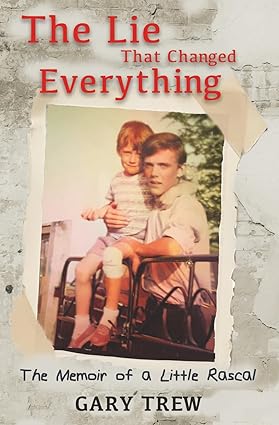

From the first page, Gary Trew makes it clear this is no sugarcoated stroll down memory lane. The Lie That Changed Everything is a memoir that blends sharp humor, biting honesty, and painful recollections into a story that feels both chaotic and deeply human. Trew recounts his early years with a mix of wit and grit, pulling readers through family dysfunction, childhood scrapes, and the bruising aftermath of being raised in a world where love often arrived tangled in trauma. It’s a tale of survival told with an irreverent laugh, even as it shines a light on moments of loneliness, rejection, and heartbreak.
I was taken in almost immediately by Trew’s voice. His writing has a rhythm that swings between wild comedy and gut-punch sadness, and that constant shift kept me hooked. Some chapters had me laughing at his absurd family stories, while others had me pausing to let the weight of what he endured sink in. The mix is unusual, but it works. He doesn’t let the pain take over, and he doesn’t let the jokes cheapen the truth either. At times, I found myself frustrated with the sheer cruelty he describes, but then he’d toss in a line of dark humor, and it felt like sitting in a pub listening to a mate tell a story he can only tell because he survived it.
There were moments where the writing felt a little jagged, but that roughness actually added to the authenticity. It made me feel like I was being trusted with unpolished truths rather than a neatly packaged memoir. I also found myself admiring his willingness to talk about shame, resentment, and fear without dressing them up. His honesty struck me as both brave and disarming. The book reminded me that family histories are rarely tidy, and sometimes the best way to survive them is to laugh at the madness and keep moving forward.
By the time I reached the final chapters, I felt both drained and strangely uplifted. This isn’t a book for someone who wants a gentle or inspirational memoir. It’s for people who appreciate raw honesty, gallows humor, and the messy beauty of a life that didn’t follow the script. If you’ve ever grown up feeling like the odd one out, or if you’re drawn to stories that reveal both the scars and the resilience of childhood, this book will resonate.
Pages: 278 | ASIN : B0FGKN1M47

Amidst the Darkness
The Hate Game: Screaming in the Silence is your memoir sharing the experiences you underwent at the Knoll School for Boys in Hove, Sussex, back in the 1970s and the bullying that was inflicted on you for your beliefs. Why was this an important book for you to write?
To clarify. I wasn’t bullied for my beliefs. I was bullied because I was young, an ‘outsider,’ and was a late developer. Any pupils in that category were labelled as “Jews,” by the “superior” bullies.
I had shared stories with numerous people and had pushed memories to the back of my mind. PTSD does that. Later in life, as a social worker in child protection, I came face to face with my past on several occasions. I had a “Eureka” moment interviewing a young teen who had (thankfully) failed to take her own life: her story was my story, and I started to come to terms with the horrors that had transpired during my adolescence. My extended (British) family were very resistant to me sharing truths with the world as it wasn’t the “British” way to be transparent about the past. The school and personal experiences were shocking, and rather than bury them, I chose to tell my story. The writing of The Hate Game was cathartic, albeit painful.
I appreciated the candid nature with which you told your story. What was the hardest thing for you to write about?
Everything. I felt ashamed about the bullying and abuse at school. I hadn’t told my wife and children about the historical sexual assault, so that was a challenge (despite working in a field where I encourage transparency). The death of my father and later writing about my mum brought up feelings and emotions that I had buried. I also felt shame about laughing through the dark times but understood that it is (and still is) a coping mechanism. One of the hardest things about writing a memoir is the judgment that may emanate from others. However, the overwhelming gratitude that my story could be told outweighed the negatives by a country mile.
What were some ideas that were important for you to share in this book?
It is crucial to share one’s feelings with a trusted adult. Unfortunately, I did not know any adults I could trust. The teachers were more abusive than the students, and I couldn’t rely on anyone in authority. Even today, children and young people tend to keep their distress to themselves, a concerning trend I’ve observed in my work in child protection. It is imperative for adults, particularly parents, to build a strong, trusting relationship with children. Despite my love for my family, they were not the safe haven I needed to confide in.
What do you hope is one thing readers take away from your story?
Amidst the darkness, pain, and feelings of utter hopelessness, there is a beacon of light at the end of the tunnel. I was determined to survive and, somehow, thrive. It’s imperative to foster open communication with your children rather than hastily judging them for their acting-out behaviours. There is often a deep-rooted cause, and dismissing it as merely ‘hormones’ will cause further isolation for the child or youth. My own experiences have instilled in me resilience and a profound sense of empathy for those in need, whether they belong to minority groups or are families and children in crisis. As a result of my adverse childhood experiences, I have been able to help and empower numerous vulnerable young people. My transformation from trauma to triumph, guided by a profound encounter with God, has equipped me to make a meaningful impact on the lives of others.
Author Links: GoodReads | X (Twitter) | Facebook | Instagram | Website | Amazon
At school, survival wasn’t just about fitting in—it was about making it through the day with his dignity intact. The first time they shoved Gary’s head into the toilet bowl, he questioned how much more he could take. By the time they drew a swastika on his forehead, he stopped wondering.
In the backdrop of 1970s England, Gary navigates the chaotic seas of adolescence in the English coastal town of Hove. With humour and a delicious sense of naivety, he steers through a life marked by a blend of love and dysfunction, anchored by his loving and quirky mother and his deeply cherished father. But beyond the warmth of home, school is a much darker and crueller reality. At Knoll Boys, Gary confronts a relentless and vicious bullying that pushes his spirit and resilience to the brink. The horrors he endures are not just physical—they are ritualistic and dehumanizing, the cruelty seemingly unending. Yet, Gary’s resilience shines through, a testament to the human spirit’s capacity to endure.
Despite the bruises and hate-filled taunts, Gary discovers moments of unexpected joy, like the awkward thrills of first love and the surprising strength that begins to grow within him. As he navigates his family’s unpredictable antics and the dark corridors of his school, Gary’s journey becomes one of ultimate transformation—a testament to his unbreakable spirit and a beacon of hope for all who face similar challenges.
The Hate Game is a raw and profoundly moving coming-of-age memoir that explores the power of laughter and love. It’s a story that will leave you rooting for Gary, laughing with him, and inspired by his indomitable will to rise above the pain and become the change he longed for.
The Hate Game: Screaming in the Silence – A Memoir

The Hate Game: Screaming in the Silence is an evocative memoir by Gary Trew that delves into the harrowing experiences of his youth at Knoll School for Boys in Hove, Sussex. Set in the 1970s, the book captures the brutal reality of a boyhood overshadowed by relentless bullying, a toxic school environment, and the enduring trauma that came with it. Trew narrates his story with a raw honesty that draws the reader into the bleak halls of “Knollditz,” a nickname derived from the Nazi prison camp, revealing a world where survival often came at the cost of one’s spirit.
The memoir’s strength lies in Trew’s ability to convey the sheer terror and helplessness of his formative years while maintaining a sense of dark humor and resilience. His writing is candid and unflinching, offering a vivid portrayal of a school culture that normalized violence and dehumanization. The chapter titled “Playground Holocaust,” for instance, stands out for its disturbing recount of a ritualistic game where younger boys were subjected to mock concentration camp scenarios by their older peers. This chapter, among others, exemplifies the memoir’s disturbing yet necessary exploration of the long-term effects of unchecked aggression and the failure of adults to protect the vulnerable. While Trew’s recounting of events is gripping, his writing includes richly detailed passages that enhance the vividness of his memories, adding depth to the narrative. These moments offer readers a more immersive experience, allowing them to fully engage with the story. His comparison of Knoll School to infamous historical sites like Auschwitz might seem jarring at first, but it effectively communicates the intensity of the fear and oppression he felt as a child. One of the most compelling aspects of the memoir is Trew’s reflection on the psychological impact of his experiences. He does not merely recount his past but also delves into the lasting scars it left on his psyche, demonstrating a deep understanding of trauma and its complexities. His ability to articulate the silent suffering of his youth, while also finding moments of hope and resistance, makes this memoir not just a story of survival but also a testament to the resilience of the human spirit.
The Hate Game: Screaming in the Silence is a powerful and disturbing memoir that will resonate with anyone who has faced adversity or struggled to overcome the demons of their past. It’s a must-read for those interested in understanding the darker side of school life and the enduring impact of childhood trauma. Gary Trew’s story is a stark reminder of the importance of empathy, intervention, and the need to confront bullying in all its forms. This book is particularly recommended for educators, mental health professionals, and anyone interested in memoirs that explore personal resilience in the face of overwhelming odds.
Pages: 290 | ASIN : B0D9J21WGD




 LITERARY TITAN