Blog Archives
What Does Normal Look Like?

The Art Collector’s Wife follows a grandmother and survivor of Auschwitz raising her seventeen-year-old granddaughter, who is desperate to know the truth about her parents, while her grandmother struggles to deal with her grief from the past.
What were some themes that were important for you to explore in this book?
One of the main themes I explored in my book was the idea of what it’s like for a family to survive a world-wide tragedy and somehow come out intact on the other side. What does that new normal look like and how does a young survivor find the old nearly-erased story of her family while writing a new story for herself at the same time? The theme of feeling “othered” as a minority living in a dominant culture was also an intrinsic theme and informed the main characters’ point of view throughout. This is the idea that as a minority you don’t quite fit into the dominant culture but you must strive to assimilate nonetheless, even as you feel the pull of your own culture and identity calling and often coming into conflict with the majority’s influence.
What were some goals you set for yourself as a writer in this book?
I wanted to construct the sound structure of a thriller, but one with a literary voice and a historical context in which the characters were lively and three dimensional, flawed but mostly lovable. I wanted the story to have high stakes and the tension to be palpable and taut with nothing extraneous to the central tension.
What is the next book that you are working on and when can your fans expect it to be out?
I am working on writing a reincarnation crime thriller with aspects of magical realism in four sections, each one of the four elements. It’s in the early rough draft stage and will take at least up to 12 months to finish.
Author Links: GoodReads | Facebook | Instagram | Website
The Art Collector’s Wife
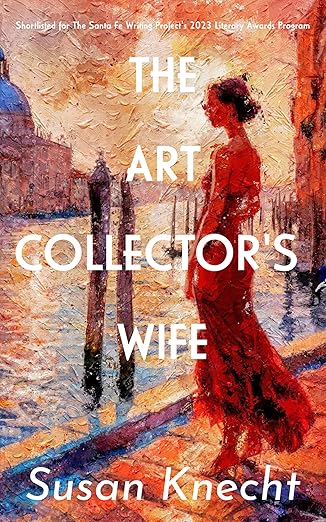

Susan Knecht’s The Art Collector’s Wife is an emotionally rich, time-skipping novel that weaves together post-war trauma, intergenerational secrets, art-world intrigue, and the sharp edges of teenage rebellion. It starts in the horror of Auschwitz, then unfolds decades later in sun-drenched Venice, following the fractured legacy of one family—particularly the women who survived and the granddaughter determined to uncover the past. It’s part historical drama, part coming-of-age, with a steady undercurrent of longing.
The prologue, set on the day Auschwitz was liberated, is devastating and lyrical—just brutal and beautiful all at once. Lila, the mother, trying to keep her friend and a pregnant girl alive, while praying for a glimpse of her son Leo, had me breathless. Knecht doesn’t hold back, and the imagery stuck with me long after I closed the book.
Then we shift to 1960s Venice, and things change gears in a really compelling way. Now we’re with Isabel, Lila’s teenage granddaughter, who’s navigating Catholic school, first love, and the weight of secrets no one will talk about. Isabel is such a great character—sharp, moody, defiant. I loved her scenes with Antonia, her chain-smoking bestie who has all the bad ideas and a heart of gold. When Isabel steals the ruby rosary and starts skipping school to flirt with Niccolo (who is equal parts charming and sketchy), the tension crackles. You can feel her aching for answers about her father and mother, and the way Knecht slowly drops hints about their story is fantastic.
But what really got me was the emotional layering. Knecht has a way of showing how grief and silence pass through generations like DNA. Lila is wrapped so tightly in control and shame, you feel her unraveling even when she says almost nothing. There’s a haunting scene at the cemetery where Isabel confronts her grandmother about her parents—Isabel demands answers, and Lila can’t speak. That silence? It screams. And Miriam, the family friend who carries so much of the emotional glue, is a favorite. She’s got this old-Hollywood flair, but also such deep loyalty and sadness. I kind of wanted a whole book just about her.
I loved this book. It’s heavy but worth it. The prose is poetic without being precious, the story moves through decades without losing momentum, and the characters feel real, flawed, and alive. If you’re into multi-generational family sagas, WWII fiction with a heart, or just crave a book that will grab you by the collar, The Art Collector’s Wife is for you.
Pages: 257 | ASIN : B0F38R8KBV




 LITERARY TITAN