Blog Archives
Human Nature

The Great Hunter follows a young hunter living in Mesolithic Britain about 10,000 years ago who is determined to wed the woman he loves, but to earn her hand, he must kill a rare and dangerous giant stag. What was the inspiration for the setup of your story?
I’ve always been a big fan of ancient myths and legends. The GREAT HUNTER is written in that style. It is a classic tale, a quest in which the hero must kill a dangerous beast in order to marry the woman he loves. A re-awakened family feud, subsequent betrayal, and long-awaited revenge are essential parts too.
What were some themes that were important for you to explore in this book?
I know a lot of authors would probably say this, but it’s the age-old theme of human nature. I don’t think it has changed very much since humans first appeared on this planet.
What intrigues you about this time period enough to write such a thrilling period piece?
I have always been into history – and prehistoric times in particular. I like the mystery of it.
But there was another reason too. Many years ago I started to experience these images – recurring images in my head. They were of ancient people who wore clothes made from animal-skins, lived in what looked like wig-wams, travelled on foot or by canoe and used tools of stone, wood, bone and antler. These images kept coming to me over several years. They really were vivid and after a while I could tell certain individuals apart. Many of the places I saw, too, looked somehow familiar.
Research led me to believe these people were part of a hunter-gatherer tribe who lived in what is now England about 10,000 years ago. I knew I had to give them a voice.
What is the next book that you are working on, and when can your fans expect it to be out?
If The Great Hunter does well, there will be a sequel: THIRTEEN MOONS – which follows on from where the first book ends.
If that does OK too there could be a series: TALES FROM THE DREAMTIME. Another two or three books about Garetto and the Nahan tribe. But also other people, other hunters and gatherers in different times and places.
I have a long-term medical condition which, though not deadly, does slow me down a bit. I have to work at my day job too. So it would probably take me about 2 1/2 years or so to write another book.
Author Links: Facebook | Website
Powerful spirits and other supernatural beings influence everything in the minds of these people, from the weather to illness, to childbirth and success in hunting or courtship.
Life is not without its challenges, but the real hardships of the Ice Age that ended over sixty generations before are becoming a distant memory. There is an abundance of game animals, fish and plant foods too, in season. Rich pickings for the numerous bands of hunter-gatherers. Yet the country is as hazardous as it is bountiful. Bears, wolves, aurochs and other wild animals that could kill a man roam the landscape. Floods, blizzards, wildfires and tree-felling storms may strike with little or no warning. Still more danger comes from the tribal wars that might suddenly flare up, with their brutal raids and counter-raids. Destruction may also come from enemies within.
A young hunter, Garetto, is determined to wed Harenshi – a woman of another camp, who he loves. True, there was trouble between their families many winters before, but all they want is to stay together, and stay with their own people.
Challenged to go away from the gathering to kill a very rare – and very dangerous – giant stag, Garetto travels far from the camps, with only his dog for company. It is the middle of a freezing, snowy winter, and the hunting-ground is a hostile one.
It seems an impossible quest, but only when Garetto returns with the sacred antlers will the ox-chief Haranga – Harenshi’s father – allow him to wed his daughter.
But the past is far from forgotten, or forgiven. Haranga breaks his promise, resolved Garetto must never return to his people. This act of betrayal – and the sudden appearance of a mysterious and powerful shaman – will have fateful consequences for the whole tribe…
The Great Hunter


Kel Paisley’s The Great Hunter follows the life of Garetto, a young man living in Mesolithic Britain about 10,000 years ago, when hunter-gatherer tribes struggled to survive in harsh landscapes shaped by ice, wind, and rising seas. At its heart, the story is about love and loyalty. Garetto longs to wed Harenshi, a woman whose father not only disapproves of him but actively threatens their bond. What unfolds is a tapestry of tribal politics, sacred rituals, dangerous hunts, and the daily fight for food and honor. The novel blends historical imagination with intimate storytelling, letting the reader step into a time when survival and tradition dictated nearly everything.
The writing is vivid, almost cinematic, and the world feels tactile. But at times, the descriptions ran long. The dialogue, though, had a sharp edge. It carried both warmth and menace, and I often felt the tension of being in a camp where every look and every word could spell danger. I liked that it didn’t sugarcoat the violence of the time or the rawness of relationships. It made the book feel honest, though also heavy.
What struck me most was how much of the book pulsed with longing. Garetto’s love for Harenshi is desperate, almost reckless, and it pulled me in. I felt for him, even when he acted out of pride or anger, because his emotions rang true. The book made me think about how love, fear, and family ties have always shaped human lives, no matter the era. Still, I’ll admit there were moments when I wanted less ritual detail and more forward momentum, but the ideas always kept me hooked. The mix of survival and spirit, blood and devotion, felt raw and human.
This is not a light read. It’s immersive, dense, and full of grit. I would recommend The Great Hunter to readers who enjoy historical fiction that leans into the primal side of human nature. If you want an adventure that is full of danger and love, and you’re seeking a story showing a clash between tradition and desire, this book is for you.
Pages: 453 | ASIN : B0FM58B2TW

Rome’s Culture

In The Altar of Victory, you take readers on a journey into the days of the Western Roman Empire and the political fallout following the death of Emperor Valentinian I. Why was this an important book for you to write?
It was important to me for several reasons. My interest in this era began long ago, when I was a European History major in college and had taken a class on the period from Late Antiquity through Charlemagne (300-800 AD roughly). The period up to Constantine was well covered, as was the actual catastrophe of the sack of Rome in 410 AD and the subsequent barbarian invasion. However, the course jumped past the last half of the 4th Century, when the Roman empire was still intact and just before these catastrophes began to increase. The more I read in the intervening years, the more evident this gap appeared. Even Gibbon’s Decline and Fall of the Roman Empire tended to treat this critical period of European history in summary fashion.
I also decided that the question of how such a technologically advanced civilization like Rome, with the most organized army and engineering in the world, could fail to see the threat and fall so quickly to less organized enemies. Was there a point when the decline could have been arrested? Did it really come down in part to the deaths of perhaps three key emperors (Valentinian, Valens, and Gratian)? Was it cultural change and the loss of a Roman identity? What role did the advent of organized Christianity play? It was a host of puzzles that I wanted to understand, if not solve.
Can you share with us a little about the research that went into putting this book together?
Before I began writing, I spent several years accumulating various non-fiction sources- books by more contemporary historians like David Brown and Michael Grant; biographies of Ambrose of Milan, etc. I also went to the limited primary sources- Ammianus Marcellinus, of course, Zosimus, the letters of Symmachus, St. Jerome, Ausonius, the Notitia Dignitatum, and others; the military manual of Vegetius. Even as I began to outline the plot and write the first chapters, I continued to read and learn what I could, and still felt that so much was still missing from the historical record. Which was also good, because it enabled me to fill in with a plot of my own devising!
What were some themes that were important for you to explore in this book?
I wanted to explore what remained of Rome’s culture in the 4th Century, and how it had been eroded or replaced as the empire had grown and the city of Rome was no longer the center of the empire. I was also interested in the courts of the emperors, when the emperors no longer came from Rome or even visited very much. The idea that the key military and administrative figures had now become Gauls, Franks, and other nationalities/tribes who had only recently been enemies of Rome seemed to me to be critical in understanding how “Romanness” could have been disappearing for decades before a military transition occurred.
Another theme of importance to me was the figure of Gratian. By all accounts, he was a decent and brave military leader and tried to be a good emperor. He was also a fairly devout Christian and took an interest in the ecumenical issues of the day. And yet, he did not last, and after his reign, the Roman army did not do well in the west. I wanted to explore whether he was the last, best hope for Rome and what factors worked against his success.
Can we look forward to more work from you soon? What are you currently working on?
I am both researching and writing the sequel to The Altar of Victory, in which I intend to conclude Gratian’s story. I am also trying valiantly to finish a collection of short stories set in the 19th and early 20th centuries of Louisiana and Texas before year end.
Author Links: GoodReads | Facebook | Website | Amazon
The Altar of Victory
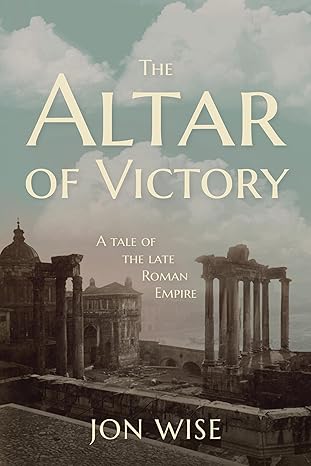
The Altar of Victory is a historical novel that plunges the reader into the waning days of the Western Roman Empire, centering around the death of Emperor Valentinian I and the political maneuvering that follows. Set in 375 A.D., it opens with Valentinian’s dealings with barbarian tribes and internal dissent, leading to his sudden death after a fit of imperial rage. The story then shifts into high-stakes political chess as the ambitious general Merobaudes races to install young Valentinian II on the throne before rivals can seize control. Along the way, the novel wrestles with themes of legacy, power, faith, loyalty, and the slow unraveling of an empire.
I found myself immediately immersed in its stark, lived-in world. The writing is richly atmospheric and historically informed, without ever feeling like a lecture. Every decision, every letter, and every small detail, like the crack in the aqueduct or the placement of a chair, feels purposeful. The prose is tight, clear, and evocative. What struck me most was how human the characters felt, especially Valentinian. He’s brutal, weary, proud, and oddly sympathetic. When he collapses mid-sentence, the emotional weight lands hard. The tension is just as strong in the quieter moments, furtive whispers in palace halls, long rides through uncertain terrain, as it is in battles and tribunals. I especially appreciated the balance between dialogue and action; the pacing kept me glued.
That said, what I really liked was the depth of the ideas. The book takes a hard look at power and how it mutates in uncertain times. The clash between the old gods and Christianity is not just window dressing; it’s a lens through which every character sees the world. Merobaudes, in particular, is a fascinating figure. He’s clever, opportunistic, not fully Roman yet entirely molded by Rome’s ideals. The women in the story, especially Justina and Mirjeta, are sharp and compelling, with agency that matters. There’s also an aching sense of decay in every corner of the empire, ruined towns, forgotten monuments, fading gods, that gives the story a haunting quality. I found myself thinking a lot about how empires die, not just politically, but spiritually.
I’d recommend The Altar of Victory to anyone who enjoys political intrigue, ancient history, or character-driven stories with bite. It’s a slow burn, but a rewarding one. If you like your historical fiction thoughtful, gritty, and emotionally textured, this one delivers. It’s not light reading, but it’s deeply satisfying, and in more than a few places, surprisingly moving.
Pages: 537 | ASIN : B0DCQ783YW

A Rich Tapestry

The Sword and the Hearth follows a young Brittonic boy thrust into leadership and survival as Saxon invaders threaten to crush his tribe and way of life, forcing him to mature quickly and navigate the complexities of war, leadership, and personal sacrifice.
What was your writing process to ensure you captured the essence of the characters?
My writing process for capturing the essence of the characters in “The Sword and the Hearth” was deeply iterative and rooted in a blend of imagination and focused development. It started with extensive brainstorming and profiling. Before I even wrote the first chapter, I created detailed character profiles for each main character, outlining not just their physical appearance but also their backstories, core beliefs, fears, desires, quirks, and even their favorite foods. This initial immersion helped me understand them as complete individuals, especially considering the varied backgrounds and social strata present in “The Sword and the Hearth.”
Then, during the actual writing, I employed method acting for authors. I’d often pause and ask myself, “How would this character react in this exact situation?” or “What would their internal monologue sound like right now?” This involved stepping into their shoes and genuinely trying to inhabit their perspective, particularly when exploring the nuanced relationships and internal conflicts central to the story. I paid close attention to their voice—ensuring that their dialogue, vocabulary, and even their thought patterns felt distinct and authentic to them, reflecting their individual journeys and development.
Finally, revision was crucial for refinement. I’d read scenes aloud, sometimes even acting out the dialogue, to catch any inconsistencies in character voice or motivation. I also relied on trusted beta readers who would provide feedback specifically on character believability, helping me to polish their nuances until they felt truly alive on the page, like companions in the reader’s own hearth.
What were some themes that were important for you to explore in this book?
Several themes were important for me to explore in “The Sword and the Hearth,” and they often interwove to create a richer tapestry:
The Enduring Strength of Family (Chosen and Blood): Whether it’s the bonds of biological family or the connections forged with individuals who become like family through shared trials, the strength and complexities of these relationships were central to the narrative. I wanted to show how these connections can be both a source of comfort and conflict, truly forming the ‘hearth’ aspect of the title.
The Nature of Identity and Belonging: Many characters grapple with who they are, where they fit in, and what truly defines them, especially when faced with challenging circumstances or new environments. This theme often explored the tension between individual desires and societal expectations, particularly within the feudal setting.
The Power and Peril of Secrets: Secrets, both personal and generational, play a significant role. I wanted to examine how secrets can shape relationships, influence decisions, and ultimately lead to either liberation or destruction, often with far-reaching consequences for the characters and the realm.
Redemption and Second Chances: I was keen to explore the idea that even after mistakes or difficult pasts, there’s often an opportunity for characters to find redemption, to change, and to build a better future for themselves and those around them, irrespective of their station or previous choices.
Will there be a follow-up novel to this story? If so, what aspects of the story will the next book cover?
While “The Sword and the Hearth” stands as a complete narrative in its own right, the literary journey for me, Ciaran MacLeod, has continued with “Echoes of the Ancient Isle,” which serves as the next significant novel in my bibliography.
“Echoes of the Ancient Isle” explores entirely new facets of the world and delves into different aspects of fantasy. It primarily focuses on the unearthing of forgotten histories and the resurgence of ancient magic. Readers will find themselves immersed in a world where the past literally resonates through the present, uncovering secrets tied to long-lost civilizations and powerful artifacts. The story examines themes of legacy, the enduring influence of ancestral spirits, and the profound consequences of disturbing dormant forces. While it features a new cast of characters and a distinct setting, it represents the continuation of my overarching storytelling themes of discovery, personal growth through adversity, and the intricate dance between human will and destiny. It expands the scope of my fictional universe, inviting readers to explore entirely different realms and challenges.
Author Links: GoodReads | Instagram | Website
Raised in the northern hills of Britannia, Cadric must navigate the complexities of war, leadership, and personal sacrifice as he becomes the unlikely leader of his tribe. Alongside him is Maev, a woman whose strength and determination challenge Cadric’s own sense of duty and love. Together, they must face not only the violent Saxon forces gathering at their borders but also the internal struggles that threaten to tear their community apart.
Amidst brutal battles, moments of heartbreak, and triumphs of courage, The Sword and the Hearth is a tale of resilience, the ties that bind people together, and the price of leadership. Will Cadric be able to unite his people and protect the hearth of his homeland, or will the Saxons prove too powerful to resist? This is a story of honor, loyalty, and the strength to protect what truly matters.
The Sword and the Hearth


The Sword and the Hearth follows Cadric, a young Brittonic boy thrust into leadership and survival as Saxon invaders threaten to crush his tribe and way of life. From the fog-choked forests of Eboracum to the blood-soaked hillforts of ancient Britain, this novel delivers an unflinching look at resistance, loyalty, and legacy. It is as much a coming-of-age story as it is a meditation on the costs of war, culture, and identity. As Cadric transforms from a frightened adolescent into a hardened leader, the reader is taken through heart-pounding battles, devastating losses, and the ever-tightening grip of fate.
I found the writing both gritty and poetic. The prose often reads like folklore, earthy, elemental, steeped in loss and myth. There are no wasted words here. Every paragraph drips with atmosphere. The mist, the blood, the grit in Cadric’s boots, it’s all vivid, almost cinematic. And the dialogue is sparse, sharp, and realistic. It respects the silence of trauma. What hit hardest for me were the quiet moments. Cadric watching smoke rise on the horizon or whispering a promise to his dying mother. The action scenes thrum with intensity, but it’s the quiet heartbreaks that linger.
The book is heavy, relentless even. There are stretches where the despair almost chokes the page, and the pacing slows as characters dig deeper into pain and politics. But maybe that’s the point. The story doesn’t pretend there are easy answers or heroic victories. It feels honest to the bone. Cadric’s growth isn’t triumphant; it’s painful, earned in blood and grief. The portrayal of the Saxons isn’t cartoonish either. There’s nuance here, a mutual alienation and brutality that makes the conflict feel tragically human.
The Sword and the Hearth shook me. It made me angry, sad, and strangely hopeful. It’s a story for readers who want their historical fiction raw and emotionally complex, who don’t need neat endings or pretty resolutions. I’d recommend this to fans of Bernard Cornwell or Mary Renault, basically anyone who appreciates richly textured worlds, stoic characters, and the ache of endurance. It’s not a casual read, but it’s a worthy one.
Pages: 368 | ASIN : B0DKPYGZDK
Honesty in Writing

Ciao, Amore, Ciao follows a jaded journalist whose career is fading fast, who discovers an old WWII photo in his dying father’s home, and after posting it online, he begins to uncover long-buried secrets and a dark legacy that needs to remain hidden. What was the inspiration for the setup of your story?
The inspiration was both cathartic—I began the novel a week after my dad passed away, and I hardly even recall writing the first draft—and to tell the story of my family, a family of no ones, and the story of boys whose sacrifices were conveniently forgotten by the very people who sent them to their deaths. I guess you could say the inspiration was personal: a personal account to try and make sense of what happened—to me, to my uncle (who was one of the tens of thousands who vanished into the Russian steppes in 1943), and my dad, who spent a life living with the wounds of that tragedy.
Some events in the book bear chilling similarities to real-life events. Did you take any inspiration from real life when developing this book?
A lot of the novel is based on “true events”, including many of the scenes with the narrator watching his dad’s slow passing. The war scenes, too, were taken from hundreds of sources and a decade’s worth of research. I tried to meld all those soldiers’ recollections into the novel so that the novel remains true to what those boys suffered in Stalingrad. I think that’s what resonates in the novel, the “truth” of it. When you read those scenes, it’s sobering to remember that hardly any of it came from imagination. They’re just a retelling of stories told by survivors, and diaries and letters from those who, like my uncle, never came home. Not even their bodies, they just vanished into the ice. The tragedy was both what happened to them during those horror-filled days of their retreat, and what happened to the survivors because it was over a decade before any of their recollections were allowed to be published. Not until the mid-’50s did Italy begin to understand the true depth of the disaster. By then, of course, Italy was already in a hurry to move on to a new future, and that entire history was conveniently forgotten by everyone except those who were there, and those families who had to find a way to deal with that unspeakable heartbreak.
What was one of the hardest parts of Ciao, Amore, Ciao for you to write?
Writing about my family and my dad was difficult because the novel could only work if I wrote honestly. And honesty in writing is the most difficult thing of all because there’s no hiding once you choose to go on that path. Reliving the moment when I saw my dad, the night he left, and I had come to the hospital alone to see him there in his bed—that was hard. I edit a lot, that’s part of my process, but for that scene, I wrote it once and never went back to it again. Sometimes, a first take is all it takes, and editing that scene would have been to try and polish a raw emotion. That’s never a good idea because instinct is to try and change things, to make the “hero” a better man or whatever.
What is the next book that you are working on, and when can your fans expect it to be out?
My next novel is Book 2 in Alex Lago’s series, set in South Africa. The “hero” this time around is the legendary South African golfer, Bobby Locke. I know, golf, right? But Locke is a perfect metaphor for the true hero of the book, Johannesburg, in all its tragic, violent colour. Similarly to both my previous novels—Ciao, Amore, Ciao, and Tracks: Racing the Sun—it’s a dual-timeline historical fiction/mystery/autofiction. Yes, maybe one day I’ll find an actual genre! But probably not. My novels are about emotion, and this new one tells the story of a man who spent his life running from them. And what that cost his family was unimaginable. I expect it to be published in 2026, the manuscript is virtually complete.
Author Links: GoodReads | X (Twitter) | Facebook | Website | Amazon
In the winter of 1942, an Italian army of young men vanishes in the icefields of the Eastern Front. In the summer of 1945, a massacre in Schio, northeastern Italy, where families grieve the dead, makes international headlines.
In present-day Veneto, an ordinary man is about to stumble onto a horrifying secret.
Alex Lago is a jaded journalist whose career is fading as fast as his marriage. When he discovers an aged World War II photo in his dying father’s home, and innocently posts it to a Facebook group, he gets an urgent message: Take it down. NOW.
Alex finds himself digging into a past that needs to stay hidden. What he’s about to uncover is a secret that can topple a political dynasty buried under seventy years of rubble. Suddenly entangled in a deadly legacy, he encounters the one person who can offer him redemption, for an unimaginable price.
Told from three alternating points of view, Martini’s World War II tale of intrigue, war, and heartbreak pulls the Iron Curtain back to reveal a country nursing its wounds after horrific defeat, an army of boys forever frozen at the gates of Stalingrad, British spies scheming to reshape Italy’s future, and the stinging unsolved murder of a partisan hero.
Ciao, Amore, Ciao is a gripping story of the most heroic, untold battle of the Second World War, and a brilliantly woven novel that brings the deceits of the past and the reckoning of the present together.
Ciao, Amore, Ciao

Sandro Martini’s Ciao, Amore, Ciao is a soul-wrenching blend of memoir and historical fiction that begins with the quiet unraveling of a family and ends with the thunderous echoes of a nation’s buried past. Told through the eyes of a grieving son, the story moves between present-day Italy and fragments of a family’s long-buried secrets, tracing the last days of the narrator’s parents while peeling back layers of memory, guilt, and unresolved trauma. It’s a story of death and love, fathers and sons, and the way history bleeds into the present, whether we ask for it or not.
This book left me aching. Martini’s voice is raw and self-deprecating, not overly polished, which makes it feel incredibly relatable. I loved how he didn’t try to wrap up his grief in a neat little bow. Instead, he let it run wild through the streets of Piovene, scream through the halls of a hospital, and settle into the quiet spaces of a father’s old car. And the prose is beautiful. Sharp and vivid, like a Polaroid that won’t stop developing. There were passages where I had to stop and breathe, not because they were hard to understand, but because they were so true.
The ideas in this book haunted me. Martini doesn’t just write about family loss; he goes after the rot that lies underneath nations and legacies. There’s bitterness here—about fascism, about immigration, about how Italy remembers and forgets its sons. But there’s also a weird kind of love buried in all that anger. The kind of love that’s too painful to talk about directly, so it comes out sideways, in jokes and cigarette smoke and rusting old cars.
I’d recommend Ciao, Amore, Ciao to anyone who’s lost a parent, anyone who’s tried to understand their family too late, or anyone who thinks history lives only in textbooks. This book is messy, emotional, and full of ghosts. But it’s also deeply honest and strangely comforting, like a long night drive with someone who knows when not to talk. I wouldn’t say it’s easy reading, but if you let it, it’ll stay with you long after the last page.
Pages: 426 | ASIN : B0DXLC2LJC



 LITERARY TITAN