Blog Archives
Supernatural Gift

The Skull of Wenceslas follows a gifted New York medieval literature scholar who visits Prague for an academic project that takes a dangerous and paranormal turn. What draws you to the historical fantasy genre?
In Prague, the history is always present, especially to an American (and in my case, Australian-born). The Charles Bridge alone, with its cobblestones and ancient towers, never lets you forget it. Every Czech child knows the legend of the founding of the city, when the Slavic princess Libuše looked out over the river valley and made her prediction that she saw “a great city whose glory would touch the stars.” It’s almost impossible to write a story about Prague and not include the history!
What made you want to give Kat both an academic mind and a supernatural gift?
I have some of Kat’s interests myself – languages and ancient manuscripts in particular. I’ve always been intrigued by the skills of calligraphy and illumination (lots of books about it on my bookshelf). The story started with bringing Bruncvik to life, and Kat’s supernatural gift was a way to explain it. It grew from there, with the idea that she could step back in time into the mind of someone in the past and see the world through their eyes.
Many of the ghosts in the novel feel like characters with their own motivations rather than simple supernatural threats. How did you develop their personalities and roles in the story?
Their stories just grew. A line from the Oprah show always stuck in my mind. “Everyone has a story.” If we could communicate with someone in the past, what could they tell us? Turned out, quite a lot! But like everything else, they don’t tell you their story in neat chronological order; they tell you what is important to them. Which lends itself to a tale of mystery.
If readers finish The Skull of Wenceslas wanting to visit Prague, what are a few places from the novel that you would encourage them to see first?
A lot depends on how much time they can spend there. Too often, it’s “three days in Prague,” which mostly limits you to what the guides call “the Castle, bridge and clock tour.” Starting at the castle and the St. Vit Cathedral, crossing the Charles Bridge, and following the crowd along the King’s Way to Old Town Square and the Astronomical Clock. You’ll want to see all of those, but I have my own favorites. I love to start at the Strahov Monastery, which is Kat’s first stop. The restaurant with the view, where she meets Mike, is gone now, but there are plenty of others. If you climb the stairs to the Library (it’s magnificent), you’ll also see the weird little museum, full of odd sea creatures (remember, the Czech Republic is land-bound, so these must have seemed exotic). There is also a Museum of Miniatures, which is fascinating – everything is viewed through microscopes. From the monastery, you can walk down to the castle. My other favorite place in Prague is the Letná Beer Garden, where you can sit under the chestnut trees and gaze at an amazing view.
Author Links: GoodReads | Facebook | Website | Substack | Amazon

Kat Schneider, a New Yorker and medieval literature scholar, arrives in Prague to translate a centuries-old manuscript. The first night, she sees the ghosts of a knight and a lion patrolling the ancient tower outside her window.
In Prague, her hidden gift of Sight pulls her into a world where history is alive, and the past collides with the present. On the Charles Bridge, Kat inadvertently summons a fourteenth-century prince into the modern world, forcing her to navigate a realm where the supernatural and human desires intertwine. With a mysterious local man and her charismatic client, she uncovers hidden truths, explores new powers, and discovers that love and loyalty are never straightforward.
Yet danger looms: a vengeful outsider plots to devastate the city on St. Wenceslas Day. To protect her friends, the city of Prague and even the Czech nation, Kat must embrace the Sight she has long hidden—and confront betrayal, ancient magic, and the haunting shadows of history.
The Skull of Wenceslas

The Skull of Wenceslas, by Marion Deland, is a paranormal mystery with a strong historical fantasy thread, set in a Prague that feels both lived-in and haunted. The story follows Kat Schneider, a New York medieval literature scholar with the Sight, as she comes to Prague to help translate an old manuscript tied to the legendary Prince Bruncvík. What begins as an academic project soon turns into something stranger and more dangerous, involving ghosts, Czech legends, a possible terrorist threat, and Kat’s growing sense that the city’s past is not finished speaking.
What I enjoyed most was how grounded Kat feels, even when the story steps into the supernatural. She’s smart, funny, guarded, and sometimes too quick to trust her own logic, which made her feel believable to me. I liked that Deland lets Prague do more than sit in the background. The city becomes part of the book’s pulse, with its bridges, statues, trams, old stones, and layered history all pressing in on Kat’s choices. The paranormal elements work best when they feel tied to place, and here they do. Bruncvík and his lion are not just spooky figures. They feel like part of a city still carrying its myths in the cracks of the pavement.
I also appreciated the author’s choice to let the book be messy in relatable ways. Kat’s relationships with Freddie, Mike, Queenie, Susie, and even the ghosts are not simple. People misunderstand each other. They get defensive. They bring old fears into new situations. That gave the story more weight than a straight adventure would have had. The plot takes its time getting where it is going, especially when Kat is absorbing the culture and history around her, but I didn’t mind that much. The slower moments help build the feeling that Prague is opening itself to her one street, one legend, and one uneasy revelation at a time.
I recommend The Skull of Wenceslas to readers who enjoy paranormal mysteries that lean into history, atmosphere, and character more than nonstop action. It should especially appeal to anyone drawn to haunted cities, old manuscripts, folklore, and stories where the past keeps reaching into the present. If you like your supernatural fiction with a thoughtful narrator, a touch of romance, and a deep sense of place, this book is easy to settle into.
Pages: 332 | ASIN : B0H26T1RLZ

A Nest of All Kinds: Jewels of the House Divine


A Nest of All Kinds: Jewels of the House Divine opens on an empire at its most vulnerable: a divine emperor is dead, his infant heir has mysteriously died, and the young Empress-Dowager Anastasia is thrust into a regency fight where grief, law, prophecy, bloodline politics, and old vendettas all sharpen into weapons. Author Michael C. Reid builds a richly imagined Rasnaian Imperium inspired by Byzantine grandeur and Etruscan-Roman invention, then fills it with courtiers, soldiers, mystics, foreign princes, and children born into power before they are old enough to understand its cost.
I was enthralled with the density of the world. This is not a fantasy novel that gestures vaguely at empire; it furnishes the palace, names the offices, explains the rites, and lets the reader feel the pressure of ceremony as a living force. The prose can be ornate, but that suits the material. Incense, marble, blood, silk, ash, and divine sunlight are not decorative here; they are part of the machinery of rule. I admired how Reid makes politics feel intimate. A public decision is never merely public. It is also a father gripping his daughter’s future, a mother staring at an empty cradle, a boy hiding terror behind imperial posture.
I was also pulled in by Anastasia’s uneasy evolution. She is not written as a clean heroine, and the book is stronger for it. Her compassion is real, but so is her capacity for self-deception; her grief humanizes her, but power keeps teaching her cruel new languages. The court intrigue is sometimes labyrinthine, with many names, houses, offices, and loyalties to track, but the emotional through-line remains clear: everyone claims to be protecting someone, and nearly everyone becomes dangerous in the attempt. I found the best scenes to be the ones where tenderness and menace share the same room, especially in Anastasia’s relationships with the imperial twins, Aryan, Tatiana, and her father.
This book is best suited for readers of epic fantasy, political fantasy, court intrigue, dynastic fantasy, alternate history fantasy, and dark imperial fantasy who enjoy layered worldbuilding and morally compromised characters. Readers who love the ruthless family politics of George R. R. Martin’s A Song of Ice and Fire will recognize the same appetite for succession crises, poisoned loyalties, and children trapped inside adult wars, though Reid’s work has a more ecclesiastical, Byzantine shimmer. A Nest of All Kinds is a gilded blade of a novel: ornate, merciless, and glowing with dangerous purpose.
Pages: 410 | ASIN : B0FP5J2B6N
Two Worldviews
Runebound follows a noble girl born under a fiery omen and pulled between Christian courtly duty and the older Slavic powers her family has tried to bury. What was the inspiration for the setup of your story?
The inspiration came from my fascination with the borderlands of medieval Northern and Eastern Europe, where Christianity, older pagan traditions, and dynastic politics all overlapped in uneasy ways. I was especially drawn to the tension between public duty and private belief, the difficult choices my characters had to make to survive, the power dynamics within the Empire, and the idea of having the courage to move against the current. The fiery omen was my way of giving that conflict a mythic edge from the start: a sign that Milena’s arrival is going to shake things up, and that her life is tied to both danger and destiny. The appearance of the Elder Futhark rune Berkana was also meaningful, since it connects to Mecklenburg’s older Germanic past before the Slavic expansion, and adds another layer of historical and symbolic resonance.
The tension between Christianity and older belief systems is central. What interested you most about that conflict?
It was the emotional pressure that comes from living between two worldviews, the sacrifices one must make, and the power dynamics that emerge in that kind of setting. Faith shapes family expectations, political alliances, daily rituals, and even how people understand fate, but a person can still feel the pull of their heritage and ancestral beliefs. That clash creates not only conflict, but an opportunity for transformation.
Milena’s journey is emotional, spiritual, and physical. How did you balance her agency with the sense that something larger is guiding her?
I wanted Milena to feel like she is making real choices as a young woman trying to find her true calling, even while something larger is guiding her. She is able to discern who she is from who others want her to be and withstand peer pressure. My goal was to make her agency matter in a world ruled by duty and obligation. Her courage, her doubts, and her decisions are what make the story more human to me, because so much of life is exactly that balance between personal choice and the forces beyond our control.
Where does the story go in the next book, and where do you see it going in the future?
The next book, Wayfare, is already in the works, and it pushes Milena into an even more uncertain and dangerous stage of her journey. The choices she made in Runebound have consequences, and she has to face not only outside threats but also the deeper cost of becoming who she is meant to be. She will find and bond with the next rune, which will further sharpen her awareness and bring new abilities, and several interesting characters will be introduced. I am anticipating a June 2027 release. As for the future of the series, I am only gradually shown glimpses of it as the story unfolds.
Author Links: GoodReads | Website | Amazon
Born into a Christian court that has abandoned the old gods in favor of the Church and promised to a Saxon noble to secure her father’s rule, she is expected to submit without question, even as the remnants of the pagan North still breathe beneath the surface.
Haunted by prophetic dreams and guided by intuition, Milena receives a rune long destined to find her. Its ancient power awakens something within her that does not belong to the world she knows.
When Norse traders arrive to barter with her father, she is introduced to another way of being and encounters a young warrior who becomes a threat to everything her father has built on buried grief, shame, and regret.
To choose her own path means betraying her family, her faith, and the fragile order that holds her world together.
And once she begins, there will be no turning back.
Runebound is a richly grounded historical fantasy with a thread of romantic tension, set in the twelfth century, where the old gods endure in the shadow of the rising Cross. It’s a tale of love, destiny, forbidden belief, and awakening power for readers drawn to mythic, folkloric stories in the tradition of The Bear and the Nightingale and Uprooted.
RUNEBOUND

Runebound by Alessa M. Norwen follows Milena of Mecklenburg, a noble girl born under a fiery omen and pulled between Christian courtly duty and the older Slavic powers her family has tried to bury. As her father arranges a Saxon marriage to secure political peace, Milena’s bond with the Berkana rune awakens, drawing her toward forbidden rites, ancestral memory, Brynjar’s Norse world, and finally a dangerous escape northward rather than submission at the altar.
I was most taken by the book’s atmosphere: frost on stone, incense in chapels, smoke in forests, lake mist around longships. Norwen writes history as if it still has breath in its lungs. The conflict between old faith and new order gives the story more than decorative mythology; it becomes Milena’s private weather, the pressure system inside every choice she makes.
Milena’s rebellion worked for me because it is not clean or merely triumphant. She is frightened, angry, uncertain, and sometimes carried by forces she cannot fully name. The prose can be lavish, occasionally almost ceremonial, but that suits a story about inheritance, ritual, and destiny. I also appreciated that the book lets parents be complicated: Pribislav isn’t a simple tyrant, and Woizlava’s quiet blessing has more voltage than many louder scenes.
The target audience is readers who like historical fantasy, Slavic mythology, Norse fantasy, coming-of-age fantasy, pagan magic, medieval political intrigue, arranged-marriage rebellion, and slow-burn romantic tension. It reminded me of Katherine Arden’s The Bear and the Nightingale, especially in the way old gods press against Christian authority, though Runebound leans more openly into court politics and saga-like destiny.
Pages: 270 | ASIN : B0GQ85KT6K

Live for the Moment

Therein Lies the Pearl follows two resilient women in a medieval world ruled by men and sharpened by war who discover that survival, faith, and quiet courage can shape history just as surely as swords. What first drew you to the period surrounding the Norman Conquest?
From traditional sources, everybody knows of the events leading up to and including the Norman Conquest of 1066: the death of the childless king, the men fighting for the crown, the subsequent rebellions and invasions. But what if you could experience a past event from the perspective of someone left out of the history books? Someone whose voice had been ignored because they were not powerful, wealthy, or famous?
The origins of Therein Lies the Pearl started with a visit to Edinburgh Castle. There, a small Romanesque structure made of stone sits at its summit, the place known as St. Margaret’s Chapel.
The first time I sat on the wooden bench beneath the stained glass window, I found myself lost in thought, wondering about this woman who had been called the “Pearl of Scotland.” From my Catholic upbringing, I knew a few skeletal details of her life–like the fact that she wanted to be a nun but somehow wound up married to a king and that she later came to be known as the patron saint of mothers and families. On a more personal level, I also liked the idea that her feast day was celebrated in my own birth month of November. Beyond that, I had no concept of just how fascinating her life had been.
There was no question in my mind that I wanted to write a book about Margaret, one where she would be a central character. But let’s face it, sometimes virtuous people can be boring (from a reader’s standpoint), so I needed something to spice things up a bit.
In came Celia.
Celia is not conventionally “likable.” Why was that important to you, and what does Margaret bring to the story that contrasts with Celia?
The feisty girl from Normandy is a completely fictional character. Unlike Margaret, she is thoroughly immersed in the secular world, and her very survival depends upon pluck, grit, and daring. In the beginning, Celia served as the perfect foil to the would-be nun, but oddly enough, the more pages I wrote (in my marble notebooks), the more the two women seemed to be mirror images of one another. The circumstances that surrounded each may have been vastly different–Saxon princess vs. simple farm girl–but the truth was they each had to find ways to maneuver amidst a world that did not have their best interests at heart.
When their lives eventually did intersect, they were supposed to be enemies. At least that was the distinction placed upon them by the men in power. However, the more time they spent together, observing and evaluating one another, the easier it was to shed that imposed label. And the bond they formed, based on mutual respect and admiration, could not be broken by any king, priest, or duke. Even death itself wasn’t able to diminish their connection.
What were some themes that were important for you to explore in this book?
One of the most obvious themes, of course, is female resiliency and agency in a male-dominated world. Despite their limited power in effecting sweeping changes, Celia and Margaret have an impact on their immediate surroundings because of their uncommon courage and unwavering devotion to doing what they believe is right.
Another theme involves strength. The word itself resists a single interpretation. Celia seems to embody the stereotypical picture of the undaunted warrior, but Margaret, in her own way, is just as strong. In fact, Celia initially judges her incorrectly, thinking that Margaret’s piety and contemplative nature convey weakness. As time passes, Celia realizes how wrong she was. Margaret possesses a sustained inward power that commands respect through consistent action, not outward noise or aggression.
Lastly, I think one of the greatest messages of the novel is to live for the moment. As recounted on certain pages in the novel, what we want in life and what we get may not always match. But we mustn’t go through our days worrying about that imbalance. Instead, we must “keep reaching out toward life, blissfully thankful for the ignorance.”
Why is it important to tell history from the margins?
I think that question lies at the heart of the historical fiction genre.
If you want a telescopic version of events, pick up a non-fiction text and read a generalized presentation of what took place. Get to know all the “big names,” the movers and shakers of history. But if you want to listen to voices that, perhaps, were not given a chance to speak in such chronicles, then grab a historical fiction novel and experience the event from the microscopic lens of someone who is living, breathing, and navigating his/her way through those same events on a personal and intense level. Telling history from the margins offers the reader a more nuanced understanding of the past–like getting to experience the Norman Conquest from the perspective of two women who carve their destiny armed only with strength, resilience, and faith.
Author Links: GoodReads | X (Twitter) | Facebook | Website | Amazon
The events leading up to the Norman Conquest of 1066 are well documented in the annals of history: various men are fighting for possession of the English throne, each believing himself to be the chosen one. The situation intensifies when King Edward, childless and already in failing health, sends for his nephew, Edward the Exile, to return home. What will this mean for Harold, Earl of Wessex and East Anglia? For William, Duke of Normandy? And when Edward mysteriously dies almost immediately after coming ashore, what will become of his son Edgar, the last surviving son of the royal dynasty? This story is not of the men, however, but of two women–Celia, a resilient young girl from Normandy, and Margaret, daughter of Edward the Exile. As they struggle to survive amidst adversity, loss, and death, their disparate worlds intersect, and they soon come to realize they are kindred spirits–brave, steadfast, and true. From beyond the grave, they implore us to listen to their retelling of the events that altered the course of history forever.
Therein Lies the Pearl
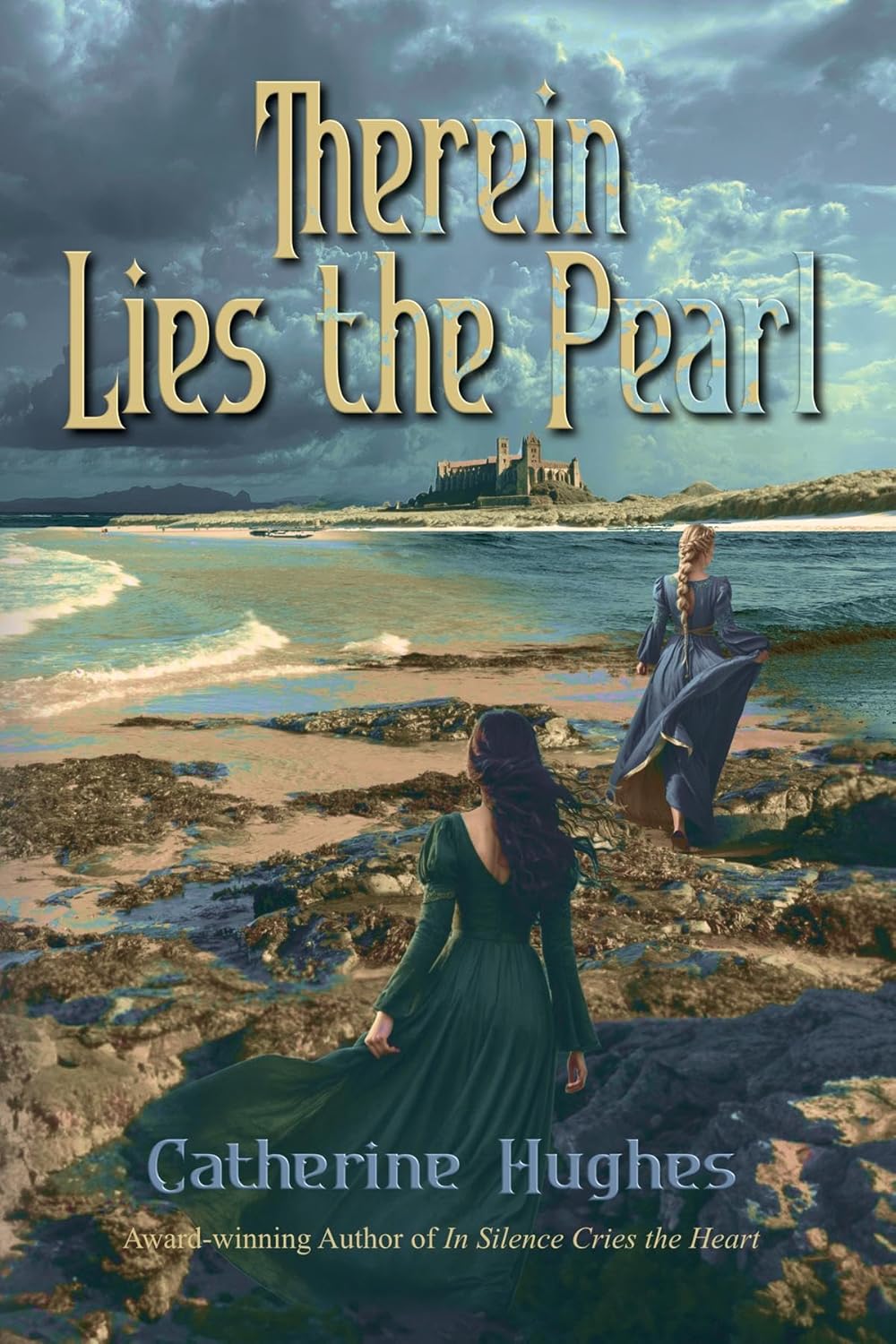
Therein Lies the Pearl by Catherine Hughes is a historical fiction novel set in the 11th century, moving from rural Normandy into the orbit of Duke William and then across the Channel into England in the years around the Norman Conquest. The story follows Celia as loss and duty harden her early, especially after her mother dies in childbirth and Celia becomes the steady center for her baby sister, Vivienne. Over time, Celia is pulled into larger forces and unfamiliar institutions, including religious life and English politics, with friendships and loyalties tested as power shifts and violence spreads. The book frames all of it with a storm at sea in 1068, a moment that feels like the story’s emotional bookend and its reckoning.
I liked the writing’s physical closeness. Hughes keeps putting your hands in the work: bailing, washing, digging, carrying, feeding. It is the kind of detail that makes survival feel earned, not symbolic. Celia, especially, is drawn with a sharp edge that I came to trust. She is not “likable” in a neat way, and that is the point. When she is tender, it lands because you have seen how hard she fights to keep tenderness alive in a world that keeps trying to stamp it out. The language is earnest and old-world without getting showy, and it often uses simple, concrete sensations to keep you grounded, like cold water, rough cloth, and the hush of spaces where people are not saying what they mean.
The author’s choices around history are interesting, too. This is not a battlefield chronicle, even though wars and rulers matter. It is a story about how big events leak into kitchens, convent halls, and friendships. One scene that was particularly impactful for me was the chaos around William’s coronation, where misunderstanding and fear turn into fire and violence, and the personal cost lands right inside the political moment. I also appreciated the way the book admits what it is doing: it is fiction inspired by historical events and family stories, not a literal record. That honesty makes it easier to relax into the novel’s emotional logic, especially when the plot shifts into court pressure, religious scrutiny, and the quiet bargaining people do with themselves to endure.
By the end, I felt like I had lived beside these characters, not just watched them. The final movement, looping back to the storm framing, brings a stark, fateful mood that fits what the story has been asking all along about agency, sacrifice, and what we owe the people we love. I would recommend this most to readers who like historical fiction that prioritizes interior life and lived detail over nonstop action, and to anyone who enjoys stories about resilient women navigating faith, family, and power without being turned into saints. If you want a medieval world that feels muddy, intimate, and emotionally serious, you’ll enjoy this novel.
Pages: 518 | ASIN : B0G67J1G46
Essential Human Longings

Valor, Book Two, follows a young woman of Druidic blood who flees her past and confronts prophecy, peril, and the awakening of her own fierce magic as she steps into a destiny shaped by sacrifice, love, and rebirth. What ideas did you want to introduce in this book that were different from Book One?
In Book One, Sacrifice, Ena—also known as Catherine—is a young woman caught between duty and desire, shaped by the rigid expectations of noble birth and Christian decorum. Her understanding of herself is narrow, inherited, and heavily prescribed. She moves through the world reacting to forces around her.
In Valor, I wanted to explore what happens when that same young woman chooses to step outside every boundary that once defined her. This book shifts the tone from repression to autonomy. Ena sheds the identity that never fit and takes responsibility for forging her own path, even when that path is treacherous, lonely, or morally complex.
So the new ideas I wanted to bring forward are rooted in personal sovereignty; claiming one’s freedom, and experiencing the profound, often painful unfolding of selfhood. Valor is more about becoming. It’s the story of a woman who confronts both the darkness behind her and the light rising within her, and discovers the courage required to inhabit her true self.
The book balances sudden bursts of violence or magic with quiet, sacred moments; how did you approach crafting that rhythm in your storytelling?
Crafting is an interesting term here. Because these quiet pauses that occur—mostly after some intense rising action—occur more organically than by any attention to planning. After scenes filled with danger, magic, or emotional upheaval, both the reader and I need a breath! I write from inside the characters’ bodies, minds, and hearts, so those quieter moments feel instinctive—almost like a spiritual exhale. They become sacred spaces within the narrative where meaning can settle, and where transformation can take root.
Mysticism and dreamlike imagery play a strong role in the book’s atmosphere. What mythologies or symbolic traditions influenced your vision for this world?
That’s a great question!
For most of my life, I’ve been fascinated by the worlds that existed before organized doctrine—mythology, symbolism, and forgotten religions, especially the Druidic traditions. Valor draws heavily from years of exploring these ideas. One major influence for this book is Hermeticism, attributed to Hermes Trismegistus, a figure who bridges Greek and Egyptian wisdom traditions. The Hermetic axiom “as above, so below,” and its counterpart “as within, so without,” form a subtle backbone in the series.
Other contributing traditions include the I Ching, Vedic wisdom, and Christian mysticism. On the surface, readers will see the conflict between paganism and the rising Holy Roman Church. But beneath that lies a deeper theme: that across cultures, religions, and mythologies, we share the same essential human longings—to understand ourselves, to find meaning, to feel love, and to experience the sacred.
What can readers expect in Book Three of The Evensong Enchantments series?
Well, lots more magic! In Book Three, Truth, Ena’s gifts continue to evolve and ultimately reach their apex. The stakes intensify when a powerful bishop sets his sights on her young son—heir to the throne—for his own personal and spiritual ambitions. This threat strikes at the core of Ena’s beliefs and forces her into a battle on multiple fronts: political, mystical, and deeply personal.
The narrative carries readers to some of the most evocative settings in medieval Europe, including the sacred crypt beneath Chartres Cathedral and the enchanted Valley of No Return within Brittany’s magical Forest of Broceliande.
Truth blends gritty medieval reality with liminal, mythic spaces where Druidic magic, Celtic lore, and Christian dogma collide. Ultimately, Ena must rely on her heritage, her allies, and her awakening powers to secure her son’s destiny and usher in a new era grounded in enlightenment, understanding, and true fellowship.
Author Links: GoodReads | X (Twitter) | Facebook | Website | Amazon
Escape to the Middle Ages with the fierce heroine of this series, as her inherited gifts come to life on a perilous journey to the Middle East.
In distant lands, Ena must confront her darkest shadows to face an ancient force that still covets her powers, while Philip, now king of the Franks, struggles with the weight of his new regime—and his undying love for her—as the First Crusade threatens to consume them both.
As her path intertwines with Bernard Ato, the enigmatic Viscount of Nîmes, his loyalty to the Church and the campaign of the Holy War is a harsh reminder of Philip’s vexing blind faith. Will Ena’s growing attraction to Bernard hinder her journey—or ignite her purpose as an instrument of the Divine Feminine?
For those who love magical realism, profound romance, and historical fiction, Valor is a must-read. If you are captivated by enchanting worlds and gripping medieval tales, you will not be able to put down this riveting blend of history, chivalry, romance, and fantasy.
Buy your copy today and be swept away in the immersive world of Valor, Book Two of The Evensong Enchantments.
Elemental Magic
Sacred Sites
The First Crusade
Slow-burn Romance
Druidic Prophecy
Strong Heroine
Potential Triggers: killing, death, war, violence, trauma, loss and grief, famine and plague, attempted rape, demonic possession, religious persecution, graphic childbirth, near death experience.
Spice level = 1 out of 5 (no smut)
Parents: This book is suitable for ADULTS ONLY.


