Blog Archives
Magnus and the Last Dragon


Jeremy D. Scholz’s Magnus and the Last Dragon is a contemporary young adult fantasy centered on Magnus, a foster child who has spent much of his life feeling misplaced. His friendship with Mallory, another teenager carrying private fears and family wounds, gives the story its emotional foundation. When the pair begin seeing magical beings hidden within the ordinary world, they’re drawn into a conflict involving dragons, fairies, giants, and the Order, an organization that captures supernatural creatures and harvests their power. The novel combines a coming-of-age story with an expanding fantasy adventure, moving from school hallways and city streets to ancient sanctuaries, mountain strongholds, and large-scale battles.
Magnus and Mallory are most compelling when their supernatural experiences reflect their personal struggles. Magnus’s foster care history has taught him to expect every home to be temporary, while Mallory wrestles with anger, vulnerability, and the fear that she’ll never be enough. Their loyalty provides stability when the world around them becomes increasingly dangerous. The book’s guiding idea appears in its opening declaration: “Home isn’t where you’re placed. It’s what you protect.” That theme develops through the relationships the characters build with Ripple, B3, Carillisa, Gaia, and the other magical beings they encounter. Home gradually becomes an act of commitment.
The novel’s fantasy elements grow steadily in scale, beginning with strange figures that only Magnus can see and developing into an organized campaign against magical life. Sorren and the Order bring a calculated form of danger to the story because they treat living creatures as resources to be collected and consumed. Against that cruelty, the novel emphasizes compassion, responsibility, and the value of protecting those who are vulnerable. Some of its strongest scenes place the characters under emotional pressure rather than relying only on physical conflict, particularly when Mallory considers sacrificing herself to save Gaia. Even during the climactic confrontations, the central question remains personal: what are Magnus and Mallory willing to risk for the family they’ve chosen?
Magnus and the Last Dragon is a story about young people transforming isolation into belonging. Its accessible prose, brisk chapters, imaginative creatures, and clear moral stakes make it well suited to middle-grade and younger young adult readers, while its treatment of foster care, insecurity, grief, and chosen family gives the adventure emotional substance. The rescue of Ripple distills the novel’s values into Mallory’s promise, “You’re our family; we will always come for you.” By the end, the novel has a satisfying resolution that remains faithful to its central theme.
Pages: 302 | ASIN: B0H61YVHHJ

A New Way To Know
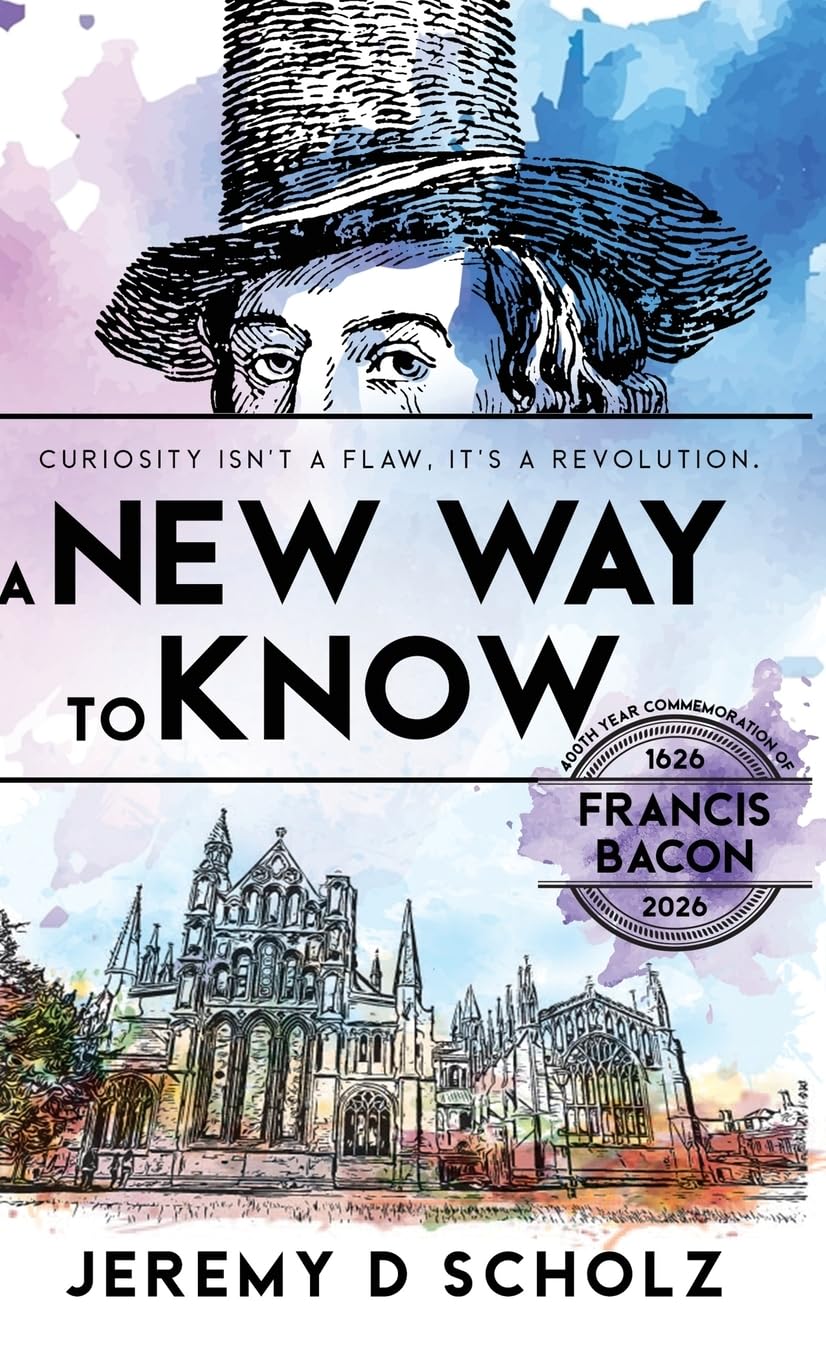
A New Way to Know is middle-grade historical fiction that follows Francis Bacon from a sharp-eyed boy in Queen Elizabeth’s noisy court to a grown man who helps invent a new way of doing science and then pays a steep price in politics. We watch him question his teachers, tinker with secret experiments, navigate his risky friendship with the fiery Earl of Essex, rise to become Lord Chancellor, and finally fall under charges of corruption, before the story jumps to a modern classroom where kids are using his method without even realizing it.
The scenes at court are vivid and concrete – the rustle of gowns, the sharp look from Elizabeth, the way everyone seems to be acting on a stage. I liked how often the book slows down for small details, like a feather falling or a pear dropping from a tree, and uses them to show how his mind works. The writing is clean and very readable, with short, punchy lines sitting next to longer, thoughtful ones. The recurring image of his little notebook and planting questions like seeds gives the story a gentle rhythm that feels just right for younger readers without talking down to them. Sometimes a line of dialogue spells the lesson out a bit plainly, but overall it still feels like a story first and a message book second, which I appreciated.
What really hooked me was the way the author builds Francis’s inner life. The author does not pretend that loving truth is simple. We see Francis grieving his father, scrambling after lost inheritance, testing seeds in chilly sheds, and then standing in rooms where his words might condemn a friend or save a kingdom. The chapters around Essex’s failed rebellion and trial are especially rough; Francis chooses evidence and duty over loyalty, and the book lets that ache sit there instead of smoothing it over. Later, when Bacon himself is accused of corruption and decides to accept blame to protect the stability of the realm, you can feel how much he has learned about pride, power, and bending so the world does not crack. For a work of historical fiction aimed at kids, that is a pretty honest look at how messy integrity can be. I also loved the author’s note that says this “new way to know” grows out of grief and doubt and the refusal to stop asking questions. It made the whole story click for me.
The last section, where a modern science teacher walks her students through a simple rot experiment, might have been cheesy in another book, but here it felt earned. The kids joke about grapes having “five-star freezing” and complain about gross samples, yet they keep coming back to Bacon’s basic rules: observe, test, compare, let evidence lead. As someone who likes both history and science, I enjoyed seeing the genre stretch a little. This is historical fiction that almost turns into a quiet science class at the end, and it works. It ties his life to their world in a way that feels practical rather than heroic and distant.
I’d say A New Way to Know is historical fiction for middle-grade readers that also works as a very human introduction to how the scientific method grew out of one person’s stubborn curiosity. If you like character-driven stories set in real history, if you teach upper elementary or middle school science, or if you have a kid who asks “why” ten times in a row, this book is a great fit. Adults who want a warm, accessible look at Francis Bacon will get a lot from it too, as long as they are happy to read in a younger voice. For that curious crowd, I’d recommend it without hesitation.
Pages: 132 | ASIN: B0GFVWBNQV
Guiding Principles

Aries I – The King of Mars follows a 13-year-old boy who, after his mother’s death, ends up part of the Mars colony, leading him on a journey of self-discovery and understanding of what survival really means. What were some of the emotional and moral guidelines you followed when developing your characters?
When developing my characters, I followed emotional and moral guidelines rooted in loss, survival, and empathy. The death of my son last year fundamentally changed how I understand pain, resilience, and what it truly means to endure. Grief stripped away any interest I had in shallow motivations or easy answers. From that point on, I felt a responsibility to write characters who carry weight, who hurt, adapt, and keep moving forward, not because they are fearless, but because stopping isn’t an option.
One of the strongest guiding principles was an understanding that all life is engaged in a constant struggle to survive. Whether human, animal, or even systems we build to sustain ourselves, survival is never abstract; it is physical, emotional, and moral all at once. I wanted my characters to reflect that truth. Their choices are often imperfect, driven by fear, love, guilt, or hope, but always grounded in the instinct to protect what remains and to find meaning in continuing on.
Emotionally, I allowed characters to be shaped by loss rather than defined by it. Grief does not disappear; it changes form. I tried to honor that reality by letting characters carry their wounds quietly, sometimes awkwardly, and sometimes in ways that create conflict. Morally, I avoided clear heroes and villains in favor of people making the best decisions they can with the tools they have at that moment. Survival, after all, rarely allows for clean moral lines.
Ultimately, these characters exist because I believe survival itself is an act of courage. Every living thing fights to breathe, to belong, to matter—even in hostile environments. Writing from that place, shaped by personal loss, became a way to acknowledge pain without surrendering to it, and to recognize that continuing forward, however imperfectly, is one of the most human acts there is.
What were some themes that were important for you to explore in this book?
At its core, this book is centered on a single idea: life fights to survive. Everything else grows out of that truth. My experience with loss helped me to see survival, not as something dramatic or heroic, but as something constant and relentless. Life persists even when it is broken, even when it is exhausted, even when it has been reshaped by loss. That realization became the emotional foundation of the story.
I wanted to explore survival in all its forms, not only the physical struggle to stay alive, but the quieter, harder fight to keep going emotionally and morally. Every living thing is engaged in that struggle, adapting to hostile conditions, scarcity, fear, and uncertainty. In the book, survival demands resilience, cooperation, and sacrifice, whether the challenge comes from an unforgiving environment or from the weight carried inside a person’s heart.
The idea that life continues forward also shaped how I approached legacy and responsibility. Survival isn’t only about the present moment; it’s about protecting what remains and making space for what comes next. Even after loss, life pushes forward through memory, through purpose, and through the act of building something that can endure.
Ultimately, this story is about the stubborn persistence of life. It doesn’t deny pain or minimize grief, but it recognizes that choosing to continue—to breathe, to build, to hope—is itself an act of survival. Life may be fragile, but it is also determined, and that determination is what drives the heart of this book.
Where do you see your characters after the book ends?
When Aries I: The King of Mars ends, the story is really just beginning. The characters may have survived the first and most dangerous step, arriving and establishing themselves, but survival is only the opening chapter of a much larger journey. Mars is not a destination that stays still; it pushes back, changes the people who live on it, and forces them to evolve.
Aries, in particular, is only at the beginning of becoming who he will be. By the end of the book, he has proven he can survive, adapt, and contribute, but leadership, identity, and consequence are still ahead of him. Mars will demand more than intelligence and resilience; it will test his values, his relationships, and the kind of future he believes is worth fighting for.
The other characters follow similar arcs. What starts as cooperation for survival will grow into conflicts over control, legacy, and what it truly means to claim a new world. Some characters will rise in unexpected ways, others will fracture under pressure, and alliances that seem solid at the end of this book won’t remain untouched by time or hardship.
In many ways, Aries I is the foundation stone. The next chapters explore what happens after survival, when building, ruling, and protecting a world brings new dangers that are no longer purely environmental. This story was always envisioned as a trilogy, and the later books dig deeper into the cost of leadership, the weight of inheritance, and how far people will go when Mars is no longer just a place to live, but something worth fighting over.
Author Links: GoodReads | X (Twitter) | Facebook | Website | Amazon
At first, Mars is just another hostile frontier, a place for scientists, soldiers, and survivors. But when disaster strikes and no one listens to the boy who knows the colony best, Aries must choose: follow orders or forge his own path.
What begins as rebellion becomes legend. Alone among the wreckage, Aries discovers that survival means more than oxygen and water, it means leadership, courage, and the will to challenge Earth itself.
In a world where every breath is borrowed, one boy dares to claim a planet.


