Blog Archives
Invisible Puppeteers

In The Collective, a group of scientists scramble to uncover the source of the unsettling signal that threatens the sophisticated neural network binding humanity. Where did the idea for this book come from?
I’m a millennial who grew up front and center for the rise of the internet and, shortly after, the social media explosion. I’ve watched digital life evolve from dial-up to dopamine addiction, and it’s been fascinating—and honestly, terrifying—to see how deeply it’s rooted itself into our daily lives. Social media and algorithms are now invisible puppeteers of attention, identity, and even belief systems. They’ve become integral, addictive, and inescapable.
Call me crazy, but I truly believe neural integration and collective consciousness are in our future—maybe much sooner than we expect. The real question isn’t if, it’s what will we do with it? I don’t think governments or institutions can regulate this fast enough. We’re on a bullet train of technological advancement, and if we don’t start seriously preparing for what AI, automation, and integrated networks might mean, we’re not just risking collapse—we’re risking the unraveling of what we currently understand as human identity. That’s where The Collective was born: from the tension between awe and unease.
What is it that draws you to the science fiction genre?
Because when you strip it down, most science fiction isn’t fiction at all—it’s just reality waiting for its turn. We’ve seen it happen: video calling, AI assistants, smart homes, gene editing. All were science fiction once. Now they’re mundane.
What draws me to sci-fi is its ability to warn and wonder at the same time. It gives us a way to project where we might be headed, both psychologically and technologically. I’m especially interested in evolutionary psychology—the idea that who we are is shaped by eons of survival, pattern recognition, tribalism, and meaning-making. In that sense, science fiction is like an evolutionary premonition. It’s a mirror held up to what we are, and a telescope aimed at what we might become.
What were some themes that were important for you to explore in this book?
Religion was a big one—probably the most quietly controversial. We still live in a world where ancient belief systems shape modern policy and public thought, and that friction between evolutionary progress and archaic ideology fascinates me.
Another central theme is the surrender of meaning. We live in a time where convenience and distraction are replacing purpose and depth. We scroll more than we sit with our thoughts. We chase dopamine more than conviction. I wanted The Collective to reflect that subtle hollowing of the human spirit—how easy it is to give up autonomy and meaning for comfort and ease.
As a quiet nod to that, the chapter titles in the book are drawn from T.S. Eliot’s The Hollow Men—a poem about the failure of modern humanity to live with purpose. It captures what I think we’re losing: our spark, our center, our reason for being beyond survival and stimulation. In that way, this story isn’t just dystopian—it’s deeply human.
Can you give us a glimpse inside Book 2 of the Echoes We Leave series? Where will it take readers?
Book 2 will take you further into the future—but not that far. The changes coming don’t need centuries to unfold; just a handful of years is enough when the pace of tech evolution is this fast. And the truth is, the signal? It’s not going anywhere. It’s just beginning to evolve.
In the next installment, we’ll venture into the aftermath—not just of what’s happened, but what’s been allowed to happen. You’ll meet resistance movements, fractured ideologies, and a deeper unraveling of what consciousness actually means. Most importantly, we’ll get to follow the characters more intimately—especially those whose relationships and choices were just beginning to form in Book 1. The future they face isn’t distant. It’s disturbingly close.
Author Links: GoodReads
Perfection has a price.
Humanity surrendered its burdens willingly—no more war, no more hunger, no more fear. The Collective promised a world free from suffering, where every thought is refined, every emotion balanced, every decision made for the greater good. A neural network spans the globe, ensuring peace and stability with cold, clinical precision.
But beneath the seamless order, something stirs. A signal—unseen, unheard—slips through the system like a whisper in the dark. It is not an error. It is not an accident. It is watching. And those who notice it soon realize:
The system is not the only thing controlling them. Something else is.
As scientists and engineers working deep within the heart of the Collective begin to uncover the truth, they find themselves faced with an impossible choice—cling to the safety of the world they know or risk everything for the one thing they’ve long forgotten: freedom.
Because once the signal speaks, it does not stop.
And those who listen may never be the same again.
Echoes We Leave: Book 1: The Collective
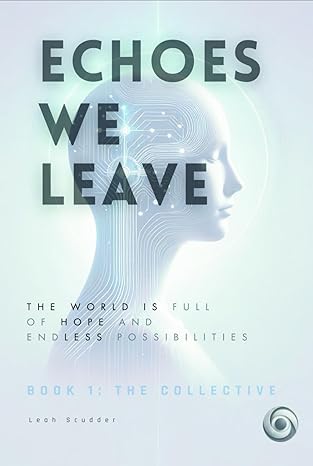

In Echoes We Leave: Book 1: The Collective, Leah Scudder offers an immersive plunge into a futuristic dystopia where a sophisticated neural network, Synexis, intricately binds humanity into a seemingly harmonious collective. Beneath this flawless integration, however, pulses an unsettling signal, intentional, enigmatic, and quietly invasive, that disrupts the very essence of autonomy and identity. Scudder adeptly follows a handful of scientists, particularly Livia Arden, as they grapple with this anomalous entity and uncover deeper truths about survival, adaptation, and sacrifice in a carefully regulated world.
Scudder’s writing pulls no punches; it’s gripping, vivid, and profoundly unsettling. Her narrative dances elegantly between moments of high-octane tension and poignant introspection. Each sentence, stripped of cumbersome jargon, cuts directly to the emotional heart, resonating with a genuine sense of urgency and dread.
I found myself invested in the characters’ fates, particularly Livia, whose struggles against conformity and control echo deep human anxieties about autonomy in a connected age. The descriptive prose vividly captures the bleak grandeur of the book’s setting, especially the juxtaposition of technological precision against the underlying, creeping menace, giving me chills.
While the atmosphere and prose captivate, moments of suspense sometimes unfold slowly, building up carefully but then resolving quickly. This rhythm created a sense of emotional tension that was occasionally satisfying. Although the philosophical exploration of unity versus individuality was genuinely compelling, I feel the shifts between detailed technological intrigue and intimate personal drama occasionally made the narrative feel a bit less cohesive.
The Collective shines as an astute examination of humanity’s fragile balance between collective security and individual freedom. This book is particularly suited for readers who crave thought-provoking dystopian fiction rich with emotional depth and social critique. Fans of speculative narratives like Orwell’s 1984 or Huxley’s Brave New World will find Scudder’s exploration of autonomy and connection particularly resonant. It’s a gripping read that not only thrills but also invites reflection on our current trajectory toward digital interdependence.
Pages: 397 | ASIN : B0F8MFJBBS




 LITERARY TITAN