Blog Archives
Winning is Not Always Winning
MATE takes a unique look at marriage through the lens of a chess match in which each phase of the relationship is examined with play-by-play commentary. Why was this an important book for you to write?
This was my first and, probably will be, my only, relationship book. The challenges were many. I had to restrain myself from judging the couple’s actions. Since “the game” happens on a subconscious level, I didn’t want their behaviors to be extreme. The book revels in making the everyday, seemingly insignificant things said and done to be monumental and epochal. Only they don’t know it. Hence, the use of the commentator, who may get a tad overwrought in the interpretation and importance of their actions. Also, I had to purge myself of caring who was the winner in “the game”. The commentator addresses this early on. Winning may be not be really winning. Winning a game may actually be detrimental, but the players will never see why.
How did your idea to use the chess metaphor evolve as you planned and wrote this book?
I started with the Chess scheme. It had been on my mind for many years. The chess/marriage idea seemed natural. “War” might be extreme. You could call it battles. The conflict and friction that I dwell on was probably influenced my reading the work of R. D. Laing in the 1970s. His book Sanity, Madness, and The Family had an impact on me.
What do you find is the most difficult aspect of writing about relationships?
The most difficult part was trying not to forget to include the many aspects and perspectives on their relationship. Each other, the kids, the friends, parents, the in-laws, not mention the other innumerable sources of conflict. Ultimately, it took a long time to write the book because of the nature of the narrative. There were few opportunities to elaborate on the details of their conflicts except for the times the commentator rhapsodized about certain episodes and the games that were summarized and did not advance move by move.
What is one thing you hope readers take away from MATE?
Because MATE took a long time to write, causing me to think too much about different ways to engage the reader. Two examples: One, leave some blank pages after a chapter and have the reader rewrite how he or she would have the chapter on the children or the living arrangements would go. Second, at the end of the novel, leave eight to ten pages and have the readers write the “game” of their own marriage – it would be interesting to compare the woman’s to the man’s version.
Author Links: GoodReads | Website | Facebook | Amazon
MATE: a novel in twenty games
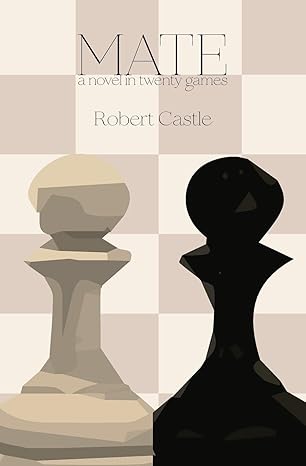

MATE: a novel in twenty games, by Robert Castle, is unlike any book I’ve read. It dissects a marriage by mapping each moment of intimacy, conflict, and compromise onto the framework of a chess match. The story of Pillsbury and Larkin unfolds over twenty “games,” each representing phases of their relationship like courtship, childbirth, relocation, and eventual separation. Every chapter reads like a brutal play-by-play commentary of a high-stakes match where each line of dialogue is a calculated move. The result is raw, honest, and often uncomfortably accurate in its portrayal of the delicate, ongoing war that can exist beneath the surface of domestic life.
Castle’s writing is sharp, biting, and at times hilariously cruel. His chess metaphor isn’t just a clever gimmick; it’s an ingenious device that illuminates the absurdity and tragedy of two people trying (and failing) to love each other properly. The characters aren’t likable in a traditional sense. In fact, they’re often selfish, petty, or clueless. But that’s the point. Marriage, as Castle paints it, is not about romance or even companionship; it’s about control, defense, sacrifice, and sometimes resignation. It was refreshing, even when it hurt to read.
I do feel the relentless move-countermove commentary, while brilliant, could feel overwhelming to some readers. The structure, while unique, can become a bit too clever, making some of the emotional beats feel like intellectual puzzles rather than lived moments. Still, I can’t deny that Castle has created something utterly original. He lets the characters tear each other apart, and we’re left to pick through the wreckage.
MATE is not a book for romantics. But if you’ve ever been in a long relationship, especially one that has frayed over time, Castle’s work will speak to you. It’s for readers who want their fiction uncomfortable, honest, and unflinching. It would resonate with couples therapists, chess fans, failed lovers, and those quietly questioning their own relationships. It’s both cynical and relatable, and it left me thinking about it long after I put it down.
Pages: 176 | ISBN : 978-1963908497



 LITERARY TITAN