Blog Archives
Tap Your Emotions & Write Sincerely


Matson’s Case No.2 follows a detective leading the investigation of five complex murder cases who discovers a government coverup operation in the process. What was the inspiration for the setup of your story?
Reading about Operation Paper Clip and how the United States government brought many German scientists, Nazi intelligence officers, and members of death camp personnel here. This open door policy also was extended to members of Unit 731, the Imperial Japanese Army’s biological weapons unit. I used my character, Robert Matson, to peel back the layers of this onion. In the process, Matson reveals how the Agriculture Lab off the coast of Lyme, Connecticut, became the epicenter for Lyme’s disease and other infectious diseases that have been diagnosed in this area. Members of the U. S. Senate were informed about the tick colony at this facility and how the insects had escaped, but they took no action. Lab leaks do not happen only in China.
With so many emotionally impactful scenes in your book, what was your hardest scene to write and why?
The death of Bumpy Johnson was hard to write, because I wanted to open with an event that was significant for Matson because Bumpy, although a criminal, had been helpful in starting Matson’s career on the police force. I wanted to make sure that the scene was very accurate in terms of location, who was there, and what Matson’s emotions as he saw his friend die in front of him. It also reminded me of witnessing my first death and how I felt seeing a patient alive only a few hours earlier and then at autopsy.
What advice would you give to aspiring writers?
Write about things that move you. Don’t think about financial gain, because if that is your primary focus, you will never write anything worthwhile. Tap your emotions. Write sincerely about your at experiences: the loss of a loved one, the birth of a child, the anger at being betrayed, the fear when facing danger. Be a good observer of life. Describe people, places, and objects. Put the reader in those places. Think about what would make you turn the page.
What types of questions do you ask yourself when planning a new book?
What is your interest in the particular story you want to tell? Who are your characters? Who are they before they show up in your story? Each character has a life. He or she breathes, eats, loves, and hates. How do you write these things so that your reader will find your story worthwhile to read? While I do not outline a story in advance of writing it, many writers prefer to do that. Whatever works best for you. I also have no idea how many pages I will need to write to tell my story. I let my characters dictate what happened, where they’re going, and what happens next and in the long run. Do not keep writing after you finish telling your story just to add more pages. It’s not the length of a book that counts; it’s the quality of the writing on whatever pages it takes to tell the story.
What are you in the middle of writing now?
I am writing a series about a family during the Spanish Reconquista from about 1230 to 1492. This three-part historical novel deals with the politics, intrigue, war, family life, and heartaches of noblemen and women trying to survive.
Author Links: GoodReads
In their investigation into the three murders, all revealing ties with Hitler, the two cops go to the FDA’s animal research facility, site of the three murdered men’s work on biological warfare off Lyme, Connecticut, namesake for Lyme disease.
Who murdered whom becomes a twisted riddle of love and covert operations—and protection of government secrets. Will the truth ever be known? Matson and Smith, in their search for the answer, venture off to the FDA’s Animal research facility, site of the three Nazi scientists’ work on bacteriological warfare off Lyme, Connecticut.
In the familiar sub-plot to the Matson series, he continues to advance in the police ranks, despite ongoing discrimination during the pre-Civil Rights era of the late 1950s. Sissy, Matson’s wife, begins her education in earnest toward becoming a highly respected psychologist.
Matson’s Case No. 2
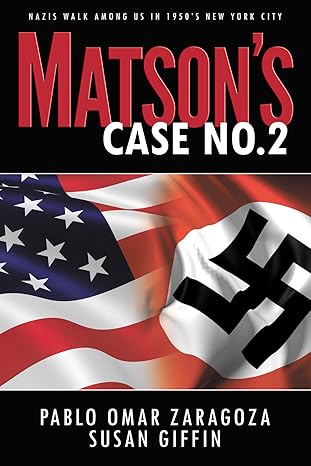

Matson’s Case No.2 by Pablo Omar Zaragoza and Susan Giffin takes readers on a riveting journey back to one of Matson’s most challenging cases under the supervision of O’Neal. The narrative centers around a complex investigation involving five murder victims: three former Nazis and a Jewish couple. Matson’s dogged determination and unconventional approach lead him to unravel the intricate web behind the murders, transcending the limitations of the evidence at hand. Set in the 1950s New York City, this mystery novel delves deep into the dark underbelly of governmental corruption. Matson finds himself not only battling the perpetrators but also navigating the treacherous waters of US government machinations. The government, eager to conceal its dealings with the deceased Nazis, tries to obstruct Matson’s investigation. However, Matson’s resolve and intellect prove superior, allowing him to outmaneuver the authorities and reveal the uncomfortable truths they sought to hide.
The book’s core lies in its critique of the US government’s moral decay, showcasing how war criminals were protected and even employed despite their heinous pasts. The government’s ruthless tactics to silence those who might expose its secrets, including the murder of the former Nazis contemplating surrender, form a central theme. Matson’s Case No.2 is a quintessential mystery, marked by the pursuit of justice for the five victims. Zaragoza and Giffin masterfully incorporate translated German phrases, enhancing the authenticity and immersive experience of the story. The narrative’s strength lies in its ability to take readers on an emotional roller coaster, with Matson uncovering crucial information only to face numerous setbacks. The portrayal of racial issues feels somewhat underdeveloped. Given the era’s prevalent racism, I expected these challenges to play a more significant role in Matson’s professional life, beyond the occasional hurtful comment. This aspect could have added another layer of realism and conflict to the narrative.
Matson’s Case No.2 is a gripping and thought-provoking read, perfect for fans of historical mysteries and those interested in the ethical complexities of post-war politics. Zaragoza and Giffin’s storytelling prowess ensures an engaging experience. This book is ideal for readers who appreciate a well-researched mystery that challenges the reader to think beyond the surface of the crime.
Pages: 342 | ASIN : B07Z463BQS



