Blog Archives
Never Too Late

No Woman Left Behind is part personal memoir, global health crusade, and all heart, following your journey from an ad executive to an advocate for women suffering from obstetric fistula, a childbirth injury that is almost entirely preventable. Why was this an important book for you to write?
The day a woman gives birth is the day she is most likely to die or be seriously injured, particularly in the poorest parts of our world. It’s easy to forget that in a place as prosperous as the US where most women have safe childbirth experiences in hospitals. I believe that no woman should suffer a life of incontinent misery and isolation simply for trying to bring a child into the world. While fistula ruins the lives of too many women, it doesn’t have to. Most women can be cured with a single surgery. Our biggest obstacle to getting more of the one million women with the injury treated is lack of awareness of their plight. My goal in writing No Woman Left Behind was to create awareness and encourage more people to step up to help women they will likely never meet get their lives back.
What were some ideas that were important for you to share in this book?
I wanted people to know that they have the power to help too often forgotten women get a new shot at a healthy and productive life. We all live in challenging times; the world is filled with many intractable problems, but fistula isn’t one of them. We know what works to help women.
Another idea that I wanted to share is that it is never too late to create a new professional path for yourself. In my 20s I was working on “Madison Avenue,” using wily strategies to get people to buy stuff they may neither want nor need. The work was draining and ultimately unfulfilling. I left that behind, to find work that spoke to my heart. I hope that others may see themself in my journey.
Can you share with readers more about the Fistula Foundation’s Love-a-Sister program?
Our Love-a-Sister program provides the opportunity for donors to sponsor a surgery for a woman, that on average costs just $633. They can give one donation of that amount or give monthly to eventually fund a surgery. Most of fistula patients are indigent so our donors big-hearted generosity provides surgery for women who would often otherwise go without.
What do you hope is one thing readers take away from your story?
Our tagline is “Help Give a Woman a New Life.” I hope people will be motivated to help, and perhaps at the same time, gain increased gratitude for the many blessings those of us living in a developed country like the United States often take for granted, like safe hospital-based childbirth.
Author Links: GoodReads | X (Twitter) | Facebook | Website | No Woman Left Behind | Amazon
The day a woman gives birth is also the day she is most likely to die or suffer severe injury—a sobering reality that comes into sharp focus when Kate Grant visits the Addis Ababa Fistula Hospital in Ethiopia’s capital. There, she sees row after row of beds occupied by young women afflicted with obstetric fistula, a childbirth injury that leaves them incontinent and too often shunned by their communities, modern- day lepers. She soon learns that surgery is the only way to end their suffering.
In No Woman Left Behind, Grant recounts her decision to abandon a promising advertising career, and the ups and downs of building Silicon Valley– based Fistula Foundation from a modest start-up into the global leader in fistula treatment. Through vivid firsthand accounts of surgeons toiling in remote corners of Africa and Asia, we see inside the fight to restore hope to some of the world’s most vulnerable women.
A compassionate army of donors spanning nearly 70 countries makes such life-changing care possible. Grant demonstrates the profound power of individual action to change lives at scale, since Fistula Foundation takes no government money. No Woman Left Behind is a compelling personal journey and a how-to guide for anyone looking to make a lasting difference in the lives of others.
100% of the net proceeds from No Woman Left Behind will go to Fistula Foundation’s Love-a-Sister program to fund free surgeries for women with childbirth injuries.
Healing in Advance: Your Prehabilitation Handbook
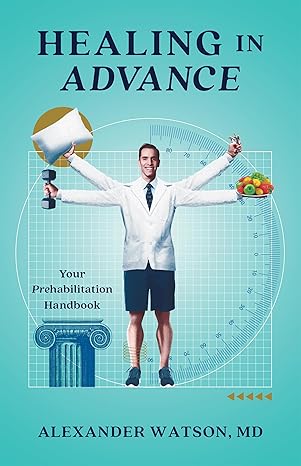

Alexander Watson’s Healing in Advance is a comprehensive guide designed to empower individuals navigating challenging medical journeys. Whether managing chronic illnesses, preparing for major surgeries, or undergoing acute treatments, this book introduces a transformative concept: “prehabilitation” (prehab). Watson positions prehab as a proactive strategy to build physical and mental resilience before medical interventions. Through a focus on exercise, lifestyle changes, and nervous system care—what he calls the “three pillars”—the book equips readers with tools to optimize outcomes and enhance quality of life.
Backed by evidence-based insights and current research, Watson presents practical strategies grounded in science. Readers benefit from detailed exercises, nutritional guidance, and stress management techniques, all tailored to diverse conditions. Emerging treatments, including innovative drug combinations and cutting-edge therapies, reflect the book’s forward-thinking approach. This breadth of information ensures the content remains inclusive and relevant, appealing to a wide audience.
Watson writes with empathy and support, acknowledging the emotional and psychological toll of medical challenges. The tone reassures without minimizing the difficulty of these journeys, empowering readers to take actionable steps with confidence. By combining research-backed interventions with a conversational, non-judgmental style, the book becomes both a credible resource and a comforting companion. Clear disclaimers encourage consultation with healthcare professionals, reinforcing its role as a supplemental guide rather than a replacement for medical advice.
Watson employs an accessible, direct style that balances technical detail with relatability. Relatable metaphors and analogies—such as likening medical challenges to navigating a fast-moving vehicle—simplify complex concepts. The book’s structured chapters, clear headings, and use of bullet points ensure a logical flow, making it easy for readers to digest and apply the information.
Alexander Watson’s Healing in Advance is an essential guide for anyone seeking clarity in the complexities of medical preparation. It blends empathy, scientific rigor, and actionable advice to serve as both a roadmap and a source of reassurance. Watson’s focus on preparation transforms feelings of helplessness into purposeful action, offering a sense of control during uncertain times. With its engaging tone and well-organized content, Healing in Advance is a vital contribution to the fields of patient empowerment and prehabilitation literature.
Pages: 270 | ASIN : B0DNWJYB8M

Seeking Clarity in the Labyrinth: A Daughter’s Journey Through Alzheimer’s

Losing a loved one to Alzheimer’s is a journey without a roadmap. It can be mercifully brief or agonizingly prolonged, with each family’s path uniquely different yet heartbreakingly similar. In her deeply personal and cathartic book, Jessica Stokes delves into her family’s experience with this disease, often termed “the longest goodbye,” as she witnessed her mother’s cognitive decline. The narrative highlights how Alzheimer’s impacts not only the diagnosed individual but also the entire family, necessitating extensive care and adjustments. This story will resonate with many.
Seeking Clarity in the Labyrinth: A Daughter’s Journey Through Alzheimer’s is a poignant memoir by Jessica Stokes that serves as both a personal account and a therapeutic exploration. Beyond detailing her family’s 13-year journey with her mother’s Alzheimer’s, the book delves into themes of grief, balance, acceptance, change, and, above all, love. Stokes recounts the gradual loss of her mother, sharing how she learned to embrace the evolving versions of her. While not always consistent in this endeavor, she navigated the situation with resilience, steering through unwanted yet unavoidable challenges.
The narrative, though mostly linear, mirrors the workings of memory, where a small detail can spark an entirely new recollection. The book also carries a spiritual undertone, exploring concepts of life, death, and the possibility of an afterlife. The mindful and intentional journey of the labyrinth—both as a concept and through specific examples worldwide—was a constant presence for Stokes and her family, eventually becoming a metaphor for their experience. The labyrinth in her parents’ backyard, lovingly constructed by family members, symbolizes a sanctuary, providing peace within a convoluted path. Stokes revisits this imagery throughout her book, using it to illustrate the emotions accompanying the disease’s progression.
This book will be painfully familiar to those who have lost or are in the process of losing a loved one to Alzheimer’s. It offers comfort in a shared experience. Despite its deeply personal nature, Stokes’ story resonates universally. Even readers without direct experience with Alzheimer’s may relate to the gradual loss of a parent. Stokes writes with clarity and frankness, delivering a story that is heartfelt and heartbreaking.
Pages: 136 | ISBN : 978-1955683418
Human Physiology

Nurse Florence®, Tell Me About the Lymphatic System offers young readers valuable information about the lymph nodes, spleen, and the thymus in easy-to-grasp language and serves as a valuable resource for families and educators. Why was it important for you to cover this topic in your children’s series?
We will be covering all basic human physiology questions in the Nurse Florence series, and it was time to do this topic.
Did you find anything interesting in your research for this installment in the Nurse Florence series?
I think this is a little-known system of the body and many families of all ages will learn many things from this book.
Your Nurse Florence series is extensive. Do you receive feedback about your books from schools? How are they being utilized?
The long-term plan is for there to be a set of the series in every library.
Can you give us a peek inside the next topic explored in your series?
We are about to publish books about the inner and middle ear. There are some fascinating things about the ear that I think many people will learn new things with these books. The book about the outer ear should publish next year.
Author Links: GoodReads | Facebook | Website | Amazon
Sometimes it seems only a nurse can bring technical information down to an understanding that an ordinary person can grasp. The Nurse Florence(R) book series provides high quality medical information that even a child can grasp. By introducing young kids to correct terminology and science concepts at an early age, we can help increase our children’s health literacy level as well as help to prepare them for courses and jobs in Science, Technology, Engineering, and Math. We need more scientists so I hope that many children will enjoy this book series and consider a job involving science. Introducing Some Medical Words to Kids in Every Book(R) A Movement of Global Health Promotion and Literacy Dow Creative Enterprises(R) Help Civilization Reach Its Potential
Medicine Continues to Evolove

In Nurse Florence®, What is Type 1 Diabetes?, you provide young readers with an introduction to Type 1 Diabetes, its causes, symptoms, and the challenges of managing the disease. What made you choose this topic for a book for children?
People usually get diagnosed with this type of diabetes when they are children. I wanted to provide an additional resource for families affected with this disease.
Nurse Florence has helped you introduce many children to complex medical conditions. What is your process for making the most difficult concepts easier to understand?
I bring the formation down to a very small unit of information and then slowly build up from there. I have faith my readers will be able to understand.
What is one misconception you think many people have about living with diabetes?
A misconception might be the way they treat the disease for the last several years may be how they will have to always deal with it. Medicine continues to advance and now people can have insulin pumps connected to a smartphone to constantly monitor blood sugar levels and automatically provide the correct amount of insulin.
What is one thing you hope readers take away from this installment of the Nurse Florence series?
Signs and symptoms of hypoglycemia and hyperglycemia.
Author Links: GoodReads | Facebook | Website | Book Review
Educating the Whole Family
Nurse Florence, What is Dementia? follows the school nurse as she speaks with a class about Dementia, explaining the symptoms, possible treatments, and preventive measures for this complex illness. Why was this an important book for you to write?
The illustrator of this book chose the topic since her dad had dementia.
What were some ideas that were important for you to share in this book?
I really like sharing ideas on how the family can help a person with this diagnosis.
What is a common misconception you feel people have about Dementia?
It seems that people may be unaware of medication options that can help.
What was the most challenging part of writing the Nurse Florence books, and what was the most rewarding?
The most challenging part to writing the series is ensuring all research on the disease topic is included at a child’s reading level. The most rewarding part is hearing how the books have educated a whole family.
Author Links: GoodReads | Facebook | Website | Book Review
Empowering Families
Nurse Florence, What is Type 2 Diabetes? follows three friends who are curious about the human body and talk to the school nurse to find out whether a disease could affect the human body in the same way climate change impacts the Earth. Why was this an important topic for you to write a children’s book about?
Diabetes is a horrible disease. Many people can develop severe complications after years of living with the disease like going blind or getting a foot amputated. This disease is preventable by maintaining a healthy BMI, regular exercise and eating a well-balanced diet. People need more knowledge to live healthier lives, and I hope the Nurse Florence series empowers a lot of families worldwide.
What were some ideas that were important for you to share in this book?
Ideas for prevention are important for me to include in any Nurse Florence book. I don’t want to scare people about diseases they may get but want to give them actionable info to improve their lives.
What is one thing that people point out after reading your book that surprises you?
That this disease is reversible with lifestyle changes.
Have you ever considered a spin-off series to Nurse Florence to teach kids about the different career options available in the medical field?
No, but Dow Creative Enterprises plans to publish about 30 other book series for kids. The second one has already started and is called Nurse Dorothea. It is about mental health for teenagers and young adults although it could be read by the elderly as well since we should be lifelong learners. Visit www.nursedorothea.com for more info.
Author Links: GoodReads | Facebook | Website | Book Review
Nurse Florence®, What is Dementia?

In Nurse Florence, What is Dementia? by Michael Dow, Nurse Florence makes a special visit to Ms. Smith’s class, where best friends Jean, Condi, and Sonia, along with their classmates, learn about dementia in a way that is accessible and engaging. Nurse Florence explains the symptoms, possible treatments, and preventive measures for this complex illness, which affects so many families.
This book offers an excellent introduction to a challenging subject. Dementia, often a frightening topic for many, is handled with care as Nurse Florence guides the children through the nuances of the illness. Her approach is gentle yet informative as she walks the class through the signs of dementia and demystifies the spectrum of conditions that fall under its umbrella. While the illustrations by Lindsay Roberts may not be my preferred style for children’s books, they are detailed and complement Nurse Florence’s biology presentation effectively. What truly sets this book apart is Nurse Florence’s interactive teaching style. She doesn’t simply lecture; she engages the students in meaningful dialogue, encouraging them to think about prevention and care. This approach helps soften the intensity of the topic, making it easier for young readers to process without feeling overwhelmed. Nurse Florence’s emphasis on maintaining the dignity of those affected by dementia and the importance of supporting caregivers adds a thoughtful and compassionate touch to the lesson, bringing the discussion to a well-rounded conclusion. Approaching a subject as difficult as dementia is no easy task, and Michael Dow deserves recognition for this thoughtful and educational introduction. By providing clear facts, practical advice on prevention, and meaningful guidance on how to support those affected, this book answers many tough questions in a way that is accessible for young readers.
For its remarkable educational value and ability to address dementia without inducing unnecessary fear, Nurse Florence, What is Dementia? is ideal for readers aged 8 and up. This book is an excellent resource for anyone wanting to learn more about dementia, its causes, and potential treatments. It serves as a valuable tool for understanding a common yet complex illness in a way that encourages curiosity and compassion.
Pages: 240 | ISBN : 1312012390


