Blog Archives
Become Advocates

Tucson 9-1-1: Do The Right Thing! is a deeply personal, sometimes fiery, and always passionate insider account of the rise and fall of Tucson’s emergency communications center. Why was this an important book for you to write?
9-1-1 service is so critical to emergency services, but it suffers everywhere from neglect for political reasons. A little advocacy could easily turn this around, but there are no advocates. I want people to know how they can save lives simply by letting government officials know that we are watching. I want people to become advocates. After 14 years, the 9-1-1 service of Tucson has only degraded even more. Why is this tolerated?
What were some ideas that were important for you to share in this book?
Anyone would imagine that doing great service for people who call 9-1-1 is automatic, a no-brainer. However, the reality is far different. I had this personal experience, but this same kind of truth is paralleled everywhere. I felt it was important to report the facts and quote the actual communications because readers could accurately judge the behavior of myself and all involved. Some might see me as a troublemaker, but then they will have to wonder that no one else was speaking for the victims calling 9-1-1 and dying quietly. Someone should speak for them.
How did you balance the need to be honest and authentic with the need to protect your privacy and that of others in your memoir?
I am not sure that I protected anyone. I deliberately avoided naming some people in some situations to prevent unfairness and harm to them. Maybe, I was too protective, but I don’t think anyone would say so. It’s a memoir, so I could not be honest and still protect myself.
What do you hope is one thing readers take away from your story?
Demand what you value from your elected officials because politics governs what happens. Advocacy is necessary. Nothing is easy.
Author Links: GoodReads | Linkedin | Amazon
Tucson 9-1-1: Do the Right Thing!


Tucson 9-1-1: Do The Right Thing! is a deeply personal, sometimes fiery, and always passionate insider account of the rise and fall of Tucson’s emergency communications center. Michael LaFond, a former 9-1-1 operator, brings readers behind the curtain of public safety communications to reveal the unsung heroes, complex personalities, bureaucratic missteps, and systemic flaws that shape how emergency calls are handled. The book recounts both the triumph—like the heroic response during the 2011 Tucson shooting—and the unraveling of a once-proud institution due to budget cuts, managerial changes, and disregard for public safety culture.
What struck me most about LaFond’s writing is the raw, unfiltered honesty. He writes like a man who has nothing left to lose, and that lends a gravity to every page. His admiration for figures like Louie Gonzales is touching—almost reverent. But when he turns his pen against those he sees as betraying the mission of public safety, it’s blistering. His style swings wildly from reflective to sarcastic to downright angry. That makes it a bit uneven, sure—but it also makes it real. This isn’t corporate PR. It’s a whistleblower’s war story written with both heart and bite.
At times, the story slows down to dive deep into the minutiae—office politics, scheduling policies, bureaucratic turf wars. There are long tangents that might lose readers unfamiliar with the workings of a 9-1-1 center. But maybe the tedium is part of the tragedy. Because LaFond’s central message is clear: it’s not flashy heroics but small, smart decisions made by dedicated people that save lives. When leadership forgets that, things fall apart fast.
Tucson 9-1-1: Do The Right Thing! is a stirring read. I’d recommend it to anyone interested in public service, emergency response, or organizational leadership. It’s not a thriller, but it sure feels like one when you realize what’s at stake in every call. If you want a book that will challenge your assumptions and make you care about the people behind the phones, give this a read.
Pages: 542 | ASIN : B0F2M3PG1L

Discerning Reality From Illusion
In The Conspiracy of the Christ you examine your relationship with Christ through anecdotes, mysterious encounters, and childhood reflections. Why was this an important book for you to write?
My obsession with truth seems to have been innate from my earliest recollection, and it has always been a challenge to discern reality from illusion. When I became religious, my obsession centered around Jesus Christ.
Writing is for me a learning experience. It is an excuse to do more research, and I learned a lot in writing this book. For me, this book pulled together all the threads that I left hanging for so long. I almost feel satisfied.
Is there anything you edited out of this book that you now wish you had included?
The book is too long, and I was self-conscious about that; but the volume of source material was too great, and I had to gesticulate towards the sources as a guide might point out landmarks. Giving a total overview was important. I wanted to go into more detail, but the digressions would have interrupted the flow and the balance. Especially, I hope my readers will seek out the works of Dionysius the Areopagite, which were secretly foundational to Christianity. I am thinking about doing a book on the secrets of Christianity. Also, I wanted to spend more time on atheism and Christianity, but I did not know enough sources to support that. Maybe, that is another book.
I appreciated the candid nature with which you told your story. What was the hardest thing for you to write about?
The personal miracles and perhaps hallucinations could have made me appear unreliable as an author. It was a risk.
What is one thing you hope readers take away from your experiences?
We are magical beings in a magical world, and we should become humble to better appreciate our moment in time.
Author Links: GoodReads | X | Facebook | Website
The Conspiracy of the Christ: A Memoir of Gnosis, History, the Secrets of Christianity, and Carlos Castaneda
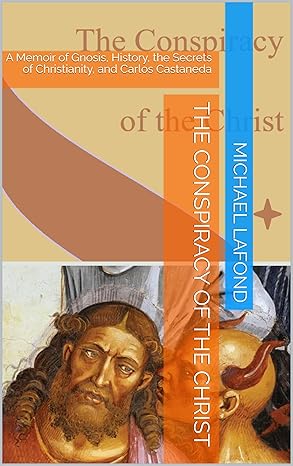
Michael LaFond’s The Conspiracy of the Christ is a memoir that defies easy classification. The book is a deeply personal exploration of mystical experiences, the nature of miracles, and a critical reexamination of Christianity. Through anecdotes from his own life—ranging from encounters with mysterious entities to reflections on childhood indoctrination—LaFond threads together theology, psychology, skepticism, and spirituality. He attempts to uncover not just the historical Jesus, but a deeper, internal experience of “Christ” as universal awareness. This is no ordinary religious memoir; it is part philosophical musing, part confessional, and part critique of organized religion.
I was immediately struck by LaFond’s openness in recounting intimate and often bizarre experiences, like the childhood encounter with what he calls the “bogeyman” in a tree—a shadowy, pulsing mass that disappeared upon his father’s denial of its existence. These stories are told with conviction and a sincerity which make them hard to dismiss. His writing has an offbeat cadence that feels both earnest and unpredictable, sometimes philosophical and other times oddly playful. It’s a rare voice—self-aware, but not self-important. I appreciated the vulnerability in passages like when he describes hearing a voice say “You will save the world,” and how, rather than embracing a messianic complex, he questions its origin and meaning. The way he balances belief and skepticism feels honest and relatable.
LaFond is clearly well-read and philosophically curious, yet his prose avoids academic pretensions. His critique of Christian doctrine, particularly miracle stories and the early church’s reliance on spectacle, is bold without being dismissive. He’s not trying to debunk belief entirely; instead, he’s trying to widen the definition. This book isn’t about theology in the institutional sense. It’s about how one person’s mind wrestles with experience, meaning, and the spiritual weirdness of life.
There are stretches of tangents and long personal digressions that don’t always circle back. It’s part of the charm, but also part of the challenge. At times I felt like I was eavesdropping on a very long, very personal monologue. But even when it wandered, the writing never felt false. His refusal to provide neat answers or a definitive worldview is what gives the book its authenticity. He lets contradictions stand—faith and doubt, science and mysticism, belief and disbelief—all jostling together under the same roof.
The Conspiracy of the Christ is a heartfelt and thought-provoking memoir. It’s not for someone seeking traditional apologetics or tidy theological conclusions. But if you’ve ever felt torn between reason and wonder, or if you’ve wrestled with religion and longed for a more personal, mystical experience of meaning, this book will speak to you.
Pages: 423 | ASIN : B0DS1KXWXS




 LITERARY TITAN