Blog Archives
A War Of Light And Shadow

The Third Way of My God follows a leader as he tries to bring the people in his kingdom to a new homeland safe from war. What was the initial idea behind this story and how did that transform as you were writing the novel?
As an author, so much of what I do with my stories is to make life harder for my characters, and this is really a case in point: after two books of Rosteval confronting the Ketaryat armies of his grandfather, I needed to really make good on the threat of invasion.
But I couldn’t just give Rosteval that challenge, because I wanted to make things more interesting. That’s where the Gontuganti came in: a quasi-vampiric dark-elf-like race of warrior-sorcerers and their armies of reincarnated human thralls.
The Gontuganti are fun for a lot of reasons, but I wanted to use them to examine the pursuit of power and domination for its own sake, untethered to any greater telos or end.
Add to that an unstable goddess of light who styles herself the Mother of Exiles, and I figured I had my own spin on the classic fantasy trope of a war of light and shadow!
With the Mother of Exiles, I wanted to examine the whole concept of inclusion for its own sake, again unaccountable to anything else, anything greater, anything that can hold it in check.
There’s also the rather mysterious and spooky figure on the cover, who connects to an important person in Rosteval’s and Ghaitta’s pasts.
Of course, that leads me to the core of the book, the idea of a third way. I think a major theme in these books is that Rosteval has to find his own way, and that means rejecting the narratives of various power players who want to defeat or suborn him.
When you’re facing a terrible darkness, and the self-appointed champions of the light are bent on wreaking havoc of their own, what else is there to do but find a third way?
Were you able to achieve everything you wanted with the characters in the novel?
I think of this story as an adventure story wrapped around a quest story.
On the one hand, there’s the adventure story: Rosteval and Ghaitta have to lead their people into exile even as a massive war between gods and armies of light and shadow breaks out all around them.
On the other hand, there’s a new character who enters Rosteval’s life bearing a mysterious power that appears to be vital to the situation they all find themselves in. At the same time, she finds that the power comes with hidden dangers of its own, dangers that force her to make difficult choices.
There’s also the recurrent theme of Rosteval and Ghaitta needing to work with enemies, people they have every reason to hate but still have to work with. I don’t want to say too much because spoilers, but I had so much fun with this aspect of the story!
So, on the whole, yes, I think I achieved everything I wanted to with these characters. As to how well I succeeded, that is for the reader to judge.
What were some goals you set for yourself as a writer in this book?
For one thing, I really wanted to explore the concept of a third way. In the context of this book, that means a people, their priests, their king—and their god, who serves as a kind of collective archetypal representation or “oversoul.”
I juxtaposed this third way against a force of darkness, the Gontuganti, bent only on power and domination, but also against the power of a goddess of light who styles herself the Mother of Exiles.
It’s easy to see what’s wrong with power and domination for its own sake, but modern society is full of far too many people who are far, far too misled about the whole concept of inclusion and who have a great deal of unjustified and extremely naïve moral certainty on this point.
The problem is treating inclusion as a telos, an end in itself, or—put another way—as a prior.
To draw on the work of the philosopher Jack Donovan for a moment, inclusion is a good virtue within a perimeter, a shared and defended boundary.
Within a family, a neighborhood, a tribe, a nation, a religion, etc., inclusion is generally a good thing provided it does not encroach on more immediate obligations.
But the problem with the Mother of Exiles is that, by her nature, she cannot make these distinctions. She represents belonging without boundaries or standards—and without boundaries or standards, there can be no growth, no ascension, no excellence.
As Jack Donovan says in Becoming a Barbarian: “The Mother of Exiles offers the warm freedom of the womb.”
Now, you might say that I’m going on about tribes and deities and what-not, and the problem is that we don’t live in that world anymore.
My answer to that is to refer you to the ~300,000 years that our species has been on this planet. What that history tells me is that human beings are tribal and coalitional (a tribe, after all, is a coalition), and tribes and coalitions will always tend to fight for scarce resources and power.
This is what we are. Embrace it, I say, and use it to inspire you both to personal excellence, and to do great things for your in-group (family, neighborhood, people, etc.).
With The Third Way of My God, again, I wanted to explore all of these themes and point to what I believe to be a better and more desirable formulation than either the Gontuganti or the Mother of Exiles: a people who understand themselves in terms of a shared identity, mediated by a priesthood and ruled by a king, a ruler, anointed by a god who represents their Oversoul, their collective archetypal excellence.
What will your next novel be about, and what will the whole series encompass?
My next novel will follow the stories of four different men and women living in a future world ruled by a vampire elite who control the levers of power and manipulate public opinion.
It’s a bizarre and perverse world where law-abiding people are terrorized by vampire street criminals, mortal humans are unable to defend their own interests, and dissidents are subjected to severe financial and career consequences.
You might say it’s urban fantasy with a side of dystopian science fiction.
As for The Rosteval Saga, I’ve also broken ground on the fourth book! I don’t want to say too much, but I will be working on both of these books at the same time.
My thinking at present is that there will be two more Rosteval Saga books for a total of five. I have big plans for the future, and I will look forward to sharing more of them through Literary Titan!
Author Links: GoodReads | Twitter | Facebook | Website
Light is their enemy…
Is there a third way?
Rosteval faces twin disasters when an enemy army comes for his kingdom, even as a terrible new menace arises from the darkness to threaten his entire world.
Forced to flee, Rosteval and Ghaitta lead their people into exile… but they are running out of time.
Outmatched in a war between gods and armies of light and shadow, can Rosteval and Ghaitta find a third way to save their people, their kingdom, and themselves?
Gods of light and shadow, clashing armies, legendary weapons, myths, mysteries, and perilous adventure abound in The Third Way of My God, sequel to The Spiral of My Destiny. Get it now.
The Third Way of My God
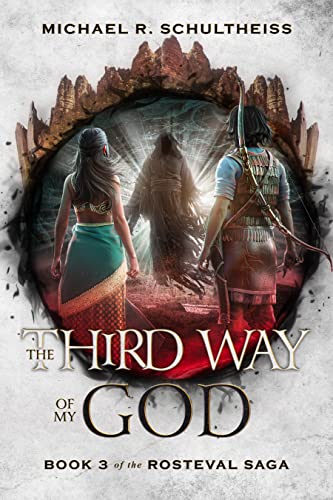

The Third Way of My God is the third entry in Michael R. Schultheiss’s Rosteval Saga. It is an impressive piece of epic fantasy that serves to round out the tale told in the first two entries in the saga while still telling its own story. The book is aimed at mature readers looking to wrestle with traditional ideas of good and evil.
The book follows the main characters, Rosteval, and Ghaitt, as they lead their people in seeking a new homeland. But unfortunately, the possibility of an enemy army attack near their home looms over them. The threat of impending destruction makes survival a near impossibility.
Rosteval and his people are stuck between a rock and a hard place. They must try to survive as a celestial war between good and evil threatens to destroy the entire world. Unable to turn to either side for help, Rosteval and his followers must find a “third way” to survive.
While it is possible to pick up The Third Way of My God and enjoy the novel as a standalone story, reading the first two books in the series gives a complete picture of the immense challenges that Rosteval is up against. Schultheiss has spent a long time crafting a complex, epic world, and specific aspects of it will be lost to newcomers. Likewise, specific plot points do not resonate as deeply without the necessary background knowledge.
While the book has a lot of heavy lifting to do in completing the story set up in the first two books, it does stand on its own. The stakes are high, and despite the book’s length, Schultheiss manages to keep the pacing brisk, only pausing when necessary.
Between the plot twists and turns, it is clear that the author has something more profound to say. The book explores how traditional narratives of good vs. evil are shaped toward what ends. Overall, The Third Way of My God is an excellent read whether you’re a fan of epic fantasy or interested in challenging traditional notions of light vs.. dark. Schultheiss has crafted a profoundly complex world that is a pleasure to get lost in for hours.
Pages: 713 | ASIN : B0BFG9G3L5

A Sense Of Transcendence
The Spiral of My Destiny continues the saga of Rosteval, where the characters are forming unusual alliances to stop the destruction of their world. What was the inspiration for the setup to your story?
For me, the most important thing was to continue Rosteval’s story in a way that would feel fresh and exciting while also building on everything I’d established in book one, The Altar of My Fate.
By the time I finished Altar, I knew I wanted Rosteval to confront some kind of threat that would be connected to the past history of his world, but I didn’t have any clear specifics in mind.
So, one thought that I had was to try to come up with my own take on the whole concept of the “dark lord.”
Now, many years ago I read Milton’s Paradise Lost, and as anyone who has read it can attest, the character of Satan, or Lucifer, steals the show in the very first scene. He’s a fascinating anti-heroic character, and he’s far, far more interesting and relatable than Milton’s portrayals of God the Father, Christ, or Adam and Eve.
My character Soltapyral thus grew out of my own fascination with the idea of the arch-evil appearing as an angel of light.
He’s an immortal, effectively a god, who is trying to take over the world by seducing people with conjurations, visions that show them immersive, individualized fantasy worlds of pleasure and desire into which they can escape permanently.
Of course, since I set up Rosteval and his wife Ghaitta as enemies of this being who is trying to end all wars, all conflicts, all cruelty and oppression and suffering, and who has the means to do so, I had to explore human nature, good and evil, and the meaning of life.
Many aspects of modern life more or less reflect Soltapyral’s mindset: the idea that individual comfort and consumption should be the telos, that is to say the meaning, the end-all and be-all, of human existence.
Essentially the whole edifice of modern civilization is built on this idea, but it’s a lie.
We moderns have more cheap calories, more drugs, and more entertainments and distractions than any other group of humans in the whole of world history… but are we happy, fulfilled, and contented for it?
If the satisfaction of individual appetites and the pursuit of individual comfort, self-esteem, and validation was the key to human fulfillment—what Aristotle calls eudaimonia, in essence “the good life”—we wouldn’t have skyrocketing rates of obesity, drug abuse (prescription and illegal), and depression, anxiety, loneliness, and deaths of despair.
The thing of it is, and this is another key theme in Spiral, human beings need meaning, purpose, and identity, and that means we need to struggle toward meaningful goals, cultivate meaningful relationships with others, and find a sense of transcendence, a sense of something higher than ourselves.
Let me step off my soapbox and close by acknowledging another source of inspiration for this story: my amazing, incredibly supportive fiancée. I really could not have written the central relationship in this story, namely Rosteval and his wife Ghaitta, without having experienced the life we are building and have built together.
Did you create an outline for the characters in the story before you started writing or did the character’s personalities grow organically as you were writing?
I’m one of those people who writes with a mixture of the “architect” approach, which is heavy on outlining, and the “gardener” or “pantser” (as in “seat of my pants”) approach, which is all about seeing what happens as the story goes along.
What this means is that I created an outline with some story beats, and then started writing. I had a good grasp on Rosteval and Ghaitta since, after all, I had spent a whole book with them already, but some of the other characters surprised me.
A case in point is Kurjayak, a tribal chieftain who joined Rosteval in the first book. He’s a brave but ruthless warrior, and he has led his people on numerous raids against enemy tribes for the purpose of capturing slaves.
This is all very typical in this world. Kurjayak is not unusual in this regard among his people, and his people are not unusual among the other warring tribes and kingdoms of the world of the Rosteval Saga.
For that matter, there have been many times and places in our own world’s history in which Kurjayak would have fit in perfectly.
As I gave Kurjayak free rein to express himself, though, I found him expressing a view of life defined by responsibility, struggle, and achievement.
His warrior culture is preoccupied with courage, action, and a keen sense of personal honor that must be ruthlessly defended.
And in many ways, Kurjayak embodies those values and uses them to affirm his own life. I’ll say this: he was a lot of fun to write.
I also had to think about how Rosteval’s own mentality had shifted, or would shift, in this book.
He spends essentially the whole of Altar attempting to gain things: status, power, slave-girls, a place for his people.
There’s a certain mentality you need if you’re going to undertake an adventure like that, and a somewhat different mentality you need if you’re married and planning to defend your position of power.
How long did it take you to imagine, draft, and write the world your characters live in?
This is a challenging question to answer because in truth, I spent years working on Rosteval’s world, but I added things with this new book and am adding even more things with the one I’m working on now.
Basically, it took me three tries from 2013 to 2018 to come up with a complete draft of Altar, and I did a lot of worldbuilding during that period.
Then I set the whole thing aside until my now-fiancée talked me into picking it back up, which I did in 2020 during the pandemic. I did a lot more worldbuilding in 2020 and 2021, and the process continues today with the book I’m working on now (about which more below).
What is the next book that you are working on and when will it be available?
I’m working on Book Three, the working title being The Third Way of My God.
My goal right now is to complete it and publish it before my fiancée and I get married in early August, but we’ll see: I may need more time due to the size and complexity of this story.
Also, if any of my readers want to stay in touch, right now the best place to do it is my Facebook page. And please feel free to reach out, whether on Facebook, Instagram, Twitter, or through the website!
Author Links: GoodReads | Twitter | Facebook | Website
An enemy god ascends…
Ancient immortals scheme…
Who can they trust?
Rosteval faces a new peril: an old rival has unleashed an ancient immortal, a being who is now ascending to godhood.
A vanquished foe offers a questionable alliance, and a connection with otherworldly beings who may be able to help… but at what price?
Even as dangers mount from every quarter, Rosteval and Ghaitta embark on a journey to gain powers, win allies, and master a conflict between entities who see them as pawns.
Dangerous foes, revelations from the past, questionable allies, intrigue, suspense, and passion all abound in The Spiral of My Destiny, sequel to The Altar of My Fate. Get it now.
The Spiral of My Destiny

Rosteval is faced with many decisions as he is forced to partner with a former enemy to defeat their new nemesis. Soltapyral is a Rishvanti and is bent on destroying the world in an attempt to regain their lost glory. Ghaitta is Rosteval’s wife and is also a powerful sorceress. The two of them together must find a way to stop Soltapyral and his army of Rishvanti before they can destroy the world and a group of people known as the Shapers.
Rosteval knows that he must end Soltapyral’s plans before it’s too late. Rosteval and Ghaitta’s journey takes them across treacherous landscapes and on an epic adventure through deadly battles. Along the way, they meet colorful characters and make allies with some unlikely heroes. However, the world is at stake, and Rosteval and Ghaitta must discover the true nature of their destiny.
The Spiral of My Destiny is the second book in The Rosteval Saga, and it does not disappoint. The author Michael R. Schultheiss has written a fast-paced and exciting novel that makes this book extremely hard to put down. There are plenty of twists and turns to keep the reader engaged. With exciting battles and a quest to answer the age-old question of the meaning of life, there is something for everyone in this book.
The author’s use of descriptive language immediately transports the reader into another world. His worldbuilding is unique and engaging. There is a wide range of characters that are as rich and complex as the stories they inhabit. I feel it would have been helpful if there was a list at the end of the book of the characters for readers to reference. I found the maps included at the beginning of the book that displays the realms and kingdoms most helpful. This is an excellent addition because readers can refer to the map to see where specific kingdoms are and where the characters are traveling.
The Spiral of My Destiny is a riveting epic fantasy adventure that will keep readers glued to the page from beginning to end. Readers will be transported to another world to follow the action and adventure as the saga continues.
Pages: 551 | ASIN : B09RMMX5FB
Striving For Glory and Recognition
The Altar of My Fate follows a warrior and his companion as they embark on a dangerous quest to defeat an ancient god. What was the inspiration for the setup to your story?
First of all, thank you for such thoughtful questions!
A big part of my inspiration came from history. After all, history is full of stories like Rosteval’s: an intrepid warrior and his band on a search for adventure and spoils.
In particular, I’ve really been gripped by the histories of the Middle East and South Asia. Proud city-states, warring kingdoms, migrating tribes, and rich bodies of mythology and lore – what’s not to love?
Sharp-eyed history buffs may also spot interesting parallels between the trade in slave-girls and war-horses across the Sebaiya Desert, and the real-world Trans-Saharan Slave Trade.
What was the inspiration for the relationship that develops between Ghaitta and Rosteval?
As in, warrior acquires slave-girl, and they subsequently fall in love?
I have to award much of the credit for that to my fiancée. She read an earlier draft of the book, one in which Ghaitta actually played a relatively minor role – Rosteval had a different love interest, believe it or not – and she really zeroed in on Rosteval and Ghaitta.
So, I rewrote Altar at her urging, which is another thing I have to credit her for (I was going to scrap it altogether) and gave Ghaitta a much more important role. It still took me one more draft and at least two more re-writes of the ending of the book to realize that the real love story here was Rosteval and Ghaitta!
All that to say, I have to thank my fiancée for talking sense into me. This book is far, far better for her influence.
What were some themes that were important for you to explore in this book?
Striving for glory and recognition is a key theme. Through the various drafts of this book, Rosteval has always had a passionate yearning to distinguish himself and make his mark on the world.
I think it’s why I like him so much: as a writer, I can relate!
Adventure is another theme, the allure of distant lands and peoples. I think a lot of the fun for me in writing this book came from watching Rosteval and his war-band as they rode in search of lands beyond the horizon.
There’s also, of course, themes having to do with history, culture, and geography. I love learning about people from different cultures, who lived in different places and times, and I hope to inspire others to take an interest in world cultures and history.
For me, looking at history and culture is an opportunity to learn how to view things from a different perspective than my own, and reflect on how the values of human societies change and evolve.
One of the things you notice when you study history is that people in many different places and times had ideas and attitudes about things like invasion, war, conquest, and yes, slavery, that are shocking to modern Westerners.
Altar has quite a bit of these things – as one reviewer noted, almost every aspect of Rosteval’s adventures revolves around slaves – but I’m confident when I say that I pulled my proverbial punches. Real history from practically every corner of the world is a much, much grimmer affair than anything you’ll read in my novels.
I think one of the tragedies of the human condition is our own repeated inability or unwillingness to see the perspectives of others: we tend to either presume that everyone thinks like we do, or else we think other people are simply Other, alien, incomprehensible at best if not downright “bad” or “evil.”
Seeing how other people view the world doesn’t mean changing our own values or perspectives, but it should, in my view, help us to be humbler. How much of our modern sensibilities are predicated on full bellies, warm houses, and being able to turn on the lights whenever we want?
What is the next book that you are working on and when will it be available?
Book 2, The Spiral of My Destiny, is out now! I am currently working on book 3 (title to be announced), and I expect it will be ready to go in June. I’m getting married in August, and I am completely adamant that it will be published before then!
Author Links: GoodReads | Twitter | Facebook | Website | GooglePlay | B&N | Kobo | Apple | Books2Read
A slave-girl with a secret…
Can they claim the ancient altar?
Trained to the warrior’s path, Rosteval yearns for glory and craves adventure in unknown lands.
Leading the war-band he created, he sets off on a quest to brave a formidable desert and the swords and arrows of a growing number of enemy tribes.
He expected the mounting dangers… but he didn’t expect Ghaitta, the beautiful slave-girl with a secret… and the power and peril of an ancient altar, an artifact of the vanished Shaper race.
As his enemies multiply, Rosteval is forced to confront an immortal adversary and the looming specter of defeat. Can Rosteval and Ghaitta avert disaster, and claim the fateful power of the ancient Shaper altar?
Brimming with fierce tribes, deadly perils, ancient powers, and sexy slave-girls, The Altar of My Fate is the epic fantasy adventure you’ve been craving. Get it now.
The Altar of My Fate


In The Altar of My Fate, by Michael R. Schultheiss, we follow a warrior named Rosteval and a slave-girl named Ghaitta. Through a fascinating series of events, the two find themselves connected via the altar of an ancient Shaper race. The pair grows both in character and in their relationship with destiny while Cat-Eye Pon proves to be instrumental in their journey. Their destiny is to defeat an ancient god named Haldua. Author, Michael R. Schultheiss, has given readers a novel that is an epic narrative describing an incredibly vast world and steeped in exceptional character development.
While the novel contains many positives that every fantasy reader will enjoy, if you are not used to the typical stages of a fantasy, the structure of Schultheiss’s novel can take some getting used to. The plot can, at times, appear to be a sort of fetch quest–moving the characters from one location to another to retrieve a single bit of knowledge or an item. While this is a standard plot device for works of fantasy, the novel can drag slightly because of this technique.
Schultheiss attempts to break up some of the longer stretches of narrative with detailed backstories and interesting dialogue, but the novel seems more heavily focused on the fetch quest aspects of the plot. As I read, I noted that the plot slows at times and then picks up speed. I was, however, able to gain a better understanding of this hyper-detailed world. Schultheiss has managed to create various styles of characters–all fascinating in their own ways. Readers will enjoy the journey as the plot builds toward meeting the antagonist. This journey is one well-earned–not cliched as some works in the fantasy genre tend to be.
Overall, Schultheiss’s novel is an excellent addition to the fantasy genre. The characters are well-written, trope-subverting, and the stakes in the story are believable. It is quite a long read but enjoyable the entire way through–only seeming to slow in a few spots. I recommend Schultheiss’s work to any fan of the epic fantasy genre who are looking to explore a new author who is adept at character development and intensely focused on a detailed plot from start to finish.
Pages: 488 | ASIN : B09P6WWK9X



 LITERARY TITAN