Blog Archives
Poetry Thrives on a Mystery

What We Hold No Longer is a collection of poems that circle around memory, aging, identity, and the haunting void that lies beneath it all. What inspired you to write this particular collection of poems?
I’ve recently become an avid reader of psychoanalyst Adam Phillips. Last year, one of his books introduced me to Jacques Lacan. Specifically, how our subconscious impacts language, and in turn, how we use language shapes desire. For a poet, what could be more delicious to explore? Ineluctably, even mentioning Lacan brings up his theories on the Void (The Thing) and religion. This, in turn, led me to Lacanian scholar Richard Boothby (Embracing the Void). Along the way, I also read a book by Phillips on our ambivalence towards transforming our lives (On Wanting to Change). Transformation is a particularly important topic at this stage of my life. What I did not anticipate in reading this book was the evocation of so many memories. As a pediatric psychoanalyst, Phillip’s description of childhood, particularly the excruciating years of adolescence, flooded me with things I’d long forgotten (eg, seeing my grandfather’s corpse at age 9, the inchoate sense of frustration, and seeking revenge on my parents’ reputation with a can of red spray paint, etc.).
Can you share a bit about your writing process? Do you have any rituals or routines when writing poetry?
I’m trying to understand my writing behavior. I appear to have a natural rhythm, whereby I’ll write a dozen poems over a month or two and then go silent for just as long. During the quiet months, I read more and pay attention to what I see and listen to: all the things popping up as thoughts and feelings. The poems “The False God’s Lullaby” and “New Year’s Day” were brief glimpses of people, just a few moments of an image that resonated deeply, and unexpectedly.
What moves me from outside triggers something poignant nesting deep inside: “The I of my other who moves silently with me” (The False God’s Lullaby). Also, I love editing. Paul Valéry once said: “A poem is never finished, only abandoned.” I think he meant you can always refine and improve a poem. I try to limit my revision window to six months. Once a poem reaches structural stability (ie, I know what I want to say and the confines to say it in), I put it away for several days or weeks at a time. It’s important to understand that during initial composition, the poem’s neural map is being built using high stores of neurotransmitters. This is how we learn. However, it also prevents us from seeing inherent weaknesses when we’re still trying to get our thoughts written down. Taking a break for days or weeks reduces neurotransmitter stores. This removes the blinders to our writing, so we can see problems more readily and find better ways to say what we’re trying to convey.
How do you approach writing about deeply personal or emotional topics?
I think it is important during initial composition to just let things rip, because that is likely to be the most truthful. However, there is a balance to be struck. I’m reminded of a phrase from the Upanishads: “The path to salvation is narrow. It is as difficult to tread as the razor’s edge.” I view confessional poetry as an attempt to achieve psychic salvation. To shy away from powerful emotions creates a sense of falsity impossible to ignore. Yet, in the passion of writing, we can also say too much. Poetry thrives on a mystery, on what is left unsaid. That’s part of the art form I’m still working on improving.
How has this poetry book changed you as a writer, or what did you learn about yourself through writing it?
I have the sense in writing What We Hold No Longer that I’m beginning to mature as a poet. I’m not sure anyone else would agree. But there was something about the Lacanian cycle of poems that shifted my writing in a way I haven’t fully grasped. At this moment, I can’t imagine writing anything more profound or better composed than those poems. Time will tell. Every book I’ve written so far has enriched my sense of self and given me a sense of being more at peace with myself. Something that had eluded me before I’d written The False God’s Lullaby.
Author Links: GoodReads | Amazon
Such topics have been the foundation of his poetry explored in his previous works and have been expanded upon in “What We Hold No Longer.” As in his other works, poems are grouped together in themes. These themes approached from a deeply psychic perspective and include: personal transformations throughout life, existential encounters with “Nothingness,” the rise of fascism, loss, and the realm of an interior life (both our conscious narratives and our river of unconsciousness). What Gedaliah refers to as “the I of my other, who moves silently with me” (The False God’s Lullaby).
The poems in this current collection maintain characteristics that reviewers of his previous works have consistently noted. That “Gedaliah seamlessly blends philosophical depth with artistic expression, offering a deeply reflective journey through identity and human complexity, striking a perfect balance intellectual exploration and emotional resonance.”
A Means of Self-Healing

The False God’s Lullaby is a collection of poetry and prose that explores the beauty and tragedy of the human experience, taking readers on a journey through your memories and emotions using in-depth imagery. Why was this an important collection for you to publish?
I’m entering the last phase of my productive life when I’ve found myself having reached the end of so many other journeys. Although I’ve been writing poetry since 1990 (when I first became interested in it), it wasn’t until I had reached an existential nadir so-to-speak in June of 2023. New poems just seemed to flow out of me, and so I went back to edit others I’d written over the years that I thought were suitable for publication. Something (more accurately someone) inside me desired to speak. It’s the time in our life when we wish to leave something that might survive our absence.
Were there any poems that were particularly difficult to write? If so, why?
If you’re asking, “Was it difficult for me to expose my inner life?” the answer is no. I began writing poetry after my profound experiences at the Esalen Institute in Big Sur. I’ve viewed my poetry as a means of self-healing (if you’ll excuse my use of a rather tedious California cliche).
How do you know when a poem is truly finished?
That is an interesting process question. It’s a matter of reaching a nodal point of comfortable satisfaction. This generally occurs within a week or so when the nagging feelings cease (eg. “Something’s not working but I can’t figure out what it is yet.”). Afterward, there’s a period of minor word-smithing that goes on for months. But finally, I have to tell myself to stop. There’s a point when “fine polishing” begins to weaken the poem’s impact.
What is the next book that you are working on, and when can your fans expect it to be out?
I’m already deep into investigating and writing my third collection of poetry (and perhaps some prose) focused on the works of Jacques Lacan and others on topics such as the connection between nothingness and spirituality and transformation. It’s largely a continuation of my interests in the multiplicity of selfhood. The working title is The Shadowed Crossing from a stanza in Rainer Maria Rilke’s Sonnets to Orpheus.
Author Links: GoodReads | Facebook | Amazon
The poetry is presented by topics that move like moods. The collection begins with contemplations of what the author calls “interior worlds.” This comprises over half of the poems and are the first and last titled sections. Interior worlds are expressed in such poems as “Memory,” “Confluence,” and “Longing.” This is followed by “Closeness and Distance” with poems describing experiences of both sexual (“Absolution”) and emotional intimacy (“Endearment”), as well as withdrawal (“Disillusionment”). The mid-topic sections move into the darker subjects of mortality (“Wandering,” “Big Sur”) and despair (“Awaiting the Pandemic”). Pulling back from these dark explorations are the poems found in “Lightness of Being.” These range from metaphorically comedic sexuality (“The Drummer’s Advice”) to a gathering with friends (“Friday Dinner”). “Interiors Worlds” are returned to with a prolific, seven-part poem exploring the external and internal aspects of familiarity (“Home”) and ends with the poem from which the book is named (“The False God’s Lullaby”). The final section is a small collection of prose pieces that add context to many of the poems. It also ends with a work from which the title poem was created.
Two major themes form the basis of internal worlds. First is the notion expressed by Lou Andreas-Salome’ of primitive consciousness arising in-utero. The poet fuses this with Soren Kierkegaard’s notion that we internally possess a sense of “the eternal.” The second theme ponders the implications of evolutionary neurobiology: that we are largely governed by the ancient powers of our animal brain (eg. “Limbic, paralimbic structures”). What Freud called “The It.” These are explored in the poems “Confluence,” “The Ancient Within,” and “Otherness.”
Despite the deep, dark themes of life that pervade many of these works, the author endeavors to find for himself and his readers how these encounters unavoidably lead to a sense of endearment and gratitude for life itself. In this, the author reveals the influence of his most beloved poet, Rainer Maria Rilke; for whom the poem “Wandering Rainer” was written.
Pick Up a Plate & a Book
Sweet Emotions is a collection of poetry inspired by your mother’s cooking and her love of sharing it with others. Why was this an important book for you to write?
My mother’s passion for cooking & ability to create mouthwatering dishes always fascinated me. Her food brought people together, creating unforgettable moments filled with love & happiness. I wanted to capture those emotions & share them with others through my writing. Sweet Emotions is a way of honoring her legacy & preserving those cherish memories.
What is the one thing you hope readers take away from the book?
Above all, I hope that readers find a deep connection to the emotions & memories that food & words can evoke. I want them to recreate the warmth that my mother’s cooking brought into our lives. Also, I hope that readers are inspired to explore their own culinary passions, experiment in the kitchen, & create memorable moments with loved ones, just as my mother did. And keep seeking my words.
What were some ideas that were important for you to share in this book?
Sweet Emotions is not just a poetry book. It’s a poetry book based on my heartfelt tribute to my mother’s legacy. The things she stood for & lived for every day. God, family, food & books. That poetry book with cooking because we love food so much that when I write, you will find elements of food that I decided to put a recipe. God, food & words brought people together. Through the pages of Sweet Emotions, I aim to inspire readers to infuse their own dishes with love & passion. Cooking is not just about nourishment but also creating everlasting memories. Pick up a plate & a book. Preferably my book.
What is it about food that you think brings out an emotional response in people?
Food has the power to evoke a range of emotional responses in due to several reasons. First & most important… nourishment & survival. We need it to carry on in life. The fact it tase good adds more.
Cultural & social significance… it brings many in touch with their history & different cultures together through leaning & happiness. Sharing meals promotes a sense of belonging & an emotional connection.
Comfort & satisfaction during difficult time having food together ease the pain.
Overall, the emotional response to food is deeply ingrained in our biology. It has the power to create joy, comfort, nostalgia & social connections. Making it highly sought @ times which I wish for my words. They won’t have the same sensory experience you wont smell, taste or feel the texture. But once you see & read my words you will get the emotional rush as they trigger memories.
Sweet Emotions
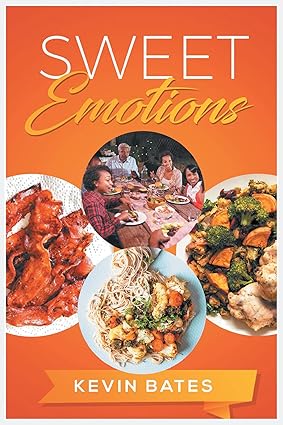

In Sweet Emotions, Kevin Bates, both an author and poet, offers readers an eclectic mix of romantic and introspective writings. This collection is not just a compilation of poetry; it also includes a unique blend of original recipes and semi-erotic illustrations. A notable aspect of Bates’ work is the integration of culinary themes, weaving food and beverage motifs throughout his poems. These compositions explore a spectrum of human emotions and experiences, ranging from love and admiration to memories and spirituality, with a few touching on the theme of conflict. The brevity of each poem adds to the collection’s distinct character.
The religious-themed poems in the book are particularly noteworthy. They provide moments for contemplation and introspection, adding a meaningful depth to the anthology. These reflective pieces resonate with heartfelt sentiments, offering a nuanced reading experience. The book presents an innovative format that blends various elements, creating a unique experience. The inclusion of recipes alongside the poetry adds an intriguing, unexpected dimension to the collection. While the fusion of illustrations with these recipes offers a distinctive approach, it also contributes to the book’s eclectic charm. The poetry itself, rich in its complexity, invites readers to engage deeply, presenting an opportunity to explore various layers of meaning and interpretation. As for the rhythm and structure of the poems, particularly when read aloud, they provide a distinct style that may prompt readers to reflect on the deliberate choices made in their composition.
Sweet Emotions is an ambitious endeavor that spans various literary landscapes. Bates’ work encapsulates the essence of passion and creativity, and though it grapples with inconsistency and ambiguity, it provides glimpses of wisdom and sincere emotion. The collection invites readers to immerse themselves in the complexities of love, spirituality, and the human condition.
Pages: 96 | ASIN : B0BSVN4JCF




 LITERARY TITAN